Though both are skeptics of institutional religion, public intellectuals Sam Harris and Alain de Botton arrive at the same uncomfortable conclusion: secular life suffers from a poverty of ritual and community. Religion, for all its theological disputes, excels at gathering people together and giving shape to life’s milestones. The secular world has become remarkably proficient at dismantling these institutions, but far less capable of replacing them. The result is a culture populated by isolated individuals wandering through private existential crises, each convinced that loneliness is a personal defect rather than a social condition.
Human beings require more than ideas.
They require liturgies.
Which brings me to the Donkey Calf Raise.
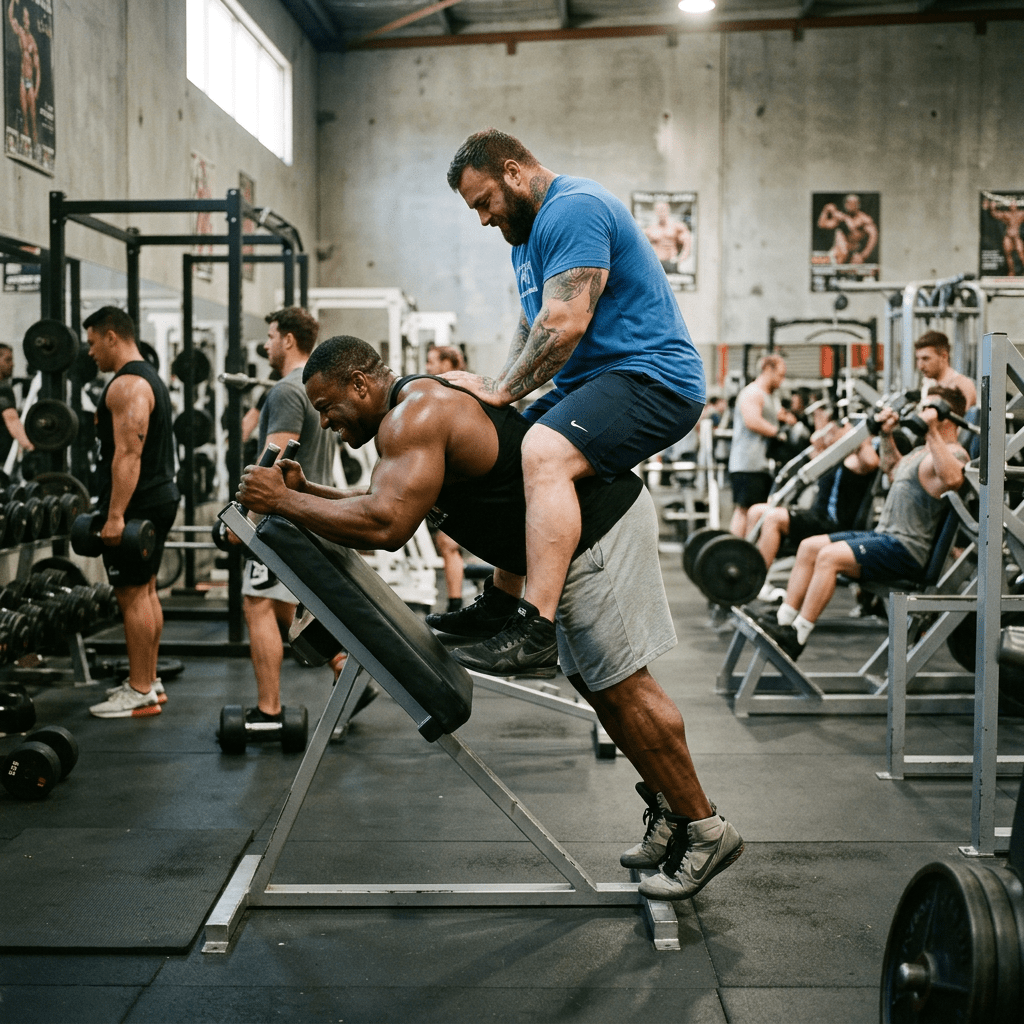
The Donkey Calf Raise is bodybuilding’s enduring proof that lifters will gladly sacrifice dignity upon the altar of hypertrophy. Popularized by Arnold Schwarzenegger—who sometimes performed the exercise with one or two training partners literally sitting on his lower back—it required the lifter to bend forward at the waist while rising onto his toes under load, resembling less a Greek god than a hardworking mule carrying humanity’s collective insecurities. To the uninitiated, it looked like an elaborate fraternity prank. To serious bodybuilders, however, it was sacred doctrine. There existed an unshakable belief that any exercise capable of making you look completely ridiculous was almost certainly producing extraordinary results.
As a teenage bodybuilder in the 1970s, I encountered the Donkey Calf Raise long before I ever attempted one. It appeared in magazine after magazine beside Arnold and the era’s other legends. Performing it was more than an exercise. It was a catechism.
It announced your membership in the tribe.
Mention the Donkey Calf Raise to a poseur and he would blink at you with the vacant expression of someone who had wandered into the wrong religion. The authentic bodybuilder, by contrast, knew exactly what you meant. He had suffered through it himself. Shared absurdity had become shared identity.
That is how rituals work.
Their power lies not in their efficiency but in their ability to bind strangers into a community through shared sacrifice. The Donkey Calf Raise built more than calves. It built belonging.
I remember those rituals with genuine affection, though I harbor no illusions about what followed.
The Donkeys eventually disappeared.
The needles arrived.
Performance-enhancing drugs gradually replaced eccentric exercises as the primary badge of authenticity. The gym atmosphere changed with them. What had once resembled a fraternity of disciplined eccentrics increasingly resembled an arms race conducted by chemically inflated men stalking the weight room in genie pants, glaring suspiciously at one another, each convinced that everyone else was simultaneously inferior and somehow cheating. The laughter diminished. The paranoia increased. That was when I quietly exited the bodybuilding world.
Religious rituals, by contrast, possess remarkable staying power.
Church picnics. Bingo nights. Food drives. Car washes. Bowling leagues. Litter cleanups. Potlucks where every casserole has a family history longer than some civilizations. The specific theology may evolve, but the rituals endure because they satisfy permanent human needs: fellowship, continuity, service, and shared purpose.
The Donkey Calf Raise enjoyed no such immortality.
Spot a group of lifters performing Donkeys in a commercial gym today and your first instinct would not be admiration. You would assume someone was filming a comedy sketch. The ritual has become unintelligible because the culture that gave it meaning has vanished.
That realization reminds me that when I say I loved bodybuilding, I am speaking of a particular moment in its history, not the entire enterprise. The 1970s were its Golden Age—a peculiar blend of discipline, camaraderie, eccentricity, and optimism. Later decades often replaced those virtues with pharmacology, narcissism, and escalating displays of reckless bravado.
Since 2005 I have trained alone in my garage, accompanied by talk radio, podcasts, and audiobooks. I enjoy the solitude. It allows me to think.
But I have no romantic delusion that solitary exercise is equivalent to belonging.
A garage gym can strengthen the body.
It cannot replace the tribe.
That is why Harris and de Botton are right. Human flourishing requires more than correct ideas or optimized routines. We long for rituals that make us feel part of something larger than ourselves. The Donkey Calf Raise, absurd as it looked, accomplished precisely that. It was a sacrament disguised as an exercise, a ridiculous little liturgy through which a generation of young men found fellowship, identity, and, if only for a moment, the comforting illusion that they were carrying one another’s burdens instead of merely someone sitting on their backs.


Leave a Reply