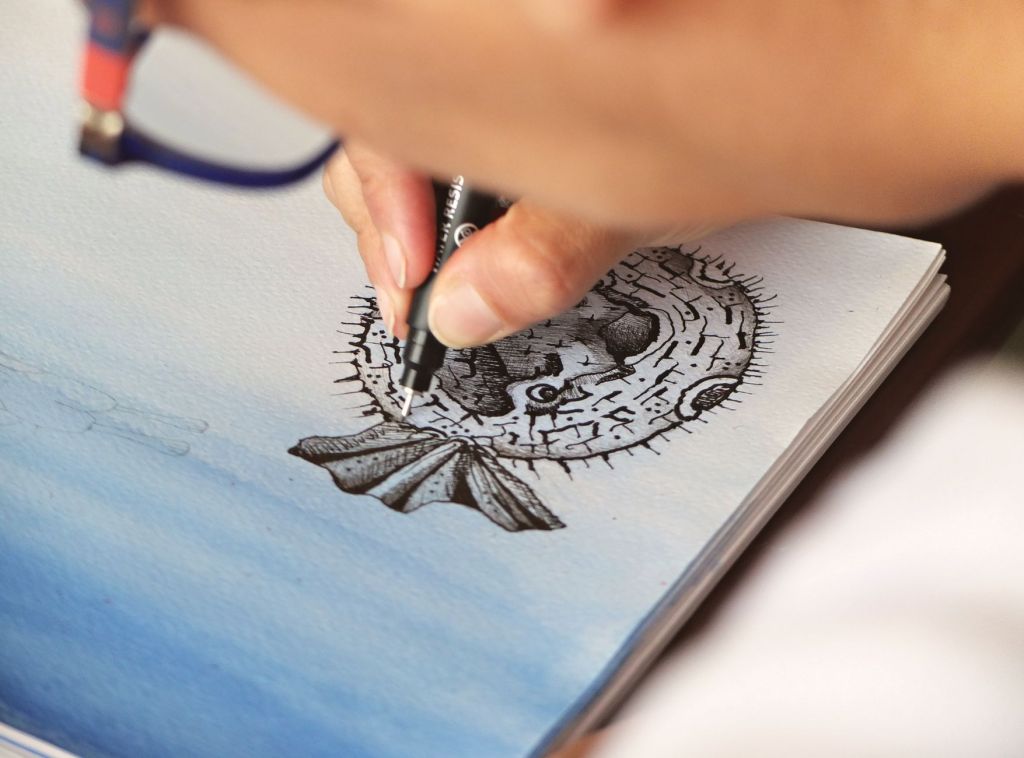
One afternoon in Mrs. Eckhart’s fifth-grade class, I finished my reading assignment with nearly an hour to spare. Faced with that glorious stretch of unclaimed childhood time, I did what any aspiring future contributor to Mad Magazine might have done.
I built a submarine.
Not an actual submarine, of course. I drew an enormous one on a sheet of white construction paper, complete with rows of portholes. Every window framed a tiny character, and every character had something ridiculous to say.
One man was making pancakes and inviting the crew to breakfast.
A woman with curlers in her hair refused to leave her cabin because she wasn’t presentable.
Another sailor complained that his cereal box had promised a free toy that was nowhere to be found.
Someone couldn’t nap because everyone else was making too much noise.
Another had a piece of apple peel wedged between his teeth and regarded this minor inconvenience as civilization’s greatest crisis.
The submarine was less a military vessel than an underwater apartment complex populated entirely by neurotics.
I loved it.
I imagined myself one day writing and illustrating absurd little worlds where everyone took trivial problems with magnificent seriousness.
Then Mrs. Eckhart stopped beside my desk.
Her red bouffant seemed to rise another inch as she studied my masterpiece. Her eyebrows arched with the unmistakable expression adults reserve for children who have somehow managed to disappoint them in unusually creative ways.
“Is this how you spend your time in my classroom?” she asked.
“I finished the assignment,” I said. “I was just drawing quietly.”
She ignored my explanation.
Instead, she began reading the dialogue bubbles aloud in a voice dripping with sarcasm. The class erupted in laughter.
My submarine, moments earlier the crown jewel of my artistic career, had become evidence in a public trial.
Then came the sentence.
“I want your parents to sign this.”
She turned the paper over and wrote a note explaining that I had spent class drawing cartoons instead of doing schoolwork.
That evening I presented the evidence to my father.
He read the note.
He looked at me.
Then he sighed.
“You pissed off your teacher.”
“I don’t know why,” I protested. “I finished my work. I wasn’t bothering anybody.”
“That doesn’t matter.”
“I didn’t do anything wrong.”
“You insulted her.”
I stared at him.
“I don’t understand.”
He leaned back in his chair.
“By finishing early and drawing cartoons, you told her her work wasn’t challenging enough.”
“But I never said that.”
“You didn’t have to.”
“I wasn’t criticizing her.”
“She thought you were.”
I still resisted.
“But I was right.”
My father nodded.
“Maybe.”
Then he delivered one sentence I have remembered for more than half a century.
“It’s better to be smart than to be right.”
At ten years old, I found this profoundly irritating.
“I thought they were the same thing.”
“They aren’t.”
He explained that technical correctness and practical wisdom often occupy different neighborhoods.
Perhaps I had violated no classroom rule.
Perhaps I had every right to draw after completing my assignment.
None of that altered the outcome.
My teacher felt disrespected.
Once that happened, being right became largely irrelevant.
Only years later did I understand that my father had given me a lesson far more valuable than any fifth-grade reading assignment.
He had introduced me to The Smart-Right Principle: the recognition that factual correctness often matters less than the social intelligence required to achieve a constructive outcome. Winning the argument while damaging the relationship is rarely a genuine victory.
Children naturally believe that justice consists of discovering who is objectively correct.
Adults eventually discover that human beings seldom react to objective correctness.
They react to perceived respect.
Or disrespect.
Intention often loses to interpretation.
I intended nothing more inflammatory than entertaining myself after finishing my work.
Mrs. Eckhart interpreted my drawing as a silent declaration that her assignment had failed to occupy me.
Whether she was objectively right no longer mattered.
Her perception became reality.
I have watched this drama replay itself countless times throughout adulthood.
Employees prove their managers wrong while destroying their careers.
Husbands win arguments that cost them intimacy.
Politicians deliver devastating rebuttals that persuade no one.
Professors publicly expose weak reasoning while privately humiliating students who might otherwise have remained eager to learn.
Every participant leaves convinced that truth prevailed.
Usually only resentment does.
The Smart-Right Principle does not ask us to abandon truth.
It asks us to recognize that truth travels through relationships.
People rarely remember whether you were technically correct.
They remember how you made them feel while proving it.
Ironically, my father never suggested that Mrs. Eckhart had behaved wisely.
He simply understood something I did not.
Life is not graded like a geometry proof.
You do not receive full credit merely because your logic is impeccable.
Human beings are not propositions.
They are creatures of pride, dignity, insecurity, gratitude, vanity, and interpretation.
Ignore those realities, and you may spend the rest of your life winning arguments while quietly losing people.


Leave a comment