Category: Confessions

  • How Pain Turns Writers Into NPCs. 

    How Pain Turns Writers Into NPCs. 

    Writers love to repeat this creed: writers write. Every day. They sit down, stare at the blank page, and through sheer ritual force the gears to turn. In The War of Art, Stephen Pressfield insists on this daily discipline and warns of the inevitable adversary—Resistance. Resistance whispers that your writing is vain, repulsive, predictable, and hollow. Why bother? Go online. Look at shoes. Browse wristwatches. Watch YouTube reviews of sedans you’ll never buy. Burn the day on frictionless nonsense. It’s all equally meaningless, right?

    Pressfield and therapist Phil Stutz argue that this internal battle is the whole point of being alive. Pressfield calls the enemy Resistance. Stutz calls it Part X. Different names, same parasite. Its goal is not laziness but annihilation—to grind you into a nihilist, a Non Player Character who anesthetizes himself with consumer trinkets and cheap pleasures while his self-respect quietly decomposes.

    This morning, Part X arrived early and well-fed. My left shoulder throbbed from a five-month war with a torn rotator cuff and biceps tendon. Two days ago, I committed the cardinal sin: light pec flyes. Light. Humane. Respectful. Wrong. My shoulder throbbed. Apparently my shoulder has revised the Geneva Convention. I’m furious. A pec pump feels like a constitutional right. Don’t take that from me.

    But reason—cold, joyless, correct—has entered the chat. It says: you don’t need a pec pump; you need healing. If the weight room has turned hostile, pivot. Yoga. The bike. Calisthenics that whisper instead of shout. I’ve lifted my entire life, but at sixty-four my shoulder has submitted its closing argument, and it’s persuasive.

    The real danger isn’t losing bench presses. It’s waking up sore, cranky, and vulnerable—exactly the emotional state Part X thrives on. Injury lowers your defenses. Pain invites despair. Despair opens the door to distraction, and distraction is how the demon eats.

    So today I’ll keep it modest. Trader Joe’s. Groceries. Lower-body kettlebells. Rehab work that looks unimpressive but feels like loyalty to the future. May my shoulder accept this offering. More importantly, may it keep Part X from getting its teeth in me before breakfast.

  • It Took a Village to Buy My Watch

    It Took a Village to Buy My Watch

    Last night I dreamt I was presiding over a vast communal effort devoted to a project of enormous importance—though no one, least of all me, could say what the project actually was. It had the gravity of a cathedral build or a moon launch, but the specifics were conspicuously absent. People just knew it mattered. My daughter’s childhood therapist, Olivia, was there, radiating purpose. She had invested a great deal of money into the endeavor, and I could hear others murmuring that I ought to reimburse her, which struck me as both reasonable and vaguely ominous.

    The house filled with people. Then it overflowed. There was so much movement, discussion, and civic enthusiasm that I slipped out, went to the gym, exercised—as one does in dreams when overwhelmed by responsibility—and returned to find the situation had escalated. Now there were dozens of neighbors on the lawn, standing around with the earnest posture of volunteers waiting to be assigned meaning. The sheer body heat inside the house had become an issue, so an air-conditioning repairman was summoned, as if climate control were now a municipal concern.

    I stood on the front lawn waiting for the repairman when Olivia emerged from the house and calmly announced that the project was complete. No speeches. No ribbon-cutting. Just resolution. She approached me holding a velvet pillow, and on it rested a three-thousand-dollar Seiko MM300 diver—white dial, blue markings, mounted on a sumptuous bracelet. I accepted it, stunned. I had believed myself to be in a strap-only phase, a man past bracelets, past flash. But there it was, on my wrist, and I knew instantly that this was the watch. The Holy Grail. Bracelet and all.

    The joy was real—but so was the shame. It dawned on me that I had apparently mobilized an entire community, generated heat waves, summoned tradesmen, and absorbed financial investment…all to solve a problem that was, at its core, exquisitely trivial. A watch. Beautiful, yes. All-consuming, certainly. But narcissistic? Undeniably. I woke with the uneasy recognition that even my unconscious mind knows how absurdly far I’m willing to go in pursuit of the right object—and how many people I’m prepared to inconvenience along the way.

  • How Zombies Taught Me to Do the Dishes

    How Zombies Taught Me to Do the Dishes

    I was in sixth grade when I made the worst procrastination decision of my young life: I watched Night of the Living Dead instead of doing the dishes.

    I didn’t even want to watch it. My parents were out for the evening and issued a single, modest commandment: Do whatever you want—just do the dishes. The sink was stacked with plates, bowls, pots, and pans, a greasy jungle daring me to enter. I took one look and decided I deserved a short rest before battle. I collapsed into a yellow bean bag chair, turned on the TV, and landed on Creature Features, which was broadcasting one of the most psychologically devastating films ever made.

    I’d heard about the movie at school. Kids spoke of it in hushed, reverent tones, as if surviving it were a rite of passage. Fear, apparently, was proof of greatness. How bad could it really be? I told myself this while enjoying the immediate relief of not scrubbing forks. Then the movie started: a brother and sister visiting a grave. The atmosphere curdled instantly. Something was wrong. I should have changed the channel. I didn’t. I couldn’t. Fear and curiosity locked arms and dragged me forward.

    Minutes turned into hours. I watched bodies fall apart, social order dissolve, and hope get eaten alive. The gore wasn’t just gross—it was existential. By the time the credits rolled, something essential in me had been misplaced. Innocence, for starters.

    It was nearly midnight. My parents still weren’t home. I wandered into the kitchen and stared at the sink, now radiating menace of a different kind. I was in no psychological condition to clean anything. Zombies had ruined that option. I retreated to my room, crawled into bed, and slept with the covers pulled over my head like a man hiding from the apocalypse.

    Morning arrived with consequences. My parents were furious. The dishes remained undone. I tried to explain that I had endured profound trauma at the hands of George A. Romero, but this defense carried no legal weight. I had failed on all fronts: my psyche was scarred, my parents were enraged, and the dishes were still filthy.

    That night taught me a lesson I’ve never forgotten. Procrastination lies. It promises comfort and ease but delivers a punishment far worse than the task you avoided. I could have spent thirty dull minutes cleaning plates. Instead, I spent the night traumatized by the collapse of civilization and woke up grounded. Avoiding the dishes cost me about a hundred times more than doing them ever would have.

  • How I Tried to Shrink Time to Survive

    How I Tried to Shrink Time to Survive

    In mid-December of 1967, when I was six years old, my mother had a severe bipolar episode, attempted to take her own life, and was hospitalized for a year. My brother was eighteen months old. My father was overwhelmed. The decision was made that I would live with my grandparents in Long Beach while my mother disappeared behind hospital walls and locked doors.

    I was enrolled in a new elementary school where I had no friends and made no effort to find any. I was distant and guarded, already practiced in withdrawal. I was preoccupied with my mother’s absence and with the unanswered question that haunted me daily: what version of her, if any, would come back. My grandparents were loving, steady, and kind, but Long Beach felt foreign and provisional, like a place you wait in, not a place you live. All I talked about was going home to San Jose.

    One afternoon, my grandmother tried to help me endure the waiting. She gave me a calendar and a red pen. She told me I would be going home on June 15, 1968. “Every day,” she said, “you can circle the date, and you’ll know you’re one day closer.” I flipped through the pages and felt something tighten in my chest. The calendar reminded me of movies where prisoners lie on cots in damp cells, carving days into stone, counting time as if it were a sentence rather than a passage.

    After about a week of dutiful circling, patience failed me. I circled every remaining day at once, all the way to June 15, as if the red pen were not just a marker but a lever, something that could force time to lurch forward. When my grandmother saw what I had done, she didn’t scold me. She smiled, but there was sadness in it. “You thought the pen could move time itself,” she said. “It doesn’t work that way.”

    That instinct—to accelerate the calendar, to force arrival—never left me. It hardened into a temperament. When I feel overwhelmed, I reach for control. I measure, schedule, ritualize. I distrust spontaneity. I cling to routines and clocks and daily structures as if they were railings on a narrow bridge. In many ways, I am still that six-year-old boy, circling days, believing that orderly time might tame a chaotic universe and keep me from falling apart.

    The cost of this way of living is distance from life itself. I’m reminded of Ariel Leve’s memoir An Abbreviated Life, which I’ve read twice. Leve describes growing up with a psychologically volatile mother and coping by shrinking the world—by narrowing experience, limiting exposure, contracting life until it feels survivable. That’s what I was doing with the calendar. I wasn’t counting days so much as trying to reduce terror to something measurable.

    I think I’ll listen to Leve’s book again, this time on Audible. Some stories need to be revisited, not because they change, but because you finally recognize yourself inside them.

  • Chuck Klosterman, Joe Montana, and the Shape of Greatness

    Chuck Klosterman, Joe Montana, and the Shape of Greatness

    I’ve been reading—and now listening to—Chuck Klosterman on music and culture for over a decade. He’s a rare specimen: a true hipster precisely because he has no interest in being cool and too much interest in ideas to waste time polishing his image. His new essay collection, Football, keeps that streak alive. I’m consuming it on Audible while trying to erase myself on the Schwinn Airdyne, pedaling hard enough to regret my life choices. Every so often, Klosterman drops a line that forces me to slow the bike, release the upper-body levers, and frantically thumb notes into Google Docs like a deranged monk copying scripture mid-martyrdom.

    Today’s line stopped me cold: “Greatness is about the creation of archetypes.” He was talking about the Beatles. Not record sales. Not chart dominance. Greatness, he argued, is the act of filling an archetypal mold so completely that everyone who follows can only approximate it. They may be talented, even brilliant, but they’re echoes, not origins. The mold has already been cast.

    That idea made me think of Klosterman as a fourth grader, devastated when the Cowboys lost the 1982 NFC Championship to the 49ers on Joe Montana’s pass to Dwight Clark. I was living in the Bay Area then, and Montana instantly became something more than a quarterback. He wasn’t a flamethrower like Elway or a mythic warhorse like Staubach. He was smaller, calmer, unnervingly steady. He slew the Goliath that had humiliated the Niners for years. Montana wasn’t just great—he was David with a slingshot. That archetype mattered more than his stat line, and for a time it made him the greatest quarterback alive.

    I’m not a Beatles devotee, but I understand why people place them on that pedestal. Archetypes don’t require personal devotion; they require recognition. You can see the mold even if you don’t want to live inside it.

    Earlier in the book Klosterman expressed his genuine, hard-earned contempt for Creed—contempt earned the old-fashioned way, through actually listening—and my mind wandered to the opposite of greatness: a strange kind of cultural infamy where a band becomes a symbol rather than a sound. That’s when I realized I’d mixed up Creed with Nickelback, which led me down a brief but intense psychological spiral when I couldn’t find the documentary Hate to Love: Nickelback on Netflix. That film makes it painfully clear that Nickelback’s “crime” is not incompetence or fraud. They’re talented, professional, and wildly successful at pleasing their audience. Their real achievement is unwanted: they became the most socially acceptable band to hate.

    Nickelback’s loathing isn’t sincere. It’s ritualized. Once social media weaponized contempt for them, sneering became a form of virtue signaling—a low-effort way to broadcast cultural superiority without doing the work of listening. Most of the haters probably couldn’t name three songs. The scorn isn’t about music; it’s about belonging.

    Which is why I’d love to talk this through with Klosterman. He’s the right mind for it. Also, he might help me straighten out my chronic band confusion. This isn’t new. When I was five, I used to confuse the Monkees with the Beatles. Apparently, my brain has always had trouble keeping its mop-tops and punchlines in their proper bins.

  • Why Men Can’t Stop Writing Manifestos

    Why Men Can’t Stop Writing Manifestos

    My wife has never been one to traffic in lazy generalizations about men and women, but a few years ago she offered one observation so sharp it lodged itself in my brain. Men, she said, have a peculiar itch that women conspicuously lack: the need to write a manifesto. Not a gentle essay about waking up early to tend tomatoes and eggplant while discovering the joys of fiber and self-care. No. A manifesto is something else entirely—a doctrinal collision, an absolutist thunderclap so brimming with rectitude, so certain of its own world-historical importance, that its author feels morally obligated to broadcast it to the four corners of the earth. Silence would be selfish. Restraint would be unethical.

    A manifesto, of course, cannot emerge from a vacuum. It requires a conversion story—preferably violent. The man was once lost, deformed, wandering in a fog of ignorance. Then something happened. The cosmos intervened. He was singled out. Enlightened. Charged with a mission. His truth, having been hard-won and privately revealed, must now be universalized. To keep it to himself would be a crime against humanity. Thus the manifesto is born: part gospel, part grievance, part personal branding exercise.

    My wife was not complimenting men. She was diagnosing a particular strain of virulent egotism—one that disguises itself as sincerity and moral urgency while quietly pursuing something else: control. To impose a worldview is to dominate. To dominate is to feel powerful. Strip away the rhetoric and you find that many manifestos are not about helping others live better lives but about arranging the world so it finally stops resisting the author’s will.

    Because many men will inevitably produce many manifestos, conflict follows. Doctrines metastasize. Defenses harden. Footnotes sprout like fortifications. Converts gather. Commentaries appear. Some commentaries become so influential they eclipse the original manifesto and establish themselves as superior, corrected versions. The ecosystem expands, competitive and self-referential, like an intellectual CrossFit gym where everyone is chasing the same leaderboard.

    What my wife was really saying, I think, is that men don’t create philosophies primarily to serve others. They create them the way athletes build muscle: to compete. A manifesto is intellectual athletics—grandstanding, bluster, and chest-thumping in paragraph form. It’s less a tool for understanding the world than a way to announce dominance within it.

    Here is my confession, one I may or may not share when my wife gets home tonight: I, too, feel the pull of the manifesto. The fantasy of a grand conversion, followed by the construction of a flawless, infallible system that explains everything, is intoxicating. But if I’m honest, what draws me to that fantasy isn’t egotism so much as fear. The world is a roiling swamp of ambiguity and uncertainty. A manifesto promises certainty on a silver platter, a pacifier for the anxious adult who wants the noise to stop.

    Perhaps my wife is right. Egotism may just be fear in a tuxedo. Men, for whatever reason—biology, culture, testosterone, self-loathing—seem especially adept at projecting their inner chaos onto the world and then mistrusting it for the mess they recognize in themselves. The manifesto becomes a coping mechanism, a way to simulate control in a reality that stubbornly refuses to cooperate.

    Women don’t write manifestos because a manifesto lectures. It talks down. It closes the case. Women talk instead. Life, as they seem to understand it, is an open court—conversation, improvisation, shared meaning, surprise, trust. Men, by contrast, barricade themselves inside doctrine, shout it through a megaphone, and grow indignant when no one salutes.

    When my wife gets home, I think I’ll abandon the manifesto project. I’ll try something riskier. I’ll start a conversation. I’ll listen.

  • Captain Cancel and the Rise of Domestic Hermit Drift

    Captain Cancel and the Rise of Domestic Hermit Drift

    The other day my wife went to lunch with a longtime friend—call her A—and, as women do with admirable efficiency, they covered marriage in a single sitting. A complained that her husband had been drinking more, growing possessive, increasingly controlling. During the meal, he called her three times. By the third interruption, my wife said, the phone might as well have been sitting at the table demanding a chair. When she told me the story later, I said it reminded me of the Tears for Fears song “Woman in Chains.” She didn’t hesitate. “That’s her life exactly,” she said.

    After a pause, the conversation turned, as it inevitably does, to me. “I told A you don’t drink,” my wife said. “You’re not jealous or possessive. But you won’t leave the house. You’re a shut-in.”
    “Doesn’t he go to the gym?” A asked.
    “Not for twenty years,” my wife replied. “He does yoga and kettlebells at home. He’s been trapped in the man cave ever since. And what scares me,” she added, “is that he’s happy.”

    I’m not entirely sure I am happy. I just know my tolerance for annoyance is perilously low, and it drops another notch with each passing birthday. I also know that my friends from my formative college years now live scattered across the country, like artifacts from a previous civilization. We’ve grown apart without drama, which is to say, efficiently. Locally, I have two friends. Tom, a wrestling coach, is either teaching or in Santa Barbara with his girlfriend. I see him about once a year, usually when he drives me to Home Depot so I can transport oversized items back to my cave. My other friend, Pedro, is an engineer who is thirty years younger than I am. The generational differences are… pronounced. We have lunch about four times a year. Add it up and yes—half a dozen social encounters annually qualifies me as a shut-in. Which makes me, by default, an authority on a condition many men my age quietly acquire: Domestic Hermit Drift.

    Domestic Hermit Drift is the gradual, mostly unintentional retreat of a married man from friendships and public life into the managed comfort of home, where routine, hobbies, and solitude replace the effort and risk of maintaining relationships. It isn’t fueled by hostility or misanthropy but by convenience, irritability, fatigue, and the slow atrophy of social muscles. As his world contracts, his wife’s often expands, creating an asymmetry in which she carries the invisible labor of social connection, public presence, and emotional buffering. The genius of the drift is its stealth. No announcement is made. No door slams. The man simply mistakes peace for fulfillment and stability for sufficiency.

    As an expert in Hermit Drift, allow me to identify the warning signs.

    First, your sleepwear, gym clothes, and home clothes become indistinguishable. You sleep in gym shorts and a workout shirt, wear them around the house, exercise in them, shower, and rotate in a freshly washed identical set. You call this efficiency. You experience genuine pleasure in this loungewear optimization and feel morally superior to the sheeple who change outfits multiple times a day. Minimalism, you insist, is a virtue.

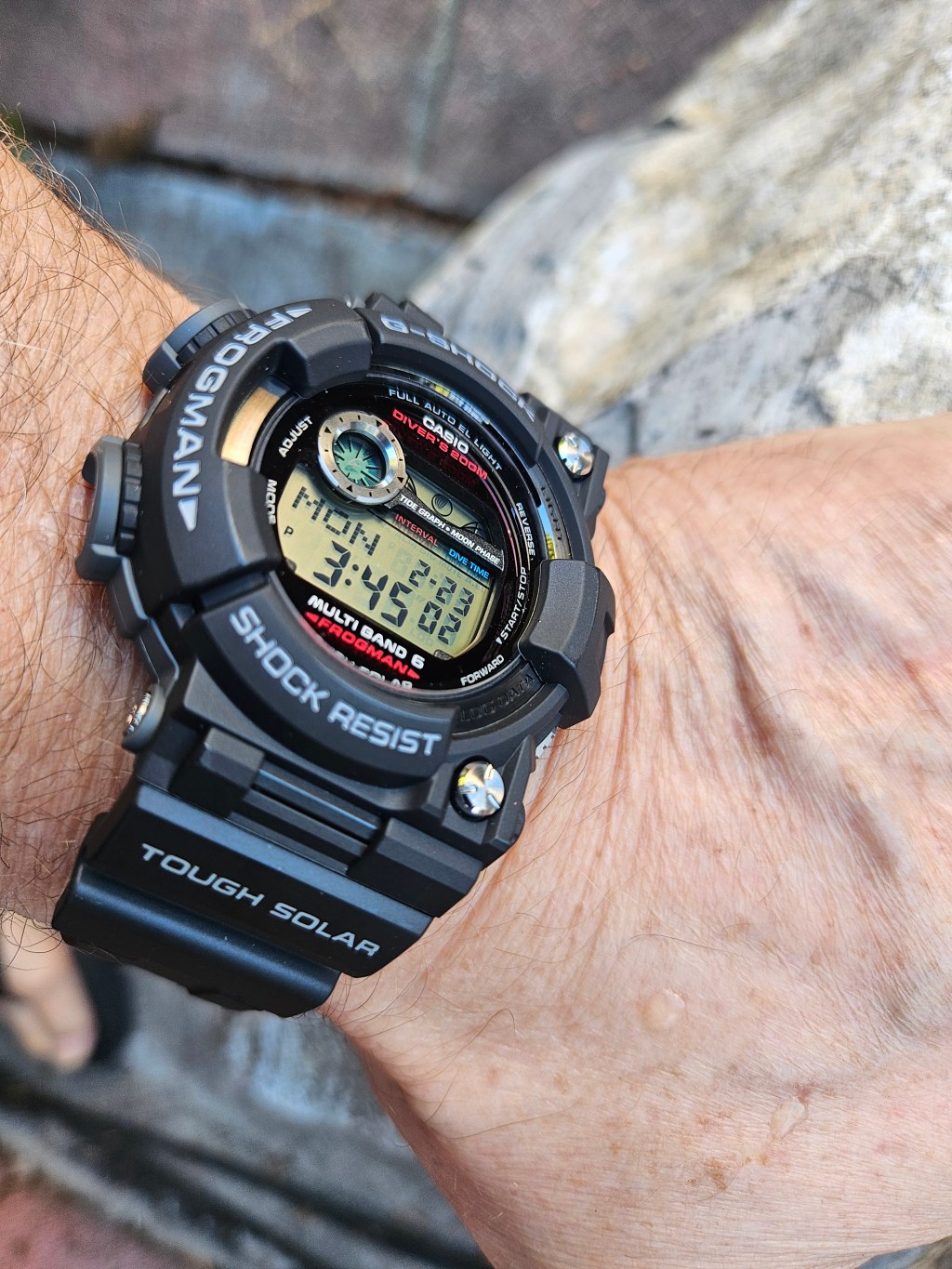
    Second, while your wife and her friends design custom T-shirts and handmade signs for rock concerts in the desert, you remain home on a Saturday night swapping straps on your diver watches. You build watch-rotation calendars. You track wrist time. You rank your collection by annual usage. The fact that you know you wore your Seiko Marine Master for exactly 863 hours last year strikes you as reasonable, even impressive. Others find it alarming.

    Third, because your tolerance for irritation is low, you shop only at dawn, when grocery stores are nearly empty and the few people present are still half-asleep—docile, unthreatening, manageable. You take pride in shopping before the rat race wakes up. This dovetails nicely with your time-management philosophy: bed at nine, up at five. By the time the world stirs, you’ve had your coffee, your steel-cut oats, your kettlebell workout, and your canvas grocery bags—your weekly macros—put neatly away. You are, in your own mind, winning.

    The rest of the day unfolds under a regime your wife has named Captain Cancel. Every proposed outing meets a veto. You can’t attend a concert because it might rain, despite cloudless skies. You can’t go to a restaurant because parking is inadequate, and when your wife reminds you of the new parking structure, you explain that it’s widely known to be contaminated with asbestos. A comedian you once loved is playing in Hermosa Beach, but you inform her he hasn’t been funny since the Reagan administration. A trip to Maui is ill-advised due to avian flu, especially dangerous during air travel. A beach picnic is canceled because of a sewage spill that, you explain, has compromised not just the water but the atmosphere. You agree to Taco Tuesday at the local brewery, but it’s too loud. You stuff toilet paper in your ears, announce you’re unwell, and Uber home. You are never invited again. This makes you smile as you drift into a deeply satisfying sleep.

    If you recognize any of these traits, congratulations. You are anti-social. You are Captain Cancel. You have chosen your isolation, locked yourself in your cage, and—most importantly—convinced yourself it was the sensible thing to do.

  • Why I Must Become the Skinny Yoga Guy

    Why I Must Become the Skinny Yoga Guy

    As the clock keeps punching holes in the calendar and I drift into the middle distance of my sixties, I’m stalked by the uneasy sense that I am not the man I’m supposed to be. I carry thirty extra pounds like unpaid emotional invoices. I cave to food temptations with embarrassing regularity. I indulge in narcissistic spirals of self-pity. My body bears the archaeological record of a lifetime of weightlifting injuries. Something has to give. The question isn’t whether I’m a complex human being—of course I am—but which single image can give me dignity, courage, and self-possession as I face my obligations, stay engaged with this lunatic world, and fend off entropy. The image that keeps returning, uninvited but insistent, is this: I am the Skinny Yoga Guy.

    The Skinny Yoga Guy eats vegan, clean, and whole, not as a performance but as a quiet discipline. He hits his protein macros with buckwheat, pumpkin seeds, peas, soy, garbanzos, and nutritional yeast, without sulking or negotiating. He cooks plant-based meals anchored in Thai, Mexican, and Indian traditions, not sad beige bowls marketed as “fuel.” He doesn’t snack like a raccoon in a pantry; he sips cucumber water and green tea and moves on with his day.

    He practices yoga six days a week, a full hour each time, sweating without complaint. The body lengthens. The spine straightens. He appears taller, calmer, less compressed by life. There’s a faint health glow—less “Instagram guru,” more “someone whose joints don’t hate him.” The discipline reshapes his temperament. The short fuse and indulgent sulks fade. In their place emerges a man who notices other people, attends to their needs without sermonizing, and discovers—almost accidentally—that service makes him sturdier, not smaller.

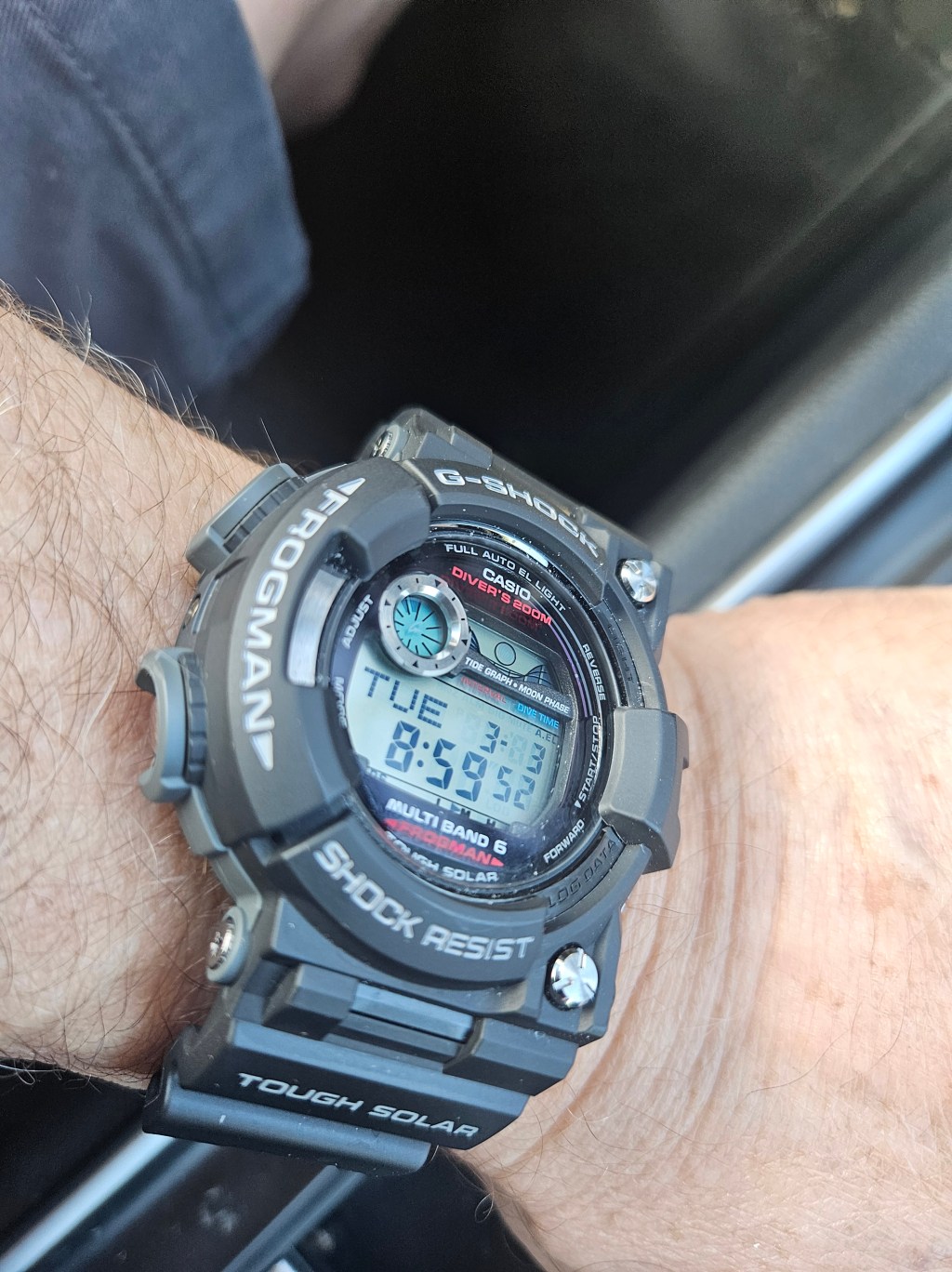
    In this revised operating system, the watch obsession quietly dies. No more chunky diver watches as heroic cosplay. No rotation. No drama. Just one watch: the G-Shock GW-5000. The purest G-Shock because it refuses theater. Shockproof, accurate, solar-powered, atomically synced. No Bluetooth, no notifications, no begging for attention. It does one thing relentlessly well: it tells the truth about time. It is reliability without narcissism.

    If the GW-5000 is indestructibility stripped of spectacle, then my assignment is clear: I must become its carbon-based counterpart. Less bloat. Fewer features. More uptime. Yoga becomes joint maintenance. Vegan food becomes corrosion control. No supplements that blink. No gadgets that chirp. No dietary Bluetooth pairing with guilt. Just a lean system designed to absorb impact, recover quickly, and remain accurate. GW-5000 firmware, now awkwardly attempting to run on two legs.

    The longing is real. I want to be the Skinny Yoga Guy—disciplined, light, healthy—wearing a single $300 G-Shock as a quiet marker of having stepped off the status treadmill. I no longer want validation from a $7,000 luxury watch. Wanting this man is easy. Becoming him is not. That requires character, not aspiration.

    My hunch is that I need to write my way into him. A novel titled The Skinny Yoga Guy. Not a parody, not a self-help tract, but a chronicle of real-time change rendered with mordant humor and unsparing honesty. The book isn’t the point. Transformation is. The novel would simply be the witness.

    So here I am, a larval creature trapped in my cocoon. I must emerge as a new creature. The challenge is issued. Whether the world is waiting for my metamorphosis is irrelevant. I am. And that, for once, feels like enough.

  • The Shingles Shot, the Vanishing Kettlebell Workout, and a Brief Descent Into Strap Madness

    The Shingles Shot, the Vanishing Kettlebell Workout, and a Brief Descent Into Strap Madness

    I got my shingles vaccine yesterday at noon and felt absolutely nothing afterward—so nothing, in fact, that I woke up the next morning feeling smugly invincible. I went to Trader Joe’s, bantered with the employees about the collective psychosis surrounding their limited-edition mini tote bags, came home, unloaded the groceries, and mentally penciled in a righteous kettlebell session in the garage. Then, right around 10 a.m., my immune system cleared its throat. A slow, heavy wave of fatigue rolled in, the kind that doesn’t ask permission. I took what I told myself was a “precautionary” nap. I made a deal with my body: if I felt fine in an hour, the kettlebells were back on. By 11, the aches had arrived, lethargy had unpacked its bags, and the deal was quietly voided. The iron would have to wait.

    Now, 28 hours post-shot, I’m more tired than I was this morning, which feels like a violation of some unspoken contract. In what I can only describe as a low-grade vaccine fever fugue, I apparently decided this was the perfect moment to perform strap surgery on my watch collection. The Seiko SLA051, 055, and 023 all lost their OEM waffle straps and emerged reborn on Divecore FKM. Yes, I’m aware that FKM is rumored to whisper chemical lullabies into the bloodstream. No, I’m not persuaded that wearing these watches a few hours a week is going to tip me into a Superfund site.

    In any case, I’m already planning to swap the FKMs for Divecore’s hydrogenated waffle straps in a few months. If there’s any exposure happening, it’s brief, intermittent, and vastly overshadowed by whatever biochemical fireworks the shingles vaccine is currently setting off inside me. For now, I’ll rest, hydrate, and let my immune system do its thing—apparently with a side hobby in horological rearrangement.

  • Learning About Rejection on a Flight to Miami

    Learning About Rejection on a Flight to Miami

    In the summer of 1972, when I was ten years old and convinced my destiny was to become a musclebound baseball god in the image of Reggie Jackson, I found myself on a flight from LAX to Miami, pressed against the window and staring out at adulthood like it was another continent. In the middle seat sat a blonde bombshell in her mid-twenties wearing pink hot pants with psychedelic purple-and-white stripes and legs so aggressively tanned they could have powered a citrus-processing plant. She wasn’t just attractive; she was a mood. She radiated the entire seventies—optimism, excess, invitation. I wasn’t merely drawn to her. I was drawn to the future she seemed to promise.

    On the aisle sat her conversational counterpart: a pencil-necked, dark-haired man of similar age with impeccable manners, minimal charisma, and the quiet dignity of a man who alphabetizes his spice rack. He was an accountant. She was in dental hygiene school. For five uninterrupted hours, the two of them performed their biographies live, with me as the captive audience. Mostly she spoke. He nodded, gasped on cue, and occasionally supplied a sentence fragment to prove he was still alive. She talked about school, snacks, weather, philosophy—everything. It felt like watching a reality show pilot that forgot to end. But I didn’t mind. She was animated. She was confident. She was hope in hot pants.

    At one point she announced that her ears needed to pop and offered both of us Dentyne gum, explaining that it helped with altitude. I briefly wondered if she thought we were participating in some sort of triathlon of inner-ear resilience. The accountant accepted the gum solemnly, like a man taking medical advice from destiny.

    When the plane finally shuddered to a stop at the gate, the accountant—buoyed by five hours of uninterrupted conversation and the survival glow of having endured it—asked her out on a date. She declined with practiced kindness, the sort of smile perfected by women who have said no thousands of times without ever raising their voice. He accepted the rejection gracefully, even apologetically, as if her disinterest were an inconvenience he had caused.

    My ten-year-old brain short-circuited. I felt like I’d witnessed something indecent. Rejection, I believed, was supposed to be private. Public rejection multiplied the shame. I flashed back to junior high dances where I’d cross the cafeteria, ask a popular girl to dance, watch her recoil as if I’d mistaken bravery for stupidity, then retreat to my friends’ laughter. Now I was seeing the adult version. How could this accountant—handsome, polite, numerically gifted—be rejected after such an extended airborne courtship? I sat there, my romantic assumptions collapsing like cheap sci-fi scenery. Maybe he was too bland. Maybe she had a chaotic love life waiting in Miami. Or maybe—this was the real lesson—she’d simply enjoyed a conversation to pass the time on a long flight. Whatever the reason, I absorbed his rejection as if it were my own. I remain convinced that somewhere in the universe’s permanent records, my name appears next to a small but enduring note: rejected by attractive woman. And yes, it still stings.