Category: Health and Fitness

  • The Vegan That Lives in My Head (and Nowhere Else)

    The Vegan That Lives in My Head (and Nowhere Else)

    At six a.m., mug in hand, I sat down at my desk with the smug satisfaction of a man pretending to be in control of his day—only to be ambushed by a large brown spider launching itself from my desk drawer like it was fleeing the FBI. It vanished into the shadows, and I was left stewing in the indignity of defeat. I didn’t catch it. Worse, for the second morning in a row, I couldn’t remember my dream. Something about a car near the ocean, a faceless authority figure mumbling instructions, and then—blank. Freud would be disappointed. I’m more annoyed.

    My dreams often involve cars. They also often involve the ocean. I suspect this means I’m perpetually trying to get somewhere, while simultaneously wanting to be swallowed by the Great Womb of the Deep. Birth, Death, and the Cycle of Life.

    Midway through my coffee, my teenage daughter wandered into my office, eyebrows raised in alarm as I recounted the spider saga and my failed dream recall. She showed the appropriate amount of concern, then casually announced she was heading to Starbucks for a chai latte. It’s comforting how the rituals of youth persist, even as their fathers spiral existentially over arachnids and unconscious symbolism.

    I banged out a new essay prompt for next semester—something about manufactured authenticity and influencer FOMO—then drove the girls to school, came back, and burned 805 calories in 61 minutes on the Schwinn Airdyne. Or as I’ve come to call it: The Misery Machine. This isn’t exercise. This is penance. Only those seeking redemption or working through unresolved guilt buy these medieval contraptions. The bike doesn’t offer health—it offers absolution.

    Post-shower weigh-in: 231. Still twenty pounds away from my goal, but less disgusting than I was yesterday, so—progress.

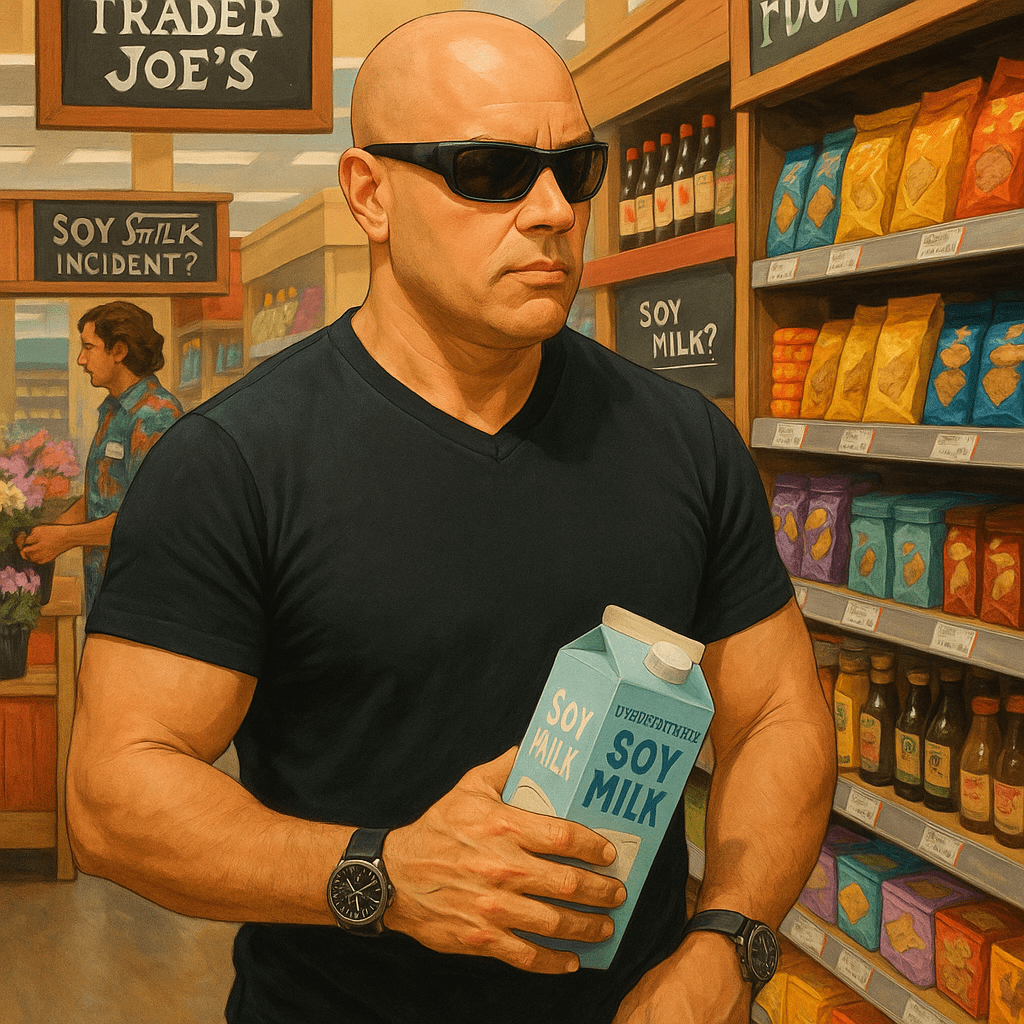
    Later, I drifted into my usual morning fantasy: becoming a vegan. No, not a preachy zealot in hemp sandals, but a serene, plant-based domestic monk, stirring lentils and sipping soy lattes like some morally superior Miyagi of meal prep. In this fantasy, I don’t haul home slabs of meat leaking blood onto Trader Joe’s paper bags. No. I have evolved.

    In this alternate timeline, breakfast is steel-cut oatmeal or buckwheat groats with walnuts, berries, soy milk, and a dash of protein powder. Lunch and dinner are identical—because I’m disciplined, not boring—a sacred Le Creuset Dutch oven bubbling with a Caribbean rice-and-beans concoction: quinoa or white rice, black beans, cubes of tempeh, coconut milk, tomato sauce, and enough spice to remind me I’m still alive. The afternoon snack is a tall glass of soy milk with a scoop of vegan protein, because the aspirational me is nothing if not consistent.

    Of course, this will never happen.

    My wife and daughters won’t eat this way. Neither, frankly, will I. I’ve known student-athletes who withered into pale husks trying to go vegan. Others have thrived and glowed like enlightened celery sticks. I, on the other hand, turn into a foggy-headed anemic with the energy of a depressed manatee. But the fantasy persists. This vegan version of me—let’s call him “The Better Me”—exists only in the realm of self-mythology, filed away with other fictional selves: The Novelist Who Writes Before Dawn, The Man Who Loves Yoga, and The Guy Who Only Checks His Phone Twice a Day.

    They’re all gathering dust in the mental trophy case labeled Deferred Dreams. To catalogue them all would require another post—and a second pot of coffee.

  • Bro Science and the Collapse of Critical Thinking: Why Fitness Influencers Thrive in a Post-Truth Culture (College Essay Prompt)

    Bro Science and the Collapse of Critical Thinking: Why Fitness Influencers Thrive in a Post-Truth Culture (College Essay Prompt)

    In the digital era, health is no longer just about wellness—it’s about performance, optics, and identity. Two recent Netflix documentaries, The Game Changers and Untold: The Liver King, serve as cultural artifacts of a rising genre: influencer-fueled fitness propaganda wrapped in moral theater and masculine branding.

    The Game Changers promotes a plant-based diet as not only an ethical choice, but as a gateway to elite athleticism, virility, and moral superiority. It uses cinematic flair, celebrity cameos, and pseudoscientific claims to repackage veganism as a Bro Lifestyle—a body-hacking shortcut to strength, stamina, and environmental salvation. Meanwhile, Untold: The Liver King profiles Brian Johnson, a self-styled “Ancestral Living” guru who gained millions of followers by promoting a raw-organ-meat, shirtless-in-the-woods routine before being exposed for secretly spending over $10,000 a month on performance-enhancing drugs.

    Despite their opposing diets—one vegan, one carnivore—both narratives follow a suspiciously similar script. They offer simplified solutions to complex problems, appeal to masculine insecurity, and promise transcendence through aesthetics, all while playing fast and loose with science. Their real power lies not in evidence, but in storytelling—stories that market identity, exploit fears, and seduce with cinematic emotion.

    This style of rhetoric, often called “Bro Science,” thrives in an age of algorithmic truth, where virality trumps validity. In this environment, influencer-driven wellness culture doesn’t just ignore science—it weaponizes it, bending facts to serve a brand. The result is a cultural climate where image, ideology, and emotional resonance increasingly matter more than data or critical thinking.

    Assignment:

    Write a well-argued, 1,700 word essay that analyzes The Game Changers and Untold: The Liver King as case studies in rhetorical manipulation, identity-based marketing, and the collapse of evidence-based discourse. In your essay, argue that the success of these Bro influencers lies not in their scientific credibility, but in their emotional, aesthetic, and ideological appeal.

    You must compare the rhetorical strategies used in both documentaries and analyze the cultural implications of how masculinity is rebranded, how virtue is commodified, and how fallacious reasoning is normalized in the guise of motivation and self-improvement.


    Your essay should address the following:

    1. Rhetorical Strategy – How do both documentaries use visual storytelling, celebrity testimony, repetition, and emotional appeals to persuade the viewer?
    2. Logical Fallacies – Identify and critique examples of cherry-picked science, false cause arguments, appeals to authority, or false dichotomies in each film.
    3. Branding Masculinity – How do the documentaries construct competing visions of the “ideal male”? What do they promise men, and what fears do they exploit?
    4. Collapse of Evidence-Based Thinking – Situate these documentaries in a larger cultural moment. Why do identity-driven narratives flourish in a time of disinformation, algorithmic echo chambers, and a crisis of expertise?

    Style, Structure, and Submission

    • Your essay must include a thesis with mapping components, clear topic sentences, and evidence-based analysis.
    • You may write in a formal academic tone or use a more critical/cultural studies voice with vivid prose—as long as your argument is coherent, supported, and original.
    • Use MLA style consistently.Final draft due: [Insert Date]

    Sample Thesis Statements (with Mapping Components)


    1.
    While The Game Changers promotes lentils and The Liver King pushes liver, both documentaries peddle the same myth: that aesthetic transformation equals virtue. Through emotionally manipulative storytelling, logical fallacies disguised as science, rebranded masculine identities, and algorithmically engineered messaging, these films reveal the dangerous collapse of evidence-based thinking in modern wellness culture.


    2.
    The success of The Game Changers and Untold: The Liver King lies not in their nutritional claims but in their weaponization of narrative. Both films rely on emotionally loaded visuals, performative masculinity, fallacious scientific rhetoric, and identity-driven marketing to sell a fantasy of bodily perfection that exploits insecurity and bypasses rational analysis.


    3.
    By glamorizing extreme lifestyle choices through visual spectacle, moral branding, and rhetorical sleight-of-hand, The Game Changers and Untold: The Liver King reveal a disturbing cultural trend: the replacement of scientific rigor with personal mythologies, the commodification of authenticity, and the rise of Bro Science as a post-truth performance of health.


    Sample Outline


    I. Introduction

    • Hook: The modern Bro doesn’t just lift—he converts.
    • Brief overview of both documentaries and their appeal
    • Thesis statement with four components:
      • Emotional storytelling
      • Logical fallacies
      • Rebranded masculinity
      • Decline of evidence-based thinking

    II. The Emotional Power of Narrative

    • Use of cinematic techniques, voice-over, editing, and transformation arcs
    • Celebrity endorsements (e.g., Arnold, athletes, Johnson himself)
    • Case study: how emotion trumps empirical data in both documentaries

    III. The Rhetoric of Fallacy

    • The Game Changers: cherry-picking studies, false cause arguments
    • Liver King: appeal to nature, denial of PEDs, appeal to “ancestral purity”
    • How fallacies are disguised through slick production and confidence

    IV. Masculinity as Lifestyle Branding

    • Compare how each documentary rebrands masculinity (lean vegan warrior vs. raw primal alpha)
    • Analyze underlying fears being addressed: weakness, softness, irrelevance
    • How “virtue” (animal ethics vs. authenticity) becomes a selling point for muscle aesthetics

    V. The Cultural Crisis of Truth and Expertise

    • Rise of influencer health culture amid distrust in traditional institutions
    • The algorithm as echo chamber: content tailored to belief, not inquiry
    • Bro Science as the new gospel in the post-truth digital age

    VI. Conclusion

    • Recap major points
    • Reflect on the danger of narratives that bypass critical thought
    • Call to rethink how we engage with health media and influencers in the age of viral propaganda
  • Workout & Diet Strategy for Thriving in My 60s

    Workout & Diet Strategy for Thriving in My 60s

    I’m 63 and maintaining strength, stamina, and mobility with a sustainable weekly routine. Here’s my current workout and diet plan—structured, protein-rich, and cardio-intense without trashing the joints.


    Training Plan (6 Days/Week – 1 Rest Day)

    I rotate three different 1-hour sessions. All kettlebell (KB) workouts are circuit-style with minimal rest.

    Workout A – Strength & Squat Emphasis

    • Goblet Squats – 3 sets of 20
    • KB Lat Rows – 3 sets of 15
    • Push-Ups – 2 sets of 20
    • KB Clean, Squat & Press – 15 reps
    • Hand-to-Hand Swings – 30
    • Around-the-Worlds – 30
    • KB Circles – 20
    • Turkish Get-Ups – 3/side
    • Lying KB Pullover + Sit-Up + Press – 15
    • Medicine Ball Slams – 30

    Workout B – Swing & Flow Emphasis

    • Hand-to-Hand Swings – 2 rounds of 40
    • Single-Arm Clean, Squat & Press – 15
    • KB Lat Rows – 2 rounds of 20
    • Figure 8s – 20
    • Push-Ups – 20
    • Side Plank Deltoid Raises – 20
    • KB Deadlifts – 20
    • Around-the-Worlds – 40
    • Turkish Get-Ups – 3/side
    • Lying KB Pullover + Sit-Up + Press – 15
    • Single-Arm Chest Press – 15
    • Single-Leg Romanian Deadlifts – 20

    Workout C – Schwinn Airdyne Session

    • 1 hour at 80–95% HR max
    • ~700 calories burned

    Weekly Cycle

    Rotate A → B → C, repeat. One full rest day weekly.

    Diet & Macros (Maintenance/Cutting)

    High-protein, moderate-calorie, lowish-carb. Simple meals, consistent results.

    Breakfast

    • 1 cup plain Greek yogurt
    • Scoop of whey protein
    • Chia seeds, berries
    • Coffee

    Lunch

    • Arugula salad with balsamic
    • Canned fish
    • ½ block Trader Joe’s tempeh
    • Cottage cheese
    • Jalapeños, herbs, spices

    Post-Nap Snack

    • ¾ cup yogurt with berries

    Dinner

    • Lean protein
    • Vegetables
    • Apple

    Macros:

    • Protein: 160–180g
    • Calories: ~2,300
    • Carbs: 100–120g

    Supplements

    • Fish Oil
    • Creatine (5–7g daily)
    • Magnesium

  • Soylent Nation: The Death of Food and the Rise of Optimization

    Soylent Nation: The Death of Food and the Rise of Optimization

    If our first essay examined how GLP-1 drugs alter our humanity by suppressing hunger, our second essay takes us deeper into the culinary uncanny valley—where food, as we’ve known it for millennia, is quietly vanishing. In its place? “Foodstuffs”—a sterile word for whatever futuristic slop keeps our bodies upright and insurance premiums low.

    Here’s the prompt:
    GLP-1 drugs like Ozempic are already dulling the primal scream of hunger, while artificial intelligence promises to spoon-feed us algorithmically tailored, nutrient-optimized meals. Together, these forces threaten to end food as a sensory, emotional, and cultural experience. In its place: hyper-efficient eating designed for health metrics, economic survival, and corporate convenience.

    Write a 1,700-word argumentative essay that responds to the following claim:
    We are shifting from being Pleasure Creatures who gather, share, and celebrate food to Optimized Creatures—pharmaceutically sedated, algorithmically fed, and culturally detached from eating as anything but fuel.

    In your response, examine both the promises and the perils of this transformation. What’s gained in the name of longevity, affordability, and controlled weight? What’s lost when shared meals, sensual pleasure, and culinary identity are reduced to biometric feedback and calorie quotas?

    Also consider this grim possibility: What if the Optimized future isn’t a choice? What if remaining a Pleasure Creature means disqualifying yourself from affordable health care, workplace perks, or state-sponsored insurance? Can anyone really resist this transition when optimization becomes not just encouraged but economically mandated?

    You’re not here to write a dystopian novel or a eulogy for artisanal bread. You’re here to think critically. Engage with nuance. Acknowledge contradictions. If your reader finishes your essay feeling uncomfortable, you’re probably doing something right.

  • The Wellness Racket: Shaming, Scamming, and Selling You Salvation

    The Wellness Racket: Shaming, Scamming, and Selling You Salvation

    In How to Be Well, Amy Larocca vivisects the modern feminine ideal and lays it bare: not the goddess of hearth or harvest, but the “abstracted wellness she-god”—a taut, juiced-up high priestess of turmeric tinctures and lymphatic drainage rituals. This new oracle doesn’t offer wisdom but a curated Amazon storefront. She peddles empowerment with one hand and $128 collagen powder with the other, all while perched atop a Peloton like some neoliberal Delphic seer.

    These wellness influencers don’t just sell products; they sell paranoia dressed in millennial pink. Every scroll of your feed is a sermon in self-improvement with a side of fear: Eat this, not that. Touch this, never that. Microwave? You might as well lick plutonium. Their gospel is a toxic cocktail of pseudoscience, product placements, and shame. You’re not ill, darling—you’re just uninformed and understocked.

    And here’s the trick: they wave the banner of feminism, preaching self-empowerment while quietly mugging you with your own insecurities. They exploit the universal dread that something you ate in 2009 is still lodged in your spleen, slowly killing you. Who doesn’t want to be informed? Who wants to die from an unpronounceable preservative in a childhood granola bar? But the more you try to “be well,” the more you’re trapped in a never-ending scavenger hunt for health hacks, supplements, and contradictions.

    It’s not wellness. It’s a designer panic spiral. And the moment you start shaping your habits, meals, and bank account around their gospel, congratulations—you’re not just a follower. You’ve been converted. And this church doesn’t just ask for tithes. It demands your wallet, your weekends, and your soul.

  • Blessed Are the Gluten-Free: America’s New Spiritual Elite

    Blessed Are the Gluten-Free: America’s New Spiritual Elite

    Reading Amy Larocca’s How to Be Well is like watching Gwyneth Paltrow’s ghost possess a Whole Foods employee mid-mushroom latte. Her book is equal parts riveting and scalpel-sharp, dissecting the strange mutation of fashionistas who’ve traded in Gucci for goop and now drape themselves in wellness jargon like it’s couture. These wellness evangelists don’t just eat clean—they chant it. They speak in tongues made of spirulina, lipospheric vitamin C, Cordyceps, Shilajit resin, and ho shou wu, stringing together syllables like they’re summoning the ghost of Hippocrates.

    What we’re witnessing isn’t self-care—it’s a personality cult with better lighting. The modern wellness priestess has crowned herself a demigod, armed with adaptogens instead of sacraments, waving her magic tincture dropper and pointing lesser mortals toward the True Path of purified, gluten-free, unpasteurized transcendence. It’s not just health—it’s high-performance sanctimony.

    Larocca nails the diagnosis with surgical precision: “I sometimes think of wellness as the project of buying your own body back for yourself.” Translation? Welcome to America’s chicest hostage situation, where the ransom is payable in collagen peptides and oat milk. The goal is to become the luxury-branded version of you—perfect skin, toxin-free bowels, and moral superiority radiating from every overpriced yoga mat. The side effect? It magnifies the gaping inequalities of modern life like a magnifying mirror you didn’t ask to look into.

    Because let’s be honest: none of this comes cheap. These rituals of wellness cost money—bucketloads of it. We’re not talking about a jog around the park and some tap water. We’re talking $12 green juices and $300 infrared saunas. The entire project is rigged to serve the few while gaslighting the many. The wellness priestess doesn’t just ignore that her lifestyle is unattainable for most—she markets that inaccessibility as part of the charm.

    This isn’t health—it’s spiritual cosplay for the affluent.

  • Wristwatches and Wastelands: How Fashion Can Hollow You Out

    Wristwatches and Wastelands: How Fashion Can Hollow You Out

    Amy Larocca, a fashion journalist with twenty years of runway reportage under her belt, understands the psychological scaffolding beneath a well-tailored sleeve. “Fashion,” she writes in How to Be Well, “is about beauty, of course, but it is also about the desire to elevate daily life from its more banal limitations, to consciously and actively share something about how you’d like to be perceived by the rest of the world.”

    And that, my friend, is exactly where the trouble starts.

    Take a stroll through the horological asylum known as the watch community. What starts as an appreciation for precision craftsmanship often spirals into a neurotic fixation. A dive watch isn’t just for telling time—it’s for announcing to the world that you’re rugged, refined, and possibly ready to harpoon something. The desire to “elevate daily life” with just the right wrist candy turns into a slow-motion personality collapse. It becomes a lifestyle audition for an identity you don’t actually inhabit.

    The trap is cunning. At first, fashion promises transformation: a sharper silhouette, a touch of mystique, a sense of control in a chaotic world. But when the performance replaces the person—when dressing well becomes a proxy for purpose—you’re not elevating your life. You’re embalming it in linen and leather.

    The real tragedy isn’t vanity. It’s the way compulsive self-curation smothers empathy. Narcissism isn’t just annoying—it’s lonely. It dislocates you from community, connection, and anything approaching transcendence. A meaningful life, if it’s worth living at all, doesn’t orbit around the mirror.

    To be clear: there’s nothing wrong with looking sharp. Be fit, be stylish, radiate confidence. But when your wardrobe becomes your worldview—when you dress not to express but to impress—you trade depth for dazzle. You don’t become interesting. You become exhausting.

  • Toxins, Teas, and the Tyranny of Self-Care

    Toxins, Teas, and the Tyranny of Self-Care

    In How to Be Well: Navigating Our Self-Care Epidemic, One Dubious Cure at a Time, Amy Larocca introduces us to the “Well Woman”—an aspirational specter of affluent spirituality who floats through Erewhon aisles like a priestess of turmeric. She is non-religious but deeply “spiritual,” an educated, upper-middle-class avatar of intentional living. Her diet? Whole, organic, plant-based. Her skincare? Sourced from the tears of ethically massaged avocados. Her wardrobe? Soft, breathable cottons dyed with herbs. Her soul? Allegedly pure.

    She’s the type who throws around words like “boundaries” and “holding space” while sipping adaptogenic mushroom tea. Fluent in therapy-speak and swaddled in the cozy lexicon of mindfulness, she’s not just living—she’s curating her life, building an identity out of emollients, detoxes, and artisanal spices. And all of it—every mindful, ethically sourced drop—feeds the $5.6 trillion wellness-industrial complex.

    Larocca sees through the yoga-scented fog. The Well Woman, she argues, is just the latest installment in America’s ongoing franchise of unattainable feminine ideals: a new model to aspire to, envy, and—most importantly—buy into. Today’s purity isn’t moral; it’s material.

    Reading Larocca’s opening, I couldn’t help but think of Todd Haynes’s 1995 masterpiece Safe, in which Carol White—a vapid housewife in the chemical-glazed sprawl of the San Fernando Valley—slowly dissolves into the cult of purity. After one too many trips to the dry cleaner, Carol spirals into an obsession with environmental toxins, abandons her friends and family, and ends up exiled to a pastel-drenched wellness commune. There she lives alone in a sterile dome, staring at herself in the mirror, parroting affirmations until there’s nothing left behind her eyes but empty devotion.

    Carol White is the ghost of the Well Woman’s future—a cautionary tale in Lululemon. She doesn’t find peace; she finds a purgatory curated by Goop. And as Larocca peels back the lavender-scented rhetoric of self-care, it’s clear she sees this modern cult of wellness not as healing but as hollowing—a $5.6 trillion seduction that promises salvation and delivers scented self-delusion.

  • Trapped in the AI Age’s Metaphysical Tug-of-War

    Trapped in the AI Age’s Metaphysical Tug-of-War

    I’m typing this to the sound of Beethoven—1,868 MP3s of compressed genius streamed through the algorithmic convenience of a playlist. It’s a 41-hour-and-8-minute monument to compromise: a simulacrum of sonic excellence that can’t hold a candle to the warmth of an LP. But convenience wins. Always.

    I make Faustian bargains like this daily. Thirty-minute meals instead of slow-cooked transcendence. Athleisure instead of tailoring. A Honda instead of high horsepower. The good-enough over the sublime. Not because I’m lazy—because I’m functional. Efficient. Optimized.

    And now, writing.

    For a year, my students and I have been feeding prompts into ChatGPT like a pagan tribe tossing goats into the volcano—hoping for inspiration, maybe salvation. Sometimes it works. The AI outlines, brainstorms, even polishes. But the more we rely on it, the more I feel the need to write without it—just to remember what my own voice sounds like. Just as the vinyl snob craves the imperfections of real analog music or the home cook insists on peeling garlic by hand, I need to suffer through the process.

    We’re caught in a metaphysical tug-of-war. We crave convenience but revere authenticity. We binge AI-generated sludge by day, then go weep over a hand-made pie crust YouTube video at night. We want our lives frictionless, but our souls textured. It’s the new sacred vs. profane: What do we reserve for real, and what do we surrender to the machine?

    I can’t say where this goes. Maybe real food will be phased out, like Blockbuster or bookstores. Maybe we’ll subsist on GLP-1 drugs, AI-tailored nutrient paste, and the joyless certainty of perfect lab metrics.

    As for entertainment, I’m marginally more hopeful. Chris Rock, Sarah Silverman—these are voices, not products. AI can churn out sitcoms, but it can’t bleed. It can’t bomb. It can’t riff on childhood trauma with perfect timing. Humans know the difference between a story and a story-shaped thing.

    Still, writing is in trouble. Reading, too. AI erodes attention spans like waves on sandstone. Books? Optional. Original thought? Delegated. The more AI floods the language, the more we’ll acclimate to its sterile rhythm. And the more we acclimate, the less we’ll even remember what a real voice sounds like.

    Yes, there will always be the artisan holdouts—those who cook, write, read, and listen with intention. But they’ll be outliers. A boutique species. The rest of us will be lean, medicated, managed. Data-optimized units of productivity.

    And yet, there will be stories. There will always be stories. Because stories aren’t just culture—they’re our survival instinct dressed up as entertainment. When everything else is outsourced, commodified, and flattened, we’ll still need someone to stand up and tell us who we are.

  • Medicine Ball Confessional: A Garage Epiphany

    Medicine Ball Confessional: A Garage Epiphany

    Medicine Ball Rapid Squats with Explosions—yes, actual liftoff, feet airborne like a NASA launch—have officially dethroned the stationary bike as my cardio weapon of choice. For sixty glorious, self-inflicted minutes, I was drenched in blissful sweat, hurling that rubber orb like it owed me money. Then came the aftermath: fatigue so pure and existential I could hear the clock ticking on my lifespan. I collapsed into a nap with the urgency of a man dodging the Grim Reaper.

    Now? I’m upright. Serene. Humbled. Prepping to teach a class on Ozempification, AI, and the slow, clinical death of food culture. The brain is willing, the PowerPoint is ready—but spiritually, I’m still in the garage, shirtless and heaving, chasing glory with kettlebells and a medicine ball like a 63-year-old Olympic hopeful with a PhD in futility.

    I don’t know what compels me to train this hard. Maybe it’s defiance. Maybe it’s denial. Some hybrid of Rocky Balboa and Hamlet. Either way, this zeal is a strange cocktail of vitality and panic. I hope it’s health. But I’d be lying if I said it didn’t reek, just a little, of desperation. Then again—what is passion, if not a dignified form of flailing against the void?