Category: Health and Fitness

  • Trapped in the Sauna: When Bro Talk Becomes Brain Fog

    Trapped in the Sauna: When Bro Talk Becomes Brain Fog

    I’m 63, I live in the suburbs, and I like to sweat, laugh, and think—ideally all in the same day. I’ve got a soft spot for health and fitness talk, well-produced comedy, and podcasts where the ideas land harder than the punchlines. Back in the day, I gave Joe Rogan some ear time—especially when he had guests like Michael Pollan who could string together a sentence without referencing elk meat or hallucinogens. The show scratched a certain male itch: that longing for a tribal fire pit where you could grunt, swap kettlebell routines, and talk nonsense without getting side-eyed.

    I got it. I really did. There was a certain charm in the early years—the man cave as refuge, not bunker. A place for unapologetic masculinity that wasn’t trying to sell you a four-pack of testosterone supplements and a tactical flashlight.

    But then something changed. The man cave didn’t evolve—it ossified. It turned into a walled-off compound of grievance, smug anti-intellectualism, and half-baked conspiracy theories passed around like a tray of stale edibles. What once felt like a mixed bag of bro-science and genuine curiosity devolved into a middle-aged lunch table where the same unfunny comedians riff about whiskeys, bow hunting, and whether they’d survive a bear attack armed only with sarcasm and nicotine gum.

    So when I stumbled across Ghost Gum’s YouTube essay “The Collapse of the Joe Rogan Verse,” I hit play with morbid curiosity—and found it eerily validating. Turns out, I wasn’t alone in sensing that Rogan’s podcast had turned into a predictable, self-congratulatory echo chamber, where counterarguments go to die and every guest seems contractually obligated to flatter the host.

    The video’s roast of Tom Segura was especially brutal—and fair. Once the chubby, relatable everyman, Segura now floats in orbit around Planet Rogan, sneering at the unwashed masses like a guy who did keto once and now thinks he’s better than you. His comedy used to punch up; now it just punches down and preens.

    Comedy rooted in tribal loyalty becomes fan service, then becomes boring, then becomes embarrassing. What began as a countercultural clubhouse has curdled into a locker room thick with stale air and self-importance.

    Maybe Joe Rogan was once a necessary irritant to polite discourse, a reminder that the man cave had value. But too much time in that space without fresh air—and you forget it was never meant to be a throne room.

    Perhaps Joe Rogan’s unraveling podcast is just another cautionary tale of what happens when someone marinates too long in their own echo chamber and starts mistaking the sound of agreement for the sound of wisdom. Spend enough time surrounded by yes-men and protein powder, and eventually, you’re just getting high on your own supply—delirious with self-importance and blind to the rot setting in.

  • The Vegan Martyr of Suburbia

    The Vegan Martyr of Suburbia

    This is a story soaked in irony, clucking with heartbreak. It’s the tale of Ned Pearlman, a 63-year-old man whose conscience became his personal executioner.

    Ned was a lifelong weightlifter, a barrel-chested patriarch with calloused hands and a back catalog of deadlift anecdotes. When egg prices began to flirt with the absurd, his family took the Depression-era route and bought chickens. Backyard livestock as economic strategy.

    They started with a humble flock—a few hens, a rooster, and one poorly socialized silkie that pecked at everyone’s ankles. But something shifted in Ned. The hens began following him around the yard like starstruck interns. The rooster started presenting Ned with tributes: gum wrappers, pocket change, ornamental twigs. It was clear—Ned was the alpha.

    At night, the chickens would nestle beside him in bed, each with its own green velvet pillow like feathery courtiers in a royal suite. Ned, a man once fueled by steaks and protein shakes, looked into their beady eyes and saw innocent souls. Souls that changed him. He went vegan overnight.

    Not just vegan—missionary vegan. He researched. He supplemented. He downed algae-based omega-3s and pea protein smoothies that tasted like damp cardboard soaked in guilt. He clocked in 180 grams of protein a day, but his body, unimpressed by numbers, absorbed barely a fraction. The mighty Ned began to shrink.

    He became fatigued, confused. The barbell mocked him. His once-proud biceps began to resemble disillusioned baguettes. Despite his family’s desperate pleas—“just some yogurt, Ned, or a scoop of whey!”—he remained unwavering. This was a moral epiphany, not a diet. Animal products were betrayal. Flexibility was sin.

    Soon, the man who once bench-pressed lawn furniture was bedridden and showing signs of rapid cognitive decline. His doctor called it malnutrition-induced dementia. Ned called it sacrifice.

    His family, feeling abandoned, visited him rarely—guilt-visitations sprinkled in between Facebook posts and emotional exhaustion. But the chickens stayed. Loyal. Soft. Slightly judgmental. And the geriatric facility, either out of mercy or lack of clear policy, let them roost near him.

    One sunny afternoon, Ned was wheeled onto the grass. The chickens gathered around him, forming a feathered perimeter. In a rare moment of clarity, he looked to the sky and muttered, “Why, dear God, did my health not align with my ethics? Why must my clean conscience kill me and alienate those I love?”

    He received no reply. The clouds rolled by in soft indifference. Ned closed his eyes and died, flanked by his beaked apostles, surrounded by the warm, gentle souls that had rewritten his values—and slowly drained his life.

  • Mother’s Day, Brioche, and the Gospel of Joe

    Mother’s Day, Brioche, and the Gospel of Joe

    Before heading out to Los Alamitos for Mother’s Day, I took out the trash—literal and existential—and ran into my neighbor Joe, who was shirtless, glistening, and fully immersed in the sacred rite of garage cleansing. A former state wrestler, well over six feet and built like a retired Marvel stuntman, he stood there in gym shorts holding his yelping Dachshund like a small, furry accordion.

    “Tell your wife happy Mother’s Day,” he barked, like a man who’s yelled instructions through chain-link fences and Little League dugouts.

    He asked what we were doing. Smash burgers, cake, and ice cream at my sister-in-law’s in Los Alamitos, I told him.

    I floated a question that had been gnawing at me like a rat in the attic: “Should I eat the burger without the brioche bun?”

    Joe turned slowly. Scoffed. “Eat the bun, Jeff. You’re going to die soon.”

    This wasn’t nihilism. This was wisdom from the pulpit of heatstroke and middle-aged clarity.

    “In the last four months, I’ve lost three friends your age,” he said. “One of them was a ripped surfer. Sat down on the couch, died of an aneurysm. Didn’t even spill his smoothie.”

    He paused, letting that land like a kettlebell on my soul.

    “You need twenty-five pounds of emergency fat. A cushion. In case you get sick. You can’t cheat Mother Nature. Eat the bun. Eat the cake. Enjoy your life. Don’t micromanage your macros while white-knuckling your way into an extra ten years of prune juice and self-loathing.”

    It was the most persuasive argument for gluttony I’d ever heard.

    So I went to Los Alamitos. And I didn’t just “cheat”—I defected. I committed dietary treason. I licked frosting off my fingers like it was the Eucharist. I let French vanilla ice cream puddle across my plate without apology.

    The penance would come Monday. That’s the deal.

    But I vowed not to wallow in the usual puddle of self-loathing and Calvinist regret. I would take it like a man. Chin up. Macros reset. Guilt-free. Mostly.

  • The Astroturf Gospel and the Temptation of Lilikoi

    The Astroturf Gospel and the Temptation of Lilikoi

    It’s Mother’s Day, which means my wife and twin daughters are headed to my sister-in-law’s house in Los Alamitos—land of perpetual canopies, well-behaved shrubbery, and a backyard lined with astroturf so immaculate it feels like a corporate fantasy of grass. It’ll be a dry 83 degrees, the kind of weather that screams “perfect” but secretly smells like sunscreen, grilled onions,and the cloying ghost of dryer sheets wafting from the laundry room, where the rhythmic hum of tumbling towels offers the unsettling ASMR of suburban captivity.

    Lunch will be irresistible smash burgers, sizzling beneath a pop-up tent while two imprisoned dogs hurl themselves against the sliding glass door like furry protestors demanding civil rights. Their eyes will say, We are family, so that we mercifully let them free to sniff us and beg for food.

    I’ll eat my 2-pound burger without the brioche buns, which will trigger my brother-in-law Daniel to give me that look. You know the one. The “Oh, you’re dieting again” look, equal parts amusement and subtle mockery. I’ll explain that I began my latest odyssey—The Protein’s Progress—on April 10, and as of yesterday, I’m down 14 pounds. I will present this as fact, not brag. He will respond with his eyes, which will sparkle with skepticism, the kind that says we’ve seen this episode before.

    Once macros are discussed and dismissed, we’ll drift—inevitably—into our usual techno-futurist rabbit hole. Daniel will extol the revolutionary power of 3-D printers, which, according to him, can now build electric cars, houses, power generators, and possibly an emotional support animal, all at half the cost of corporate versions. He’ll pivot to ChatGPT, lamenting its encroachment on college classrooms and human employment in general, before predicting a future where we all live in 3-D-printed orchard communes—rudderless, jobless, and governed by self-appointed mayors fluent in blockchain and Blender.

    I’ll tell him this sounds less like an economic forecast and more like a limited series on HBO Max starring Pedro Pascal and an emotionally damaged android. We’ll laugh.

    Then comes dessert.

    I’ll admire the cakes I brought—one Paradise, one Lilikoi, both from King’s Hawaiian Bakery—and initially, nobly, decline. I will be strong. I will not cave.

    Then my sister-in-law will appear with a Costco-sized tub of Kirkland French Vanilla and start ladling it over thick slices of passionfruit-laced cake, and I will feel something in my chest shift. Not a heart attack—worse. It will be a spiritual failure.

    Excusing myself, I’ll go to the bathroom, stare into the mirror, and whisper, “It’s Mother’s Day. You’re allowed.”

    But the mirror will say, Are you, though?

  • The Gospel According to Protein: Five Questions, Zero Worship Required

    The Gospel According to Protein: Five Questions, Zero Worship Required

    I’ve been on a high-protein diet since I was twelve, back when I was a Junior Olympic Weightlifter with delusions of grandeur and a lunchbox full of boiled eggs. Since then, I’ve watched the cult of protein grow into something resembling an early church council—complete with feuding sects, sacred macros, and influencers with ring lights in place of halos.

    Before you start weighing your chicken breasts with the reverence of a Vatican archivist, let’s break this down. Anyone walking the high-protein path has to reckon with five questions. Five. Not fifty. And none of them require a podcast marathon or the blessing of a shirtless guru on TikTok.

    1. What even counts as high protein?
    To some, 100 grams is high. To others, it’s starvation-level—a one-way ticket to shrink into a protein-deficient homunculus. A real high-protein diet, for the average man with muscles in mind, starts around 160 grams a day and tops out around 200. Women who lift, train, or simply don’t want to be hungry all day can thrive on 120–140 grams.

    2. How much protein do you need if you train like a beast?
    Competitive athletes and bodybuilders often require more—up to 250 grams daily. Why? Because lifting heavy things repeatedly rips you apart, and protein is the duct tape of the human body. If you want to recover, grow, and not feel like a sentient bruise, you’ll need the extra load.

    3. What kind of protein should you eat for best results?
    Not all proteins are created equal. Whey protein, derived from dairy, is the bioavailability gold standard. It’s fast-digesting, rich in leucine, and built for muscle synthesis. Vegan proteins? Not useless—but they’re often slower-digesting, less complete, and may require blending or fortification to match whey’s efficiency.

    4. Should you use protein supplements?
    If you’re a monk with time to grill and prep six high-protein meals a day, go for it. For the rest of us: supplements are practical tools, not signs of weakness. A good whey protein powder can plug the gaps, especially when you’re busy or simply don’t want to eat another chicken breast.

    5. Can too much protein hurt you?
    Let’s address the boogeyman. The phrase “too much” already contains the answer. Yes, if you binge 400 grams of protein a day while ignoring water, fiber, and kidney health, your body will rebel. Moderation matters—even in the temple of gains.

    Despite clear science and decades of nutrition data, we’ve turned protein into a theological debate. Scroll through YouTube or Instagram and you’ll find influencers analyzing the topic with the fervor of 4th-century bishops arguing over the Trinity. Algorithms love it. Audiences crave it. What should be a basic nutrition conversation now has the gravity of a Nicene Council.

    So here’s my final word: Yes, eat protein. Eat a lot of it. Eat it regularly. But for the love of hypertrophy, don’t let your fitness journey become a protein-themed identity cult. Eat, lift, recover, repeat. Then go outside. Call your mom. Touch some grass. You’ll be fine.

  • The Bacon Cult vs. the Olive Branch: My Quiet Rebellion Against Carnivore Extremism

    The Bacon Cult vs. the Olive Branch: My Quiet Rebellion Against Carnivore Extremism

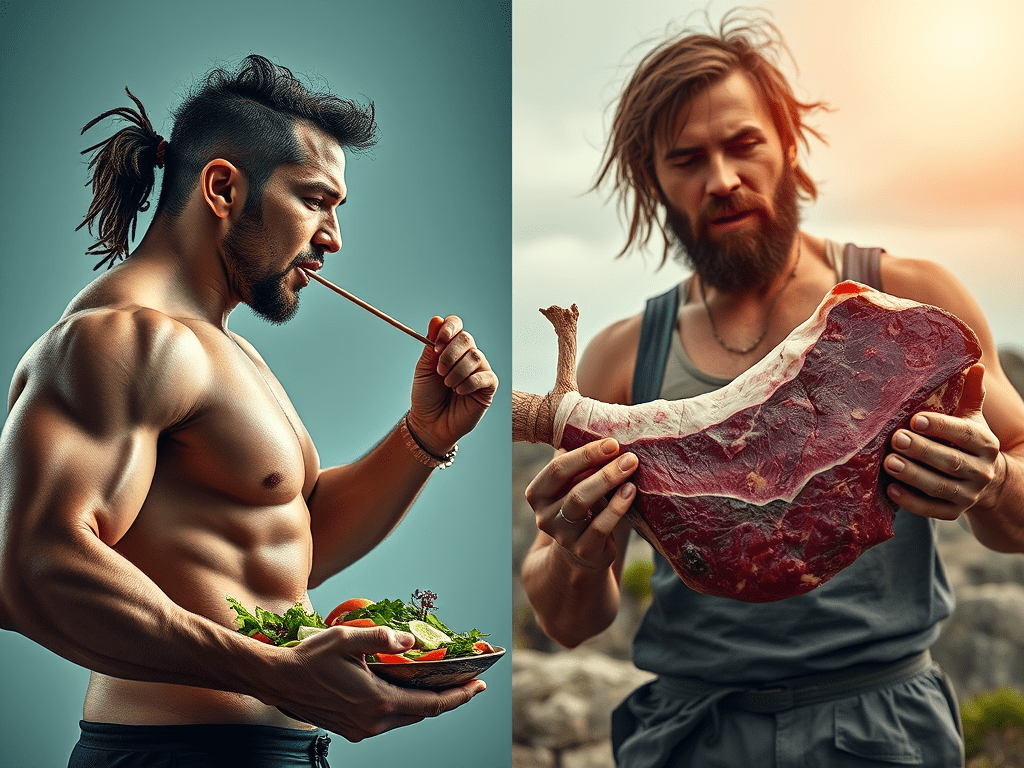
    As a veteran of the appetite wars, I’ve heard dispatches from the front lines: fellow travelers claiming victory over hunger by going full carnivore. Their gospel? Two sacred meals a day—meat, eggs, cheese—and a strict excommunication of carbs, 30 grams max. They say this is the only way to stay lean, full, and sane. And for a time, I believe them.

    I could probably ride that high-fat, low-carb wave for three or four months. Then, inevitably, my gag reflex would revolt. There’s only so much sizzling animal fat you can pretend is delicious before your tongue files for emancipation. And while this diet drops weight like a bad habit, I can’t shake the sense that my arteries are whispering, “This is a trap.”

    Then there’s the ethical hangover. Do I really want my health tethered to a parade of livestock? Relying on bacon and beef to feel okay seems like a nutritional pyramid scheme with a side of cognitive dissonance. I’m not a full-blown vegan—spare me the lectures and turmeric lattes—but I don’t want to be dependent on a barnyard either.

    Enter the Mediterranean diet. It won’t melt belly fat like a grease fire, but it doesn’t ask me to choose between wellness and sanity. I’m talking lentils, Greek yogurt, grilled sardines, a smug little splash of olive oil on everything. It’s a diet that feels lived-in, human, sustainable—not some turbo-charged biohack masquerading as a lifestyle.

    Sure, I’ll lose weight slower. But I’ll do it without gagging on bacon or whispering apologies to farm animals in my dreams. Call it wellness with a conscience—or just survival with dignity.

  • The Shop Foreman of My Own Dysfunction and Other Life Chapters

    The Shop Foreman of My Own Dysfunction and Other Life Chapters

    At 63, I now divide my life into chapters—not by achievements or milestones, but by bone density, hormone decay, and the gradual hardening of the frontal cortex. Think of it as an anatomical calendar, where each page curls with protein shakes, pretension, and the occasional existential crisis.

    Chapter One: The Barbara Eden Years.
    Childhood wasn’t about innocence—it was about Cap’n Crunch. Bowls of it. Oceans of sweetened corn rubble. I dreamed not of firetrucks or baseball cards but of living inside Barbara Eden’s genie bottle—a plush, velvet-lined fever dream of satin pillows and cleavage. If Barbara Eden wasn’t beaming into my imagination, there was always Raquel Welch in fur bikinis or Barbara Hershey smoldering her way across a screen. This was hormonal awakening served with a side of sugar coma.

    Chapter Two: The Strength Delusion.
    By twelve, I was slamming Bob Hoffman’s bulk-up protein like it was communion wine. At Earl Warren Junior High, I became a Junior Olympic Weightlifter—a gladiator-in-training who wanted pecs like dinner plates and the gravitas of a Marvel origin story. This was the age of iron worship and adolescent mythology: I wasn’t building muscle—I was forging armor.

    Chapter Three: The Intellectual Flex.
    In my late teens, I realized I had all the social charm of a wet gym sock. So I went cerebral. I buried myself in Kafka, Nabokov, and classical piano, amassing a CD library of Beethoven and Chopin that could rival the Library of Congress. I worked in a wine shop where I learned to pronounce “Bordeaux” with a nasal twang and described Chablis as “crisp with notes of existential regret.” I didn’t just want to be smart—I wanted to be the human embodiment of a New Yorker cartoon.

    Chapter Four: The Shop Foreman of My Own Dysfunction.
    Marriage and employment hit like a cold bucket of reality. Suddenly, I had to function around other human beings. My inner demons—once delightfully antisocial—were now liabilities. I had to manage them like a foreman supervising a warehouse of unruly toddlers armed with crowbars. Turns out, no one wants to be married to a psychological landfill. I had to self-regulate. I had to evolve. This wasn’t personal growth; it was preventative maintenance, or what other people simply call adulthood.

    Chapter Five: Diver Cosplay.
    In my forties, I had just enough disposable income and suburban ennui to start collecting dive watches. Not just one or two. A flotilla. I wanted to be the hero of my own fantasy—a rugged diver-explorer-adventurer who braved Costco parking lots with a Seiko strapped to his wrist. This was less about telling time and more about clinging to the idea that I was still dangerous, or at least interesting. Spoiler: I was neither.

    Chapter Six: The Age of Denial and Delusion.
    These days, the watches still gleam, but now I’m staring down the barrel of cholesterol, visceral fat, and the slow betrayal of my joints. I swing kettlebells five days a week like a garage-dwelling warlock trying to ward off decay. I track my protein like a Wall Street analyst and greet each new biomarker like a hostile corporate audit. Am I aging gracefully? Hardly. I’m white-knuckling my way through geriatric resistance and calling it “wellness.” If I’m Adonis, then somewhere in the attic there’s a Dorian Gray portrait of my pancreas in open revolt.

    I know what’s coming: Chapter Seven. The reckoning. The spiritual compost heap where I either make peace with my body’s betrayal or turn into a bitter relic that grunts through foam-rolling sessions like it’s trench warfare. It’ll be the chapter where I either ascend or unravel—or both.

    And while our chapters differ in flavor, I suspect we’re all reading from the same book. Different fonts, same plot twist: we start with fantasies, build identities, fight the entropy, and eventually, we all kneel before the mirror and ask, “Was that it?

  • Kafka, Not Clenbuterol

    Kafka, Not Clenbuterol

    I’ve never quite gotten over the deaths of the Mentzer brothers—Mike and Ray—whose obsession with perfection and reliance on steroids ultimately hastened their exit. Their physiques were statuesque, yes, but their lives were carved short. That’s the part that lingers.

    I admire Mike Israetel—he’s brilliant, transparent, and still juiced, albeit at what he calls a “low dose.” He concedes he may shave a decade or more off his life for it. That trade-off sticks with me. It’s a Faustian bargain that never appealed to me, even back in the 70s when the bodybuilding bug bit hard. I was tempted to go all in—steroids, competitions, the works—but I veered. I went to college. I fell for Kafka instead of clenbuterol, and bodybuilding became a passion, not a profession.

    And you know what? That’s been enough.

    I never needed steroids to love the grind. The clang of plates, the satisfying fatigue of a well-earned pump—that’s always been sacred to me. It’s a kind of meditation with weight. No enhancement necessary.

    These days, my goal is simple: keep the protein high and the calories hovering just above the edge of a deficit. Lean enough to see the muscle I’ve built, not buried in fluff. I’m not after mass for mass’s sake—I’ve seen that movie, and the ending isn’t great. I’d rather stay lean and defined than bloated and breathless.

    This isn’t about vanity. I just want to see what’s been built underneath, after fifty years under the bar.

  • Biceps and Biohazards: A Life on Nutritional Alert

    Biceps and Biohazards: A Life on Nutritional Alert

    I’ve been a bodybuilder most of my life. At 63, my muscles still bulge like I’m auditioning for a special forces propaganda reel—but even that doesn’t exempt me from the quiet humiliation of mortality. Lately, I’ve been staring into the abyss not with dread, but with diagnostics. My blood pressure, triglycerides, cholesterol—these numbers have become my new Greek chorus, whispering prophecies of heart disease, kidney failure, and other charming ways the body stages its final betrayal.

    I want to live long. I want to be healthy. I want to be around for my family, not just as a protein-shake-fueled statue, but as someone present, alert, alive. And so I try to eat right. I try to live clean. But in doing so, I’ve become a man who spends his days mentally auditing every almond. I walk through my own kitchen like it’s a minefield, knowing one wrong step—say, a 700-calorie bowl of Shredded Wheat with berries and walnuts—might plunge me into the void.

    This is what vigilance looks like now: standing in front of the fridge at 8 p.m., debating whether two Medjool dates and a dollop of whole milk Greek yogurt is self-care or self-destruction. I’ve got a body that could still turn heads at a funeral, and yet I’m haunted by the nutritional content of a single ounce of bourbon, as if one sip will hurl me into a Roman orgy.

    And so I ask myself: Is this it? Is a healthy life supposed to feel like I’m forever balancing on a dietary razor wire, eyes scanning for invisible enemies made of saturated fat?

    Where’s the joy in this script? Where’s the wonder, the enchantment, the spontaneity that’s supposed to come with vitality? Am I prolonging life or merely stretching the anxiety?

    These are the questions I ask while chewing a forkful of salmon and silently longing for a croissant. Yes, I want to live longer—but must I do it while fearing the yogurt that is staring at me from the refrigerator?

  • Tantalus in a Tupperware World

    Tantalus in a Tupperware World

    Thirty days into The Protein’s Progress—my arduous pilgrimage through the inferno of fat, the purgatory of portion control, and the promised land of protein—I’ve shed fifteen pounds of penance. I’ve grown oddly fond of the hollow pang of an empty stomach. Where once it sparked anxiety and triggered fridge raids at midnight, now it whispers virtue, discipline, even moral superiority. Hunger has gone from demon to deity. I feel like a monk in compression shorts.

    And yet, for all my newfound mastery over grilled chicken and self-denial, I find myself teetering on the edge—not from hunger, but from the cognitive bandwidth this quest consumes. Every bite is a decision tree. Every family gathering is a psychological gauntlet. A cousin’s lasagna or a plate of molasses-drenched cornbread can send me spiraling like Tantalus in a food court. I’m not just resisting cravings; I’m playing calorie Tetris with the dread of a man trying to maintain sainthood at a Vegas buffet.

    Yes, I can be healthy. Yes, I can punish the Airdyne Misery Machine and swing kettlebells like a Spartan with midlife angst. But I grow skeptical. Can any lifestyle that requires this much mental gymnastics and dietary dread be sustainable? Can you truly thrive if your thoughts are forever circling grams of protein and the algebra of dinner?

    They say a healthy life is a happy one. But if every meal feels like a theological debate between virtue and vice, then what I need isn’t another chicken breast—I need a guide, a Guru, a Sherpa of Self-Control to keep me trudging along the True Path. Because right now, the view from this narrow road looks bleak, and I’m haunted by the scent of cinnamon rolls wafting in from the roadside.