Category: Health and Fitness

  • The Temu-ization of Everything—Again

    The Temu-ization of Everything—Again

    I’m reading Cory Doctorow’s freshly minted Enshittification. Early on, he revisits Facebook circa 2010: the honey pot that lured billions before curdling into a slurry of compulsion loops, conspiracy gristle, and industrial-scale data mining. It’s sharp, it’s punchy—and it gave me déjà vu. Then my stomach dropped: I like the coinage, I like the thesis that we’re living through the Enshittocene, but the insights feel old. Jaron Lanier mapped a lot of this terrain eight years ago in Ten Arguments for Deleting Your Social Media Accounts Right Now, a book I’ve taught over the last seven years.

    Doctorow’s Amazon chapter triggers the same shrug. The platform seduces us with convenience, tightens its talons, and gradually morphs from glossy marketplace into Temu-adjacent bazaar. True, and thoroughly litigated across a thousand essays and think pieces. We’ve been warned about the house always winning; we don’t need another tour of the casino floor.

    What I wanted—and didn’t get—was a deeper dive into the anthropology of the rot. Black Mirror’s “Nosedive” or “Joan Is Awful” doesn’t just wag a finger at platforms; it autopsies the psyche and the systems. New Yorker writer Kyle Chayka nails the gap: Enshittification is “pointed and efficient,” but reads like “professional blogging extended for three-hundred-plus pages,” leaving you hungry for a larger cultural x-ray that goes beyond the usual suspects.

    To be fair, packaging a messy discourse into one memorable term matters; not everyone read Lanier or binged Brooker. Doctorow’s snark has its uses. A clean label can move an idea from seminar rooms to dinner tables. But once you’ve named the disease, the next move isn’t to repeat symptoms; it’s to map vectors, power centers, and countermeasures with fresh cases outside the Big Tech pentagon.

    So yes: I love the word. But the book left me underwhelmed. Doctorow has given us the bumper sticker; I’m still waiting for the field manual. The Enshittocene doesn’t need another catalog of platform sins—it needs a blueprint that shows how to break the flywheels, where policy and design can bite, and why our appetites keep refilling the trough. Name the era, sure. Now show us how to survive it—and, if we’re lucky, how to end it.

  • State of the Misalignment Situation

    State of the Misalignment Situation

    I had hoped my blog, Cinemorphosis, would feed my video essays—serve as a compost heap of half-baked thoughts that could later bloom into something cinematic and worthy of making video essays. Instead, the blog has swallowed the energy that once went into my videos. What was meant to be a support system has become a rival ecosystem. The crossover I imagined—the blog fueling the videos and the videos enriching the blog—never happened. It turns out writing and filming come from different parts of the brain, and those parts refuse to share the same neural conference room.

    Friends say, “Don’t sweat it, McMahon. Just lean into the blog and let the videos go.” Easy advice for people who aren’t haunted by the specter of irrelevance. I can’t shake the feeling that the video essays keep me sharper—more visible, more alive. The blog satisfies my mind; the camera keeps me from turning into dust.

    Sam Harris once said he can spend five years writing a book, agonizing over edits and the publishing gauntlet, only to reach a few thousand readers—if he’s lucky. Meanwhile, a one-hour podcast can reach millions overnight, and snippets of it go viral before the author’s espresso cools. That line haunts me. The medium matters. The way we reach people has become part of the message.

    I see the same logic in my own small way. A blog post I’m proud of might earn a few dozen engagements. A decent video essay? Thousands of views, maybe more. But numbers only tell part of the story. The real draw is the vitality the videos demand—something performative, almost athletic. When I’m on camera, I feel like I’m “getting my reps in,” keeping mentally limber. The blog is therapy; the videos are training.

    Still, there’s a fine line between vitality and vanity. Part of me believes the videos keep me youthful, engaged, even relevant. Another part suspects it’s all just a resistance workout against mortality. Staying fit is one thing; refusing to age gracefully is another. Desperation doesn’t wear well on men over sixty, even under good lighting.

    So maybe writing suits me better now. Maybe the written word is the right pace for a man learning to accept that his eyesight, patience, and tech literacy are all in slow retreat. Maybe I should only return to video when I have something worth saying—something that isn’t just a performance of endurance.

    Which brings me to the real question: what do I still have to contribute?

    For over a decade, my YouTube channel orbited around my watch obsession. That obsession gradually narrowed until it became monastic—just diver watches, all on straps. I convinced myself that a collection larger than seven would doom me to spiritual ruin. I also stopped flipping watches like a Wall Street day trader, deciding it was bad for my mental health. That slowdown siphoned the manic energy that used to fuel my videos. The creative rush didn’t vanish—it simply rerouted into blog posts about my newest fixation: alignment. Or more precisely, misalignment.

    Because if I’m honest, I feel increasingly out of sync with the modern world. I adapt to new technology at the pace of continental drift. TikTok bewilders me. Smartphones offend my thumbs. Driving at night now feels like a scene from Apocalypse Now. My relevance, visibility, and patience are fading in a culture that worships youth and touchscreens.

    My anxieties about self-worth and mortality are now on the front burner, while watch collecting—the “Watch Potency Principle,” the “wrist-rotation anxiety”—has been moved to the back burner where it is simmering to a lukewarm stew.

    To illustrate my current state: two weeks ago, I bought a new LG OLED TV, which was fine—until I broke two Samsungs in one day trying to move them. I manhandled the first 55-inch like it was a kettlebell, frying half its pixels in a single jerk. Then I jammed my thumb straight through the second screen while relocating it from my daughter’s room. My wife, the household adult, had to carry the new Roku replacement into our bedroom as I stood there looking like a Neanderthal who’d just discovered electricity—and promptly electrocuted himself.

    My war with technology didn’t end there. The new garage door opener came with instructions written in a dialect of cruel mockery. The installer vanished without explaining how to sync it with my phone, so my wife once again had to step in and figure it out. Now I open the garage door through an app, and every time I hear the alert that the door is moving, I step back in awe—half-terrified, half-mesmerized—like a caveman who’s just invented fire.

    I feel both too old for this world and too infantile to function in it. A man-baby marveling at his gadgets, bewildered by his own house. Think about that. My house has become a museum for technology of the future while I wander through it like a mesmerized tourist. My mouth is agape and my daughters say to me, “Relax, Dad, this is our house.” I respond by saying, “No it’s not. It’s a museum of strange and wonderful things that I don’t know how to use.” 

    These are the moments that give me content for my blog Cinemorphosis. I post almost daily, while it takes me weeks to metabolize these experiences into something coherent enough for a video essay. Writing helps me think; filming helps me pretend I’m still current.

    So that’s my current state of affairs. This channel used to be State of the Watch Collection. Now it’s more like State of the Man Who Can’t Sync His Garage Door Opener.

  • The Eight Ages of –ification

    The Eight Ages of –ification

    From Conformification to Enshittification: how every decade found a fresh way to ruin itself.


    The Age of Decline, Accelerated

    In Enshittification, Cory Doctorow argues that our decline isn’t gradual—it’s accelerating. Everything is turning to crap simultaneously, like civilization performing a synchronized swan dive into the sewer.

    The book’s subtitle, Why Everything Suddenly Got Worse and What to Do About It, suggests that degradation is now both universal and, somehow, fixable.

    Doctorow isn’t the first prophet to glimpse the digital abyss. Jaron Lanier, Jonathan Haidt, and other cultural Cassandras have long warned about the stupidification that comes from living inside the algorithmic aquarium. We swim in the same recycled sludge of dopamine and outrage, growing ever duller while congratulating ourselves on being “connected.”

    This numbness—the ethical anesthesia of the online age—makes us tolerate more crappiness from our corporate overlords. As the platforms enshittify, we invent our own little coping rituals. Some of us chant words with –ion suffixes as if they were incantations, linguistic ASMR to soothe our digital despair.

    When I saw Ozempic and ChatGPT promising frictionless perfection—weight loss without effort, prose without struggle—I coined Ozempification: the blissful surrender of self-agency to the cult of convenience.

    Now there’s an entire liturgy of –ifications, each describing a new layer of rot:


    • Enshittification — Doctorow’s coinage for the systematic decay of platforms that once worked.
    • Crapification / Encrappification — The transformation of quality into garbage in the name of efficiency.
    • Gamification — Turning life into a perpetual contest of meaningless points and dopamine rewards.
    • Attentionification — Reducing every act of expression to a plea for clicks.
    • Misinformationfication — When truth becomes a casualty of virality.
    • Ozempification — Replacing effort with optimization until we resemble our own avatars.
    • Stupidification — The great numbing: scrolling ourselves into idiocy while our neurons beg for mercy.

    But the crown jewel of this lexicon remains Enshittification—Doctorow’s diagnosis so precise that the American Dialect Society crowned it Word of the Year for 2023.

    Still, I’d like to push back on Doctorow’s suggestion that our current malaise is unique. Yes, technology accelerates decay, but each era has had its own pathology—its signature form of cultural rot. We’ve been creatively self-destructing for decades.

    So, let’s place Enshittification in historical context. Behold The Eight Ages of –ification: a timeline of civilization’s greatest hits in decline.


    1950s — Conformification

    The age of white fences and beige minds. America sold sameness as safety. Individuality was ironed flat, and television became the nation’s priest. Conformification is the fantasy that security comes from imitation—a tranquilized suburbia of identical dreams in identical ranch homes.


    1960s — Psychedelification

    When rebellion became transcendence through chemistry. Psychedelification was the belief that consciousness expansion could topple empires, if only the colors were bright enough. The result: self-absorption in tie-dye and the illusion that enlightenment could be mass-produced.


    1970s — Lustification

    A Freudian carnival of polyester and pelvic thrusts. From Deep Throat to Studio 54, desire was liberation and the body was both altar and marketplace. Lustification crowned pleasure as the last remaining ideology.


    1980s — Greedification

    When morality was replaced by market share. The decade baptized ambition in champagne and cocaine. Greedification is the conviction that money cleanses sin and that a Rolex can double as a rosary.


    1990s — Ironification

    The decade of smirks. Sincerity was cringe; irony was armor. Ironification made detachment the new intelligence: nothing believed, everything quoted, and feelings outsourced to sarcasm.


    2000s — Digitification

    Humanity uploaded itself. Digitification was the mass migration to the screen—the decade of Facebook envy, email anxiety, and dopamine disguised as connection. We stopped remembering and started refreshing.


    2010s — Influencification

    When everyone became a brand. Influencification turned authenticity into a business model and experience into content. The self became a product to be optimized for engagement.


    2020s — Enshittification

    Doctorow’s masterstroke: the final form of digital decay. Enshittification is what happens when every system optimizes for extraction—when user, worker, and platform all drown in the same algorithmic tar pit. It’s the exhaustion of meaning itself, disguised as progress.


    Epilogue: The 2030s — Reification

    If trends continue, we’ll soon enter Reification: a desperate attempt to make the unreal feel real again. After decades of filters, feeds, and frictionless fakery, we’ll long for something tangible—until, inevitably, we commodify that too.

    History repeats itself—only this time with better Wi-Fi.

  • Caveman Meets Garage App

    Caveman Meets Garage App

    In March 2005, at 43, I was besotted with my Classic iPod and its holy clickwheel. It took a minute to learn how to tether it to desktop iTunes and wrangle my playlists (mostly podcasts), but I did it without pestering my wife, and I was proud. A newer iPod arrived soon after; I refused to learn its tricks. Once I master a gadget, it becomes my comfort zone—I’d rather live there than relocate.

    I listened to podcasts all night and during post-workout naps. My life felt archived in that iPod, which—ridiculously, wonderfully—made me feel plugged into the modern world.
    My wife, less sentimental, declared it obsolete. The future was smartphones. I recoiled. They looked like bricks of chaos—apps, updates, notifications—houseplants with demands, only worse because I had to squint at ant-sized text.

    By 2014, I still clung to the iPod. It wasn’t cheap loyalty: the headphone jack snapped about once a year, and I’d pay $70 at the local shop to resurrect it. Then September 2014 arrived, our twin daughters started preschool, and my wife insisted I get a smartphone—for school runs, doctor visits, playdates. Texting was essential; parenthood demanded it.

    So I pried my fingers off the fossil and bought a Galaxy S4 at Costco. To my surprise, downloading podcasts was blissfully easy. As a podcast machine, the phone was a star. Everything else? Lame. I hated watching tiny videos, reading tiny text, and spelunking for apps. The phone became a super-iPod; the rest of its features were just extra chaos. Texting was torture—my fat fingers whacked the wrong letters, and I backspaced my way through tedium. I barely used the thing except for podcasts. My wife envied my perpetually 90% battery; to console her, I’d brag that after an all-night podcast binge I dropped to a shocking 80%.

    Yes, smartphones are addiction machines that track, nudge, and strip privacy. True. But I only use a sliver of their powers because the tactile experience annoys me.

    Part of me resents the smartphone for killing the rotary landline. That dial’s ratcheting click felt like reciting a secret code to open a cave. Beige, avocado, mint green, custard—those phones had heft that implied quality, with long, flexible cords that snaked across the room. Conversations were events; an ear would grow tender and force the ritual mid-call ear swap. Now the landline is dead—and so, largely, are conversations, replaced by texts and emojis. Speed and convenience exacted their toll: degraded communication, which means degraded friendships.

    Cory Doctorow gave us enshittification—how tech optimizes itself into garbage. I’d love to say that’s why I resist. But that’s too pat. I’m simply slow to adapt. Incompetent with new tools. My memory refuses the steps; I have to re-teach myself, again and again.

    Recently, my wife synced my phone to our garage door. A week later, I tapped the app and watched the door rise, gawking like a caveman who just discovered fire and is already imagining a barbecued brontosaurus rack. It’s a good trick. I still keep Genie remotes in the house and car as backups, but the phone option is lovely. This isn’t enshittification; it’s the opposite—unsuckification. Some things that used to suck don’t have to anymore.

    In fact, I’m eager for toilet + AI matrimony: a throne that reads biomarkers, prescribes medication, screens like a colonoscopy, and spares me the waiting room. I’m also rooting for a custom GLP-1 patch that recalibrates appetite so a morning bowl of porridge with protein powder—and another in the late afternoon—actually sates me. Easy weight management, better markers, minimal dishes.

    All of this is part of the unsuckification project.

    I’ll admit it: I’m older, I resist change, and new tech gives me a headache. But if modern tech can spare me a colonoscopy, open heart surgery, and the indignities of being twenty pounds overweight, then sign me up. 

  • Comparison Is the Mother of Misery

    Comparison Is the Mother of Misery

    The mother of misery is comparison. In fourth grade I plunged into despair because I couldn’t draw like Joseph Schidelman, the illustrator of Charlie and the Chocolate Factory. About the same time, baseball humbled me: my bat speed wasn’t in the same galaxy as Willie Mays, Dick Allen, or Henry Aaron. In my teenage bodybuilding years, I had muscles, but nothing like that of Arnold Schwarzenegger, Sergio Oliva, and Frank Zane; I wisely retired the fantasy of becoming Mr. Universe and managing a gym in the Bahamas. In college, as an aspiring intellectual, I flogged myself for lacking Vladimir Nabokov’s wit and velocity. My chances of becoming a famous novelist were equal to my odds of winning Mr. Olympia. Later, when I flirted with composing and singing, I heard Jeff Buckley’s soul pour through the speakers and realized my voice would mainly trigger a neighborhood dog-barking contest and a chorus of angry neighbors. Decades passed. My classroom persona faced a generation handcuffed to smartphones and ChatGPT. I scrambled for “edutainment” tricks to dodge irrelevance, but the gap widened no matter how I danced.

    The sting doubled when I watched Earthquake (Nathaniel Stroman) flatten an audience with a preacher’s cadence and bulletproof wisdom. His special Joke Telling Business left me muttering, “If I had Earthquake’s power, I could resuscitate my teaching career and stroll into old age with a shred of dignity.”

    Meanwhile, fresh incompetencies arrived like junk mail. I broke two Samsung TVs in one day. I failed to sync my new garage door opener to my phone. My wife had to rescue me from my own maladroit tech spiral. The result was predictable: I was condemned to the Shame Dungeon.

    Down in the basement of depression, I noticed another casualty: my YouTube channel. I usually post once a week and have for over a decade—mostly about my obsession with diver watches. But as sanity demanded I stop flipping watches, I ran out of new divers to discuss. I tried pivoting—open with a little watch talk, then segue to a wry misadventure with a morsel of human insight. If I nailed the landing, I’d get a few thousand views and enough comment energy to believe the enterprise mattered.

    But with my sixty-fourth birthday closing in, the doubts got loud. I don’t want to do “watch talk,” and I’m too mortified to perform a perky, self-deprecating monologue about my misalignment with the universe.

    I keep hearing Mike Birbiglia in my head: you must process your material before you present it; the set has to be a gift, not your live catharsis. The healing happens before you step onstage. You speak from the far shore, not mid-drowning. Otherwise, you’re asking the audience to be your therapist.

    So I’m stuck at a fork: Will this current fear and anxiety about age and disconnection pass through the refinery of my psyche and emerge as something worthy? Or will I remain in the Shame Dungeon, comparing myself to Earthquake, and decide that with talent like his prowling the earth, my best move is to hide under a rock?

    Here’s the dilemma plain: Hiding isn’t viable; it starves the soul. But serving the world a plate of unprocessed mediocrity is just as unforgivable. If I’m going to tell a story about breaking two TVs and my garage-opener meltdown, I have to deliver it with Earthquake’s power and confidence. Otherwise I’ll stay home, mope on the couch, and binge crime documentaries—losing myself in bigger, cleaner tragedies than my own.

  • Eternal Embarrassment

    Eternal Embarrassment

    Nietzsche imagined hell as reliving your life on loop—eternal recurrence. A demon forces you to endure every joy and misery again. Let’s revise the experiment: not your whole life, just the embarrassing parts on repeat. Eternal embarrassment. If that isn’t the full biography, it’s certainly old age. You no longer fit the world. Your butt shrinks; belts stop doing their job. Cheeks sag. Your neck goes a little fleshy. Your interior vocal editor—never stellar—finally quits, so you talk more than anyone asked for, mostly about how cold you are and how the TV volume is too low. You’ve slowed down, and the world—amped on Red Bull—won’t wait.

    In two weeks, I broke two Samsung TVs, failed to sync my phone with the new garage-door opener, threw an infantile tantrum, and my wife had to bail me out. She could have gone full prosecution; instead, her annoyance was tempered by pity. She saw me trying—earnest home-improvement flailing—and, when I stumbled, she picked up the pieces. I was left embarrassed and nursing a small crisis of confidence.

    So I went hunting for redemption. My family had been grumbling about dinners. Thursday’s Caesar-with-chicken-skewers had overstayed its welcome; they wanted better lunch ingredients—better bread, meats, cheese, and more interesting condiments. As the designated Saturday Trader Joe’s runner, I sat at my computer, family gathered around, actually listened, and updated the list like I was drafting a treaty.

    Next morning—Saturday—I launched my ritual at Hawthorne and Del Amo, a tradition I’ve upheld with the zeal of a cultist for twenty-two years. Grocery shopping isn’t a chore; it’s a military operation. My $350 haul is executed with Navy SEAL precision. Delays, obstacles, small talk? Enemies of efficiency. Armed with the evolving list, I dart through aisles like I’m on Supermarket Sweep, a stopwatch ticking in my skull. 

    That morning, I stepped out of my gunmetal gray Honda, I caught a reflection in the store window—an angle so unforgiving it announced, We’ve had one too many second helpings. I looked away. Denial is cheaper than therapy. In my mind I’m a sleek, youthful me—190 pounds of toned potential, not the spectacle of a 225-pound man auditioning for the Dad-Bod Calendar.

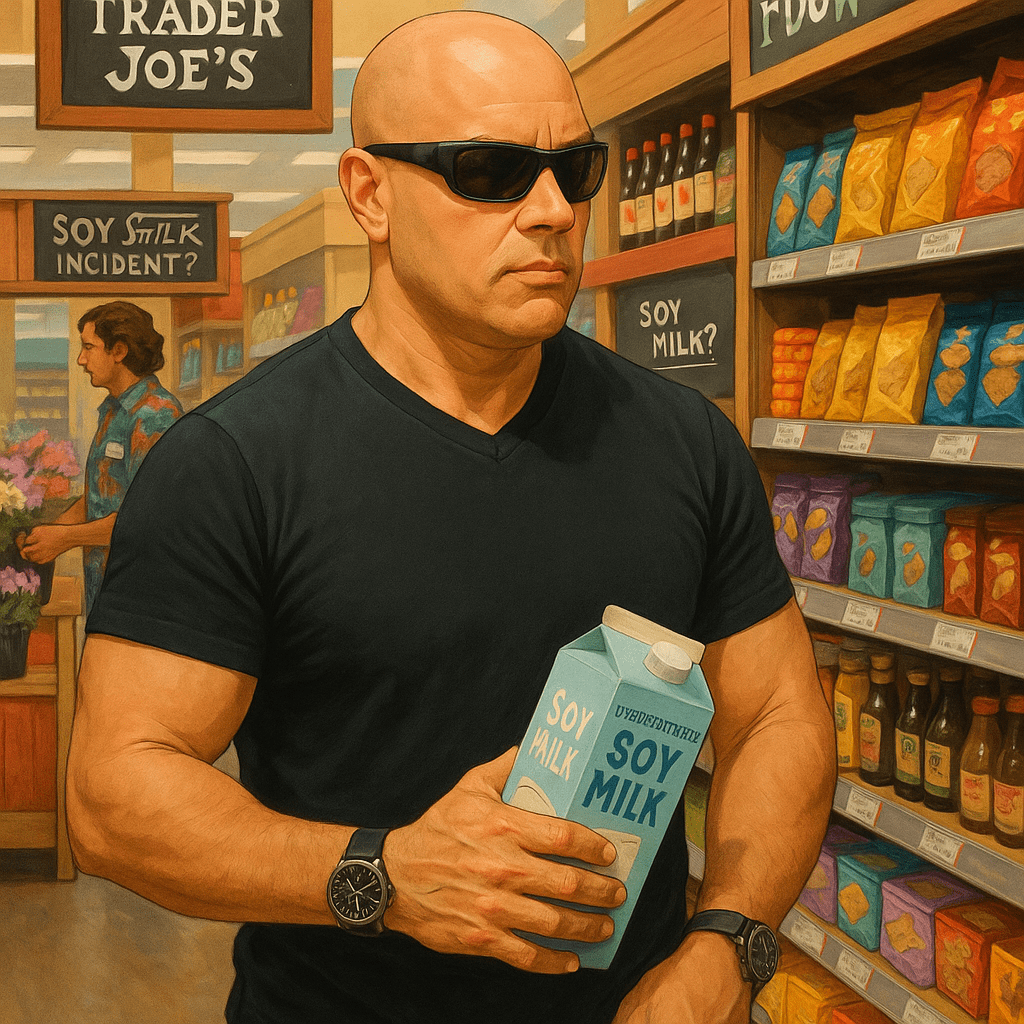
    Inside, my confidence was restored. The staff knows me; they greet me with the friendly heckling reserved for clockwork regulars. If I show up off-schedule, they act like I’ve survived a plane crash. One cheeky clerk calls me the “Larry Csonka of Trader Joe’s.” I play along: “There’s been a Larry Csonka sighting in aisle five.” The rapport was golden—until The Incident. The shelf was barren of unsweetened soy milk—the only plant milk with actual protein. I spotted Mary, the assistant manager, stocking canned goods. I asked, politely, if there was soy milk in the back. She said she’d check, then resumed stacking cans like bullion. Assuming she’d forgotten, I quietly asked another employee to check. Fatal misstep.

    By the time I looped back with bread and pastries, Mary had stocked the soy milk—and wore a look that said I’d insulted her canned-goods ethics. In that instant, I crossed the border from beloved regular to pushy customer. Two decades of goodwill, spilled across the linoleum for a stupid carton of soy. If I could time-travel, I’d go home and order a case of Edensoy on Amazon. Once, I entered like Larry Csonka at a Super Bowl parade; now I skulked, head low, list clutched like a last shred of dignity.

    Trader Joe’s was supposed to be my safe space, but I botched it—just like the “simple” garage-door purchase. Simple things kept flowering into fiascos. I was busy processing shame and embarrassment when Nietzsche drifted back in: eternal recurrence. Except my condition was worse. Who needs to replay old humiliations when fresh ones keep arriving on the conveyor belt?

  • The Farmer’s Carry and Other Acts of Old-Age Desperation

    The Farmer’s Carry and Other Acts of Old-Age Desperation

    In July of 2025, I had dinner at The Kebab Shop with an old friend—a former boxing champion turned engineer, the kind of guy who looks like he could build a bridge in the morning and break your nose that afternoon, all while discussing Tolstoy.

    He is a former student, thirty years younger than I am, and at a completely different phase in his life. As we at our kebabs, he told me he had broken up with his girlfriend and confessed something strange and honest:

    “I feel like I’m chasing the sad,” he said. “Just so I’ll feel better about myself.”

    I told him not to worry—sadness would find him, bite him in the ass, and tell him to die. It was just a matter of time. . Sometimes pain is too large to register. Like being so exhausted you can’t fall asleep, or so depleted you can’t even feel tired.
    He nodded, then casually dropped the bomb: he just bought a Lexus. I assumed an SUV—some respectable adult-mobile with storage. Nope. He turned his phone toward me and grinned. It was an obsidian black Lexus RC350 coupe, a low-slung, 311-horsepower statement of rebellion against mediocrity and middle age. Price tag? A cool $70,000.

    Why? Because he gets bored. Easily. He’s cursed with a mind that needs friction. His current job is too easy, and when things get too easy, life feels mechanical. He’s planning to move on—to another job, another city, more challenge, more money, more meaning.
    He told me staying home to watch TV feels like soul rot. So instead, he journals (in a real book, with prompts—who knew that was a thing?), plays soccer on weekends, and takes private dance lessons. Yes, dance. This man has better time management than most monasteries.

    I told him I admire him. I mean it. He’s not surrendering to entropy; he’s interrogating it with pen, ball, and motion. He’s writing his way out of the void. I might need to follow his lead when I retire in two years. No matter our age, we either rage our fists at mortality or we start sinking into the upholstery.

    I then told my friend that I nearly bought a $2,000 recliner last week. A magnificent beast of engineered comfort. But the moment I imagined myself melting into it, day after day, I envisioned not rest—but early burial. A leather sarcophagus with cupholders. I backed away like it was a cursed object.

    I was inspired by my friend’s hunger for adventure, so the next morning I punished myself with a new exercise: the Farmer’s Carry–two kettlebells, one in each hand, pacing in circles across my front lawn like a rogue warlord in gym shorts. Neighbors peeked through their blinds to watch this 63-year-old Larry Csonka doppelgänger lumbering across the grass like I was either training for something… or losing a very public battle with aging.

    I get the sense that my neighbors pity me. Here is a man who can’t let go of his bodybuilding years. He is so desperate he is going to kill himself. I imagine their fingers are poised over their phones, ready to dial 911. 

    The exercise nearly broke me. I’ll keep it in rotation, but with moderation. I train to feel alive, not to hemorrhage my last remaining Life Force into the turf of suburban California.

    And now, I wait for my friend to pull up and take me for a ride in his Lexus. He’s earned it. The man’s been driving the same Corolla for thirteen years. Now it’s his turn to live a little. And me? I’ll tag along, a passenger for a while, enjoying the ride through this strange, accelerating cycle of life.

  • Speedos at Sunset

    Speedos at Sunset

    The New York Times article, titled “Skimpy Men’s Swimming Briefs Are Making a Splash,” offers a solemn dispatch from the front lines of GLP-1 drugs, but I would guess that men—having exhausted every form of visible self-optimization—are now expressing their Ozempic-enabled slenderness via tiny, Lycra-clad declarations of status. We’re talking male bikinis, or what I like to call the ego sling.

    Apparently, if you’re dropping $18,000 a year to chemically suppress your appetite and shed your humanity one subcutaneous injection at a time, you deserve the privilege of looking like a Bond villain’s pool boy. I suppose this is the endgame: pay to waste away, then wrap what’s left in a luxury logoed banana peel.

    Luxury underwear companies, never ones to miss a chance to monetize body dysmorphia, are now marketing these second-skin briefs not as mere swimwear, but as power statements. To wear them is to say: “I’ve defeated fat, joy, modesty, and comfort in one fell swoop.”

    I’m almost 64. My aspirations remain high—ideally, I’d like to look like a special-ops operator on vacation in Sardinia. But I know my place. I wear boxer-style swim trunks, the cloth of the pragmatic and the semi-dignified. They’re not exciting, but neither is seeing a sun-leathered septuagenarian adjust a spandex slingshot over a suspicious tan line.

    There’s a difference between being aspirational and being delusional. The former means striving for vitality, strength, and energy. The latter means stuffing yourself into a satirical undergarment and pretending you’re a twenty-two-year-old wide receiver with a sponsorship deal.

    To my fellow older men: sculpt your body like it’s your spiritual obligation—but when it comes to swim briefs the size of a hotel mint, maybe opt out. Not every part of youth is worth reliving. 

    When I think of old guys clinging to their youth by wearing undersized swim trunks, I often think back to the summer of 2019 when my wife and twin daughters were in Maui and I was treated to one of life’s great grotesques: a compact man in his mid-seventies parading the beach in dark-blue Speedos with a woman young enough to be his granddaughter. She was Mediterranean gorgeous, twenty-something, and clearly imported as the ultimate accessory. He was trim, shaved, strutting across the sand like a hedge-fund satyr who believed that constant motion kept the Grim Reaper wheezing in his wake. He dove into the surf not like a man swimming, but like a man negotiating—bargaining with Time.

    You could smell his wealth before you could smell the salt air. A CEO, no doubt—half his life in boardrooms, the other half clawing at immortality. His creed was Hefner’s: work hard, play harder, and Botox anything that betrays the passage of time. I’m not here to moralize about his May-December arrangement. What fascinated me was the fantasy: money, discipline, and a bit of manscaping as talismans against entropy, as if youth could be distilled into a cologne.

    But the tableau reeked of mismatch—two puzzle pieces jammed together with superglue. Forced smiles, awkward touches: every moment chipped another sliver from the illusion until they looked less like lovers and more like hostages. This was not youth preserved; this was youth taxidermied. His confidence read as terror. His curated life, meant to inspire envy, collapsed into a sad performance—a tuxedo on a traffic cone.

    He reminded me of Joe Ferraro from Netflix’s Mafia: Most Wanted: born in Ecuador in ’62, raised in Toronto, obsessed with bodybuilding, crime, and women. He had it all—the Rolex Daytona, gold chains, sunglasses so huge they had their own weather system. Then came prison and deportation. Now in his sixties, Ferraro is a sculpted parody: sport coat draped like a cape, tight black jeans, hipster boots, eyes full of melancholy. He wants his life back, but he knows the casino is closed. Like the Speedo satyr, Ferraro can’t stop looking back, calcifying into a monument of salt.

    And salt is the right metaphor: Lot’s wife glancing back until she froze mid-regret. Neither Ferraro nor Speedo Man could let go of their “youth identities.” Without them, death feels too close. With them, they look embalmed while still breathing.

    I understand how hard it is to let go of the life you think you deserve. Spend a week in Hawaii, and you step into a parallel universe—Sacred Time. You board a $400-million jet, dehydrate for five hours, and land convinced you’re immortal. Within 24 hours you’re marinating in mai tais, demolishing lilikoi pies, and basking under sunsets scripted by God to flatter your ego. Clocks stop. Deadlines vanish. Sacred Time whispers: Death can’t find you here.

    Which is why leaving Hawaii feels like a cosmic eviction notice. You board the plane and return not just to California but to Profane Time, where bills, emails, and mortality resume their tyranny. For weeks after, you’re sun-drunk and disoriented, still hearing waves in your ears while the neighbor’s leaf blower revs like a dentist drill. Sacred Time is an opiate; reentry is cold turkey.

    Nostalgia is the next fix. For me, it’s the summer of 1977 at Don Castro Swim Lagoon. I was fifteen—half-boy, half-bicep—sunbathing like a pagan sacrifice to the gods of narcissism, The Happy Hooker hidden in my gym bag, my skin baptized in banana-scented cocoa butter. That lagoon was my Eden: the girls in bikinis, the musk of suntan oil, the hormone haze of adolescence. That era hardwired me to believe pleasure was a birthright.

    But nostalgia curdles. Today I’m older, paler, a few Adonis fragments left in the rearview. What once felt like a creed now feels like a rerun of Fantasy Island with bad lighting. The boy in me still demands his sunlit altar, but now he feels like a squatter. Am I still bronzing in Eden—or am I frozen in salt, looking back too long at a self that no longer exists?

    Enter the “Return to the Womb.” Aging produces this primal regression: a desire not just for beaches, but for obliteration of responsibility. For me, it smells like Florida—the state of my birth, equal parts Eden and punchline. Mango air, coconut breezes, sultry rain: a fetal simulation with Wi-Fi. But even I know it’s not vitality; it’s paralysis. It’s not Life Force—it’s brain rot in Tommy Bahama.

    During lockdown, I tasted this desire to return to the womb. Pajamas at noon, Zillow scrolling barrier islands, buckwheat groats as immortality. My body synced with the rhythm of a hot tub. I didn’t want to emerge. I still don’t. Which terrifies me—because Father Time is no cuddly mascot. He’s a cosmic accountant, and he wants receipts. What did you do with your time?

    Meanwhile, I’m bicep-curling nostalgia like it’s protein powder. For five years, I hounded my wife about Florida. She countered with Some Kind of Heaven, the documentary about The Villages. Watching geriatric Parrotheads do water ballet to Neil Sedaka was enough to kill the fantasy. It wasn’t Eden—it was a gulag of shuffleboard and scheduled fun. Leisure not as freedom, but as occupation.

    The film’s standout was Dennis Dean, an octogenarian grifter prowling bingo halls for rich widows. Watching him lie catatonic under a ceiling fan after another failed con, I realized my wife had played me like a Stradivarius. My Florida obsession died in that moment.

    So now I’ve scaled back. No more eternal-Adonis-in-the-tropics delusions. No Speedos. Just a week vacation in Maui or Miami, then back to Profane Time with my Costco protein powder and kettlebells. Still chasing immortality—but with at least a fig leaf of self-awareness.

  • His Last Words: “Too Much Trouble”

    His Last Words: “Too Much Trouble”

    No one wants the following carved into their headstone:
    “He really liked convenience.”
    Or:
    “He really knew how to wind down after a long day.”
    Or the ultimate in mediocrity:
    “He was quite the expert at calmly not answering the door when strangers knocked.”

    Yet I can’t lie—those epitaphs could summarize me with cruel efficiency. I should be ashamed. If the highlight reel of my life is craving convenience and dodging conflict, then I’m a sloth, a coward, and a comfort-zone junkie. Guilty as charged.

    Of course, apologists for my particular brand of laziness will insist there’s wisdom in centering life on convenience: you save time, conserve resources, and maximize efficiency. But let’s not kid ourselves. “Optimization” is just a euphemism for avoiding reality. And then come the even shinier euphemisms: “life hacks.” If all you’ve done is engineer a way to dodge effort, that’s not a hack—it’s a confession.

    Not that every convenience is unworthy. I won’t step foot in a gym: too expensive, too crowded, too germy, and far too drenched in bad pop music. I prefer my garage—cheap iron, good podcasts, and zero chance of catching COVID off the lat pulldown machine. That’s not clever; it’s survival.

    Same with my diet: when I’m home alone, dinner is steel-cut oats or buckwheat groats with protein powder and soy milk. It’s not innovation; it’s five minutes of apathy in a bowl. To call it a “hack” would be grandiose.

    The pandemic hardened this streak. Three-fourths of my classes went online in 2020, and they’ve never returned to campus. Everything lives on Canvas now. I barely drive 3,000 miles a year. Efficiency became narcotic. Once you’ve tasted it, going back to inefficiency feels like shoving rocks in your shoes for nostalgia’s sake.

    Even my piano habit has become infected. Cecil, my seventy-eight-year-old tuner, has warned me: when he’s gone, so is my piano’s soul. Skilled tuners are rare. My solution? Buy an electric keyboard. Sure, the sound won’t have the magical sound of my acoustic Yamaha, but it’ll move easily from room to room and never need Cecil. Convenience conquers music too.

    I’m also a poor excuse for a parent in the Uber era. Driving my teen daughters to football games, birthday parties, and amusement parks feels like sacrilege to my convenience creed. Honestly, if I were truly committed to convenience, I never would’ve had children. Or cats. Litter boxes, flea treatments, vet visits—each one an affront to my principles of time-saving and efficiency.

    Convenience can metastasize into pathology. Violations of my “policies” breed resentment. Aging itself infuriates me because it’s inconvenient. Doctor appointments and funerals snarl my schedule. Death doesn’t just terrify; it inconveniences.

    Routine is the bride to the groom of convenience, and together they dominate. 

    Even my relationship to religion is seen through the lens of convenience. I wish I could slam the door on doubt and join the ranks of militant atheists—or zealous believers. Either extreme would be neat, clean, convenient. Instead, I’m stuck in agnostic purgatory, forced to read philosopher Elizabeth Anderson’s critiques of scripture, Saint Paul, and every thinker in between. Anderson reduces morality to evolution; Paul calls us fractured, fallen souls, a mirror I dislike but recognize. I want a bow on the present of certainty, but instead, I get the knot of doubt.

    Jesus, of course, preached a gospel of uncompromising inconvenience. His very life was a rebuke to comfort. Following him means picking up a cross, not a La-Z-Boy. For disciples of the gospel of ease, his way is impossible—requiring nothing less than a Damascus-level conversion to set a new course.

    When I think of convenience, I think of Chris Grossman, my co-worker at a Berkeley wine shop in the 1980s. He was the store’s golden boy—popular with customers, armed with quick wit and easy charm—and utterly allergic to human entanglements. Girlfriends, he explained, weren’t worth the trouble. Not because of their flaws, but because the whole enterprise of romance reeked of inconvenience: compromise, obligation, scheduling. He lived alone, ate the same meals on repeat, and once a year drove his Triumph to Carmel for a car show. I adored him. He was my kind: a fellow monk in the Church of Convenience.

    Some of us are more diseased than others, and the infection corrodes standards. I loathe factory farming, dream of veganism, but recoil at the social cost. Every vegan I’ve spoken with admits the hardest part isn’t the kale; it’s the cold shoulder. I already wear the family badge of black sheep. If I imposed tofu bakes on my wife and daughters, I’d be ostracized. They want meat; I want peace. When I mention plant-based dinners, they shoot me a side-eye sharp enough to slice seitan. Push it further, and I can see my tenuous connection with them unravel thread by thread until exile is complete. And clawing my way back into their good graces would be the most inconvenient penance imaginable.

    I’m already a neurotic who alienates people more often than I’d like. Rebuilding broken ties is grueling work—humiliating, exhausting, inconvenient. So I stay walled up in my fortress of convenience, half-proud, half-ashamed, imagining my epitaph chiseled in granite: He preferred the easy way.

  • Boomer Samsung in a Gen Z OLED World

    Boomer Samsung in a Gen Z OLED World

    Two months shy of sixty-four in August of 2025, I found myself on the 405 heading north, fantasizing about writing a book on life’s last trimester. My wife (still spry at fifty), one twin daughter, and I were crawling toward Studio City for cousin Pete’s seventy-fifth birthday. Around Westwood, the freeway collapsed into one lane of misery thanks to a construction project that looked like it was engineered by Dante himself. A trip that should have been forty-five minutes mutated into a two-hour festival of fumes and despair. Traffic isn’t just exhausting—it’s the nihilist’s victory parade, proof that “progress” and “civilization” are marketing scams.

    By the time we arrived, Pete’s lush estate felt less like Studio City and more like Sherwood Forest with valet parking. He asked how I was doing. I told him I needed a “405 Traffic Therapist” to exorcise the demons of my commute. Was there a triage tent with a cot so I could convalesce for a couple of hours and then join the party refreshed?

    The party teemed with cousins and their friends, ninety percent of them over seventy, including the Beatles-and-Stones cover band. I admired them: financially secure but not pompous, health-conscious without being kale cultists, capable of joy in ways I’ve never mastered. When twilight came—salmon sky, ninety degrees—they stripped down and leapt into the pool like aging dolphins, while I swatted mosquitoes and sulked in long pants.

    Later, in the spacious backyard beneath the canopies, I sat with a plate of hummus, feta, figs, and baba ghanoush and talked with Jim, my cousin Diane’s husband—a seventy-eight-year-old retired ophthalmologist.

    He complimented my kettlebell regimen, and I confessed the truth: early bedtimes, bladder-draining night patrols, and terror of driving after dark. He leaned in, lowered his voice, and delivered the line that should be etched on my tombstone: “The hardest part of aging is becoming invisible. You still take up space, but people’s eyes skip over you, as if you’re furniture.” 

    I countered that invisibility was merciful compared to the greater horror: we are annoying relics in a world sprinting at 5G speed. Father Time has us hardwired for lag. You can swallow kale and swing iron all you want, but in the end, you’re a Samsung with a dying processor.

    I bit into a fig, dribbled juice onto my shirt, and told Jim about my actual Samsung QLED. Four years old, picture fine, processor a fossil—menus freeze, apps load slower than a Pentium II. Samsung skimped on the chip. My fix? Upgrade to an LG OLED with a 4K AI processor that doesn’t choke when I click Netflix. The irony was obvious: I scorn Samsung for its lag while lumbering through life as a laggy processor myself. My thirty-something colleagues update effortlessly; I freeze, buffer, and curse the interface. I’m a Boomer Samsung in a Gen Z OLED world.

    Jim tried to comfort me—“You’re still funny, the students must love you”—but I waved him off. Nature documentaries have already written my script: Scar the lion rules until the young challenger rips him down, and then Scar limps off, invisible, licking his wounds. You don’t fight the arc; you nod, maybe crack a joke, then spend five grand on an OLED so you can pretend you still belong in the modern ecosystem. I looked down at the feta crumbs on my lap and muttered, “Did they forget napkins?” Meanwhile, dozens of voices rose from the pool in a raucous “Hey Jude” singalong under a moonlit salmon sky. It was a magical moment, and all I could think about was how I’d forgotten to spray myself with DEET.