Category: Health and Fitness

  • When Distrusting Experts Becomes Its Own Dogma

    When Distrusting Experts Becomes Its Own Dogma

    In his Atlantic essay “Everyone Hates Groupthink. Experts Aren’t Sure It Exists,” David Merritt Johns challenges the reflexive idea that groupthink is always harmful. He notes that Robert F. Kennedy Jr. and the MAHA movement accuse public-health experts of groupthink in order to undermine trust in institutions. Their narrative is familiar: elite scientists misled the public on masks and lockdowns, so now vaccines must be suspect too. But this rebellion against “consensus” doesn’t eliminate groupthink—it simply creates a rival version of it, one driven by conspiracy, resentment, and selective skepticism.

    Johns argues that not all group alignment is created equal. Sometimes consensus forms because experts evaluate evidence and converge on the best available guidance. Other times, conformity produces catastrophic choices. The trick is to distinguish disciplined collaboration from unthinking obedience. Irving Janis gave groupthink its negative reputation as the enemy of independent thought, but scholars like Sally Riggs Fuller and Ramon Alday complicate the picture, noting that what we often label “groupthink” may actually be bureaucratic opportunism—people following political incentives, not blind loyalty.

    The term has since been weaponized. Political commentators now dismiss peer-reviewed science as “groupthink” whenever it clashes with their ideology. Johns argues this is sloppy and dangerous. Blaming pandemic missteps on a mystical force called groupthink distracts from real causes, while assuming “lonethink”—the rebel outsider posture—automatically produces better decisions is equally foolish. Expertise demands rigorous debate, scrutiny, and correction, not reflexive suspicion or anti-institution bravado.

    Following conspiracy movements like MAHA and their crusade against vaccines reveals the stakes. Lives saved through immunization are treated as evidence of corruption, and public-health systems are condemned for doing exactly what they are designed to do: evaluate data, revise strategy, and protect citizens. When political identity replaces critical thinking and “groupthink” becomes a lazy insult for any professional consensus, the result is not liberation—it is reckless decision-making disguised as independent thought.

  • The Gospel of De-Skilling: When AI Turns Our Minds into Mashed Potatoes

    The Gospel of De-Skilling: When AI Turns Our Minds into Mashed Potatoes

    Kwame Anthony Appiah, in “The Age of De-Skilling,” poses a question that slices to the bone of our moment: Will artificial intelligence expand our minds or reduce them to obedient, gelatinous blobs? The creeping decay of competence and curiosity—what he calls de-skilling—happens quietly. Every time AI interprets a poem, summarizes a theory, or rewrites a sentence for us, another cognitive muscle atrophies. Soon, we risk becoming well-polished ghosts of our former selves. The younger generation, raised on this digital nectar, may never build those muscles at all. Teachers who lived through both the Before and After Times can already see the difference in their classrooms: the dimming spark, the algorithmic glaze in the eyes.

    Yet Appiah reminds us that all progress extracts a toll. When writing first emerged, the ancients panicked. In Plato’s Phaedrus, King Thamus warned that this new technology—writing—would make people stupid. Once words were carved into papyrus, memory would rot, dialogue would wither, nuance would die. The written word, Thamus feared, would make us forgetful and isolated. And in a way, he was right. Writing didn’t make us dumb, but it did fundamentally rewire how we think, remember, and converse. Civilization gained permanence and lost immediacy in the same stroke.

    Appiah illustrates how innovation often improves our craft while amputating our pride in it. A pulp mill worker once knew by touch and scent when the fibers were just right. Now, computers do it better—but the hands are idle. Bakers once judged bread by smell, color, and instinct; now a touchscreen flashes “done.” Precision rises, but connection fades. The worker becomes an observer of their own obsolescence.

    I see this too in baseball. When the robotic umpire era dawns, we’ll get flawless strike zones and fewer bad calls. But we’ll also lose Earl Weaver kicking dirt, red-faced and screaming at the ump until his cap flew. That fury—the human mess—is baseball’s soul. Perfection may be efficient, but it’s sterile.

    Even my seventy-five-year-old piano tuner feels it. His trade is vanishing. Digital keyboards never go out of tune; they just go out of style. Try telling a lifelong pianist to find transcendence on a plastic keyboard. The tactile romance of the grand piano, the aching resonance of a single struck note—that’s not progress you can simulate.

    I hear the same story in sound. I often tune my Tecsun PL-990 radio to KJAZZ, a station where a real human DJ spins records in real time. I’ve got Spotify, of course, but its playlists feel like wallpaper for the dead. Spotify never surprises me, never speaks between songs. It’s all flow, no friction—and my brain goes numb. KJAZZ keeps me alert because a person, not a program, is behind it.

    The same tension threads through my writing life. I’ve been writing and weight-lifting daily since my teens. Both disciplines demand sweat, repetition, and pain tolerance. Neglect one, and the other suffers. But since I began using AI to edit two years ago, the relationship has become complicated. Some days, AI feels like a creative partner—it pushes me toward stylistic risks, surprise turns of phrase, and new tonal palettes. Other days, it feels like a crutch. I toss half-baked paragraphs into the machine and tell myself, “ChatGPT will fix it.” That’s not writing; that’s delegation disguised as art.

    When I hit that lazy stretch, I know it’s time to step away—take a nap, watch Netflix, play piano—anything but write. Because once the machine starts thinking for me, I can feel my brain fog over.

    And yet, I confess to living a double life. There’s my AI-edited self, the gleaming, chiseled version of me—the writer on literary steroids. Then there’s my secret writer: the primitive, unassisted one who writes in a private notebook, in the flickering light of what feels like a mythic waterfall. No algorithms, no polish—just me and the unfiltered soul that remembers how to speak without prompts. This secret life is my tether to the human side of creation. It gives my writing texture, contradiction, blood. When I’m writing “in the raw,” I almost feel sneaky and subversive and whisper to myself: “ChatGPT must never know about this.” 

    Appiah is right: the genie isn’t going back in the bottle. Every advance carries its shadow. According to Sturgeon’s Law, 90% of everything is crap, and AI will follow that rule religiously. Most users will become lazy, derivative, and hollow. But the remaining 10%—the thinkers, artists, scientists, doctors, and musicians who wield it with intelligence—will produce miracles. They’ll also suffer for it. Because every new tool reshapes the hand that wields it, and every gain carries a ghost of what it replaces.

    Technology changes us. We change it back. And somewhere in that endless feedback loop—between the bucket piano tuner, the dirt-kicking manager, and the writer lost between human and machine—something resembling the soul keeps flickering.

  • Confessions of a Nine-O’Clock Man

    Confessions of a Nine-O’Clock Man

    Forgive me, but I’m still trying to figure out where I fit in this digitized circus we call life. I’ll be sixty-four in a few days, and you’d think by now I’d have achieved some level of ontological clarity—but no. I’m still ensnared by the shimmer of online browsing, the algorithmic promise that I might finally become “somebody” by curating a virtual persona. Mostly, the internet feels like a tease: a hall of mirrors where everyone’s reflection looks happier, thinner, and better lit.

    I tell myself I want to contribute, to engage, to share some original thought. But then I open the news and wonder what I could possibly add to the churning doomscroll—what fresh moral insight could come from a man who still double-checks whether he unplugged the toaster?

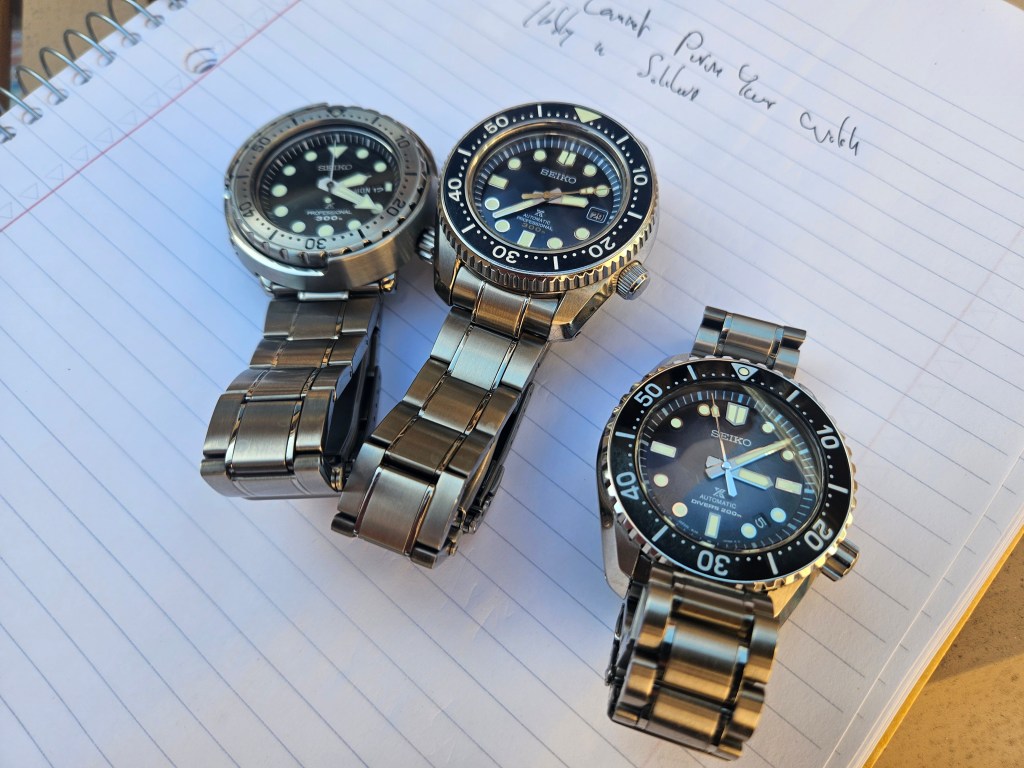
    It would be laughable for me to preach self-control. I can barely keep my own appetites in check. Apart from my morning kettlebell rituals—five days a week of grunting and penance—I’m an introverted “cozy boy.” I stay home, binge true crime docuseries on Netflix, and rotate my diver watches like a museum curator with OCD. I make my monkish meals: buckwheat groats, Japanese yams, steel-cut oats, tofu glazed in teriyaki and moral superiority. I am a herbivore surrounded by carnivores. My family mocks me gently while gnawing ribs.

    Sometimes, in a fit of ambition, I record a two-minute piano piece for my neglected YouTube channel. It receives twelve views, one of them mine, and a comment that reads, simply, “Lovely.” The algorithm yawns and moves on.

    I am obsessed with the rituals of minor luxury—fine organic whole-bean coffee that accompanies me in my morning writing jaunts, triple-milled soap redolent of rose and citrus, podcast playlists curated for insomniac philosophers. My life is the slow burn of scent and sound, a long intermission between existential crises.

    By nine o’clock, I’m done. My wife and daughters laugh as I shuffle off to bed, a middle-aged Sisyphus retiring his rock for the night. I read for twenty minutes, then fall asleep to the soothing drone of Andrew Sullivan or Sam Harris debating civilization’s decay. It’s my lullaby of reason and despair.

    Forgive me if this sounds paltry. I’m still trying to figure it all out—how to live, how to matter, how to grow up before the credits roll.

  • Thou Shalt Remember: Swagger Fades, But Authenticity Endures

    Thou Shalt Remember: Swagger Fades, But Authenticity Endures

    In the summer of 1977, my church was Cull Canyon Lake, and tanning oil was the sacrament. Every Saturday, I’d anoint myself in Hawaiian Tropic Dark Tanning Oil—zero SPF, 100 percent hubris. It smelled of coconuts and artificial paradise. When I think back to the hormonal heat haze of youth, I can still smell it: the scent of lust, vanity, and skin damage baking in the California sun.

    That’s when I first saw him—the apostle of artificial cool. I didn’t know his name, so I christened him Camaro Frankenpimp. Late twenties, brown wavy hair, gold chain, Speedo so tight it threatened constitutional rights. His black ’76 Camaro—with its white racing stripes and glassy arrogance—glimmered in the parking lot like a totem of misplaced masculinity.

    Camaro Frankenpimp strutted across the grass in his blue briefs, boombox blaring, white Frisbee spinning in hand, Playboy cooler close behind. He had perfected his entrance and rehearsed his lines. Every Saturday, I’d hear the same monologue:

    He’d paid five hundred bucks for that custom paint job. His dad owned a chain of clothing stores in the Bay Area. He’d managed them since high school. He was waiting to hear from a Hollywood studio about a small part in a martial arts movie. And, the pièce de résistance, he owned a home in Parsons Estates. He dropped that name like a holy incantation, as though suburban real estate were the path to transcendence.

    I later realized he’d memorized his script from Eric Weber’s How to Pick Up Girls!—the ur-text of sleaze, which instructed men to approach women like sales prospects: persistence over decency, bravado over authenticity. I’d seen the book passed around my high school locker room like contraband scripture. Camaro had apparently underlined every commandment.

    He was successful, at least by his own shabby standards. Each Saturday, he had new blondes—interchangeable apostles in bikinis—tossing his Frisbee back like he was the messiah of mediocrity.

    Then came the reckoning.

    One afternoon, I watched from my towel as Camaro held court on his grassy knoll, his tanned body gleaming under the sun, boasting to two bikini-clad disciples. Suddenly, he howled like a wounded wolf.

    “You stepped on a bee!” one girl cried.

    The bee twitched in the grass, mission accomplished. Within seconds, Camaro was sweating, limping, and insisting he was fine. His skin shone like varnish; his foot ballooned to the size of a Christmas ham.

    “I’m fine,” he kept saying, though panic had already claimed his eyes.

    Moments later, he collapsed, chest heaving, mouth foaming. His body convulsed, the boombox still playing Fleetwood Mac’s “Dreams” in surreal counterpoint. By the time the ambulance arrived, Camaro Frankenpimp—the self-anointed prophet of Parsons Estates—was gone.

    I went home shaken. My hero, the sun god of Cull Canyon, slain by a bee. That night, I sought counsel from Master Po.

    “Why, Master,” I asked, “did such a magnificent man die so suddenly?”

    “Choose your heroes wisely, Grasshopper,” said Po. “The man was no hero. He was a hollow idol, built of vanity and insecurity. He was all surface and no soul, all pose and no power. His death was not tragic—it was poetic. For it is written: he who cannot conquer himself will be conquered by the smallest of creatures.”

  • Thou Shalt Honor the Monster Who Shows Mercy

    Thou Shalt Honor the Monster Who Shows Mercy

    At sixteen, I thought I knew what a monster was. Then I met one—an authentic, breathing specimen of mythic proportions: John Matuszak, defensive lineman for the Oakland Raiders, the kind of man who made other men rethink their species.

    I’d seen him on TV—hulking, bearded, snarling—but television flattened him into two dimensions. In person, at The Weight Room in Hayward, California, Matuszak looked like evolution had taken a brief detour toward the gods. Nearly seven feet tall, close to 300 pounds, he was a paradox of mass and grace—slender by geometry, enormous by gravity. His hair was a feral snarl, his beard an ecosystem, and his eyes had the predatory focus of a hawk scanning for something foolish enough to move.

    One afternoon, the gym speakers played England Dan and John Ford Coley’s “Love Is the Answer”—a ballad so syrupy it could give insulin shock to a diabetic. Matuszak’s lips curled. “Bullshit,” he muttered, then grabbed the barbell loaded with 400 pounds and began to press, growling his blasphemy with each rep as if the song itself had personally insulted his testosterone.

    Between sets, he asked if I played football.
    “No,” I said, “I’m a bodybuilder—sort of.”
    He raised an eyebrow. “How old are you?”
    “Sixteen.”
    “Good for you,” he said, clapping a hand on my shoulder that felt like a catcher’s mitt made of stone. “Keep training, my brother.”

    Then he disappeared into the locker room, leaving me with the distinct impression that Zeus himself had just offered career advice.

    The kindness startled me. I’d heard the legends—Matuszak the maniac, Matuszak the ungovernable animal who devoured offensive linemen and bar fights with equal ferocity. Yet here he was, treating me, a lost, self-conscious teenager, with decency and warmth. The other pros at the gym wouldn’t even glance at me, but Matuszak talked to me like I mattered. He looked me in the eye. He saw me.

    When he emerged from the locker room later, showered and reborn as a gentleman—a sports coat, slacks, mirrored sunglasses—he’d point at me and say, “See you later, kid.” Then he’d vanish, as if returning to Mount Olympus by way of Interstate 880.

    I couldn’t reconcile it: this colossal madman known as The Tooz, destroyer of quarterbacks, showing kindness to a scrawny sixteen-year-old who barely knew what he was doing in life, much less the gym. That night, puzzled, I asked Master Po what it meant.

    “Grasshopper,” he said, “the Tooz is drawn to you for two reasons. First, your innocence. You want nothing from him. Everyone else approaches him with hidden motives—flattery, exploitation, self-interest. You are too young to be calculating, and he finds that purity refreshing. Second, you remind him of himself before he was devoured by fame and its demons. When he looks into your eyes, he sees the ghost of his younger self, a version unspoiled by appetite. The innocent, Grasshopper, give the fallen hope. They are proof that a life before corruption still exists.”

    “But Master Po,” I said, “I’m not innocent. I’m corrupt. I feel it.”

    He smiled that maddening, merciful smile. “Perhaps. But corruption is relative, Grasshopper. What feels like depravity to you may seem like mere dust on the soul to others. Never forget: even the fallen recognize light, and sometimes, they bow before it.”

  • If You Spend Your Life Wanting Things, You Will be in a Constant Fever

    If You Spend Your Life Wanting Things, You Will be in a Constant Fever

    One evening, I was holed up in my room, devouring a muscle magazine like it was scripture. I’d just finished an article on “progressive resistance training,” a phrase that made my adolescent heart thump with moral clarity. The world, I decided, was divided into two kinds of people: those who were progressing—pushing, grinding, improving—and those who were stuck, rotting in the swamps of inertia. Naturally, I placed myself in the first camp, the self-anointed pilgrim of progress.

    When the article ended, I drifted into the ads—the sacred appendix of every muscle mag. Protein powders, chrome dumbbells, pulleys, powders, potions—alchemy for the ambitious. But one ad stopped me cold: the Bullworker. A gleaming, three-foot rod of plastic and steel with cables sprouting from its sides like mechanical tendons. When you pulled the cables, the thing bowed like a crossbow for Hercules. A shirtless bodybuilder—pecs like carved mahogany—was using it to crush air itself. Price tag: forty-five bucks. Steep, but wasn’t self-transformation always costly?

    I marched into the living room, magazine in hand. My father sat in his recliner, beer in one hand, football roaring from the TV like an angry god.
    “Dad, what do you think?” I said, pointing to the Bullworker.

    He barely glanced at it. Still had the infantryman haircut, the square jaw, the tattoo—MICHAEL, bold and blue—across his right bicep like a relic from some forgotten war.
    “You want big muscles?” he said. “Pull weeds. Mow the lawn. Clean the gutters. Chop some kindling. That should do it.”

    “Dad, come on, I’m serious. This would be great for my workouts.”

    He sighed, studied the ad, then set the magazine down.
    “Son, this is marketing dressed up as science. But if you want to waste your allowance, go ahead.”

    “I’m short on cash.”

    “Then save. But make sure you want it. Do your research. My guess? The more you learn, the less you’ll want it.”

    “Why do you say that?”

    He smirked. “You ever heard of Sturgeon’s Law?”

    “No.”

    “Ninety-nine percent of everything is bullshit. Including that. Remember that martial arts course you bought? The one that promised black-belt skills in six weeks? What did you get? Stick figures in a pamphlet. Bullshit. Perform your due diligence, son. It’ll save you money.”

    “What’s ‘due diligence’?”

    “It means don’t be a sucker. Look closely before you buy anything. Most things collapse under scrutiny. Always be eager to save your money and reluctant to spend it. You hear me?”

    “Yes, Dad.”

    I retreated to my room, unimpressed by football and existentially wounded by paternal pragmatism. I opened another magazine and, in a desperate act of spiritual outsourcing, asked Master Po—my imaginary monk mentor—what he thought.

    “Your father is right, Grasshopper,” he said, somewhere between my conscience and my guilt. “If you spend your life wanting things, you will stay forever busy saving for them—and it will not be a noble busyness. It will be the feverish pacing of a man hypnotized by catalogs. Simplify your life, Grasshopper, and do the work that needs to be done.”

    “And what work is that?” I asked.

    “To stop pretending the world owes you the front of the line,” he said. “Stand at the back. Wait your turn. While you wait, develop yourself. Earn your place.”

    “How long will that take?”

    “A lifetime, Grasshopper,” he said. “And when you think you’ve arrived, the journey will have only begun.”

  • Thou Shall Not Skip Gravity Day

    Thou Shall Not Skip Gravity Day

    When I was fourteen, I read in The San Francisco Chronicle that the future of humanity was apparently doomed to unfold inside a giant space terrarium. The article, steeped in optimism and mild insanity, described how overpopulation and resource depletion would eventually force us to evacuate Earth aboard lunar shuttles and live in “closed-ecology habitats in free orbit.” The prophet of this plan was Princeton physicist Gerard K. O’Neill, whose forthcoming book The High Frontier promised solar-powered utopias floating blissfully through the void.

    The paper ran lush illustrations by Don Davis: rolling green hills, placid lakes, couples in flowing white linen strolling past solar panels, all living in a pastel Garden of Eden. But something about those inhabitants unsettled me. They all looked frail—thin, pale, gravity-deprived stick figures with the musculature of boiled linguine. That’s when the horror struck me: in space, there would be no gyms. No dumbbells. No pumping up. No gravity—no gains. My future would be a floating hell of atrophied muscles and existential despair. The very thought made my biceps twitch in protest.

    At the same time, a girl at school named Jennifer slipped me a birthday card with hearts on the envelope. Inside, she’d written that she liked me and wanted me to ask her out. But how could I ask her out when civilization was on the brink of being exiled to a zero-gravity tofu colony? What was the point of romance when dumbbells were about to become obsolete?

    I tore up the card, retreated to my room, and did what any hormonally charged doomsday philosopher would do: I consulted Master Po.
    “Master Po,” I said, “how can I go on living if bodybuilding dies in orbit?”
    “Grasshopper,” he said, “you live too much for yourself. You must empty yourself of self-interest.”
    “But I’m obsessed with myself.”
    “Exactly. And it shows in your quest to make your body beautiful.”
    “But bodybuilding is my life.”
    “And that,” he said, “is your curse. You train your body but let residue accumulate in your soul.”
    “So I should quit working out?”
    “Not quit. But see your body as not belonging to you. It is part of something larger.”
    “You mean, like the universe?”
    “Yes, Grasshopper. The body of the world.”
    “So, what—you want me to start picking up trash on the freeway? That’s your cosmic wisdom?”
    “Once again,” he sighed, “you are far from The Way.”

    I looked at my reflection in the mirror that night—fourteen years old, terrified of zero gravity—and realized that maybe Master Po was right. I wasn’t afraid of space. I was afraid of floating away from myself.

  • Breaking Up with the Protein Powder Industrial Complex

    Breaking Up with the Protein Powder Industrial Complex

    The deeper I dug into protein powders, the less convinced I became. What I’d been calling “nutrition” was really convenience dressed up in a plastic tub—processed, low in fiber, and shadowed by questions about heavy metals. So I scrapped the shortcuts. Instead, I built a rotation of four plant-based staples that quietly do the job: plain soy milk, pumpkin seeds, nutritional yeast, and hemp hearts.

    Now, my breakfast writes itself: oats or buckwheat groats folded with soy milk, pumpkin seeds, and hemp hearts—a meal that actually feels alive instead of engineered. For lunch and dinner, I toss the same mix with nutritional yeast into sautéed tofu, quinoa or millet, roasted sweet potatoes, and dark greens like broccoli or kale.

    Knowing exactly where my protein comes from—and how clean those sources are—has wiped out the low-grade anxiety that came with every scoop of powder. I’m no longer buying peace of mind from a supplement jar. I’ve reclaimed it in the kitchen, where real food and a decent spice rack make every meal something worth anticipating.

  • The Wrap Is the Wet Handshake of Tortillas

    The Wrap Is the Wet Handshake of Tortillas

    The Wrap—the pretentious, joyless burrito alternative that slithered into American lunch culture during the 1990s—remains an enduring insult, both culinary and conceptual. It is not a burrito, a falafel, or even a respectable sandwich. Those are categories with histories, boundaries, and soul. The Wrap, by contrast, is the menu equivalent of a corporate mission statement—vague, overpromising, and spiritually empty.

    Marketed as healthy and progressive, it is in fact a sad slurry of “lite” mayonnaise, cold protein, and moral posturing, encased in a tortilla that resembles a damp résumé. The Wrap promises wellness but delivers wetness. Its cold, papery sheath—sometimes greenish with “spinach,” sometimes orangish with “tomato-basil”—cracks under the weight of its own self-importance.

    A burrito is proud, hot, and complete—a working-class symphony of beans, rice, and molten cheese, wrapped in a warm, elastic tortilla designed to survive both gravity and appetite. The Wrap is its sterile cousin, born not in the markets of Juárez but in a boardroom buffet in Palo Alto. One feeds the soul; the other lectures it.

    If the burrito is street poetry, the Wrap is PowerPoint. Burritos radiate grease-stained authenticity; wraps arrive pre-sliced at corporate retreats, accompanied by a motivational slogan.

    And yet, there is something eerily modern about the Wrap—its prefab perfection, its sanitized efficiency. It is the edible ancestor of AI: an algorithm of health and convenience, engineered to look human but taste like compromise. The Wrap, in short, is the uncanny valley of lunch—soulless, identical, and faintly threatening. I fear, as with AI, that it may someday evolve, learn to mimic pleasure, and finally take over the world, one sad office lunch at a time.

  • The Double-Minded Man on His Exercise Bike

    The Double-Minded Man on His Exercise Bike

    Thoughtful theists often find themselves backpedaling from the most odious doctrines of their faith until what remains is no longer recognizably orthodox. Some manage this theological detour while keeping their faith intact. Others slide further down the slope until their religion becomes something more universal, even Unitarian—a faith stripped of dogma and distilled to moral simplicity: love thy neighbor, serve the poor, practice charity, and call it good.

    Within Christianity, the spectrum is wide. On one end stand the infernalists of the Augustinian school, firm in their vision of eternal punishment. On the other are the universalists who, following Origen, imagine purgatory as a place of cleansing rather than damnation, with the possibility of post-mortem salvation. Some, like Martin Gardner and H. G. Wells, found orthodoxy itself to be a spiritual illness in William James’s sense—a sickness of the soul that required liberation. Others, like Dale Allison, hold to faith but jettison the Augustinian vision of perdition. And then there is philosopher Elizabeth Anderson, who takes orthodoxy at its word and concludes that if God authored it, He cannot be moral.

    As one nears death, it would be comforting to have these matters settled—to face eternity with the theological equivalent of a neatly tied bow. But such closure eludes those of us who remain agnostic, chastising ourselves as James’s “double-minded man, unstable in all his ways.”

    I do, however, possess a few fragments of certainty. I reject Rousseau’s sentimental fantasy that human nature is innately good and can serve as our moral compass. I’ve seen enough of humanity to know we are corrupt, self-deceiving creatures who must wrestle with our yetzer hara—our bad inclination, as Jewish tradition calls it. Yet I’m not entirely convinced, as Paul was, that we are hopelessly depraved. Perhaps Paul and I are lost causes, but that doesn’t make the condition universal. The Jewish notion of meeting God halfway—using the strength He gave us—differs sharply from Paul’s portrayal of helpless man collapsing before the mercy seat. One path is desperate; the other is disciplined.

    Whether I write these reflections out of genuine spiritual torment or simple procrastination before an hour on the exercise bike is unclear. Either way, I’ll mount the Schwinn Airdyne, pedal furiously, and try not to think too much about eternal damnation.