Category: Health and Fitness

  • The Man Who Never Asked

    The Man Who Never Asked

    My wife has been sending me comedy skits about a subject that isn’t remotely funny: the epidemic of friendless adult men. The message arrives dressed as humor but lands as indictment—get off your ass and build a life that includes other human beings. Not for entertainment. For survival. For the family.

    The problem is I don’t know how.

    My friendships didn’t end with a bang; they evaporated. One by one, they thinned out, like hair in a drain, until nothing remained. I haven’t met a friend for a movie and a meal in nearly twenty-five years. Solitude didn’t ambush me; it settled in and redecorated. It became my default setting. Worse, it feels justified. I operate under a quiet but tyrannical assumption: no one would willingly spend that kind of time with me. Why would they? Friendship requires an investment, and I’ve already decided I’m not worth the return. Rejection is neatly avoided by never making the ask. A preemptive surrender disguised as dignity.

    When I think about how this calcified, I go back to 2005. My cousin and I met for dinner in downtown Los Angeles. Afterward, he wanted to extend the evening—drive twenty minutes to a coffee shop, linger, talk. I felt the anxiety rise like a fever. Dinner had been the contract; anything beyond it felt like trespass. I went along, reluctantly. He noticed. He never asked again. He moved on to a life crowded with friendships, a calendar he has to prune. I perfected the art of leaving early.

    I come by this honestly. My parents spent the last three decades of their lives without friends. My father borrowed social contact through his second wife but never rebuilt what he lost. My mother claimed friendships the way a customer claims familiarity with a waiter—pleasant, transactional, imaginary. Loneliness wasn’t diagnosed in our household; it was modeled. It looked normal. It felt inevitable.

    My parents weren’t bad people. They were self-involved, chemically compromised, and emotionally unavailable. My father once told me that if he could do it over again, he wouldn’t have children. People recoil when they hear that. I didn’t. It had the ring of truth I had already lived with. My mother, meanwhile, oscillated between warmth and collapse. Her depressions were so severe she disappeared into hospitals, and I disappeared into my grandparents’ house. Childhood became something to endure rather than inhabit.

    So I adapted. I became self-contained. I entertained myself. I eliminated the need for others before they could eliminate me. Being alone wasn’t a failure; it was a system.

    In my twenties, desire disrupted that system. I wanted relationships, so I built a version of myself that could get them. I became talkative, confident, funny—an actor with good timing and a decent script. It worked. Women believed in the character. So did I. But the performance had no depth. It couldn’t sustain love because it wasn’t built on vulnerability, only on impression. The relationships collapsed under the weight of my anxiety and selfishness. I could attract; I could not attach.

    That hasn’t entirely changed. I can still be charming in controlled environments. My colleagues enjoy me in passing. I can generate conversation the way a barista generates foam—pleasant, temporary, nonbinding. But conversation is not friendship. Friendship requires escalation, risk, the unthinkable act of asking someone to step outside the script and spend time with you. That’s where I freeze. I assume the answer will be no, and so I never pose the question. It’s a tidy system: I protect myself from rejection by guaranteeing isolation.

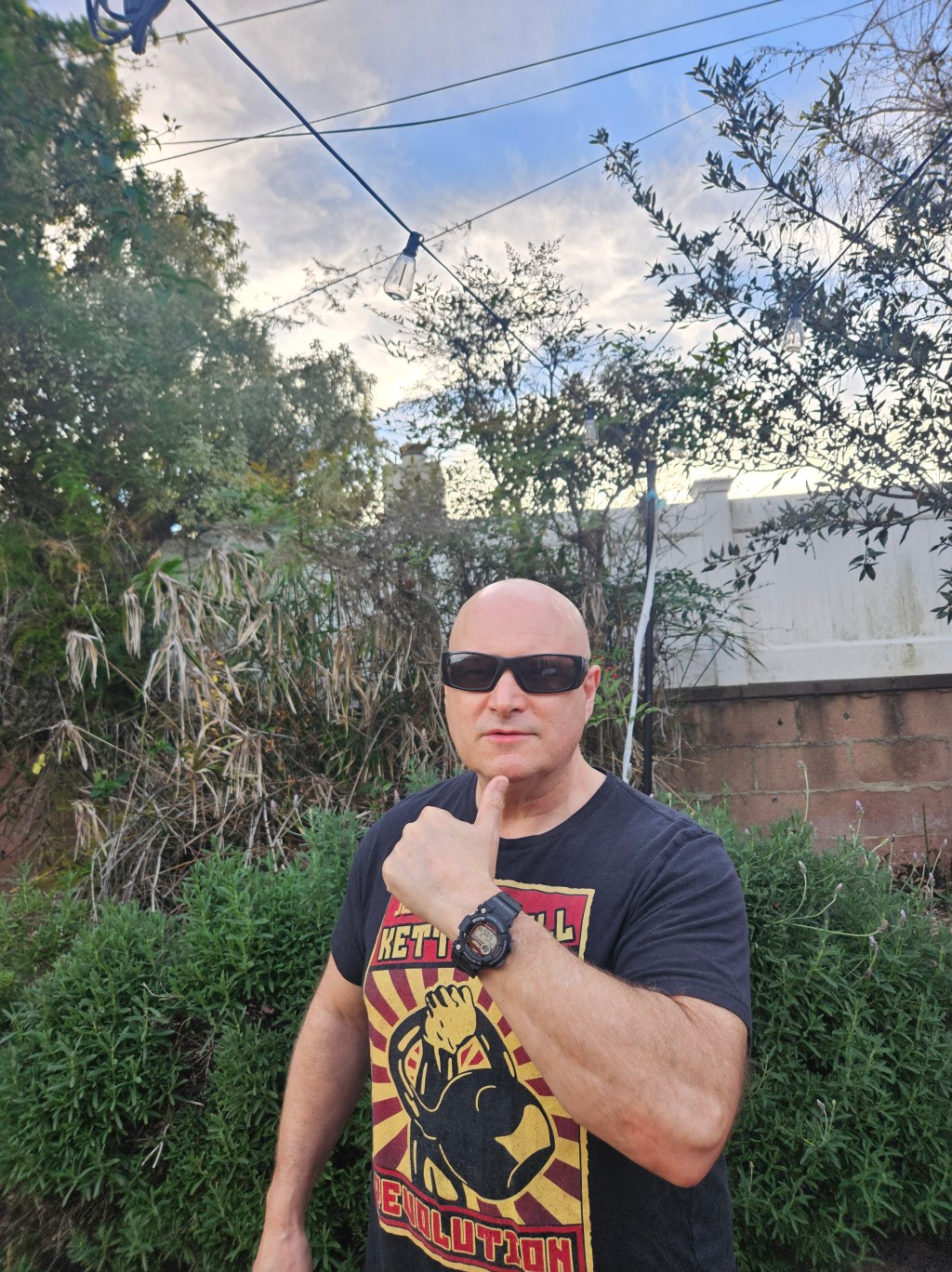
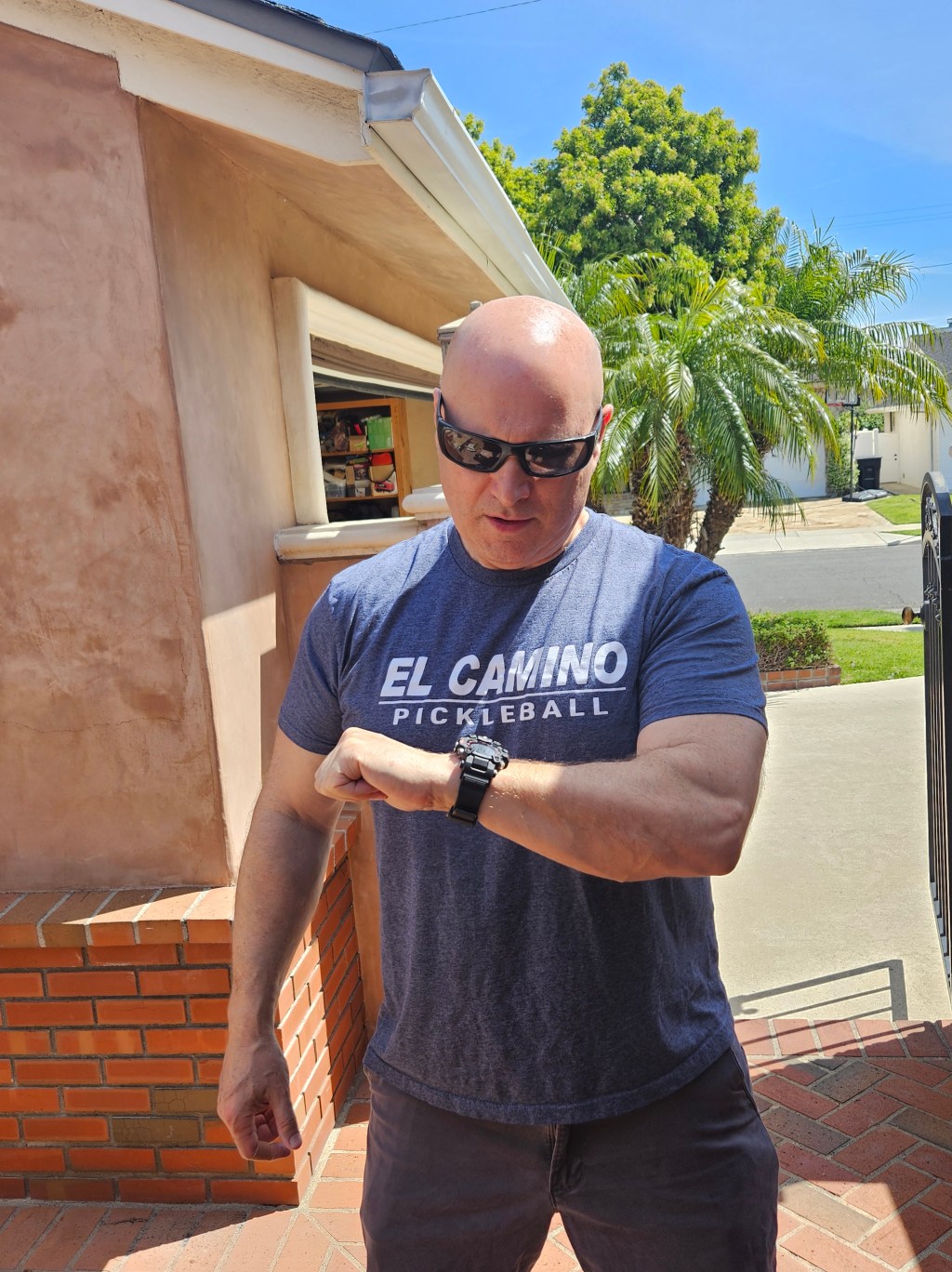
    This morning, sitting in my car waiting to take my daughters to school, I almost performed another ritual of avoidance. I reached for my watch, ready to photograph it for Instagram—a small offering to the gods of trivial validation. For a moment, I considered it. Then the idea repulsed me. The absurdity of it. As if a watch photo could compensate for a hollow social life. As if attention could substitute for connection. It felt like feeding a hunger with sugar and calling it nourishment.

    So I sat there instead, thinking about those videos my wife keeps sending me. They’re funny in the way a diagnosis can be funny—because it’s accurate. She’s worried. She should be.

    The truth is simple and unflattering: I’ve built a life that minimizes risk and, in doing so, minimizes connection. If I want to be less of a burden to my family, I have to become someone who can love beyond the walls of his own habits. That means doing the one thing I’ve spent decades avoiding.

    It means asking.
  • The Quiet Art of Not Wasting Your Life

    The Quiet Art of Not Wasting Your Life

    If we care about the state of our souls, we have to ask a difficult question: How do we treat time as a sacred, limited gift—something to be used with urgency, yet protected by stillness? In other words, how do we move with purpose without surrendering to the chaos of perpetual hurry?

    My problem—one I can’t dodge—is how easily I waste time while convincing myself I’m doing something worthwhile. I wake up intending to write, but drift into “research”: consumer products I don’t need, fitness principles I already know, or whatever flickers across my screen and triggers FOMO. The drain is subtle but relentless. A morning that should belong to reading and writing dissolves into trivial pursuits. I justify it with a familiar lie: I am a nobody with nothing to say. What difference does it make if I squander a few hours? Why not entertain myself instead?

    These rationalizations amount to treating my life with reckless disregard. They expose something uglier beneath the surface—a low sense of self-worth and a quiet flirtation with nihilism, the belief that nothing really matters.

    Of course, talk is cheap. I can articulate all of this with precision and still change nothing. I tell myself my habits should align with my beliefs, echoing Arthur Brooks from The Meaning of Your Life: Finding Purpose in an Age of Emptiness. But knowledge without discipline is decoration. When I waste time online, it doesn’t just distract me—it diminishes me. It acts like kryptonite. I become a lesser version of myself.

    I know the alternative. When I guard my attention, I compose longer, more ambitious piano pieces. When I don’t, I squeeze creativity into leftover scraps of time and produce reheated versions of my past work—safe, derivative, forgettable.

    It is astonishing how easily we waste time and then defend the waste, even when the defense collapses under minimal scrutiny. I remember falling into this pattern around the year 2000, when the internet first began its quiet takeover. Looking back, I think of Jim Harrison’s line: “It’s so easy to piss away your life on nonsense.” The accuracy is almost cruel.

    This realization struck me again this morning. I had “nothing” to write about, yet decided to open John Mark Comer’s The Ruthless Elimination of Hurry. Within two pages, the emptiness I claimed dissolved into a torrent of thoughts—about chaos, distraction, sacred versus profane time, and the psychology of hurry itself.

    Comer has reason to feel overwhelmed. As a pastor delivering six teachings every Sunday to accommodate a growing congregation, burnout is almost inevitable. My situation is the inverse. I am a college writing instructor with an abundance of free time, and with retirement a year away, that abundance is about to expand into something even larger—and potentially more dangerous.

    Comer imagines his future: a successful pastor, bestselling author, and sought-after speaker. By every external metric, he wins. But internally, he sees something else—hollowness, irritability, exhaustion, and a life that feels “emotionally unhealthy and spiritually shallow.” He barely recognizes himself.

    So he steps away. After a decade of acceleration, he takes a sabbatical. He sees a therapist. Stripped of his role as a megachurch pastor—the centerpiece of his identity—he feels disoriented, describing himself as “a drug addict coming off meth.” He has time now, but no clarity about who he is without the machinery of constant activity.

    He frames his book simply: imagine meeting him for coffee in Portland, talking about how not to drown in the “hypermodern” world. His approach is explicitly Christian, rooted in the life and teachings of Jesus, and aimed at answering a deceptively simple question: what does it mean to rest? And more importantly, how does one rest in a culture that equates value with speed?

    I approach this with skepticism. I’ve been a Christian-obsessed agnostic since I was seventeen, and I have little patience for spiritual platitudes. Still, Comer has earned his authority through suffering, not abstraction. He anticipates my resistance and addresses it directly: “If you want a quick fix or a three-step formula in an easy acronym, this book isn’t for you either. There’s no silver bullet for life. No life hack for the soul. Life is extraordinarily complex. Change is even more so. Anybody who says differently is selling you something.”

    That alone earns my attention.

    So I’ll take the invitation. I’ll sit down for coffee and listen to what he has to say in his so-called “anti-hurry manifesto.”

  • The Last Man in Orthopedic Loafers and Elastic-Waist Pants

    The Last Man in Orthopedic Loafers and Elastic-Waist Pants

    Aging doesn’t ask for your permission; it revises you anyway. Somewhere in your fifties and sixties, the body starts filing small grievances—slower recovery, dimmer recall, a half-step lost where you used to be crisp. The gap between who you were at your peak and who you are now widens just enough to notice. From that gap, a familiar assumption creeps in: that the later years should be quieter, safer, smaller—that the future is no longer a frontier but a managed environment. Call it Horizon Collapse: possibility shrinks to what’s nearby and controllable, and ambition is gently escorted out as an unruly guest.

    Prudence has its place. You don’t need to flirt with injury to prove you’re alive. But push prudence a notch too far and you build a Comfort Cage—a life engineered for ease that quietly imprisons curiosity, risk, and meaning. The edges are padded, the lighting is flattering, and nothing hurts. That’s the problem. When nothing hurts, nothing demands anything of you, and the day becomes a sequence of agreeable non-events. The soul, deprived of friction, goes slack.

    What’s more troubling is how this posture has escaped the retirement brochure and gone mainstream. Convenience has metastasized into a philosophy. With enough apps, prompts, and gentle automation, you can outsource not just your errands but your thinking. The result is Existential Downsizing: a voluntary reduction of one’s life to what is safe, efficient, and easily optimized. Big aims look wasteful; difficulty looks optional; meaning becomes a luxury item you can’t quite justify. We’ve confused the removal of obstacles with the arrival of purpose.

    This is the cultural air that breeds what Friedrich Nietzsche called the Last Man in Thus Spoke Zarathustra—a figure who has traded ambition for comfort and calls the bargain progress. He isn’t villainous; he’s deflating. He prefers safety to greatness, ease to excellence, consensus to conviction. Having minimized risk, he also minimizes transformation. He is content, and his contentment is the problem: a steady, blinking satisfaction in a life that no longer reaches beyond itself.

    Age can tempt you into this posture—“I’ve done enough; let me coast”—but so can technology. You don’t need bad knees to stop striving; you just need a system that makes striving feel unnecessary. In that sense, the Last Man is not a demographic. He’s a setting.

    I can’t pretend this isn’t a bleak picture. The best parts of my life have come from the opposite impulse: sitting at a piano until something stubborn yields; writing long, obsessive pieces that refuse to resolve themselves quickly; watching comedians build an hour of precision out of years of invisible labor. None of that is compatible with a life optimized for convenience. Achievement is allergic to ease. It requires time, friction, and a willingness to look foolish on the way to something that might matter.

    At sixty-four, with retirement approaching, the question isn’t whether decline exists—it does—but whether it gets to dictate the terms. The temptation is to let a slower body and a noisier mind argue for a smaller life. The counterargument is simple and hard: keep choosing projects that resist you. Keep placing demands on yourself that comfort would veto. Otherwise, you’ll end up perfectly safe, perfectly managed, and perfectly diminished—living proof that when you optimize for ease, you don’t just remove obstacles. You remove the reasons to move at all.

  • Leanmaxxing and the New Fantasy of Frictionless Medicine

    Leanmaxxing and the New Fantasy of Frictionless Medicine

    As a boy watching Star Trek, I was transfixed by the Tricorder–that tidy slab of certainty doctors waved over a body the way a priest might wave incense over a mystery. No scalpels, no tubes, no anxious waiting rooms with their stale magazines and fluorescent despair. A quick scan, a soft chirp, and the problem surrendered. The body, usually so coy and uncooperative, became a readable document–its secrets itemized, its fate clarified. It was medicine without friction, diagnosis without drama. In that universe, ignorance lasted seconds.

    For decades, the Tricorder sat where all good fantasies sit: just out of reach, gleaming with impossible efficiency. But reality has a way of cheating. The future did not arrive as a handheld scanner; it arrived as chemistry–specifically, a class of drugs that seems to negotiate directly with the body’s most stubborn impulses. If the Tricorder promised instant knowledge, GLP-1 drugs promise something more unnerving: the quiet rewriting of appetite, metabolism, and behavior from the inside out.

    In her New York Times essay “The Great Ozempic Experiment,” Julia Belluz catalogs the early returns, and they read less like a drug profile than a wish list that forgot to edit itself. Yes, there’s weight loss–the headline act–but the understudies keep stealing the show: concussion recovery, addiction dampening, relief from menopause symptoms, long COVID, alopecia, inflammation, arthritis, IBS, anxiety, brain fog. The list grows with the confidence of a rumor that keeps being confirmed. By the time you finish reading, you suspect the drug might also fix your credit score.

    The catch, for now, is almost comically modest: nausea and paperwork. The body may revolt briefly; the insurance company may revolt permanently. Yet demand surges, fueled by users who report not just slimmer bodies but upgraded lives–better mood, sharper focus, revived social calendars, improved fertility. It’s less a medication than a lifestyle intervention with a prescription pad.

    Clinicians, watching this unfold, have begun to reach for a new framework–the “root-cause” theory–because the old boxes no longer hold. These drugs don’t respect the tidy borders between endocrine, cardiovascular, and neurological disease; they trespass, improve, and move on. Even more disorienting, benefits appear in patients who don’t lose weight at all: better heart, liver, and kidney function, as if the drug were quietly tuning systems we didn’t know were connected.

    And here is where the story turns from miracle to question mark. As GLP-1 use spreads–along with the culture’s sudden enthusiasm for “leanmaxxing”–we risk trading one distortion for another: the cartoon body, now achieved pharmacologically rather than cosmetically. It is far too early to crown these drugs the real-world Tricorder, and just as premature to condemn them as a Faustian bargain. Like AI, they are moving faster than our ability to narrate them. We are watching a technology outrun our categories, and the only honest response, for now, is attention without prophecy.

  • Anorexification: How Thinness Became a Prerequisite for Social Currency

    Anorexification: How Thinness Became a Prerequisite for Social Currency

    On the The Unspeakeasy Podcast, Meghan Daum and Hadley Freeman–whose book Good Girls: A Story and Study of Anorexia reads like a field report from the edge–describe a culture quietly training itself to prefer bones to bodies. GLP-1 drugs have not merely entered the conversation; they’ve re-scripted it. In certain corners of entertainment, especially for women, thinness is no longer a trait—it’s a prerequisite. Not healthy thinness, but the spectral kind, the look of a person who has edited herself down to the bare minimum required for visibility.

    Enter the “thought leaders,” a title now worn loosely by a cadre of Bro Influencers, many featured on the documentary Louis Theroux: Inside the Manosphere, who speak about female bodies with the confidence of men who have never had to inhabit one. They circulate images so detached from biological reality that the result is less aspiration than hallucination. At some point, distortion becomes epistemology. When the standard is a body no one can sustain, we are no longer debating beauty; we are misinforming ourselves about what a human being is.

    The culture, meanwhile, doesn’t drift—it polarizes. On one end, the affluent micro-dose themselves into disappearance, refining their silhouettes into something that looks engineered rather than lived in. On the other, those with fewer resources are funneled toward ultra-processed foods—cheap, engineered, irresistible—and then displayed as cautionary spectacle on shows like My 600-lb Life. The result is a grotesque symmetry: the privileged vanish; the poor are made hyper-visible. Both outcomes are profitable. Both are distortions. Call it cartoonification—the body flattened into extremes, rendered legible for screens but unrecognizable as life.

    This is not an accident. It’s a market. Social media influencers curate a simulated aesthetic—filters, angles, pharmacology—and the entertainment industry distributes it at scale. Between them, they have manufactured a reality that looks persuasive from a distance and collapses on contact. Commerce thrives on the gap between what people are and what they are told to want.

    I listened with a teacher’s ear. In my critical thinking class I teach two units: first, the mythology of “consequence culture,” which reduces body weight to a moral ledger and blames individuals while ignoring the machinery that shapes their options; second, the role of ultra-processed foods—villain, convenience, or something more complicated. The classroom becomes a courtroom where agency and structure argue their cases, and neither gets to plead simplicity.

    After this conversation, the syllabus needs a sharper blade. I’ll have to put the Bro Influencers on the screen and examine their claims as arguments rather than vibes. I’ll have to trace how the ultra-processed food economy finds its customers—often the ones with the fewest alternatives—and how that targeting is dressed up as choice. If there’s an epistemic crisis here, it isn’t abstract. It’s embodied. It walks into the room every day, filtered, curated, and quietly misinformed.

  • The Seduction of Self-Cancellation

    The Seduction of Self-Cancellation

    You may have reached the unflattering clarity of seeing yourself as a Broken Misfit Toy. Strip away the syrup of self-pity and the diagnosis might hold. You’ve audited your habits, your relationships, your blind spots, and the balance sheet isn’t pretty. Fine. Accuracy is not the problem.

    The problem is what you do with it next.

    The moment you stamp yourself BMT, a seductive logic appears: If I’m damaged, I’m disqualified. Who am I to speak? Why should anyone listen? What could I possibly offer besides a cautionary tale? This is the mind trying to turn honesty into a muzzle.

    Let’s dispense with the melodrama. Self-pity is a terrible strategist. It doesn’t help you act; it helps you narrate your inaction with a certain tragic flair.

    Now the real question: Does a Broken Misfit Toy have anything to offer? The answer is a qualified yes—qualified by one thing only: insight. If you can look at your fractures without flinching, you can extract something from them. Loneliness, alienation, the habit of substituting art for connection, the long improvisation of living slightly out of tune—these are not rare conditions. They are common currencies.  What feels like private damage becomes public language.

    That doesn’t redeem the damage. It repurposes it.

    So call yourself a Broken Misfit Toy if you must. Just don’t use the label as a permission slip to sit out your own life. Idleness will not preserve you; it will concentrate the very defects you claim to recognize.

    And beware the neatest trap of all: the Broken Credential Fallacy–the belief that your flaws revoke your right to think, speak, or contribute. It’s a clever maneuver. It dresses up as humility while quietly ensuring you never risk being heard. It turns self-knowledge into silence and files your experience under “inadmissible.”

    You’re not disqualified. You’re on the record. The question is whether you’ll say anything worth hearing.

  • The Day the Gym Lost Its Soul–and I Took Mine Back

    The Day the Gym Lost Its Soul–and I Took Mine Back

    The gym in the 1970s was my holy temple. Not the antiseptic, glass-and-chrome shrines of today, but something closer to a workshop for men trying to hammer themselves into existence. The places I trained were rough, honest, and gloriously indifferent to appearances. No mood lighting. No eucalyptus towels. Just iron, sweat, and a shared work ethic.

    There were relics, of course, absurd contraptions left over from the Eisenhower years. Chief among them: the fat-jiggling machine. You strapped a belt around your waist or backside, flipped a switch, and the machine vibrated you like a malfunctioning appliance. The promise was surgical fat loss. The reality was public humiliation. No one touched it. To be seen using that thing was social suicide, a one-way ticket to pariah status. Even as teenagers, we understood that dignity had weight, and that machine stripped it from you ounce by ounce.

    Everything else, though, was perfect. The equipment did its job. The atmosphere did more. You could spend three hours there and feel cheated when you had to leave.

    Then came the 80s and 90s, and the gym got a facelift and a personality disorder. Out went grit; in came gloss. Chrome multiplied. Music was no longer background; it was an assault. Televisions blinked from every angle like slot machines. Smoothie bars appeared, as if protein needed to be accessorized. Personal trainers hovered, predatory, unctuous, and overfamiliar, radiating a kind of rehearsed enthusiasm that made you want to check your wallet.

    I tolerated the spectacle because I had no alternative. I didn’t have a garage full of equipment. The gym, vulgar as it had become, still held a monopoly on my routine. I assumed I’d be there until my dying breath.

    Then, in 2005, at an LA Fitness in Torrance, the illusion cracked. I noticed I was getting sick constantly—four, five colds a year. The common denominator wasn’t mysterious. It was the sauna, that damp Petri dish where strangers exhaled their pathogens in communal harmony. Add to that the blaring music, the social butterflies mistaking gossip for training, and the creeping sense that the place had become a theater of distraction rather than discipline—and I was done. The gym hadn’t betrayed me. It had simply revealed what it had become.

    So I left.

    In my early forties, I had no interest in bulking up. Call it instinct, call it desperation. Whatever it was, it pushed me toward power yoga DVDs. Bryan Kest and Rodney Yee became unlikely guides. I loved the sessions: the control, the focus, the quiet authority of breath over chaos. But yoga had a ceiling. Four to five hundred calories an hour wasn’t enough to outrun my appetite. If I lived on lentils, tofu, moong beans, and restraint, maybe. I didn’t.

    So by 2007, I pivoted to kettlebells.

    That wasn’t a compromise. It was a revelation.

    Kettlebells gave me intensity—eight hundred calories an hour—and something else the gym had quietly drained from me: engagement. Swings, squats, farmer’s carries were simple movements with endless variation. Enough complexity to keep boredom at bay, enough brutality to keep me honest. Nearly twenty years later, I’m still at it.

    And here’s the part no one advertises: I stopped getting sick. The revolving door of colds vanished. The gym, it turns out, had been taxing me in ways I hadn’t fully accounted for. Walking away from it wasn’t just a change in venue; it was a correction.

    Training at home became more than convenience. It became control. No membership fees. No commute. No background noise of other people’s trivialities. Just the work, stripped down to its essentials. I had removed friction where it didn’t belong and kept it where it mattered.

    That’s the difference between a real life hack and a counterfeit one.

    A real life hack replaces the original with something equal or superior. A counterfeit gives you convenience at the cost of substance, then flatters you into believing nothing was lost. My kettlebell training didn’t dilute the gym experience; it surpassed it. It demanded more precision, more coordination, more accountability. No machines to guide you. No rails to hide behind. Just you, the weight, and gravity’s indifference.

    This morning, I found myself studying kettlebell variations on YouTube—stop-start swings, double front squats—scribbling notes with the enthusiasm of a kid circling toys in a catalog. The same pulse I get when I spot a new Seiko Monster or Casio G-Shock release: anticipation, possibility, a little irrational excitement.

    Today is supposed to be an Airdyne day. An hour on the Schwinn, steady and predictable. But the kettlebells are calling. I know better than to give in. Experience has taught me the discipline of alternating days and sparing my joints, but the urge is there, insistent, almost childish.

    That’s how I know I’ve done something right.

    When your “discipline” starts to feel like anticipation, that’s not a workaround.

    That’s a life recalibrated.

  • The Weight of a Ringing Phone During the Landline Era

    The Weight of a Ringing Phone During the Landline Era

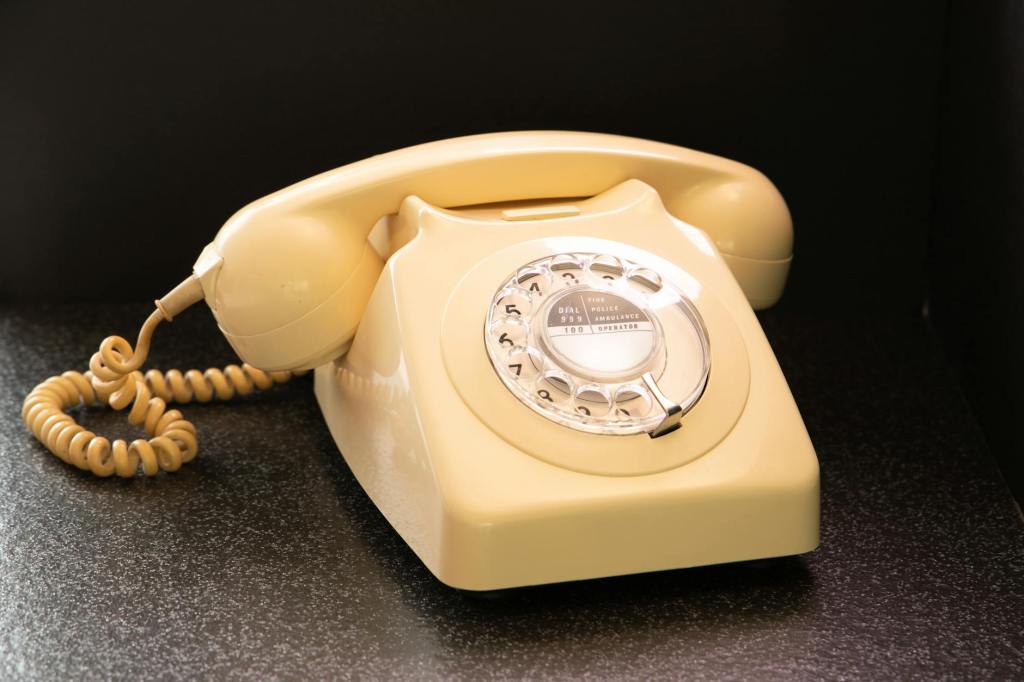
    I remember the Landline Era with a kind of reverence that borders on disbelief. Back then, I inhabited a different self. Those heavy rotary phones were not appliances; they were portals. You dialed into a world where connection had weight, where conversations stretched for hours until your ear burned raw against the receiver. When the phone rang, it didn’t interrupt life—it elevated it. The call carried you from ordinary time into something charged and consequential. Someone wanted you. Someone chose you. That alone conferred meaning.

    Even the timing of a call had its own grammar. A phone ringing before dawn meant dread. I was eleven on December 31, 1972, when my best friend Marc Warren called early to deliver news that felt too large for our age: Our beloved baseball hero Roberto Clemente had died in a plane crash while bringing aid to earthquake victims in Nicaragua. The call itself became part of the tragedy—a ritual of shared shock, proof that grief demanded a witness.

    In my late twenties, after I moved from the Bay Area to the California desert for my first full-time teaching job, the phone remained a lifeline. Friends scattered across Denver, Eureka, and back home would call, or I would call them, and we would talk—really talk—for two hours or more. We told stories not just to report events but to interpret them, to make sense of who we were becoming. The underlying message was never spoken, yet it saturated everything: you matter enough for this kind of time. Your life deserves this level of attention. I never questioned my worth because it was constantly affirmed in the currency of sustained conversation.

    By the early 2000s, the erosion had begun. Calls shrank to thirty minutes, sometimes less. You could feel the shift before you could name it. Texting arrived first, then the slow takeover of online life—relationships diluted into fragments, attention splintered across endless digital surfaces. The word “engagement” was repurposed into something thin and transactional. It came to mean clicks, likes, metrics—fleeting signals that mimicked connection without ever achieving it. No surge of digital attention could rival the steady gravity of a two-hour conversation in which your existence was never in doubt.

    In what I think of as the Parasocial Era, self-worth became unstable, tied to numbers that refreshed by the second. Real relationships receded as people adapted to simulations of connection. You watched others contort themselves to stay visible—posting constantly, performing outrage, dispensing optimism like a drug, chasing relevance as if it were oxygen. It was easy to recognize the pathology in others and harder to admit its presence in yourself. That recognition, uncomfortable as it was, pushed me to step back from social media, though not entirely free of its pull.

    Around 2006, I started a blog about my obsession with radios. It wasn’t really about radios. It was about reaching out, about recreating some version of the connection I had lost. When I joined social media a few years later, I found myself tracking engagement numbers with a vigilance that bordered on compulsion. Each fluctuation felt like a verdict. For the first time, I didn’t take my self-worth for granted; I monitored it, measured it, doubted it.

    Meanwhile, the practical demands of life closed in. Raising twin daughters, managing time, keeping everything afloat—these became the organizing principles of my days. Friendships didn’t end so much as they withered. Meeting someone in person required planning, travel, coordination—all the friction that digital life had taught me to avoid. Plans were made and then canceled. Illness intervened. Weeks turned into years. Absence became normal.

    I understand now that these simulated connections cannot supply what they promise. They offer stimulation, not sustenance. They mimic affirmation but cannot anchor it. I wish I had protected a handful of friendships with more stubbornness, more intention. Not out of nostalgia, but out of necessity—for myself, and for the people closest to me. A man with real friendships is a steadier presence at home. Deprive him of those, and something essential erodes.

    I don’t pretend there’s a way back to the Landline Era. I don’t see myself as a casualty either. I made choices. I accepted the bargain of convenience and efficiency, believing I could preserve deep connection while embracing frictionless substitutes. I believed I could have my cake and eat it too. That belief was naïve. The system was designed to flatter that illusion.

    Still, I return to that Sunday morning in 1972. A tragedy had occurred, and my friend needed to tell me—not broadcast it, not post it, not signal it to a crowd, but tell me. Because I mattered. The call was the message.

  • Grazing My Way to Nowhere—and Learning to Stop

    Grazing My Way to Nowhere—and Learning to Stop

    At sixty-four, I’m attempting a late-life renovation project: replace a few durable bad habits with better ones before they fossilize into personality. Chief among them is my relationship with hunger, which I’ve treated for decades as a medical emergency requiring immediate intervention—preferably in the form of a calorie-dense snack. I was raised to believe that hunger is unnecessary suffering, a small indignity that can be smothered with a tasty morsel or two. If I feel it, I fix it. If I might feel it later, I preempt it. I’ve spent years grazing my way out of imaginary famines, topping off the tank before the harrowing ordeal of being without food for four hours. I call this Preemptive Feeding Syndrome: the habitual practice of eating in anticipation of future hunger, based on an exaggerated fear of discomfort, resulting in chronic overconsumption and stalled weight management.

    This approach has produced a familiar cycle. I’ve lost weight half a dozen times—descending heroically from 245 to 200—only to regain it with equal conviction. The pattern is almost admirable in its symmetry. The problem wasn’t the diet. The problem was that the moment hunger appeared, I panicked. I treated every pang like a fire alarm. And when you live that way, fat loss becomes a series of interruptions, each one justified, each one fatal to the larger goal.

    At 231 pounds as I write this, with a modest but persistent halo of fat around my midsection and joints that file quiet complaints during exercises like the Farmer’s Walk, I’ve reached a conclusion that is both obvious and inconvenient: the decisive factor in my weight loss is not willpower. It is interpretation. Specifically, how I interpret hunger.

    For most of my life, I’ve read hunger as danger. Something is wrong. Fix it now. But I’m beginning to suspect that hunger is not a malfunction; it’s a message. Often, it’s the message that the system is finally doing what I’ve asked it to do—burn stored energy. The problem isn’t the signal. It’s my reaction to it.

    So I’m attempting a small but radical shift: treat hunger as information, not alarm.

    A brief pang is not a crisis. It’s a wave. It rises, it lingers, it passes—especially if I don’t chase it down with peanut butter and honey. When I leave it alone, something surprising happens: it weakens. When I don’t treat it as a threat, it stops behaving like one. In that shift—from emergency to data point—I gain leverage. Meals taste better because I arrive at them honestly hungry, not pre-satiated by a trail of defensive snacking. My appetite becomes cleaner, less frantic. What once felt urgent now feels negotiable.

    None of this came naturally. It had to be learned, which is to say, unlearned first. Each time I resist the reflex to patch over a pang with calories, I loosen the old wiring and lay down a better circuit. It’s slow work. It’s also effective. My threshold for discomfort has widened. I’m less reactive, more deliberate. My body will follow, but my mind has to lead.

    Frank Zane understood this decades ago. He treated hunger not as an enemy but as evidence—proof that his diet was doing its job. He didn’t try to abolish hunger; he put it in its place. Years later, he still eats with restraint, having trained himself to live comfortably inside that signal. That’s the model: not a life without hunger, but a life in which hunger has been demoted from tyrant to messenger.

    If I can complete this renovation—if I can rewire my response to hunger—I solve the central problem. If I don’t, no amount of planning, tracking, or good intentions will save me from another well-executed relapse.

  • Dental Work Without Anesthesia (and With Delusions of Bravery)

    Dental Work Without Anesthesia (and With Delusions of Bravery)

    This afternoon my dentist of twenty-two years—practically a family archivist of my molars—announced, with the calm authority of a man who has seen too much enamel decay, “Let’s handle this now before your roots start making public appearances.” Moments later, he was layering composite over two bottom teeth that had clearly lived a full and reckless life.

    No anesthesia. Apparently this was to be a character-building exercise.

    The procedure itself was a test of endurance disguised as routine maintenance. A styrofoam block was wedged into my mouth, prying it open to a degree that felt less medical and more architectural, as if my jaw were being renovated from the inside. Swallowing became a distant memory. Breathing required strategy. Time slowed to a crawl. For a Grade-3 claustrophobe, it was less a dental visit and more a hostage situation with excellent lighting.

    Was I brave? Hardly. Internally, I was negotiating terms of surrender.

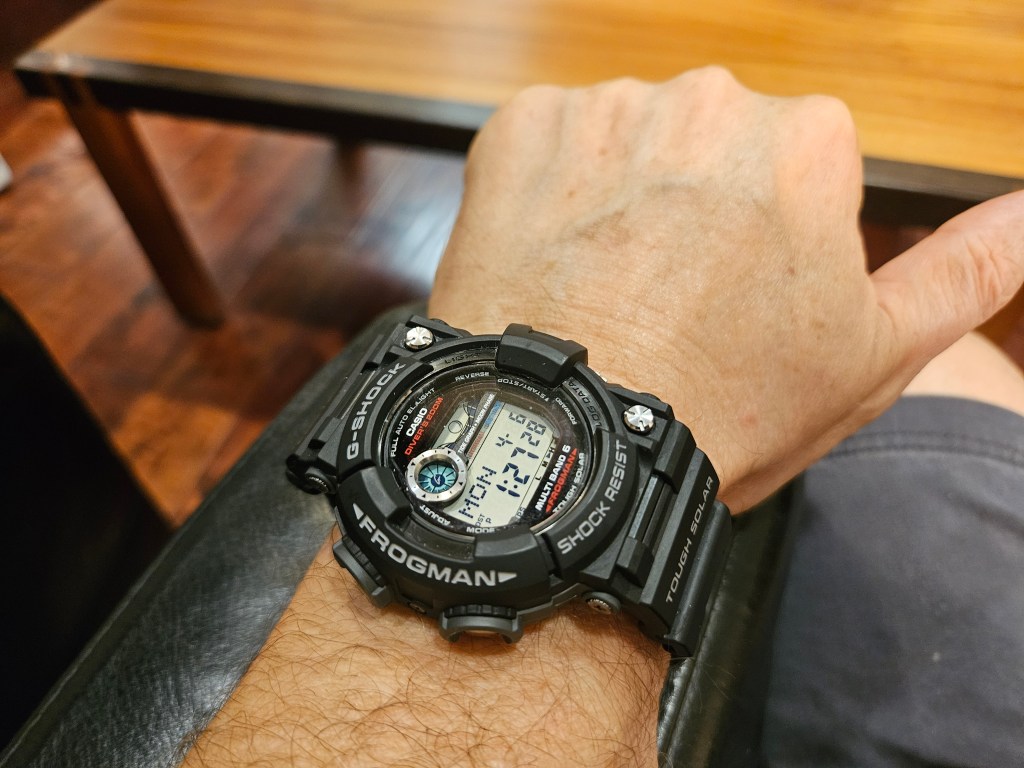
    But outwardly—this is important—I looked composed. Even heroic. On my wrist sat my G-Shock Frogman GWF-1000, a hulking instrument of indifference to human weakness, radiating the sort of rugged competence I was very much not feeling. If courage is partly theater, then I delivered a convincing performance.