Category: Literary Dispatches

  • I Am the Frogman

    I Am the Frogman

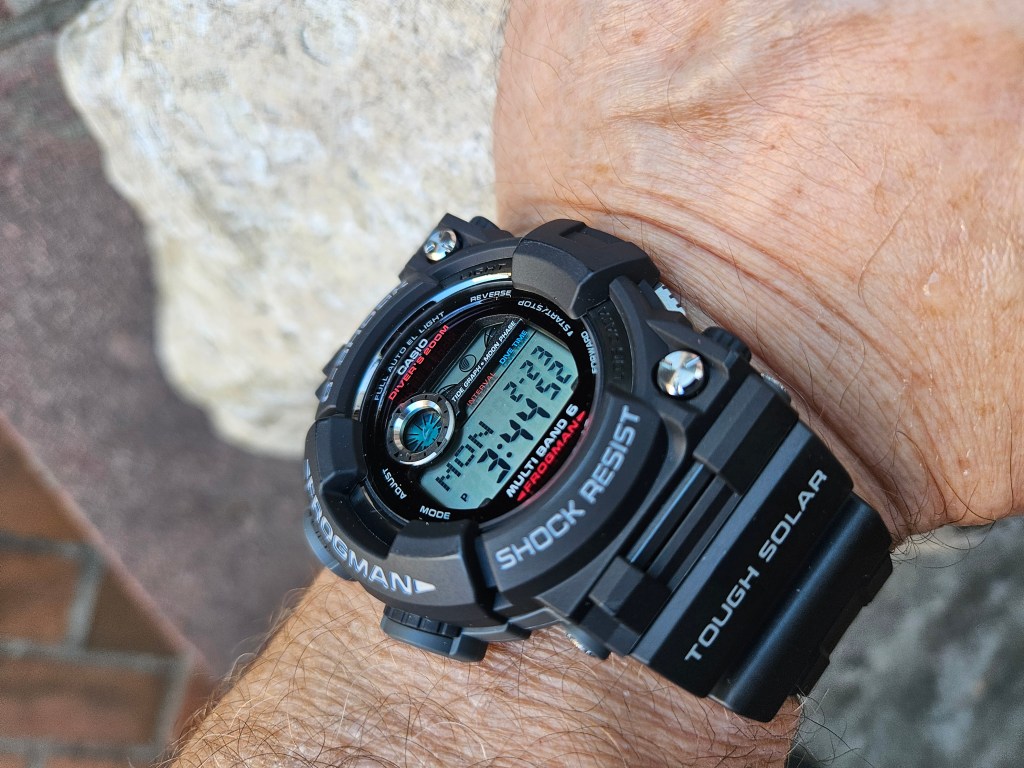
    I used to tell people I didn’t like the G-Shock Frogman GWF-1000.

    It’s oversized. It’s digital. It looks like something the wardrobe department would strap onto a second-tier superhero—Aquaman’s anxious cousin, assigned to guard the aquarium gift shop. On a 64-year-old man, it doesn’t whisper confidence. It screams midlife distress—the horological equivalent of jet-black hair dye and a motorcycle you’re afraid to start.

    And yet, for the past six months, it hasn’t left my wrist.

    My mechanical divers—polished steel, sapphire crystals, analog dignity—sit untouched, lined up in their box like former lovers trying to understand what went wrong.

    “How could you do this to us?” they seem to ask.

    “You are dead to me,” I reply.

    At this point, the relationship between my wrist and the Frogman is no longer metaphorical. It is psychological. Possibly spiritual. There may be paperwork involved.

    Let me be clear: this attachment is not based on taste. On a man my age, the Frogman doesn’t look stylish. It looks like evidence being quietly assembled by concerned family members.

    But it is not coming off.

    Because something happened.

    Not gradually. Not subtly.

    Change.

    When I started wearing the Frogman, I felt different—sharper, more contained, more adult. My appetite shrank. My focus tightened. I developed the kind of self-control normally associated with retired Marines and monks who eat lentils without complaint.

    Three meals a day. No snacks. No “kitchen reconnaissance missions.”

    Then something even stranger happened.

    My wife and daughters didn’t say a word, but their behavior shifted. The eye-rolling stopped. The subtle household demotion—from “head of family” to “eccentric roommate”—quietly reversed.

    Somehow, I had acquired gravity.

    I was no longer the suburban performance artist of half-finished plans and questionable purchases. I had become a man whose decisions suggested forethought rather than impulse.

    A man who appeared, alarmingly, to be in charge.

    But the real change was this:

    My nightmares stopped.

    Not reduced. Not improved.

    Stopped.

    For decades I lived with them—night after night, a private theater of dread that never closed. Then the Frogman arrived, and the nightmares scattered into darkness like silverfish when the lights come on.

    Now my dreams are peaceful. I run through fields of berries. In the voice of John Lennon, I sing, “I am the Frogman.”

    Explain that.

    A resin watch—battery, rubber strap, digital display—accomplished what therapy, discipline, and time could not.

    Part of me wants to leave the miracle alone. When something rescues you from overeating, ridicule, and nocturnal terror, you don’t interrogate it. You say thank you and keep your mouth shut.

    If it isn’t broken, don’t fix it.
    If you don’t understand the blessing, don’t analyze it.

    Unfortunately, I am a curious man.

    I want mechanisms. Theories. Experts. I want to understand how a mass-produced object rewired my habits, my household_toggle status, and my sleep cycle.

    That investigation is the project ahead—the study of what I can only call the Frogman Elixir Effect: a transformation so complete that the man who bought the watch no longer quite exists.

    I am no longer the wearer.

    I am the Frogman.

    Before we go further, I should correct something.

    Earlier, I said I thought the Frogman was ugly.

    That was a lie.

    Why I lied is a matter for future therapy—some mixture of denial, self-protection, and the fear of becoming the man who falls in love with industrial resin.

    The truth is this:

    The moment I saw it, I loved it.

    Not liked. Loved.

    It was, and remains, the most beautiful thing I have ever seen.

    Now that the truth is out, we can proceed honestly.

    At work, my colleague Dave noticed the change. One afternoon he suggested I attend a support group in the basement of a nearby church—men, he said, who believed they had also become Frogmen.

    Out of curiosity, I went.

    There were two dozen of us. Same age. Same watch.

    When the meeting began, we introduced ourselves the only way that felt accurate:

    “I am the Frogman.”

    Our counselor, Terry, immediately informed us that this was impossible. Only one of us could be the Frogman.

    Complicating matters, Terry was wearing the same model. There were rumors he believed he was the authentic Frogman and was using the group to establish theological authority. None of us trusted him.

    Still, we met every Wednesday.

    And something was undeniable.

    We had all changed.

    Better habits. Better focus. Better discipline. The same quiet upgrade in self-command. It was like taking creatine for the psyche. A testosterone booster for decision-making. Samson’s weapon—though one member insisted Samson actually used a donkey’s jawbone and demonstrated this point by raising his Frogman like a sacred artifact.

    The group is going well.

    Because the journey is no longer about wearing a watch.

    It is about fusion.

    What Terry eventually helped us name was Horological Identity Fusion—the state in which the boundary between wearer and object dissolves. The watch is no longer an accessory. It is a psychological extension. Removing it would feel less like changing gear and more like abandoning a role.

    Or losing a limb.

    And once that fusion occurs, something strange happens.

    You don’t wear the tool.

    You become the person the tool assumes you are.

  • The Sweet Tooth Age: How We Traded Depth for Dopamine

    The Sweet Tooth Age: How We Traded Depth for Dopamine

    In “The Orality Theory of Everything,” Derek Thompson makes a striking observation about human progress. One of civilization’s great turning points was the shift from orality to literacy. In oral cultures, knowledge traveled through speech, storytelling, and shared memory. Communication was social, flexible, and immediate. Literacy changed everything. Once ideas could be recorded, people could think alone, think slowly, and think deeply. Writing made possible the abstract systems—calculus, physics, modern biology, quantum mechanics—that underpin the technological world. The move from orality to literacy didn’t just change communication. It changed the human mind.

    Now the concern is that we may be drifting in the opposite direction.

    As social media expands, sustained reading declines. Attention fragments. Communication becomes faster, louder, and more performative. Thompson explored this shift in a conversation with Joe Weisenthal of the Odd Lots podcast, who draws heavily on the work of Walter Ong, the Jesuit scholar who wrote Orality and Literacy. Ong’s insight was simple but profound: when ideas are not recorded and preserved, people think differently. They rely on improvisation, memory shortcuts, and conversational instinct. But when ideas live in texts—books, essays, archives—people develop interiority: the capacity for reflection, precision, and layered analysis.

    It would be too simple to say we now live in a post-literate society. We still read. We still write. But the cognitive environment has changed. Our brains increasingly gravitate toward information that is fast, simplified, and emotionally stimulating. The habits required for what Cal Newport calls “deep work” now feel unnatural, even burdensome.

    A useful analogy is food. Literacy is like preparing a slow, nutritious meal. It requires time, effort, and attention, but the nourishment is real and lasting. The current media environment offers something else entirely: intellectual candy. Quick hits. Bright packaging. Strong flavor. Minimal substance. We have entered what might be called the Sweet Tooth Age—a culture that prefers pre-digested, entertaining fragments of ideas over sustained, solitary engagement. The concepts may sound serious, but they arrive in baby-food form: softened, sweetened, and stripped of complexity.

    After forty years of teaching college writing, I’ve watched this shift unfold in real time. In the past six years especially, many instructors have adjusted their expectations. Reading loads have shrunk. Full books are assigned less often. In an effort to get authentic, non-AI responses, more teachers rely on in-class writing. Some have abandoned homework entirely and grade only what students produce under supervision.

    This strategy has practical advantages. It guarantees original work. It keeps students accountable. But it also reflects a quiet surrender to the Sweet Tooth Age. The modern workplace—the environment our students are entering—runs on the same quick-cycle attention economy. Their exposure to slow thinking may be brief and largely confined to the classroom. When they transition to their careers, they may find that on-demand writing is no longer required or relevant. 

    Not just education but politics and culture are being swept by this new age of dopamine cravings. The Sweet Tooth Age carries a cost, and the bill will come due.

    The content that wins in the attention economy is not the most accurate or thoughtful. It is the most stimulating. It is colorful, simplified, emotionally charged, and designed to produce a quick surge of interest—what the brain experiences as a dopamine reward. But reacting to stimulation is not the same as thinking. Performance is not analysis.

    Performance, in fact, is the preferred tool of the demagogue.

    When audiences lose the habit of slow reading and critical evaluation, they become vulnerable to what might be called Kayfabe personalities—figures who are larger than life, theatrical, and emotionally compelling, but who operate more like entertainers than honest brokers. The message matters less than the performance. Complexity disappears. Nuance becomes weakness. Certainty, outrage, and spectacle take center stage.

    In such an environment, critical thinking doesn’t merely decline. It becomes a competitive disadvantage.

    This is why the Sweet Tooth Age is more than an educational concern. It is a political and cultural risk. A public trained to consume stimulation rather than evaluate evidence becomes easy to mobilize and difficult to inform. Emotion outruns judgment. Identity replaces analysis. The center—built on patience, evidence, and compromise—struggles to hold.

    When literacy weakens, the consequences do not remain confined to the classroom.

    They spread outward—into public discourse, institutional trust, and civic stability. The shift back toward orality is not simply a change in media habits. It is a shift toward immediacy over reflection, reaction over reasoning, spectacle over substance.

    And when a culture begins to prefer performance to thought, chaos is not an accident.

    It is the logical outcome.

  • College Essay Prompt: The Cost of Happiness

    College Essay Prompt: The Cost of Happiness

    In Ursula K. Le Guin’s “The Ones Who Walk Away from Omelas,” a radiant society rests on a brutal condition: one child must suffer so that everyone else may thrive. The story poses a disturbing question—does happiness always come at someone else’s expense?

    Write a 1,000-word essay that begins by answering this question in your introduction: Is your own success or pleasure part of a zero-sum system, where your gain depends on another’s loss? Draw on specific examples from your personal experience to support, challenge, or complicate this claim. Avoid generalities. Focus on moments in which your opportunities, comforts, or achievements may have intersected with someone else’s disadvantage—or where you discovered that life does not operate as a simple trade-off.

    Then extend your analysis beyond the personal. Imagine how a vegan might use Omelas as a moral framework to argue that eating meat is unethical—that human pleasure is built on the suffering of animals. Analyze the strengths of this argument. Where is the analogy persuasive? What moral insight does it reveal?

    Next, examine the weaknesses and limits of the comparison. Where does the analogy break down? What complexities—biological, cultural, economic, or philosophical—make the issue less absolute than the world of Omelas suggests?

    Your essay should move from personal reflection to ethical analysis, showing how Le Guin’s story sharpens your thinking about the hidden costs of comfort, the moral logic of sacrifice, and the question that haunts the story itself: When we benefit, who—or what—pays the price?

  • Stop Writing About Your Obsession Before It Gets Worse

    Stop Writing About Your Obsession Before It Gets Worse

    You may be tempted to turn your watch obsession into literature. The idea has a certain romance. You picture yourself channeling Dostoevsky, producing a modern Diary of a Madman, transforming your horological unraveling into art—brave, raw, cathartic. You imagine clarity emerging from confession, insight distilled from chaos.

    But this is a dangerous illusion.

    Writing about your obsession does not drain it. It feeds it. The writer inside you is not a therapist; he is a scavenger. He needs material. And if the material isn’t dramatic enough, he will improve it. Soon you are not merely observing your compulsions—you are staging them, heightening them, curating your own instability for narrative effect. What began as self-examination becomes performance. You are now caught in a Pathology Amplification Loop: the act of writing about the fixation rehearses it, enlarges it, and gives it emotional weight. Reflection becomes rehearsal. Analysis becomes reinforcement.

    There is a second problem. Writing about watches keeps your attention locked on watches. For someone trying to loosen the grip of a fixation, this is the cognitive equivalent of hosting a wine tasting during sobriety. You are not stepping away from the stimulus. You are polishing it, describing it, lighting it for dramatic effect. Attention is fuel, and you are pouring it directly onto the fire.

    There is a third cost, and it is social. Confessional obsession reads less like literature and more like a slow-motion car crash. Your friends may be sympathetic, but sympathy has limits. Once people see the full machinery of your fixation—the spreadsheets, the rationalizations, the psychic weather reports—they quietly step back. You are still invited to gatherings. You are still greeted warmly. But you are no longer the person they choose for long conversations over coffee. Everyone has their own burdens. Few volunteer to carry someone else’s.

    The wiser move is not literary but physical. Shift the energy out of the head and into the body. Walk long distances. Lift something heavy. Eat food that grew in soil rather than in a laboratory. Maintain a modest calorie deficit. Build routines that produce fatigue instead of rumination. When watch thoughts rise, do not interrogate them, narrate them, or mine them for prose. Dismiss them the way you clear your throat when a cold threatens—briefly, calmly, without ceremony.

    The goal is not a better story.

    The goal is less story.

  • The Dignity Liquidation Cycle: When Buying Feels Good and Selling Feels Necessary

    The Dignity Liquidation Cycle: When Buying Feels Good and Selling Feels Necessary

    If I were brutally honest, I’d admit that over the past twenty years, ninety-five percent of my watch purchases were impulsive. Which means ninety-five percent were evidence of arrested development with a credit card. I sold most of them at a loss—not because I needed the cash, but because I needed my self-respect. This is the Dignity Liquidation Cycle: the ritual of unloading recent purchases at a financial loss to restore psychological balance. The money forfeited becomes a self-administered fine, a tuition payment to the School of Impulse, and a symbolic attempt to reassert control over a mind that briefly wandered off without supervision.

    The harder question is not what I bought, but why I kept buying. My suspicion is cultural. I come from the Me-Generation, raised in 1970s California where desire wasn’t something to question—it was something to honor. Rob Lowe captured the atmosphere perfectly in Stories I Only Tell My Friends: the Counterculture as the Worship of the Self. Whatever the Self wants, the Self gets. No brakes. No compass. In Malibu’s sunlit dreamscape, people overdosed on pleasure, vanished into excess, and confused appetite with identity. When desire becomes sacred, reality becomes negotiable—and the bill eventually arrives.

    That wiring never quite left me. When I see a watch that speaks to me, my brain lights up like I’ve taken a controlled substance without the prescription. The surge is immediate and physical. Then comes the anger—not at the price, but at the loss of command. What does self-belief even mean if a rotating bezel can override your judgment? How do you grow into adulthood if your emotional economy still runs on the logic of a sixteen-year-old with access to a catalog?

    I don’t want rehab. I don’t want a hobby that has to be locked in a drawer for my own safety. I want a watch life that fits inside reality instead of pulling me out of it. Pleasure without compulsion. Enjoyment without drama. A collection that reflects judgment rather than appetite. In other words, I want the hobby to behave like an adult, even if the hobbyist occasionally does not.

    And here’s the punchline: even diagnosing the Me-Generation triggers nostalgia for being sixteen in Southern California in 1976, when the future felt endless and impulse felt like freedom. The danger is looking back too long. That way lies Lot’s wife, calcified in longing. So I change the channel. I close the YouTube reviews. Because the distance between “research” and “purchase” is about three videos—and I’ve learned the hard way that impulse has a very convincing voice when it sounds like happiness.

  • The Man Who Lost His Mind Watching Himself Lose It

    The Man Who Lost His Mind Watching Himself Lose It

    The Man Who Lost His Mind to Watches.

    It’s a good title. It has the faint whiff of Russian absurdism about it—the kind of story Gogol might have written if he’d traded overcoats for dive bezels. And why not lose your mind to watches? In literature, men have unraveled over less. But absurdity only works when it rests on a bedrock of truth. So what truth does this title expose?

    First, let’s dispense with denial. There exists an entire subculture of men who have, in fact, lost their minds to watches. A device whose primary function is to tell the time becomes an object of longing, analysis, acquisition, liquidation, reacquisition, and emotional weather. Madness doesn’t arrive dramatically. It waits patiently in the wings while the enthusiast compares lume, case finishing, and bracelet tolerances.

    Should we be surprised? Not at all. Civilization is a museum of fixation. People lose their minds over limited-edition sneakers, boutique fountain pens, vintage Bordeaux, carbon-fiber bicycles, custom keyboards, Japanese denim, tactical knives, collectible toys, and canvas tote bags that signal the correct cultural tribe. Watches are merely one exhibit in the larger gallery of beautifully engineered distractions.

    As Jim Harrison observed, the danger of civilization is that you will waste your life on nonsense. The watch obsessive understands this perfectly. That’s the problem. He knows the spreadsheets, the forum debates, the late-night listings, and the ritualized buying and selling produce more regret than joy. The clarity is there. The behavior remains.

    And this is where the story turns.

    Because the true obsession is no longer the watches.

    Once awareness enters the room—once the collector recognizes the irrationality of his own pattern—a second, more corrosive fixation takes hold. He begins monitoring himself. Judging himself. Auditing every impulse. Each purchase is followed not just by buyer’s remorse, but by a darker thought: What is wrong with me?

    The watches become secondary. The real object of attention is his own perceived unraveling.

    Shame enters. Then melancholy. Then a low-grade anxiety that hums beneath every browsing session: Am I losing control? Am I wasting my life? Is this what I’ve become?

    At this point, the original title is no longer accurate.

    The man did not lose his mind to watches.

    He lost his mind watching himself lose his mind.

    This is Meta-Obsession Syndrome: the recursive condition in which the collector becomes more consumed by analyzing, fearing, and diagnosing his own obsession than by the objects that started it. The hobby no longer drives the anxiety. Self-surveillance does. The enthusiast becomes both patient and examiner, actor and critic, compulsive buyer and moral prosecutor.

    And here lies the cruel irony.

    The watches may occupy the wrist.
    But the real mechanism now running nonstop is the mind—tracking, measuring, and condemning itself in real time.

    The second obsession is always worse than the first.

  • Horological Deconversion: When the Romance Finally Breaks

    Horological Deconversion: When the Romance Finally Breaks

    I recently wrote an essay arguing that pursuing mechanical watches in a digital world is a kind of elegant absurdity—an expensive devotion to obsolete technology while the rest of civilization marches toward sensors, satellites, and software. My proposed remedy was simple and slightly heretical: sell the mechanicals and replace them with an atomic or Bluetooth G-Shock. Accuracy, durability, zero drama. Efficiency instead of romance. Sanity instead of ritual.

    The piece was meant to provoke. Not just readers—me. Writing, after all, is less self-expression than self-interrogation. As Kafka put it, it’s the axe for the frozen sea. Sometimes the ice you crack belongs to your own illusions.

    What began as a tongue-in-cheek thought experiment turned into something less comfortable. It forced me to examine the possibility that my love for mechanical watches isn’t love at all—it’s theology.

    Over the years I refined my taste, sold the excess, and curated a tight collection of mechanical divers. Vintage aesthetic. Tool-watch credibility. A faint whiff of James Bond climbing out of the ocean with a harpoon gun and moral certainty. I told myself this evolution reflected discernment, maturity, identity.

    But the thought experiment raised a harder question: Did I discover my taste—or manufacture it?

    Human beings have a habit of building sacred spaces inside a profane world. Perhaps my watches became sacred cows—objects elevated not because they were necessary, but because I needed something to stand against modern life. Mechanical time as resistance. Analog as virtue. Nostalgia as courage.

    In this story, I cast myself as a quiet rebel.

    But what if the story is fiction?

    What if I’m not resisting anything at all? What if I’ve simply joined a small tribe of aging enthusiasts who reassure each other that spending thousands on obsolete machines is an act of character rather than consumerism?

    At that point, the romance starts to look like cosplay.

    Thousands spent on purchase. Thousands more on service. All to reenact a cinematic memory of youth. The whole enterprise begins to resemble those baseball fantasy camps where middle-aged men pay to take batting practice with retired heroes and pretend, for a weekend, that the dream never ended.

    The thought experiment did something dangerous: it planted a fantasy.

    Sell everything.

    Replace the collection with one or two G-Shocks.

    Start over.

    The appeal isn’t the watch. It’s the psychological reset. The possibility of closing a chapter and reclaiming the mental bandwidth the hobby quietly occupies. Change, after all, is the most intoxicating drug available to a restless mind.

    I’ve felt this kind of impulse before.

    In 2005, after three decades of gym culture, I was standing in an LA Fitness in Torrance, wiping someone else’s sweat off a treadmill while pop music pounded overhead and everyone talked about nothing. The thought hit me with sudden clarity: I need to get out of here.

    Within a week I’d left the gym, bought kettlebells, started power yoga in my garage, and never went back. At the time it felt impulsive. In hindsight, it was alignment—something deep finally overriding inertia.

    I sometimes wonder if watch collectors experience the same internal shift—the moment when accumulation feels less like passion and more like weight. The urge to take a wrecking ball to the collection. To simplify. To breathe.

    This moment has a name: Horological Deconversion—the quiet psychological turn when watches stop looking like identity and start looking like artifacts of habit, mythology, and sunk cost.

    I know someone who went through it. A serious collector. Deeply invested. One day he had the overwhelming urge to sell everything and replace the collection with a $20 Casio F-91W. Eventually he did. He told me the move saved his sanity.

    He still reads the forums. Still watches the madness unfold. But now he’s an observer, not a participant. The zoo is still interesting when you’re no longer inside the cage.

    Anyone who sells their mechanical collection, buys a single indestructible digital, and walks away lighter will have my respect. Not because minimalism is virtuous, but because exits are hard. Leaving a closed system always is.

    There’s something quietly heroic about it—the horological version of a Shawshank escape. Crawl through the tunnel. Emerge on the other side. Stand in the rain and realize the prison was partly self-built.

    And somewhere beyond the walls, there’s a small, durable watch keeping perfect time—and a life of freedom and expanding possibilities.

  • The Greatest Book My Father Never Wrote

    The Greatest Book My Father Never Wrote

    Last night I dreamed I was summoned to a publisher’s office, the kind that smells faintly of dust, old paper, and deferred hope. I sat across from a man in his early sixties wearing a beige suit so aggressively neutral it seemed designed to disappear into the shelves behind him. Those shelves were packed tight with books—the visual shorthand for authority, legitimacy, and the life I was supposed to have lived.

    He told me, calmly, as if delivering weather updates, that my father had written a perennial classic. A bestseller. A semi-autobiographical novel about growing up poor, raising me with my teenage mother in the Gainesville projects. The book, he said, was written with mordant wit and bruised humor and was routinely compared to Huckleberry Finn.

    Then he handed me a copy.

    I opened it and recognized everything immediately: Flavet Villages, the roach-infested housing complex for veterans and struggling students, where poverty clung to the walls like nicotine. The prose was first-person present tense—close, intimate, relentless. I said this out loud, the way you do in dreams when you want credit for noticing things. The publisher nodded, pleased.

    “Have you ever thought about doing something like this?” he asked. “Following in your father’s footsteps?”

    I shook my head. Then I asked the only question that mattered: “How come I never heard about this book before?”

    “Oh, it doesn’t exist here,” he said, waving the concern away. “It exists in a parallel universe in a faraway galaxy.”

    Naturally.

    At this point, he reached into his desk and handed me a gray carbon radio shaped like a pyramid—part Cold War relic, part sci-fi prop. It had a special shortwave frequency that could lock onto that distant planet, where my father’s novel was being read aloud, endlessly, by a space alien. Anytime I wanted, I could tune in and listen. It would comfort me, he said, as if this explained everything.

    I thanked him, left the office, and met my wife and twin daughters at the San Francisco Zoo. While they stared at zebras with the earnest fascination of people grounded in reality, I extended the antenna and tuned the dial. The alien’s voice crackled through—steady, patient, reverent—reading my father’s great novel for the thousandth time.

    My family looked at me like I’d finally tipped over into madness. I didn’t care.

    I was listening to the greatest book my father never wrote, being read forever in a universe where it mattered. And for once, that was enough.

  • Writing the Book That No One Can Ignore

    Writing the Book That No One Can Ignore

    You don’t sit down to write a book the world wants to read by accident. At least, it feels like an act of will. You force yourself into the chair. You produce sentences. You assemble a manuscript that lodges itself in people’s heads, agitates their assumptions, rearranges their furniture. The book exerts power—but not the vulgar kind. You’re not trying to dominate anyone. You’re simply telling the truth so cleanly, so directly, that looking away becomes impossible. Your ideas don’t shout. They persist. They refuse to be ignored.

    This kind of book is not a lecture, a scolding, or a manifesto. It doesn’t traffic in nihilism, misanthropy, or fashionable despair. It doesn’t prescribe easy solutions or luxuriate in outrage. Instead, it diagnoses. And a real diagnosis cuts both ways: it is unsparing about the human predicament while still pointing—quietly but unmistakably—toward an exit. Not optimism. Orientation.

    The book earns its authority by puncturing the clichés we treat as wisdom. It exposes the mass hallucinations surrounding happiness, success, fulfillment—all the shiny quests we pursue with religious devotion and predictable disappointment. But it does this without contempt. The tone isn’t superior; it’s exact. The pleasure of reading comes from recognition, not humiliation. You feel seen, not scolded.

    The sentences do the heavy lifting. They are short, fearless, and unembarrassed by clarity. There is no ornamental fog, no academic hedging, no decorative complexity masquerading as depth. Flowery prose and pretentious diction are weeds on a neglected lawn: they obscure what matters. This language is honed, not arid. It glints. Each sentence lands cleanly and moves on.

    If a curmudgeonly edge appears, it’s a seasoning, not the main course. A book powered by pure crankiness curdles into nihilism—and nihilism is dull. It flattens stakes, erases texture, and mistakes exhaustion for insight. This book avoids that trap. It remains alive to nuance, contradiction, and consequence.

    Because the book is so bracingly clear, other writers feel it immediately. Not admiration first—envy. The good kind. The Beatles hearing Pet Sounds and realizing the bar has been raised. The book doesn’t just succeed; it rearranges the landscape.

    What ultimately distinguishes it isn’t the subject matter but the voice. To understand that voice, Emmanuel Carrère’s Kingdom is instructive. Carrère contrasts the florid ambition of Luke—his PR-friendly, overworked prose—with the sayings of Jesus, which arrive stripped, terse, and destabilizing. Jesus’ words feel both utterly familiar and entirely unprecedented. Carrère calls this a linguistic hapax legomenon: a way of speaking so singular that it leaves no doubt a real person once spoke this way.

    That is the essence of a world-changing book. Its language has no template. It cannot be reverse-engineered or taught. It doesn’t sound like anything else. It lands in the reader’s mind with a depth that imitation can’t reach. At that point, the writer looks less like a craftsman and more like an oracle—someone through whom something passes.

    Which brings us back to will. Maybe writing such a book isn’t an act of will at all. Maybe the writer is chosen—by temperament, by obsession, by affliction—to speak this way. Either way, the true desire isn’t fame or money or validation. It’s to produce language with the force of a hapax legomenon: words that could only be said once, and yet echo forever.

    That, finally, is its own reward.

  • How Pain Turns Writers Into NPCs. 

    How Pain Turns Writers Into NPCs. 

    Writers love to repeat this creed: writers write. Every day. They sit down, stare at the blank page, and through sheer ritual force the gears to turn. In The War of Art, Stephen Pressfield insists on this daily discipline and warns of the inevitable adversary—Resistance. Resistance whispers that your writing is vain, repulsive, predictable, and hollow. Why bother? Go online. Look at shoes. Browse wristwatches. Watch YouTube reviews of sedans you’ll never buy. Burn the day on frictionless nonsense. It’s all equally meaningless, right?

    Pressfield and therapist Phil Stutz argue that this internal battle is the whole point of being alive. Pressfield calls the enemy Resistance. Stutz calls it Part X. Different names, same parasite. Its goal is not laziness but annihilation—to grind you into a nihilist, a Non Player Character who anesthetizes himself with consumer trinkets and cheap pleasures while his self-respect quietly decomposes.

    This morning, Part X arrived early and well-fed. My left shoulder throbbed from a five-month war with a torn rotator cuff and biceps tendon. Two days ago, I committed the cardinal sin: light pec flyes. Light. Humane. Respectful. Wrong. My shoulder throbbed. Apparently my shoulder has revised the Geneva Convention. I’m furious. A pec pump feels like a constitutional right. Don’t take that from me.

    But reason—cold, joyless, correct—has entered the chat. It says: you don’t need a pec pump; you need healing. If the weight room has turned hostile, pivot. Yoga. The bike. Calisthenics that whisper instead of shout. I’ve lifted my entire life, but at sixty-four my shoulder has submitted its closing argument, and it’s persuasive.

    The real danger isn’t losing bench presses. It’s waking up sore, cranky, and vulnerable—exactly the emotional state Part X thrives on. Injury lowers your defenses. Pain invites despair. Despair opens the door to distraction, and distraction is how the demon eats.

    So today I’ll keep it modest. Trader Joe’s. Groceries. Lower-body kettlebells. Rehab work that looks unimpressive but feels like loyalty to the future. May my shoulder accept this offering. More importantly, may it keep Part X from getting its teeth in me before breakfast.