Category: technology

  • Romance vs. Readiness: The $5,000 Watch Identity Test

    Romance vs. Readiness: The $5,000 Watch Identity Test

    If you had five thousand dollars to spend on a watch, would you buy a Tudor Black Bay or an apex G-Shock? Take a breath. This isn’t a trap. It’s a diagnostic. The question isn’t about taste, brand, or even watches. It’s about which story you want time to tell you when you look at your wrist.

    Because this isn’t a comparison. It’s a philosophical knife fight.

    What you’re buying with an MR-G is not nostalgia, prestige, or a century-old founder with a heroic mustache. You’re buying engineering density. The case is forged from exotic alloys—multi-layer titanium, Cobarion, DAT55—hardened, coated, and sealed like something designed to survive atmospheric reentry. The surfaces are finished with Zaratsu polishing, the same distortion-free technique used on high-end mechanical pieces, except here it’s applied to something that actually deserves the word precision.

    Inside, sentimentality has been removed for weight savings. Solar power eliminates battery anxiety. Multi-Band 6 pulls atomic time out of the sky. Bluetooth or GPS keeps it aligned with the planet. Perpetual calendar. Shock resistance. Magnetic resistance. Water resistance. This is not jewelry. This is equipment.

    In the real world, the result borders on the unsettling. The watch is essentially never wrong. It requires almost no maintenance. You don’t protect it; it protects itself. Decades pass. Nothing breaks. Nothing drifts. Nothing needs attention. Emotionally, the message is clear: you are wearing aerospace hardware. The subtext isn’t romance. It’s operational readiness.

    A Swiss mechanical watch lives in a different universe entirely.

    Here, you’re paying for inefficiency elevated to art. Hundreds of miniature parts dance together, powered by springs and friction, keeping time the way humans kept time before electricity. The movement is decorated with Geneva stripes, anglage, perlage—beautiful flourishes that improve nothing and mean everything. A large portion of the price isn’t metal or labor. It’s heritage, mythology, brand gravity, and the comforting knowledge that your purchase occupies a recognized tier in the luxury food chain.

    In practical terms, the performance is charmingly mediocre. The watch may gain or lose several seconds a day. Every five to ten years, it will require a service that costs the price of a respectable vacation. It’s durable, but not indestructible. You don’t live in it. You care for it. You wind it. You set it. You worry about it.

    And that’s the point.

    A Swiss mechanical watch is a tiny opera on your wrist. It hums with history and human effort. It suggests a world where time was slower, tools were permanent, and craftsmanship mattered more than optimization. It is gloriously unnecessary and emotionally persuasive. It doesn’t promise control. It promises meaning.

    The G-Shock, by contrast, does not care about your inner life.

    It assumes the world is hostile, gravity is inevitable, and precision is non-negotiable. Solar-powered. Atomically synchronized. Shockproof. Magnet-resistant. Overqualified for your most dangerous mission, which today will likely involve email, errands, and a conversation about air fryers. Where the Swiss watch whispers, “I honor tradition,” the G-Shock states, “Systems nominal.”

    One is a mechanical heirloom from a civilized past.
    The other is a wrist-mounted survival platform from a future that expects competence.

    This is the Romance–Reliability Divide: the tension between loving the poetry of imperfection and choosing the comfort of absolute performance. One approach treats timekeeping as an experience to be savored. The other treats it as a problem to be solved.

    There is no correct answer.

    But there is one mistake: not realizing which philosophy you’re buying when you open your wallet.

  • When the World Updates Without You: The Quiet Power of Mechanical Time

    When the World Updates Without You: The Quiet Power of Mechanical Time

    No one warned me, but I should have seen it coming: creeping toward your mid-sixties is less a rite of passage than a crisis of competence. Or, to be precise, it’s a progressive misalignment with the modern world. You drop references to Danish Go-Rounds, Screaming Yellow Zonkers, Tooter Turtle, Super Chicken, and All in the Family and watch blank faces stare back at you. You still assume that appliances are built with the sturdiness of yesteryear, only to find that today’s models disintegrate if you breathe on them sideways. This misalignment breeds a special kind of incompetence—egregious, preventable, humiliating.

    You can swallow vats of triglyceride omega-3 fish oil, but the short-term memory still slips away without mercy. You forget where you parked your socks (on the couch), that you meant to watch the final episode of that crime docuseries on Netflix, that a Costco-sized case of 12-gallon trash bags lurks in the garage, or that you already ground tomorrow’s coffee beans. The indignities pile up like unopened mail.

    These lapses, coupled with your fossilized references to extinct foods and beloved TV shows, render you a creature out of phase with the universe—an alien with wrinkles, blinking in confusion, flashing your unearned senior discount at the box office like it’s a badge of relevance.

    You can flex all you want against this verdict. Wolf down 200 grams of protein daily, clang kettlebells in the garage, and polish yourself into the semblance of a beaming bodybuilder who could pass for forty-four instead of sixty-four. But that delusion ends the second you get behind the wheel at night. Your depth perception is a cruel joke. The glare of headlights and streetlamps slices into your worn irises like laser beams, reminding you that biology—not discipline—is running the show.

    Like it or not, you’re aging in real time, a public spectacle of decline, the unwelcome prophet of mortality who shatters the younger generation’s illusion that time is indefinite. To them, you are as pleasant a presence as a neighbor’s dog barking at a squirrel at six a.m.—loud, unnecessary, and impossible to ignore.

    Congratulations–you’ve become the world’s unwanted alarm clock.

    But all is not lost. You have your watches. While the larger world moves faster than your reflexes and updates itself without your consent, the watch box waits patiently, offering a language you still speak fluently. You wind the crown. You change a strap. You turn the bezel and count the clicks like a monk fingering prayer beads. No notifications. No software patches. No judgment.

    This is Therapeutic Realignment: the quiet restoration that occurs when a man drifting out of phase with modern life anchors himself in a domain he can still master. Mechanical watches obey touch, attention, and ritual. Set the time and the movement responds. Rotate the collection and the day acquires structure. Flip the caseback toward the light and there it is—a small, disciplined universe of gears and springs, working without complaint, without irony, without asking you to download anything.

    These tactile routines create a sanctuary of competence in a world that increasingly makes you feel like a beta tester for your own existence. Where memory falters, the ritual holds. Where technology alienates, mechanics reassures. In this ecosystem, time stops behaving like a predator and becomes a companion. You move, if only briefly, from obsolescence to equilibrium. You are no longer behind. You are simply keeping time.

    Which is why the watch hobby is never just a hobby. It is a romance with mechanized time—a private jurisdiction where order still answers to your hand. While the young glance at their phones and treat time as a background utility, you study the slow sweep of a seconds hand or the living heartbeat inside your Grand Seiko. Through the sapphire caseback, time is no longer something slipping away. It is something alive, something contained, something you can hold steady—your own small sphere of Sacred Time in a loud and impatient world.

  • The G-Shock Exemption Doctrine: Why Some Watches “Don’t Count”

    The G-Shock Exemption Doctrine: Why Some Watches “Don’t Count”

    I have friends in the watch community who insist that “G-Shocks don’t count.” When they tally their collections, the squares and Frogmen are quietly left off the ledger. This is the G-Shock Exemption Doctrine—the unwritten rule that allows a collector to treat a G-Shock not as a watch, but as equipment, like a flashlight or a multi-tool. By this accounting magic, the collection remains disciplined, curated, respectable—untainted by the bulky, indestructible contraption sitting in the sock drawer, waiting for duty.

    The doctrine creates a bright border. On one side: mechanical divers, chronographs, heirlooms, objects of taste and tradition. On the other: the G-Shock. Yes, it tells time. But in the same way a Swiss Army knife contains scissors—it’s almost beside the point. To call a G-Shock a watch, in their view, is like calling a tricycle a bicycle. It operates in a different category of the brain, one less concerned with heritage and more concerned with survival, utility, and the quiet thrill of overcapacity.

    The psychology isn’t new. In the mid-1970s, the same reverence surrounded Texas Instruments calculators. They didn’t just crunch numbers; they conferred identity. The kid holding one wasn’t merely doing math—he was running systems. The G-Shock carries the same voltage. Atomic time. Solar charging. World time. Shock resistance. It doesn’t just tell you the hour; it implies operational readiness. You are synchronized, optimized, prepared—never mind that your most hazardous assignment today is grading essays or standing in line for almond milk. Press a button, and disorder yields to data. The fantasy is intoxicating: beneath the ordinary exterior lives a man quietly managing advanced capabilities.

    And the appeal goes deeper. The G-Shock is engineered for soldiers, divers, and field operators. It speaks not only to the analytical mind but to the tactical imagination. This is the fusion of Intellectual Man and Action Man—the spreadsheet warrior who is also, at least psychologically, deployment-ready.

    That’s the real divide. Mechanical watches point backward—to history, romance, and the comforting gravity of tradition. The G-Shock points forward. It belongs to the future, a small armored console strapped to the wrist, promising that whatever comes next, you will be ready for it.

  • Why I Bought the G-Shock Frogman

    Why I Bought the G-Shock Frogman

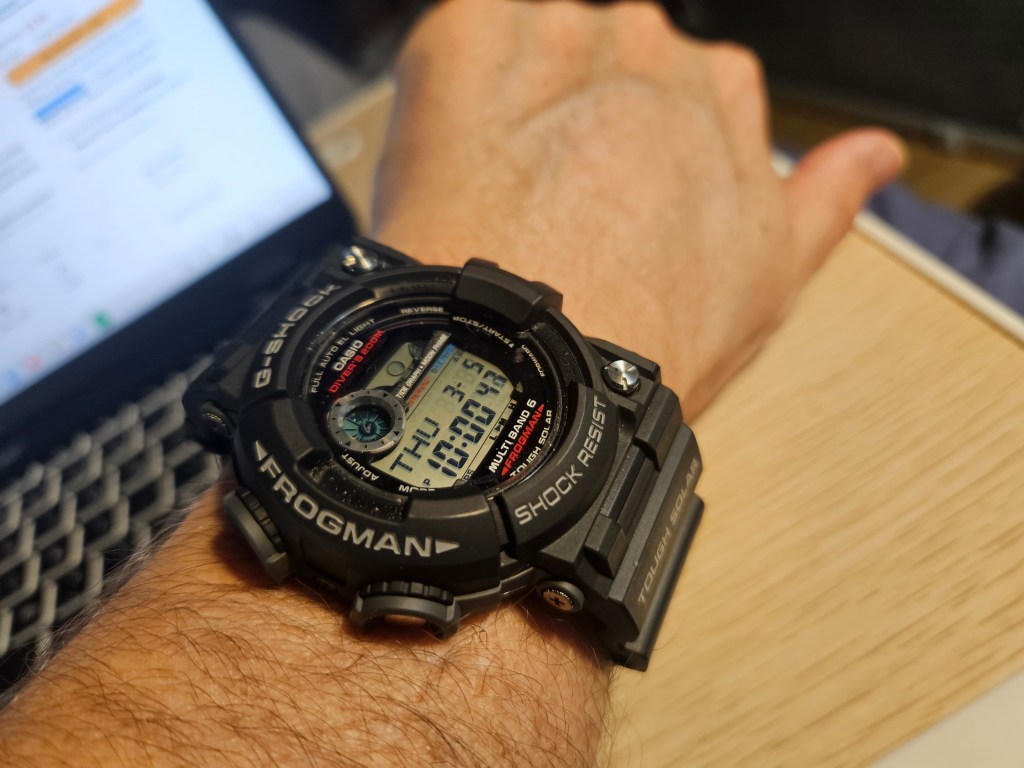
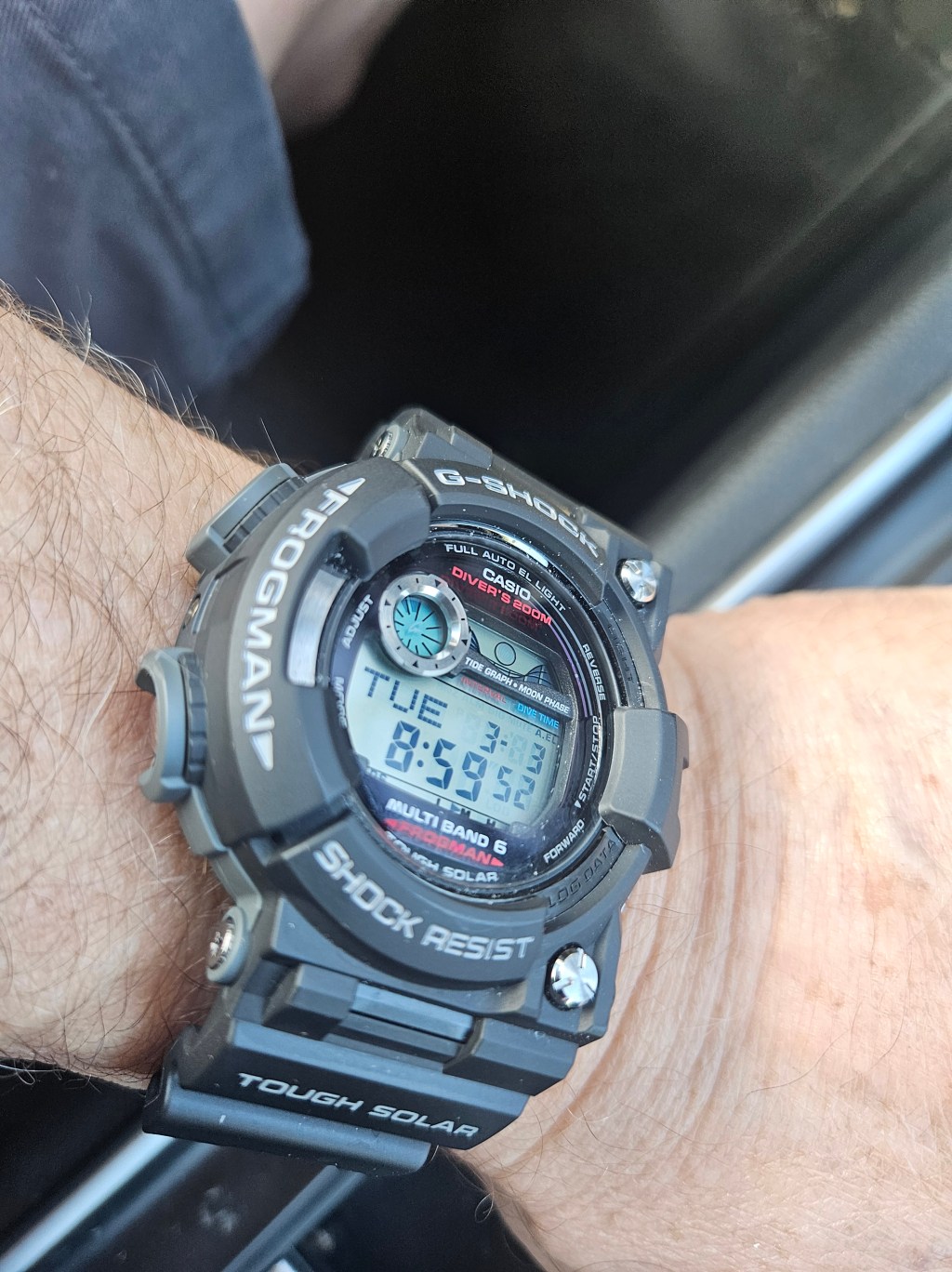
    If you’re buying the G-Shock Frogman GWF-1000-1JF, you need to abandon one illusion immediately: the fantasy that you are a solemn, high-minded “serious watch buyer.”

    Yes, the Frogman is a legitimate tool—ISO-rated, solar-powered, atomic-syncing, built like a bunker. It tracks tides. It handles world time. It could probably survive a minor meteor event.

    But let’s be honest.

    The Frogman is not a symbol of horological gravitas.
    It is a giant, unapologetic wrist toy.

    And that’s the point.

    This is not the watch of a restrained aesthete sipping espresso while discussing movement finishing. This is the watch of a twelve-year-old who never lost his appetite for adventure. The Frogman doesn’t whisper refinement. It shouts, Let’s go break something. It belongs just as comfortably on your wrist while you’re teaching rhetoric as it does while you’re wandering the house in gym shorts and a robe, pretending you might dive into the Pacific at any moment.

    So stop apologizing.

    Look at the thing. Smile.

    You’ve spent years marinating in the mythology of seriousness—heritage, prestige, restraint, the quiet dignity of brushed steel. Enough. Watches were never meant to be solemn artifacts of personal identity. They were meant to delight the eye, engage the hand, and give you a small surge of pleasure every time you check the time.

    What you’re practicing now is Gravitas Shedding—the psychological act of discarding the heavy costume of the “serious collector” and admitting a simple truth: if the hobby isn’t fun, it isn’t sustainable.

    Function still matters, of course. The watch should be well made, reliable, and usable. But once those boxes are checked, joy becomes the real criterion. The worst fate for any watch isn’t inadequacy—it’s boredom.

    Many enthusiasts have told me every collection needs at least one G-Shock for exactly this reason. A pressure valve. A reminder that watches don’t have to be precious.

    So after fifteen years of on-again, off-again longing, I finally did it.

    Last month I checked Sakura and saw the Frogman was out of stock. Prices on eBay were absurd. I assumed the window had closed. Case dismissed. Desire filed away.

    Then it reappeared.

    $440.
    $506 after shipping.

    Decision made.

    Now I have a new assignment: learn the dual-time function and actually use the thing when I travel. If I’m going to own a watch that can track the world, I might as well let it earn its keep.

    And I’ll admit it—I’m looking forward to the arrival more than I expected.

    I own beautiful mechanical divers. But when I picture myself in front of a classroom, talking about argument structure and logical fallacies, I don’t see a polished luxury piece on my wrist.

    I see the Frogman.

    Big. Black. Slightly ridiculous. Completely confident.

    Will it become my daily watch?
    Will it replace the others?
    Will it become my signature?

    That’s the experiment.

    The watch is on the way.

    We’ll see what happens.

  • G-Shock University: Studying for the Frogman Final Exam

    G-Shock University: Studying for the Frogman Final Exam

    My next personal project is to graduate from what I now call G-Shock University. Some people study Spanish. Others learn Italian. I, apparently, am trying to become conversational in Mode Logic.

    This is not my first attempt. Over the past twenty years, I’ve owned half a dozen G-Shocks, and every time the same thing happened: I opened the manual, felt like a tourist staring at a subway map written in hieroglyphics, panicked, and eventually sold or gave the watch away. I didn’t own the G-Shock. The G-Shock owned my anxiety.

    Not speaking the language of modes has been humiliating—like a prizefighter getting knocked out before the announcer finishes his name. But this time I want a comeback. This time I want fluency. Specifically, I want to master the Module 3184, the operating system inside the watch I’ve coveted for more than a decade: the digital Frogman GWF-1000.

    I don’t own the Frogman yet. First, I must earn it. I’m currently studying the operating guide like a nervous graduate student preparing for orals. I suffer from Mode Impostor Syndrome—the uneasy conviction that I am intellectually unqualified to own a feature-rich digital watch, combined with the quiet terror that someone will ask, “How do you switch time zones?” and I’ll freeze like a deer in tactical headlights.

    The interface is simple in theory: four buttons.
    Top left: A.
    Top right: B.
    Bottom left: C.
    Bottom right: D.

    Simple. Elegant. Also, somehow, psychologically menacing.

    Button C scrolls through the modes—the linguistic equivalent of changing verb tenses. My goal is modest. I want Timekeeping Mode set to LAX as my home city. I want World Time Mode so I can toggle easily when traveling to Miami, Cabo, or Maui. Diving logs, tide data, countdown timers, alarms—these are elective courses. I am here for conversational proficiency, not a doctorate.

    The manual’s tone is reassuring. Every complex procedure begins with a comforting phrase: First Thing You Should Do.

    The first thing, apparently, is to sit near a window. Already this feels less like a watch and more like a houseplant.

    From Timekeeping Mode, I hold A until the city code flashes. Then D moves east, B moves west, and eventually I land on LAX. Press A again to exit. Supposedly this locks in the Home City and sets the time.

    Supposedly.

    Here is where my second condition emerges: Mode Anxiety—the persistent fear that one wrong press will erase home time, activate some obscure subroutine, or send the watch into a digital wilderness from which it may never return.

    Page 6 introduces the Dual Time display. Press A to toggle between date and the selected World Time. This raises a terrifying question:
    Am I viewing another city… or accidentally reprogramming my home city to Miami?

    The last thing I need is to wake up in Torrance and discover I’m living psychologically in Florida.

    Manual time setting is even more daunting. Twelve variables: city code, DST, 12/24 format, seconds, minutes, hours, illumination duration, power saving, tone, day, month, year. This is no longer watch ownership. This is municipal governance.

    One setting, however, brings joy: button tone. Silence is essential. In Timekeeping Mode, hold A, press C nine times, toggle to Mute with D, press A to exit. At last, a victory. The watch will no longer beep like a microwave with opinions.

    Other questions remain.
    Do I need to manage DST, or will the radio signal handle it?
    How exactly do I move cleanly between Home and World Time without triggering a digital incident?

    At this point, I suspect what I really need is a one-hour Zoom session with a Professor of G-Shock Studies.

    Because this is no longer about a watch. This is about conquest.

    Like Ahab stalking the whale, I want to master the module and earn the right to wear the Frogman with confidence. What I’m really fighting is Frogman Qualification Anxiety—the belief that ownership of a high-end G-Shock must be earned through technical mastery, as if the purchase were a certification exam rather than a retail transaction.

    If I pass, I won’t just own a watch.

    I’ll finally be fluent.

  • Beauty Isn’t Enough: The Moment Desire Meets Reality

    Beauty Isn’t Enough: The Moment Desire Meets Reality

    We are, most of us, walking around with a quiet fracture. Something missing. Something we believe can be restored if only we find the right object, the right achievement, the right arrangement of circumstances. The trouble is that the very strategies we use to make ourselves whole often deepen the crack.

    Citizen Kane is the classic case study. Charles Foster Kane acquires everything—wealth, art, palaces, influence—only to die alone, whispering “Rosebud” like a man calling into an empty room. For all his possessions, he never possessed what he actually wanted: love. The sled was not valuable. It was a memory of unconditional belonging, the one thing money could not purchase.

    Once the unconscious decides that objects can deliver emotional completion, the trap is set. The shopping becomes symbolic. The acquisition becomes therapeutic. And the disappointment becomes inevitable.

    I would like to believe I’m immune to this logic. I am not.

    I’m not trying to buy love, exactly. What captures me is beauty. A gunmetal sports car. A finely finished watch. Once the image enters my field of vision, it begins to work on me. Beauty has a narcotic quality. It doesn’t argue. It persuades.

    When I was nine, my father and I would slow the car to stare at Corvettes and my personal holy object, the Opel GT. We didn’t own them. That hardly mattered. Looking was enough to induce a quiet intoxication.

    Some forms of beauty age well. Twenty years ago my wife and I bought a framed Botticelli Primavera from an antique store. It hangs in our living room today. I still find myself studying the figures, pulled into the scene as if it were unfolding in slow motion. The painting asks nothing from me except attention.

    Watches work differently.

    A beautiful watch does not merely sit on the wall. It demands a relationship. It asks to be worn, justified, integrated into daily life. And here the problem begins.

    I’m drawn to intricate designs—chronographs, textured dials, bold contrasts, mechanical drama. These pieces photograph beautifully. They mesmerize under good lighting. They whisper, You are a man of taste.

    But then I put them on.

    The dial is busy. The legibility suffers. The weight feels wrong. The watch stays in the box.

    That’s the gap—the quiet but decisive chasm between aesthetic admiration and lived use. Many of the most beautiful watches I’ve owned became box queens: admired, respected, and essentially abandoned.

    A fellow collector once told me he doesn’t mind owning watches he never wears. He thinks of them as wall art. People collect paintings for beauty; he collects watches the same way.

    I can’t do that.

    Unworn watches don’t calm me. They make me uneasy, like unfinished obligations. A watch that isn’t part of daily life feels less like art and more like a small, expensive mistake.

    Years ago, a neighbor let me drive his black Corvette—a childhood Rosebud made real. Within minutes, the spell broke. The cabin was cramped. The ride was harsh. Every bump transmitted directly into my spine. I handed back the keys with relief.

    The car looked magnificent. Living with it would have been miserable.

    That experience clarified something I’ve come to accept across watches, cars, and most objects of desire:

    Beauty alone is not enough.

    At some point, every enthusiast discovers a personal boundary—what might be called a Functional Integrity Threshold. It’s the moment when aesthetic appeal loses its authority because the object fails in comfort, usability, or daily harmony.

    Below that threshold, beauty is intoxicating.
    Beyond it, beauty becomes irrelevant.

    Give me both—form and function in alignment—or give me neither. Anything else is just another Rosebud waiting to disappoint.

  • Horological Deconversion: When the Romance Finally Breaks

    Horological Deconversion: When the Romance Finally Breaks

    I recently wrote an essay arguing that pursuing mechanical watches in a digital world is a kind of elegant absurdity—an expensive devotion to obsolete technology while the rest of civilization marches toward sensors, satellites, and software. My proposed remedy was simple and slightly heretical: sell the mechanicals and replace them with an atomic or Bluetooth G-Shock. Accuracy, durability, zero drama. Efficiency instead of romance. Sanity instead of ritual.

    The piece was meant to provoke. Not just readers—me. Writing, after all, is less self-expression than self-interrogation. As Kafka put it, it’s the axe for the frozen sea. Sometimes the ice you crack belongs to your own illusions.

    What began as a tongue-in-cheek thought experiment turned into something less comfortable. It forced me to examine the possibility that my love for mechanical watches isn’t love at all—it’s theology.

    Over the years I refined my taste, sold the excess, and curated a tight collection of mechanical divers. Vintage aesthetic. Tool-watch credibility. A faint whiff of James Bond climbing out of the ocean with a harpoon gun and moral certainty. I told myself this evolution reflected discernment, maturity, identity.

    But the thought experiment raised a harder question: Did I discover my taste—or manufacture it?

    Human beings have a habit of building sacred spaces inside a profane world. Perhaps my watches became sacred cows—objects elevated not because they were necessary, but because I needed something to stand against modern life. Mechanical time as resistance. Analog as virtue. Nostalgia as courage.

    In this story, I cast myself as a quiet rebel.

    But what if the story is fiction?

    What if I’m not resisting anything at all? What if I’ve simply joined a small tribe of aging enthusiasts who reassure each other that spending thousands on obsolete machines is an act of character rather than consumerism?

    At that point, the romance starts to look like cosplay.

    Thousands spent on purchase. Thousands more on service. All to reenact a cinematic memory of youth. The whole enterprise begins to resemble those baseball fantasy camps where middle-aged men pay to take batting practice with retired heroes and pretend, for a weekend, that the dream never ended.

    The thought experiment did something dangerous: it planted a fantasy.

    Sell everything.

    Replace the collection with one or two G-Shocks.

    Start over.

    The appeal isn’t the watch. It’s the psychological reset. The possibility of closing a chapter and reclaiming the mental bandwidth the hobby quietly occupies. Change, after all, is the most intoxicating drug available to a restless mind.

    I’ve felt this kind of impulse before.

    In 2005, after three decades of gym culture, I was standing in an LA Fitness in Torrance, wiping someone else’s sweat off a treadmill while pop music pounded overhead and everyone talked about nothing. The thought hit me with sudden clarity: I need to get out of here.

    Within a week I’d left the gym, bought kettlebells, started power yoga in my garage, and never went back. At the time it felt impulsive. In hindsight, it was alignment—something deep finally overriding inertia.

    I sometimes wonder if watch collectors experience the same internal shift—the moment when accumulation feels less like passion and more like weight. The urge to take a wrecking ball to the collection. To simplify. To breathe.

    This moment has a name: Horological Deconversion—the quiet psychological turn when watches stop looking like identity and start looking like artifacts of habit, mythology, and sunk cost.

    I know someone who went through it. A serious collector. Deeply invested. One day he had the overwhelming urge to sell everything and replace the collection with a $20 Casio F-91W. Eventually he did. He told me the move saved his sanity.

    He still reads the forums. Still watches the madness unfold. But now he’s an observer, not a participant. The zoo is still interesting when you’re no longer inside the cage.

    Anyone who sells their mechanical collection, buys a single indestructible digital, and walks away lighter will have my respect. Not because minimalism is virtuous, but because exits are hard. Leaving a closed system always is.

    There’s something quietly heroic about it—the horological version of a Shawshank escape. Crawl through the tunnel. Emerge on the other side. Stand in the rain and realize the prison was partly self-built.

    And somewhere beyond the walls, there’s a small, durable watch keeping perfect time—and a life of freedom and expanding possibilities.

  • Why a G-Shock Frogman Makes More Sense Than a Mechanical Collection

    Why a G-Shock Frogman Makes More Sense Than a Mechanical Collection

    If you come to me and confess that you’re curious about my watch hobby—intrigued, even—and ask for guidance so you can pursue the passion with the same enthusiasm, I won’t welcome you into the brotherhood.

    I’ll stop you at the door.

    If you are currently free from thoughts of watches, I will advise you to remain free. Walk away. Continue your life as a relatively sane and solvent human being. Because the mechanical watch hobby, viewed without romance or nostalgia, makes less and less sense in the modern world.

    You are paying premium money for obsolete technology in an age that worships useful technology. Why spend six thousand dollars on a Swiss machine that tells you the time when a five-hundred-dollar fitness watch can monitor your heart, track your sleep, detect arrhythmias, and quietly send your vital signs to your doctor before you collapse in a parking lot?

    Mechanical watches don’t make you healthier. They make you sentimental.

    The future is not kind to sentiment. As the world moves away from mechanical timekeeping, competent service will become slower, rarer, and more expensive. Your treasured watch will eventually be packed into a padded box and shipped across the country—or the ocean—where it will sit for months awaiting lubrication, regulation, or a gasket replacement. When it returns scratched, delayed, or mysteriously altered, you’ll enter a corporate complaint system so backlogged it feels less like customer service and more like geological time.

    Meanwhile, the social currency that once justified the expense is quietly evaporating.

    There was a time when a fine mechanical watch signaled professional success. Doctors noticed. Lawyers noticed. Bankers noticed. Today, most people don’t know a Rolex from a Fossil, and many don’t notice watches at all. The design language of luxury horology is becoming a private dialect spoken by a shrinking tribe.

    This is where the collector encounters Analog Futility Syndrome: the slow, uncomfortable realization that enormous resources are being poured into a technology that no longer solves a modern problem. The pleasure remains—but it is shadowed by a faint, persistent question: Why am I doing this?

    Meanwhile, the cultural signaling has inverted.

    Show up wearing a $500 solar-powered G-Shock that works everywhere, never needs service, survives abuse, and keeps atomic time, and people read something entirely different. Efficiency. Practical intelligence. Optimization. The G-Shock wearer looks like a person who solves problems, not one who collects them. The same watch works at the office, on a trail, or on a flight across time zones. It whispers competence. It suggests you might belong to MENSA. Or at least that you don’t spend your evenings arguing about bezel fonts.

    So if you ask me how to become a watch enthusiast, I will not guide you toward Swiss luxury and its Ferrari-like maintenance costs. I will point you toward the solar, radio-controlled, GPS-enabled tools that actually serve a modern life.

    A GPS Master of G Rangeman.
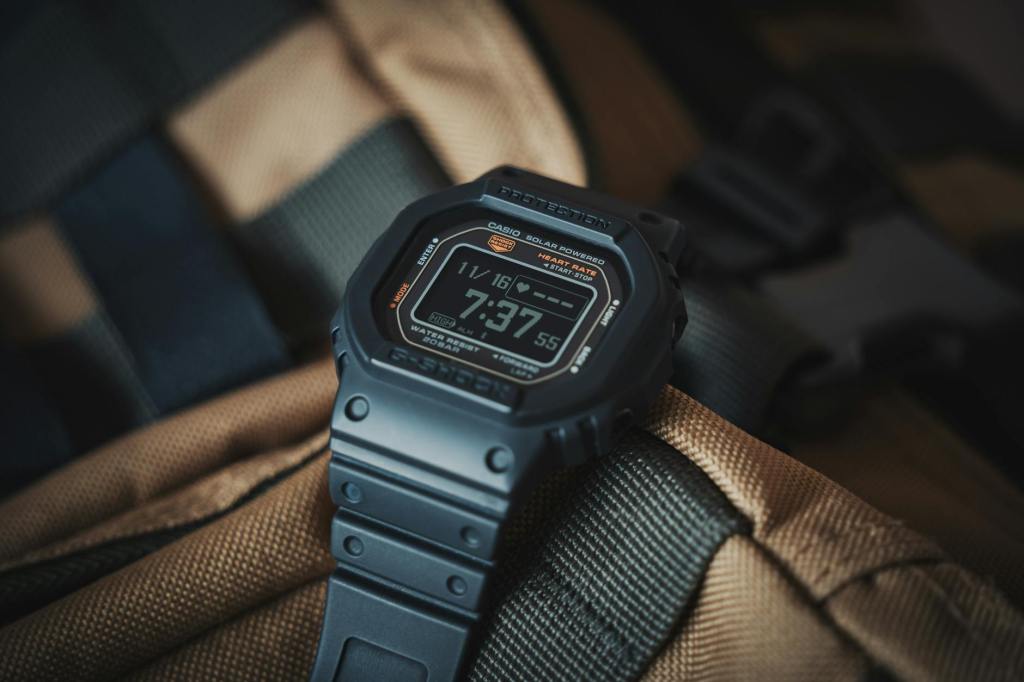
    A radio-controlled square.
    The digital Frogman.

    Real time anywhere. Light weight. Near-zero maintenance. Functional serenity.

    Writing this advice to you has caused something strange to happen to me while composing it. The argument has pointed an accusatory finger toward me. What began as guidance for you has become a prosecution of my imbecilic watch hobby.

    The longer I write, the more irritated I become at my own years of horological excess—years spent chasing mechanical romance while quietly accumulating cost, inconvenience, and low-grade anxiety.

    I may have to sell everything.

    I may have to replace the entire collection with a single indestructible digital watch and walk away.

    You think I’m exaggerating. I am not.

    Writing this has triggered a full-blown Horological Renunciation Fantasy: the emotionally charged vision of liquidating every mechanical piece and replacing them with one maintenance-free instrument—liberation not from watches, but from the psychological gravity of owning too many of them.

    The fantasy is seductive. I can’t imagine being happy right now unless I sell all my mechanicals and replace them with a digital Frogman.

    And that should tell you everything you need to know about the hobby.

  • Why Your Watch Doesn’t Make You Happy Anymore

    Why Your Watch Doesn’t Make You Happy Anymore

    To understand the madness of the modern watch addict, you’d do well to consult Dopamine Nation by Stanford psychiatrist Anna Lembke, a book that should be shelved somewhere between philosophy, neuroscience, and quiet screaming. Her central thesis? In an age of relentless indulgence, the line between pleasure and pain is not only blurry—it’s the same neurological pathway. You’re not escaping pain with your latest acquisition. You’re feeding it.

    “The smartphone,” she writes, “is the modern-day hypodermic needle.” And the drug? Dopamine—delivered in neat little parcels: TikToks, tweets, memes, and yes, wrist shots of watches you don’t own (yet). If you haven’t met your poison of choice, don’t worry. It’s just a click away.

    Lembke makes the uncomfortable truth clear: The more dopamine hits we seek, the more our brain adapts by reducing our baseline pleasure response. What once thrilled you—your grail watch, your Rolex Explorer, your Seiko with the Wabi-Sabi patina—now barely registers. You’re not chasing pleasure anymore. You’re just trying to feel something.

    Watch addicts, of course, understand this intimately. The pursuit of horological perfection starts out innocent enough: a G-Shock here, a vintage diver there. But soon you’re tumbling into the abyss of boutique limited editions and message board enablement, haunted by the need to stay relevant. Because here’s the twist: It’s not just about the watches. It’s about being seen. You post, you review, you flex because if you stop, you vanish. No new watches = no new content = digital extinction.

    And extinction, in a social-media world, feels like death.

    Lembke warns us that addiction thrives in secrecy, in the exhausting double life. The watch addict may present as a tasteful minimalist to family and friends, while secretly rotating 19 watches, five straps deep, waiting for the next “drop.” The addiction is fed by access, and we live in an access economy. New releases are no longer annual events—they’re hourly temptations. The vortex is bottomless. The supply creates the demand.

    Even worse, modern society normalizes this behavior. Everyone is scrolling. Everyone is upgrading. Our addiction to novelty is passed off as taste. Our frenzied consumption masquerades as identity. Lembke borrows from Philip Rieff to explain the deeper shift: “Religious man was born to be saved; psychological man is born to be pleased.” The modern watch collector doesn’t believe in salvation. He believes in configuration.

    But here’s the cruel irony: The more you seek to be pleased, the less capable you are of being pleased. In Lembke’s words: “Hedonism, the pursuit of pleasure for its own sake, leads to anhedonia—the inability to enjoy pleasure of any kind.”

    You can understand the watch addict’s feeble quest when you look at the Horological Dopamine Loop–the self-reinforcing cycle in which acquisition, posting, validation, and anticipation replace enjoyment. The watch no longer delivers pleasure; it merely resets the craving for the next hit.

    What’s the solution? A dopamine fast. Lembke prescribes it like a bitter medicine: Remove the source. Reset the brain. Let it reestablish homeostasis. For the watch addict, this means one thing: a watch fast.

    And yes—it’s brutal. I’ve been a watch obsessive for over twenty years. My longest fast? Six months. And I nearly went feral. New releases tempt. Friends enable. Algorithms whisper. Strap swaps and vintage reissues beckon like sirens. Even the FedEx truck starts to look like a personal tormentor.

    So you get creative. You stash watches in the safe and “rediscover” them. You buy new straps instead of new watches. You try to redirect the compulsion toward something productive: fitness, music, sourdough, monkish austerity. Anything but another chronograph.

    But the real cure, oddly enough, may be conversation—actual human connection. At watch meet-ups, we start out discussing bezels and spring bars, but within ten minutes we’re talking about life: real estate, parenting, knee surgeries, emotional burnout, dinner recipes. We talk for hours. But barely about watches.

    The truth slips out in these moments: we want to be free. We crave community more than we crave sapphire crystals. What began as a shared obsession has become a trap, and these conversations, paradoxically, offer relief from the very addiction that brought us together.

    Imagine a bunch of watch enthusiasts at a watch meet-up and we’re talking about everything but watches. Wrap your head around that.

  • Applause Collapse and the Perils of a “New Direction”

    Applause Collapse and the Perils of a “New Direction”

    There comes a moment in every watch influencer’s career when he believes—sincerely, even nobly—that his audience is ready to applaud his growth. He has done the hard work. He has pared down. He has purified. Five watches remain, all on straps, each presented as evidence of restraint and moral clarity. The comments are approving. The tone is reverent. He is, at last, becoming free.

    Naturally, this serenity bores him.

    So he shakes things up. Three new watches enter the fold. The collection now stands at eight—four on straps, four on bracelets—symmetry restored, balance achieved. He announces a “new direction.” He films a YouTube video about his “evolving philosophy.” He speaks earnestly of equilibrium, versatility, and personal growth. The framing is careful. The lighting is soft. The music is tasteful. He waits for the applause.

    It does not come.

    Instead, the comment section turns cold. The audience, once indulgent, becomes prosecutorial. I thought you were healing. This feels like relapse. You were doing so well at five. The verdict is unanimous and devastating: the addiction has returned. What’s worse is not the criticism itself, but its accuracy. The influencer feels it immediately, like a clean punch to the ribs. The comments articulate the doubt he was trying not to hear.

    Shame sets in. He replays the video and cringes at his own rhetoric. “Quest for balance” now sounds like a euphemism. The watches feel heavier on the wrist. Within weeks, he detonates the entire enterprise. Seven watches are given away. One remains, kept on a strap, stripped of pleasure and worn more as a reminder than an object of joy. He deletes his YouTube channel. He nukes Instagram. He earns a kettlebell certification. He eats clean. He helps clients. He speaks of social media with quiet contempt, like someone describing a former addiction he has sworn never to touch again.

    This is Applause Collapse: the moment an influencer unveils a carefully staged transformation, expecting affirmation, only to encounter moral disappointment so severe that disappearance feels like the only honest response. It is not the loss of praise that breaks him. It is the realization that the crowd was not watching his journey—they were auditing his compliance.