Category: technology

  • The Gospel of the Multiband 6 Solar G-Shock

    The Gospel of the Multiband 6 Solar G-Shock

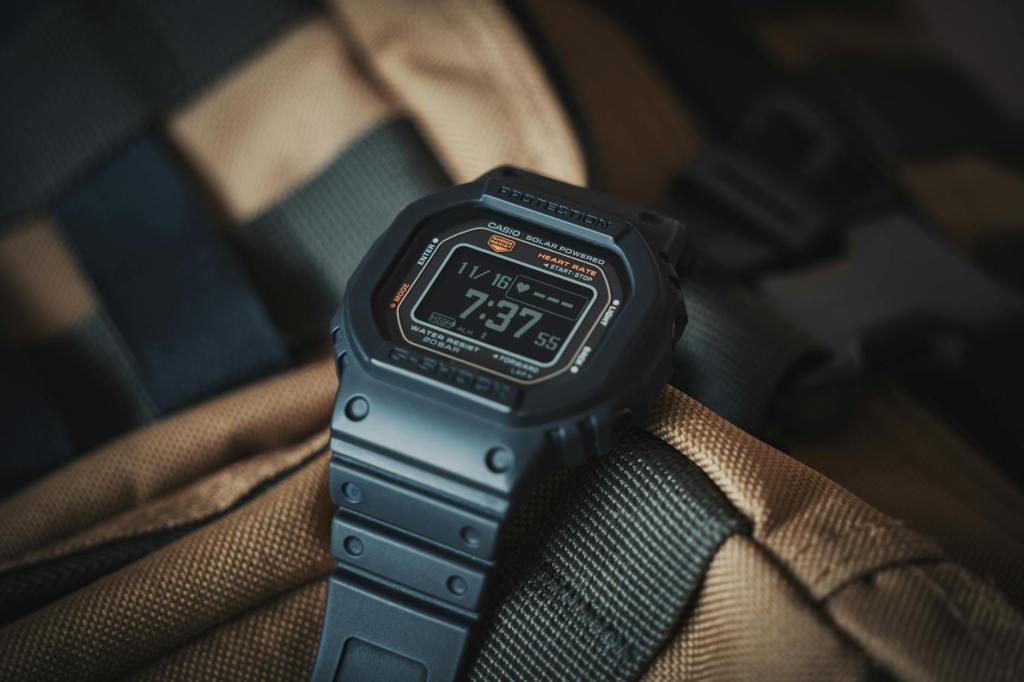
    If you’re drawn to a Multiband 6 solar G-Shock, you may possess what could be called the engineer mind—the temperament that treats maintenance as failure and automation as a moral good. You don’t want a watch so much as a system instance or virtual machine running on your wrist.

    A proper watch, in your view, should set itself, power itself, correct itself, and never—under any circumstances—require the fussy rituals of mechanical ownership. Manual winding feels like typing commands that should have been automated. Battery changes feel like scheduled downtime. Service intervals feel like flawed architecture. What you want is operational silence: install once, forget forever.

    For you, reliability isn’t a feature; it’s a philosophy. Drift is offensive. Inaccuracy produces low-grade anxiety. Atomic synchronization delivers more than precision—it delivers relief, the quiet satisfaction of knowing the number is exactly right, the emotional equivalent of clean code and zero errors. 

    Solar power satisfies the same instinct. External dependency is weakness. Self-sustaining systems feel intelligent. Over time, the watch stops feeling like an object and starts behaving like a background process—always running, never demanding attention, never crashing.

    Status signaling holds no appeal. Flash invites conversation, and conversation about objects is noise. A Multiband G-Shock communicates competence the way a well-organized server rack does: quietly, efficiently, and without asking to be admired. Like a good waiter, it serves your needs without being intrusive.

    Adding to its appeal, its overbuilt case, shock resistance, and water tolerance reflect your respect for systems designed for field conditions rather than showroom lighting. It performs like good infrastructure—essential, invisible, and indifferent to opinion.

    You may tell yourself it’s just a tool, but the attachment runs deeper. You move through a world that feels increasingly unstable, and the watch becomes an ally in your search for order. Each morning glance is less a habit than a systems check. Did it sync overnight? Is everything aligned? That small confirmation carries disproportionate comfort: something, somewhere, is still working exactly as designed.

    This is the onset of Operational Silence Dependency—the quiet attachment that forms when you come to value a device not for what it does, but for what it never asks you to do. The ideal tool makes no demands, sends no alerts, requires no rituals, and never interrupts your day with the mechanical equivalent of small talk. It sets itself, powers itself, corrects itself, and disappears. Over time, you stop noticing its presence and start depending on its absence of problems.

    You’ll know the shift is complete when you wear it through everything—sleep, showers, travel, deadlines, minor crises—because taking it off feels less like removing a device and more like disconnecting a trusted process.

    The depth of the bond becomes obvious when “upgrades” appear. New models promise new features, but you hesitate. Bluetooth, for example, strikes you as a category error. You prefer Multiband for the same reason a systems administrator prefers a cron job to a phone call: one is infrastructure; the other is a relationship. Atomic sync happens quietly in the night—no pairing, no permissions, no firmware prompts, no cheerful reminders to “stay connected.” Bluetooth drags the watch into the emotional ecosystem of the smartphone: updates, battery anxiety, dropped connections, and the faint suspicion that something somewhere needs your attention.

    Multiband 6 is operational dignity—set once, corrected by physics and radio towers that don’t need passwords. To the engineer mind, atomic time isn’t just elegant. It’s morally superior. Bluetooth asks for interaction. Multiband delivers silence—and silence, in your worldview, is the sound of a system working perfectly.

    So you won’t be replacing your Multiband 6 watch with the new Bluetooth model. The current one has proven itself. Replacing it would feel less like upgrading hardware and more like retiring a colleague who has never missed a deadline.

    Over the years, the watch absorbs your history—projects completed, trips survived, long stretches of life that passed without drift or failure. At that point, it is no longer equipment. It is continuity on the wrist: an uncomplaining witness, a small island of order carried through a world that rarely behaves as predictably as your watch does.

    The story doesn’t stop here. Over time, something subtle happens. The watch stops being something you wear and becomes something you operate with. Your rhythms align. You wake, it has already corrected itself. You move through deadlines, travel, minor crises, and long uneventful stretches, and it keeps the same quiet pace—never drifting, never asking, never failing. You stop thinking about it the way a pilot stops thinking about a reliable instrument: not because it’s unimportant, but because it’s always right. Somewhere along the way, the relationship shifts from ownership to partnership. You handle the chaos; it handles the time. Together you form a small, efficient system—human judgment paired with mechanical certainty. In a noisy, unreliable world, the two of you run clean, synchronized, and uninterrupted, less like a man and his watch and more like a single unit that simply works.
  • The Great Rangeman Dilemma

    The Great Rangeman Dilemma

    You should be grading over a hundred student essays right now—papers waiting patiently for marginal comments, thesis corrections, and the quiet mercy of a final score. Instead, you are wrestling with a question of far greater cosmic importance, a problem so profound it makes theological disputes such as substationary atonement look like small talk: Should you buy the positive or negative display of the G-Shock Rangeman GW-9400?

    After hundreds of hours on Reddit and YouTube—an advanced degree in amateur Rangeman studies—you have learned the central truth of the universe. The negative display looks better. The positive display works better. And now you stand at the fork in the road where beauty and usability glare at each other like rival theologians.

    Choose the negative display and you will live with Legibility Anxiety—the persistent suspicion that your watch looks magnificent but requires negotiation every time you want the hour. Choose the positive display and you inherit Aesthetic Anxiety—the quiet sense that you chose practicality at the expense of tactical cool. Either way, you lose something essential.

    Of course, there is the nuclear option: buy both. But this only deepens the disorder. Now each morning becomes a moral trial. Whichever watch you choose indicts the other. You will experience Rotational Guilt, the daily awareness that satisfaction has been structurally engineered out of the system.

    Welcome to the Great Rangeman Dilemma—the condition in which a minor consumer choice expands into a metaphysical crisis because every option comes preloaded with future regret. Time disappears into comparison videos, comment threads, lighting tests, and wrist shots while your actual obligations—those hundred essays—sit quietly aging like milk on the counter. The dilemma is not about watches. It is about the mind’s ability to convert a simple decision into a no-win psychological contract where perfection is mandatory, satisfaction is temporary, and productivity flatlines.

    Do not berate yourself for failing to solve it. Many have entered this labyrinth. None have emerged with certainty.

    Now close the browser.

    Your students are waiting.

  • The Cure for Function Abandonment Syndrome

    The Cure for Function Abandonment Syndrome

    You encounter a Rangeman owner who worships the stealth blacked-out model with a devotion bordering on performance art. He will tell you, calmly and without irony, that he can’t actually read the time on the negative display. It doesn’t matter. The watch stays on the wrist because it looks lethal—pure shadow, pure attitude, pure presence. Time, apparently, is now a secondary feature.

    Think about the pivot this represents. The man did not buy a timepiece; he bought an image. The geometry, the matte darkness, the tactical aura—these are the real functions. The digits exist somewhere inside the case, like a ceremonial appendix. If the light is right and the wrist is angled just so, the hour may reveal itself. But that’s incidental. The watch is no longer consulted. It is displayed.

    He resembles the fellow who once insisted he read glossy magazines for the articles, only to admit later that the articles had become irrelevant long ago. Content is gone. Only the visuals remain. In the same way, this enthusiast has crossed the line from horology to aesthetic intoxication. The watch no longer tells time. It tells a story about the man wearing it.

    Such a man is suffering from Function Abandonment Syndrome—the condition that sets in when a watch enthusiast quietly releases the expectation that the watch perform its basic task and begins wearing it purely for appearance, mood, or identity. Legibility becomes optional. Accuracy becomes theoretical. The time is technically available somewhere—under ideal lighting, at a cooperative angle—but that’s no longer the point. The owner has crossed the invisible threshold where tool becomes sculpture and utility becomes a nostalgic rumor. He doesn’t check the watch anymore; he acknowledges it. Function Abandonment Syndrome is what happens when style overwhelms purpose and the job description is politely retired without ceremony.

    Is there a cure for his condition? Yes. Imagine this: He lives happily in the glow of his blacked-out Rangeman until the day function suddenly matters again. Picture this: he’s driving a lonely stretch of highway at dusk when the fuel light comes on and the next gas station is closing in five minutes. His phone is dead. The dashboard clock is gone. All he has is the watch he chose for its “presence.” He lifts his wrist. Tilts. Squints. Rolls it toward the fading light like a man trying to read smoke signals from the wrist. The digits hover there, shy and evasive, revealing nothing but his own poor life choices. The station lights flicker off in the distance. In that moment—heart rate climbing, range dropping, darkness settling—he experiences the cold, clarifying terror that ends Function Abandonment Syndrome forever. Because style is thrilling in the showroom. But when the world gets real, the most beautiful watch on earth is the one that will tell you the time the first time you ask.

  • Avoid the Trap of Negative Display Frustration

    Avoid the Trap of Negative Display Frustration

    You saw them everywhere—YouTube thumbnails glowing with reverence, Reddit threads humming like revival meetings. The stealth blacked-out Rangeman was spoken of in near-mythic tones: the ultimate G-Shock, the watch for men who preferred shadow to spotlight. Yes, a few owners admitted the legibility could be… aspirational. But they waved off the concern with a shrug and a grin. One YouTuber confessed he could barely read the time at all, then declared it didn’t matter because he was “Mr. Rangeman.” He slipped into his convertible, wrist angled heroically toward the camera, and drove into the sunset wearing a watch he couldn’t read. He looked happy. Convincingly happy. You believed him.

    You loved the look too. This wasn’t vanity, you told yourself—it was discipline. The negative display felt tactical, restrained, professional. Less gadget, more issued equipment. On the wrist it carried authority without noise. In photos it was perfect: dark, serious, quietly dangerous. The positive display suddenly seemed cheerful, almost friendly—the wristwear equivalent of smiling too much in a job interview. You chose the darker path, convinced you were choosing character over comfort.

    At first, the illusion held. Outdoors, under strong light, the display looked sharp and purposeful. The watch projected competence. It matched the identity you’d purchased along with it: efficient, understated, immune to flash. But then the watch met real life—offices with flat lighting, restaurants with mood lighting, mornings before coffee, evenings after fatigue, quick glances from imperfect angles. The time was always there in theory. In practice, it behaved like a reluctant witness.

    This is the quiet prelude to Negative Display Frustration—the slow erosion that begins when a watch chosen for its stealthy authority requires negotiation for the basic privilege of reading the hour. It starts small: a longer glance indoors, a wrist tilt here, a button press there. Over time, the effort accumulates into low-grade irritation. The display still looks magnificent, but the relationship has shifted. The watch no longer serves effortlessly; it asks for cooperation.

    And the case studies are everywhere. Thousands of owners eventually surrender, trading their negative Rangeman for the positive version and reporting something close to psychological recovery. The lesson is not subtle. In the long run, aesthetics create admiration—but legibility creates peace. Cool impresses the eye. Clarity keeps the mind quiet.

  • The Stoic’s Watch: Time Without Drama

    The Stoic’s Watch: Time Without Drama

    A true Stoic would not own a watch for the same reason he would not carry a barometer for his feelings: he refuses to outsource his inner life to a device. He already understands the only clock that matters—mortality—and that one keeps perfect time whether he wears a tourbillon, a quartz, or nothing at all. To strap a machine to his wrist to measure passing hours would seem redundant, like bringing a flashlight to high noon. The Stoic does not ask, “What time is it?” He asks, “Am I using this moment well?” The watch obsessive counts seconds; the Stoic counts attention. One fears being late. The other fears arriving at the end of life having spent it checking the time.

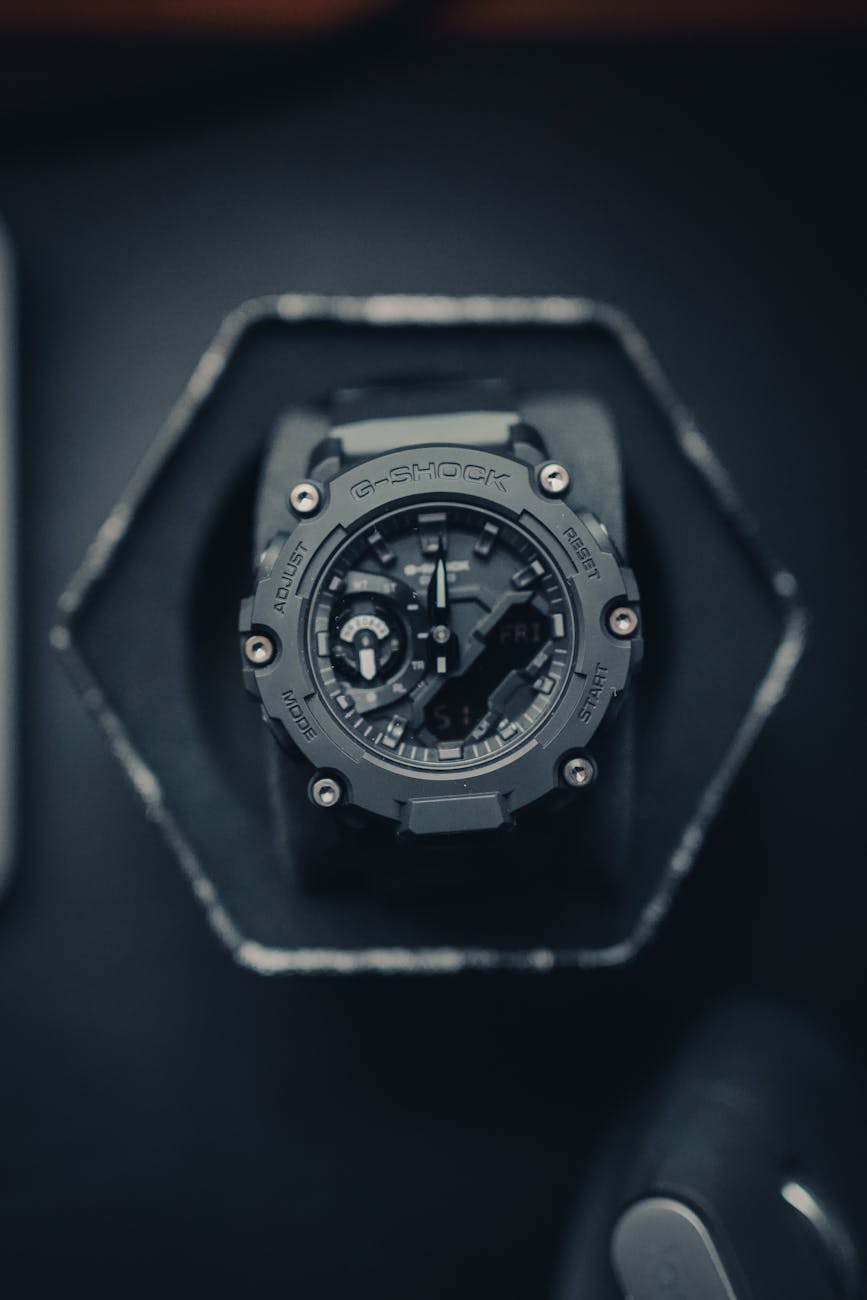
    But if the Stoic were compelled—by work, social expectation, or some bureaucratic indignity—to wear a watch, he would choose the Casio G-Shock GW-5000U without hesitation. It is austere, precise, and immune to vanity. Solar-powered, radio-synchronized, shockproof, and quietly overbuilt, it asks nothing and requires nothing. No winding. No setting. No polishing. No emotional relationship. It neither gains nor loses time, attention, or dignity. Most important, it attracts no interest from others. The Stoic does not want a watch that expresses his identity; he wants one that removes the subject entirely. The GW-5000U does what the Stoic tries to do himself: endure without complaint, perform without drama, and refuse the temptation to turn function into theater.

    This philosophy can be called Instrumental Minimalism: the discipline of choosing tools that perform their function completely while imposing zero psychological, aesthetic, or maintenance burden. A proper tool should disappear into the background of life. The moment an object asks to be admired, discussed, or emotionally managed, it has already failed its purpose. The Stoic does not wear a watch to feel something. He wears it so he can forget about it—and return his attention to the only instrument that matters: how he spends his time.

  • From Luxury Dreams to G-Shock Atomic Reality

    From Luxury Dreams to G-Shock Atomic Reality

    I made a YouTube video about my G-Shock Frogman and my growing inability to take it off my wrist. The response was immediate and disproportionate. The video drew ten times the comments I typically get when I talk about mechanical watches.

    That told me something important.

    The passion inside the G-Shock world isn’t just strong. It’s combustible.

    What surprised me even more was the pattern many viewers described. It ran directly against the standard collector narrative—the familiar climb from inexpensive watches up the luxury ladder, the gradual refinement that ends with an Omega, a Tudor, and the quiet satisfaction of having “arrived.”

    Many G-Shock owners reported the opposite trajectory.

    They did climb the ladder. They bought the Swiss pieces. They tasted the luxury world. And then something happened.

    They discovered atomic time.

    One comment captured the shift perfectly: the plan had been to move from entry-level divers into Tudor. But after experiencing the precision of a radio-controlled G-Shock, mechanical watches stopped making sense. The Tudors remained—for weddings, formal events, the occasional appearance—but daily life belonged to the digital watch.

    The romance didn’t fade gradually.

    It collapsed.

    What replaced it wasn’t thrift or minimalism. It was something colder and far more powerful: precision, efficiency, optimization. The watch was no longer a story. It was a system.

    This transformation deserves a name: Precision Conversion.

    Precision Conversion is the moment a collector crosses an invisible line. He stops wearing watches for heritage, craftsmanship, or the poetry of miniature machinery and starts wearing them for one unforgiving reason: they are correct.

    It often begins quietly. One morning, the atomic watch has synchronized overnight. No drift. No adjustment. No uncertainty. The time is simply right—down to the second, without effort, without supervision.

    After that, the mechanical watch changes character.

    What once felt soulful now feels approximate. What once felt charming now feels like a pleasant but unreliable narrator. The convert doesn’t lose respect for craftsmanship. He loses tolerance for romance that runs five seconds fast.

    Accuracy begins to feel like moral clarity. Self-correction feels like intelligence. A watch that needs adjusting starts to look less like a companion and more like a hobby that forgot its primary responsibility.

    And here’s the important part.

    Money never came up.

    Not once.

    These comments weren’t about saving cash or avoiding luxury. For true G-Shock converts, the affordability is incidental—almost accidental. The lower price isn’t the motivation. It’s simply a pleasant side effect.

    In this world, G-Shock isn’t the budget choice.

    It’s the rational one.

    The price, as the believers would say, is just icing on the cake.

  • The Frogman Effect: When the Algorithm Beats the Essay

    The Frogman Effect: When the Algorithm Beats the Essay

    On a good day, my blog draws between 100 and 150 readers. Each post is labored over like a piece of furniture: sanded, polished, adjusted until the grain of my interior life shows through. I wordsmith. I revise. I try to put something honest on the page.

    My readers appreciate it.

    Then they tell me to make a video.

    To them, the blog is fine—earnest, thoughtful, respectable. But what they really want is the moving version of me: voice, wrist shots, confession, immediacy. When I wrote about my G-Shock Frogman and its disruptive takeover of my watch life, the post attracted the usual slow trickle—perhaps a hundred readers over the course of a month.

    Then I made a video: I Am the Frogman.

    I talked about the asymmetrical case, the atomic precision, the way the digital display had pushed my mechanical divers into temporary retirement. I admitted I would probably oscillate between the two worlds, letting digital utility and mechanical romance take turns running my wrist.

    Within twenty-four hours, the video crossed 2,000 views.

    The message was clear. If I want reach, connection, and conversation, the camera wins. The keyboard, by comparison, is a quiet room at the back of the building.

    And yet, the blog stays.

    Because the difference between video and writing mirrors the difference between my atomic Frogman and my mechanical divers. One is immediate, energetic, communal. The other is slower, quieter, and inward. Moving between them isn’t a compromise. It’s therapy.

    I’ve come to think of this rhythm as Complementary Universe Rotation.

    The high-stimulation world—YouTube, comments, rapid feedback—makes the hobby feel alive. People react. They argue. They confess their own obsessions. The tribe gathers. Energy multiplies. A private fascination becomes a shared event, and that shared energy feeds motivation. It reminds me that this strange fixation on timepieces is, at its core, a social language.

    But energy comes with a tax.

    Too much exposure to opinions, releases, hype cycles, and algorithmic excitement slowly shifts the center of gravity. Comparison creeps in. So does FOMO. Without noticing it, enthusiasm becomes performance. The hobby stops being felt and starts being acted.

    That’s when writing rescues me.

    The blog is the low-stimulation world. No algorithm urgency. No comment storms. Just a blank page and a stubborn question: Why do I actually care about this watch? Writing forces distance. Distance restores perspective. Editing turns noise into narrative. Instead of reacting to the hobby, I interpret it. The page brings me back to myself.

    Moving between these worlds creates a flywheel. Community energy fuels interest. Solitude converts that energy into clarity. That clarity, in turn, makes the next video more grounded, less reactive, less infected by hype. Over time, this rotation produces something rare among collectors: stability. Fewer impulse decisions. Fewer mood swings disguised as strategy. A deeper attachment to the watches that survive the noise.

    The rotation also protects pleasure itself.

    Constant exposure dulls the senses. Too many releases, too many opinions, too much content—it’s palate fatigue. Writing creates absence. Absence restores appetite. When I return to the high-energy world, the excitement feels earned again rather than manufactured. Each universe cleans up the excess of the other: community drains isolation; solitude drains hype.

    This isn’t just a content strategy.

    It’s a survival strategy.

    Video answers the question: What excites people?
    Writing answers the more dangerous question: What actually matters to me?

    If I lived only in the video world, I’d drown in noise. If I lived only on the blog, I’d dry out in isolation. But rotating between them keeps the system balanced. The energy flows without overheating. The interest deepens without drifting.

    In the end, my watch hobby doesn’t thrive in a single environment.

    Like my wrist moving between atomic digital and mechanical romance, it lives best in parallel universes—where the crowd keeps the fire burning, and the quiet keeps it from burning out.

  • Dear G-Shock: Digital Is Your Superpower—Stop Pretending Otherwise

    Dear G-Shock: Digital Is Your Superpower—Stop Pretending Otherwise

    My G-Shock Frogman is the only digital watch in my collection, and lately it has been delivering an uncomfortable truth: accuracy and legibility beat romance.

    Atomic time. Perfect clarity. No guessing. No squinting. No interpreting the vague position of a minute hand drifting between markers like a tired compass. The Frogman tells the truth instantly, and once you get used to that level of honesty, the charm of slightly inaccurate mechanical time begins to feel less like character and more like indulgence.

    This is G-Shock’s genius. Not sapphire. Not titanium. Not luxury pricing. The magic is the display—bold, clean, readable at a glance, under stress, in motion, in the dark, in real life.

    Which is why I’m baffled by the company’s recent flirtation with high-end analog Frogman and Mudmaster models.

    Analog? From G-Shock?

    No. Just no.

    The legibility is compromised. The immediacy is gone. The very thing that made the brand indispensable—clarity—gets traded for something it was never built to do well: prestige analog aesthetics. And then the price climbs north of a thousand dollars, as if sapphire can compensate for the loss of purpose.

    Why would anyone pay luxury money for second-rate analog from a company that built its reputation on digital superiority?

    This is a category error. A brand identity crisis.

    It reminds me of those hybrid fast-food experiments you see around Southern California—the Taco Bell–Pizza Hut combination. You pull into the parking lot expecting tacos. You walk inside and there’s pizza. Technically, both foods are fine. But together, something feels wrong. Confused. Compromised. Like two identities sharing a space without sharing a soul.

    An analog G-Shock feels the same way.

    For digital precision, I want my Frogman GWF-1000: atomic, solar, brutally legible.
    For analog craftsmanship, I’ll take my Seiko Tuna: bright all-night lume, visual depth, the full romance package.

    Two different worlds. Two different languages. Each excellent on its own.

    What I don’t want is a brand forgetting what made it great.

    This is the Lane Integrity Principle: a brand earns loyalty by mastering one thing and doing it better than anyone else. When a company built on uncompromising digital clarity starts chasing analog prestige, trust erodes. Enthusiasts don’t care how expensive the materials are. They care whether the product still honors the original promise.

    G-Shock’s promise was never luxury.

    It was certainty.

    And certainty, like good design, works best when it stays in its lane.

  • The Frogman Conversion: When a Mechanical Loyalist Defects

    The Frogman Conversion: When a Mechanical Loyalist Defects

    Over the last twenty years of my watch madness, I have pilgrimaged to the Land of Mechanical Divers and have felt comfortable there. I have friends in the community who live in a distant tribe, the Land of G-Shock Precision. I respect them, I hear their calls from the distance–a prairie, a tundra, a rocky coast. I even sometimes run into them at Costco. I consider them honorable friends of mine, these G-Shock wearers, but I have always seen myself of someone who comes from another tribe. I did try to venture into their territory from time to time, purchasing handsome $100 G-Shocks, but I never bonded with them, and I ended up giving them away as gifts, and felt relieved afterwards. 

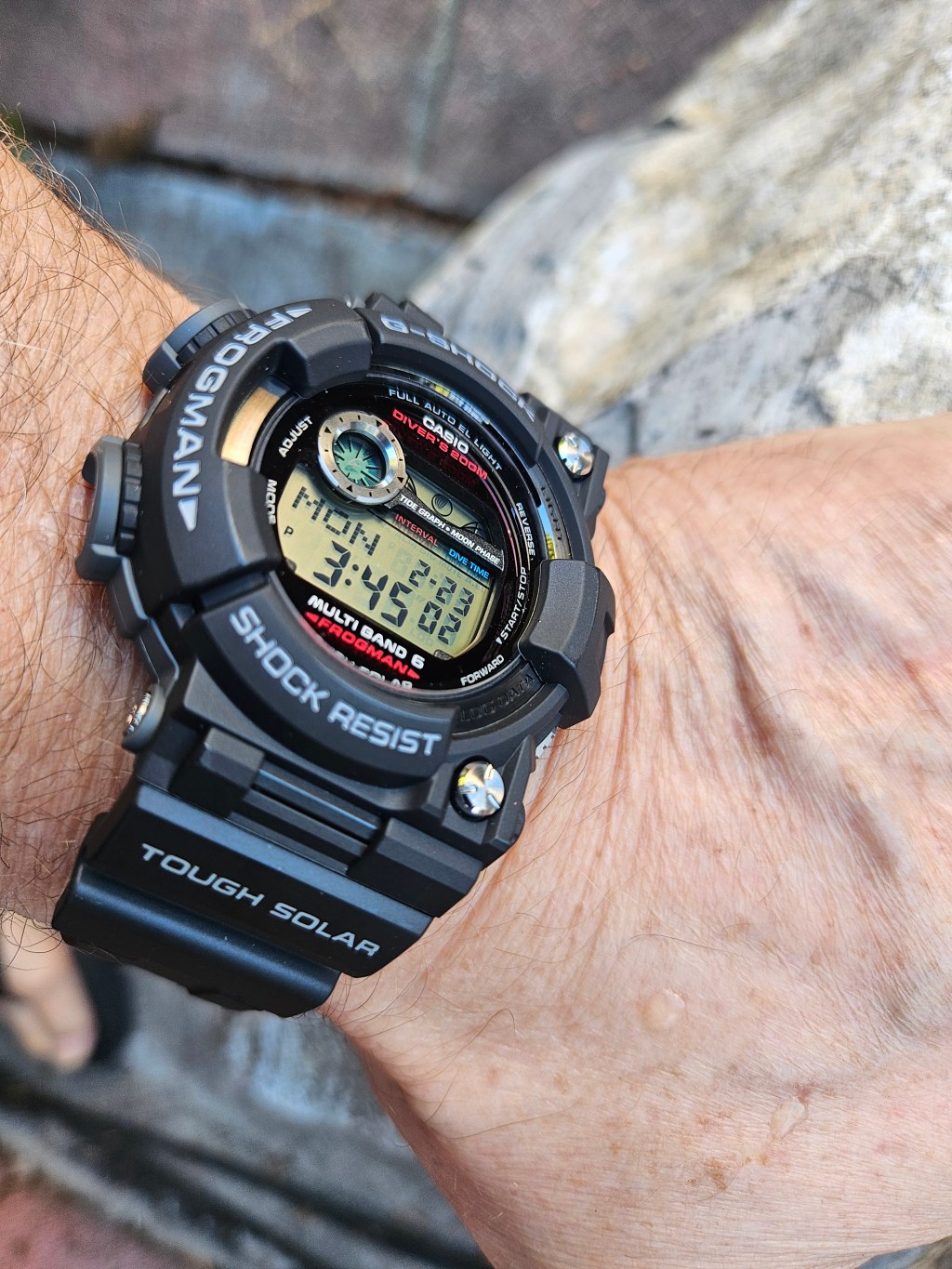
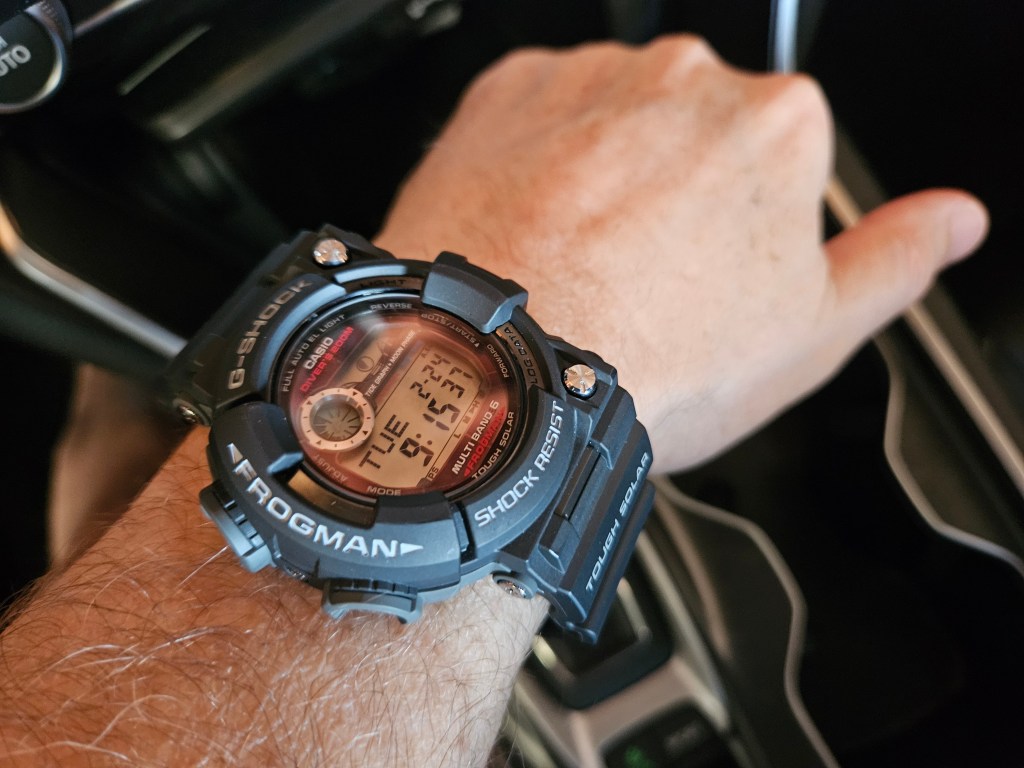
    This isn’t to say I am immune from the allure of G-Shock. There is one in particular that has smitten me for well over ten years. It is the Frogman GWF-1000. Unlike my mechanical divers, this is no analog beast. It is digital atomic. I have always been drawn to its professional tool look, its massive wrist presence, its lineage to the Seiko Arnie, and its bold asymmetry.

    So I told myself I would get one G-Shock to the fold. It would be more of a gimmick piece, an adornment for cosplay, a sort of joke. But I was wrong. Very wrong. As soon as I put it on my wrist, it felt it had melded to my skin, and it was part of me. The words “Tough Solar” seemed like a beckoning call of reassurance. 

    But what really killed me was the unexpected. I always have had a philosophic contempt for digital time, equating it with soulless phones and smartwatches. Digital time was a betrayal of my analog retro diver vibe. Or so I thought. As I looked down at my Frogman’s digital atomic readout, I found myself loving the legibility and accuracy more than my analog divers. 

    Take the classic cars from my youth. Those late-60 models of Mustang and Barracuda. Yes, they are lookers. But they don’t drive well compared to today’s cars. They squeak, they bounce, they have subpar climate control. Get into a new car and you can’t compare the technology and the comfort to vintage cars of old. Wearing my Frogman, I felt I had exited a creaky vintage car and was now gliding inside a technical marvel.

    I hate to admit this, but I now resent squinting my eyes at analog watches. I hate even more wondering why it is acceptable that a watch that costs thousands of dollars is less accurate than my atomic Frogman. 

    I don’t know what is happening to me. I don’t know where my mind will be in six months. All I know is this Frogman and its comforting atomic digital readout is not leaving my wrist.

    Friends of the watch community, hear me: You may be witnessing a Tribal Migration Event: the moment a collector crosses a long-standing identity boundary—mechanical to quartz, analog to digital, diver to tool watch—and discovers unexpected belonging. What begins as a temporary visit or novelty purchase becomes a relocation of allegiance. The emotional shock comes not from the new watch itself but from the realization that one’s horological identity was less fixed than previously believed.

  • The Sweet Tooth Age: How We Traded Depth for Dopamine

    The Sweet Tooth Age: How We Traded Depth for Dopamine

    In “The Orality Theory of Everything,” Derek Thompson makes a striking observation about human progress. One of civilization’s great turning points was the shift from orality to literacy. In oral cultures, knowledge traveled through speech, storytelling, and shared memory. Communication was social, flexible, and immediate. Literacy changed everything. Once ideas could be recorded, people could think alone, think slowly, and think deeply. Writing made possible the abstract systems—calculus, physics, modern biology, quantum mechanics—that underpin the technological world. The move from orality to literacy didn’t just change communication. It changed the human mind.

    Now the concern is that we may be drifting in the opposite direction.

    As social media expands, sustained reading declines. Attention fragments. Communication becomes faster, louder, and more performative. Thompson explored this shift in a conversation with Joe Weisenthal of the Odd Lots podcast, who draws heavily on the work of Walter Ong, the Jesuit scholar who wrote Orality and Literacy. Ong’s insight was simple but profound: when ideas are not recorded and preserved, people think differently. They rely on improvisation, memory shortcuts, and conversational instinct. But when ideas live in texts—books, essays, archives—people develop interiority: the capacity for reflection, precision, and layered analysis.

    It would be too simple to say we now live in a post-literate society. We still read. We still write. But the cognitive environment has changed. Our brains increasingly gravitate toward information that is fast, simplified, and emotionally stimulating. The habits required for what Cal Newport calls “deep work” now feel unnatural, even burdensome.

    A useful analogy is food. Literacy is like preparing a slow, nutritious meal. It requires time, effort, and attention, but the nourishment is real and lasting. The current media environment offers something else entirely: intellectual candy. Quick hits. Bright packaging. Strong flavor. Minimal substance. We have entered what might be called the Sweet Tooth Age—a culture that prefers pre-digested, entertaining fragments of ideas over sustained, solitary engagement. The concepts may sound serious, but they arrive in baby-food form: softened, sweetened, and stripped of complexity.

    After forty years of teaching college writing, I’ve watched this shift unfold in real time. In the past six years especially, many instructors have adjusted their expectations. Reading loads have shrunk. Full books are assigned less often. In an effort to get authentic, non-AI responses, more teachers rely on in-class writing. Some have abandoned homework entirely and grade only what students produce under supervision.

    This strategy has practical advantages. It guarantees original work. It keeps students accountable. But it also reflects a quiet surrender to the Sweet Tooth Age. The modern workplace—the environment our students are entering—runs on the same quick-cycle attention economy. Their exposure to slow thinking may be brief and largely confined to the classroom. When they transition to their careers, they may find that on-demand writing is no longer required or relevant. 

    Not just education but politics and culture are being swept by this new age of dopamine cravings. The Sweet Tooth Age carries a cost, and the bill will come due.

    The content that wins in the attention economy is not the most accurate or thoughtful. It is the most stimulating. It is colorful, simplified, emotionally charged, and designed to produce a quick surge of interest—what the brain experiences as a dopamine reward. But reacting to stimulation is not the same as thinking. Performance is not analysis.

    Performance, in fact, is the preferred tool of the demagogue.

    When audiences lose the habit of slow reading and critical evaluation, they become vulnerable to what might be called Kayfabe personalities—figures who are larger than life, theatrical, and emotionally compelling, but who operate more like entertainers than honest brokers. The message matters less than the performance. Complexity disappears. Nuance becomes weakness. Certainty, outrage, and spectacle take center stage.

    In such an environment, critical thinking doesn’t merely decline. It becomes a competitive disadvantage.

    This is why the Sweet Tooth Age is more than an educational concern. It is a political and cultural risk. A public trained to consume stimulation rather than evaluate evidence becomes easy to mobilize and difficult to inform. Emotion outruns judgment. Identity replaces analysis. The center—built on patience, evidence, and compromise—struggles to hold.

    When literacy weakens, the consequences do not remain confined to the classroom.

    They spread outward—into public discourse, institutional trust, and civic stability. The shift back toward orality is not simply a change in media habits. It is a shift toward immediacy over reflection, reaction over reasoning, spectacle over substance.

    And when a culture begins to prefer performance to thought, chaos is not an accident.

    It is the logical outcome.