Category: technology

  • Why I’m Not Fully G-Shockified (Yet)

    Why I’m Not Fully G-Shockified (Yet)

    A month ago, I fell—hard—for the G-Shock Frogman GWF-1000. Not a mild infatuation. Not a passing curiosity. A full conversion experience. Within days, I recruited two accomplices—the GW-7900 Rescue and the GW-6900 Three-Eyed Monster—and suddenly my mechanical divers, once the crown jewels of my collection, were sitting in the watch box like retired prizefighters telling stories no one asked to hear.

    Let me be clear: I have not renounced them. I still admire the Seiko SLA055. I still regard the quartz Tuna SBBN049 with something close to reverence. But admiration is not the same as use. Once you’ve tasted atomic time—precise, indifferent, quietly superior—it’s difficult to return to the charming imprecision of mechanical watches. You don’t switch back from filtered water to a garden hose unless nostalgia is doing the driving.

    And I’m not alone. Since confessing my condition, I’ve received a steady stream of testimonials. Men who bought a GW-M5610 or a GW-5000U and quietly stopped wearing everything else. Not because they planned to. Not because they declared war on their collections. But because the G-Shock—comfortable, accurate, frictionless—refused to leave their wrist. Their curiosity still wandered, their addiction still whispered, but the watch stayed put. Anchored. Unmoved.

    This phenomenon deserves a name: G-Shockification.

    It is the moment when a watch enthusiast, steeped in the romance of mechanical horology, is overtaken by the brute efficiency of atomic precision. At first, there is resistance. Then rationalization. Finally, surrender. Variety collapses. The rotation dies. The watch box becomes a museum, and the G-Shock becomes the only living artifact. What began as a hobby turns into a single, dominant habit—quiet, practical, and oddly liberating.

    Some resist the change. Some embrace it. Some preach it like a new religion. But they all share one outcome: the mechanical watch, once a daily companion, becomes an occasional guest.

    Which brings me to the uncomfortable question: Have I been G-Shockified?

    The honest answer is: not quite.

    I have my objections. With a G-Shock, I cannot simply glance at the time. I must present the watch to my face like an offering, or press a button and summon light—an act that triggers a faint but persistent anxiety about draining the solar charge. In a dark movie theater, the problem becomes almost philosophical. Do I illuminate my wrist and disrupt the room? Or do I behave like a civilized adult and wear something else?

    This is where the quartz Tuna reenters the story.

    Since my G-Shock conversion began, the Tuna has enjoyed a quiet renaissance. It is as if atomic time granted me permission to appreciate quartz accuracy without guilt. At night, it is flawless—constant lume, instant readability, no negotiation required. It does not ask for a button press. It does not demand a ritual. It simply tells the time, like a professional.

    And so I arrive at a compromise.

    I am not fully G-Shockified because I am not willing to tolerate certain frictions: the angle-sensitive readability, the dependence on backlight, the small social calculations about when it is appropriate to illuminate my wrist. These are minor issues, but they are enough to prevent total surrender.

    What I have instead is something more complicated: Hybridification.

    My collection is now split down the middle—four analog watches, four G-Shocks. This is not harmony. It is a negotiated settlement. The G-Shocks govern precision, durability, and daily utility. The analog watches—especially the Tuna—reclaim territory where immediate readability and luminous clarity matter.

    The result is a managed tension between two philosophies:

    • the digital world of accuracy, convenience, and indifference
    • the analog world of presence, legibility, and quiet satisfaction

    It is not a perfect system. But it is stable.

    For now.

  • The Multi-Headed Dopamine Monster

    The Multi-Headed Dopamine Monster

    Any halfway attentive observer eventually stumbles upon a depressing but unmistakable truth: modern life is a carnival of pleasures engineered to be irresistible and endlessly repeatable. Physical indulgence, consumer toys, and the shimmering applause of social media metrics arrive every day like trays of free samples at a supermarket. The problem is not their existence. The problem is their limitless availability. When gratification can be summoned instantly—one click, one swipe, one purchase—the temptation to pursue it with manic dedication becomes nearly impossible to resist.

    The results are rarely noble. Self-discipline dissolves. Organization frays. Focus collapses like a folding chair under a heavy guest. In their place arrives a nervous state of agitation accompanied by a dull, persistent suspicion: You are wasting your life on trinkets. The realization is humiliating because it is so obvious. Hedonism, convenience, consumerism, and the intoxicating glow of digital approval are not spiritual achievements. They are simply the brain chasing dopamine like a lab rat pounding a reward lever.

    At first the dopamine feels marvelous. A new gadget, a flattering comment, a few hundred views, the pleasing geometry of a purchase confirmation page. But like all stimulants, the effect fades. The rewards grow thinner. The hits arrive faster but satisfy less. Eventually a quiet despair creeps in. You feel oddly disconnected—from other people, from yourself, from the adult you imagined becoming. You begin asking dangerous questions. Is there anything meaningful enough to lift you out of this quicksand of micro-pleasures? Is there any pursuit capable of competing with the relentless ease of cheap gratification?

    You remember that you possess other faculties—creativity, curiosity, philosophical struggle, the ability to tell a story that might illuminate something about the human condition. These pursuits possess real dignity. Yet they struggle to survive in the same ecosystem as frictionless entertainment and effortless affirmation. The brain, like a spoiled monarch, prefers velvet pillows to hard chairs.

    Eventually the interrogation becomes more specific. The real engine of this predicament is not merely pleasure but technology. Your phone and computer function as a many-headed dopamine creature sitting permanently on your desk. Slaying the monster would be satisfying—but impossible. Unlike alcohol, which the addict can abandon entirely, the digital world is inseparable from modern survival. You need the machine to work, communicate, pay bills, manage life, create things, and occasionally attempt to think.

    So you continue to live beside the creature.

    You read the tidy aphorisms offered by productivity gurus: Be mindful. Stay disciplined. Follow your North Star. But these slogans feel faintly ridiculous when the dopamine cauldron sits inches away—one browser tab from ignition. The advice begins to sound less like wisdom and more like a variety of motivational wallpaper.

    And so you arrive at a strange emotional position.

    You do not yet possess a solution. But you possess something useful: anger. Anger at the machinery of distraction. Anger at the cheapness of digital applause. Anger at your own willingness to accept the bargain.

    It is not a cure, but it is a beginning.

    You can see the problem clearly now.

    The only remaining question is what you intend to do about it.

  • Late to the G-Shock Party

    Late to the G-Shock Party

    Even though I’ve been obsessed with watches for over twenty years, I arrived embarrassingly late to the G-Shock party. I didn’t plan the arrival. It felt more like this: I’m riding in the back seat of an Uber when the driver suddenly pulls up in front of a strange mansion glowing with neon light. The doors swing open. Inside are thousands of loud, jubilant G-Shock devotees who greet me like a long-lost cousin. Champagne appears. Confetti rains down. Someone hands me a microphone and asks for a testimonial.

    I have no prepared remarks. But I can tell the truth.

    For two decades I was perfectly happy collecting Seiko mechanical divers. They were my tribe. Yet somewhere in the back of my mind a particular watch kept whispering to me: the G-Shock Frogman. I had admired it on and off for over a decade. Amazingly, the same model was still available, so I finally ordered one from Japan. A watch that once would have cost me $400 now demanded $550, which is the sort of price inflation that causes a small twitch in the eyelid.

    When the Frogman arrived, something strange happened.

    I couldn’t take it off.

    The watch felt uncannily right, as if some committee of Japanese engineers had secretly studied my personality and designed a wrist instrument to match it. It was heroic, absurdly tough, and far more accurate than my mechanical divers. Within weeks I stopped wearing the mechanicals altogether. Three of them quietly left the collection. Whether I’m taking a mechanical hiatus or attending their funeral remains unclear.

    What I do know is that G-Shock has given my watch hobby a strange second life.

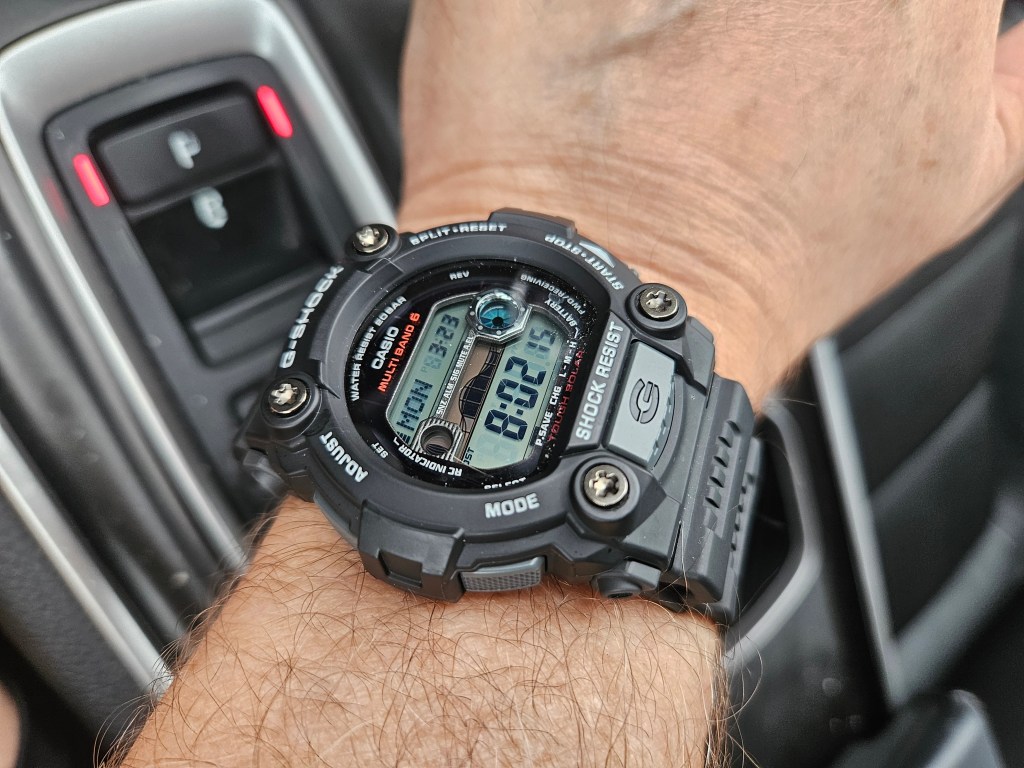
    At the moment I own two of them: the Frogman and the GW-7900. Viewers on my YouTube channel insisted the 7900 deserved a proper name. A subscriber named Dave solved the problem immediately. “Call it the Tidemaster,” he said, since the watch tracks tides.

    Perfect.

    So now I have the Frogman and the Tidemaster. One cost me $550. The other cost $110.

    Here’s the truth no luxury marketing department wants to hear: from a purely practical standpoint, the $110 Tidemaster is the better watch. Its numerals are larger, thicker, and darker. The contrast is superior. At night the backlight illuminates big bold digits that practically shout the time. The Frogman, by comparison, requires a small squint and a mild prayer.

    In other words, the cheap watch wins the legibility contest.

    A third watch is arriving next week: the G-Shock GW-6900. Like the 7900, it currently lacks a proper nickname. The watch has three round indicators above the display, which makes it look like a mildly deranged insect. I considered several possibilities. “Triple Graph” sounds like a geometry exam. “Militaire” sounds like a fragrance sold in an airport duty-free shop. So I’m going with the obvious choice:

    The 3-Eyed Monster.

    My goal is simple: settle into a stable Three-Watch G-Shock Trifecta. All three watches share the same genetic code—big heroic cases, atomic timekeeping, solar charging, digital displays, and rubber straps. That combination is my personal sweet spot.

    Now we arrive at the temptation.

    Many of you have suggested I should upgrade to the sapphire-crystal Frogman, a watch that lurks around the $1,000 mark. And believe me, that watch is occupying prime real estate in my brain. But I’d like to present a few rebuttals before I surrender to the credit card.

    First, price. The Tidemaster and the 3-Eyed Monster cost about $110 each. Even the Frogman stayed under $600. Part of the joy of G-Shock is that it delivers durability, accuracy, and ridiculous hero aesthetics without the emotional trauma of a four-figure purchase. Once you push a G-Shock toward a thousand dollars, you start undermining the very spirit that makes the watch fun.

    Second, technical overkill. The sapphire Frogman is loaded with features I will never use. Yes, the display is slightly more legible than my existing Frogman, but that problem is already solved by the Tidemaster and the 3-Eyed Monster.

    Third, rotational anxiety. Two Frogmans would cancel each other out. I doubt I could sell my current Frogman—it has already fused itself to my identity like a stubborn barnacle.

    Fourth, and perhaps most decisive, is age. If I were in my thirties or forties, building a large G-Shock collection might make sense. But I’ll be turning sixty-five this year. I don’t need a museum of watches. Between four Seiko mechanical divers, a quartz Seiko Tuna, and my three G-Shocks, I already have more watches than any reasonable human requires.

    In fact, I could easily imagine a future where I own nothing but the three G-Shocks and feel perfectly content.

    So there you have it.

    Will temptation vanish completely? Of course not. Tonight I may dream about the sapphire Frogman. In a moment of midnight weakness I might even sleep-walk to my computer and hover over the Buy Now button.

    But I like to believe that the reasonable part of my brain will prevail over the dopamine addict who lives next door.

    At least that’s the story I’m telling myself.

  • Life Is Uncertain. Porridge Is Not

    Life Is Uncertain. Porridge Is Not

    For the past week my appetite has surged like a rogue wave. That could mean several things, none of them particularly flattering. Perhaps I’m medicating stress with food. Perhaps there are subterranean stress triggers rumbling beneath the surface that I haven’t identified yet. Life, after all, provides a constant background hum of anxiety, and it’s difficult to distinguish ordinary daily strain from something more corrosive.

    Retirement is hovering in the distance like a financial fog bank. I’ve been emailing HR about the price of keeping my Kaiser coverage after I retire versus moving to my wife’s more modest plan. Her school pays less than mine, which means we’re staring at something in the neighborhood of $1,500 a month once dental and vision enter the scene. Retirement, which is supposed to represent liberation, suddenly looks like a complicated negotiation with spreadsheets, identity, and self-worth. And apparently my body’s response to this existential accounting exercise is simple: eat more chicken.

    There is, at present, a dangerous quantity of takeout chicken in this house. Fried chicken. Roasted chicken. Greasy, seductive chicken lounging in the refrigerator like a gang of edible hoodlums. I open the fridge intending to take a small, respectable bite. Five minutes later I’m standing there gnawing through a drumstick like a raccoon that has discovered civilization. The aftermath is predictable: gluttony followed immediately by anxiety.

    The anxiety, unfortunately, does not arrive alone. It brings a surveillance drone. I watch myself overeating as if my consciousness has sprouted a third eye hovering above the scene like a judgmental security camera. I am both the criminal and the detective. The more I watch myself eat, the more anxious I become. The more anxious I become, the more I eat. I have achieved what behavioral psychologists might politely call a closed loop of misery.

    Action is required.

    My proposed solution is radical in its simplicity: three meals a day, no snacking. Breakfast will be steel-cut oatmeal or buckwheat groats fortified with protein powder. Lunch will be rolled oats with yogurt and more protein powder. Dinner will consist of a sensible portion of protein, vegetables, and an apple. It is not glamorous, but glamour is precisely the problem.

    Oatmeal comforts me. It possesses the mild, reassuring neutrality of something that has no ambitions beyond keeping you alive. Perhaps it is a kind of surrogate baby food. Perhaps the approach of retirement has triggered a mild regression in which my brain seeks the emotional equivalent of warm porridge and a quiet afternoon nap. As I drift deeper into my mid-sixties, it is entirely possible that my culinary philosophy is reverting to something suitable for a kindly monastery.

    Life is uncertain. Porridge is not.

    I like the predictability of three meals a day involving some form of oatmeal. I like the idea of owning a Lenovo ThinkPad, which is the oatmeal of computers. I like the Honda Accord and Toyota Camry, which are the oatmeal of the automobile world. And I like my solar atomic G-Shocks, which are the oatmeal of timepieces—durable, accurate, incapable of drama.

    If possible, I would like to swim inside a large industrial vat of oatmeal, floating peacefully while the chaos of the modern world clangs harmlessly against the outside of the tank.

    Unfortunately, hostile forces surround the vat.

    My daughters campaign relentlessly for takeout: Dave’s Hot Chicken, Wingstop, Panda Express. Holiday gatherings appear with enough pies and brownies to launch a regional bakery franchise. A man can only resist these temptations for so long before the walls of discipline begin to buckle.

    Meanwhile, medical costs continue their relentless ascent, and retirement funds tremble nervously as global markets perform their daily interpretive dance of geopolitical uncertainty.

    Under such circumstances I find myself clinging to a personal doctrine I’ve begun to call The Porridge Principle: the instinct to confront anxiety by retreating into humble, reliable technologies and routines that promise frictionless predictability. Oatmeal breakfasts. ThinkPad laptops. Honda sedans. Solar atomic watches. These objects do not thrill, but they do not betray.

    When the world becomes chaotic, the mind begins searching for tools and rituals that behave exactly the same way every day.

    So that is the plan.

    Trader Joe’s opens in an hour. I will buy groceries for my family and a heroic supply of oatmeal. The campaign against uncertainty has begun.

    Pray for me.

  • The G-Shock Multiband 6 Salvation Fantasy

    The G-Shock Multiband 6 Salvation Fantasy

    Pascal once observed that man cannot sit quietly in his room. Leave him alone with his thoughts and he begins to itch. Mortality looms. Meaning feels slippery. Silence becomes unbearable. So he reaches for distraction—baubles, upgrades, shiny mechanical companions that promise significance if only he can tighten one more screw or polish one more bezel.

    Call this Pascalian Gadget Panic: the modern expression of Pascal’s insight that when faced with the vague terror of existence, a man will anesthetize himself with objects. Radios. Cameras. Knives. Mechanical divers. G-Shocks. The object rotates through the years like a carousel horse, but the agitation underneath remains faithfully employed.

    Consider a suburban man in reasonably good health who nonetheless struggles with discipline, boundaries, and the mild chaos of his inner life. Spiritual philosophy eludes him. Self-knowledge feels slippery. Relationships are uneven terrain. Faced with this fog, he does what many modern men do.

    He buys toys.

    In his case, the toys are watches.

    For twenty years he labors happily in the vineyards of mechanical divers—Seikos mostly—fine steel contraptions that tick like tiny diesel engines beneath sapphire glass. The collection eventually reaches a comfortable plateau: curated, restrained, almost dignified.

    And then, inexplicably, he loses interest.

    The mechanical divers are quietly retired to their watch box like aging prizefighters. In their place emerges a new obsession: G-Shocks, but only of a very specific species—digital, solar-powered, atomic-synchronized, strapped in rubber armor like tiny tanks.

    Four commandments define the new religion:
    Tough Solar.
    Multiband 6 Atomic.
    Digital-only display.
    Rubber straps.

    One madness has been replaced with another, though the patient insists this is progress.

    To maintain psychological order, he compartmentalizes. The mechanical divers remain sealed in their box like museum artifacts. The G-Shocks, however, require their own ecosystem.

    Enter the Industrial Pipe Shrine.

    This object began life as a two-tier industrial pipe jewelry stand, the sort of thing normally used to hang headphones or necklaces. But in this household it has been promoted to sacred architecture. It sits reverently on a windowsill each night so the watches may commune with the atomic time signal emanating from Fort Collins, Colorado.

    To the uninitiated, it looks like plumbing hardware assembled by a bored welder.

    To the devotee, it is a receiving station of cosmic precision.

    Each night the G-Shocks dangle from the steel arms like metallic fruit awaiting revelation. Somewhere in Colorado a radio transmitter hums. Somewhere in the suburban night a man sleeps. And somewhere between them invisible time signals pass through drywall and glass until they arrive inside the tiny ferrite antenna hidden in a digital watch.

    When the signal locks in, the man experiences what can only be called the Multiband-6 Salvation Fantasy.

    For a brief moment the universe feels orderly. Accurate. Aligned. The watch has synchronized itself with atomic time. Solar cells sip daylight. Precision has been achieved.

    The feeling of control is intoxicating.

    Unfortunately, it lasts about as long as the next YouTube review.

    When members of the G-Shock community encounter this newly converted soul, they greet him with cheerful recognition.

    “Congratulations,” they say. “You’ve been G-Shocked.”

    The phrase functions like a baptism. The initiate is welcomed into a brotherhood of people who understand the deep satisfaction of armored watches, radio synchronization, and the quiet glow of solar charging indicators.

    At this moment the man realizes something unsettling: his geekdom has intensified

    Part of him embraces the absurdity. The watches are inexpensive. The hobby is harmless. Why not laugh at himself and enjoy the ride?

    But another part of him wonders whether something darker is unfolding.

    Is this, perhaps, the arrival of the Jungian Shadow—the neglected, obsessive part of the psyche now expressing itself through tactical wristwear?

    Will the Shadow politely stop at three G-Shocks?

    Or will it grow ambitious—multiplying into a monstrous collection that colonizes dresser drawers, nightstands, gym bags, glove compartments, and every horizontal surface in the home?

    Disturbed by these questions, the man attempts a strategic retreat. He throws himself into his other pursuits: bodybuilding, physical culture, literature, television, film.

    These distractions provide temporary relief.

    But the G-Shock Shadow is patient.

    Soon he is back on YouTube watching reviews of obscure Japanese models. He is compiling wish lists. He is studying signal reception strategies.

    Late at night he imagines the watches hanging from the steel arms of his T-bone pipe stand.

    And in darker moments he sees them differently.

    Not as tools.

    But as vampire bats—black, armored creatures dangling upside down, waiting for him to drift into sleep so they can descend silently and drink his blood.

    When he wakes in the morning, they will still be there on the windowsill.

    Perfectly synchronized.

    And waiting.

  • The Signal Hunter: From Vintage Radios to Atomic G-Shocks

    The Signal Hunter: From Vintage Radios to Atomic G-Shocks

    For a long time before I became a watch obsessive, I was a radio obsessive. This was the early 2000s, when my idea of a thrilling evening involved testing AM sensitivity and comparing FM clarity the way sommeliers compare Burgundy. I developed an unhealthy admiration for 1960s and 70s Sony and Panasonic radios—machines that looked as if NASA engineers had been given permission to design living-room furniture.

    That obsession never really left. I still keep half a dozen high-end Tecsun radios scattered around the house like electronic houseplants. One in the kitchen. One in the bedroom. One in the garage. Each quietly sipping signals from the air.

    Over the next two decades my attention drifted from radios to watches, and not modest watches either. I assembled a small stable of Seiko mechanical divers, some pushing well north of three thousand dollars. They were beautiful machines—tiny brass orchestras ticking away beneath sapphire glass.

    Then, about a month ago, something strange happened. I unplugged emotionally from the mechanicals and wandered into the strange, glowing world of G-Shock Multiband-6 atomic watches.

    And to my surprise, I’m having more fun with this hobby than I ever did before.

    These watches cost a fraction of my mechanical divers. Yet I’m connecting with them more deeply. That should bother me. It doesn’t.

    But let’s not dramatize this as some kind of betrayal of my mechanical diver heritage. This is not treason. It’s zoning.

    Think of it like Jay Leno’s Big Dog Garage near the Burbank airport. Leno divides his collection between vintage machines and modern ones. Two different eras. Two different moods.

    My watch world now works the same way.

    On one side of the garage sit my mechanical divers. They’re the horological equivalent of a 1959 BMW 507 convertible with a four-speed manual. When I strap one on, it’s like taking a country drive through nostalgia. The wind is loud. The ride is bumpy. The engine chatters like a coffee grinder full of marbles.

    And occasionally, that experience is glorious.

    But as the years pile up, those drives become less frequent. The wind noise, the rattling, the mechanical fussiness—eventually the romance demands a bit more patience than my bones want to give.

    Now walk across the garage.

    Here you’ll find the modern fleet: my Multiband-6 G-Shocks.

    These are the Honda, Lexus, and BMW sedans of the watch world. Smooth handling. Effortless precision. A cabin so insulated from chaos that time itself arrives wirelessly in the middle of the night.

    Moving between a G-Shock and a mechanical diver is like stepping from a luxury sedan into a vintage convertible. Two different universes. Neither one replaces the other. You simply choose which universe you feel like visiting.

    And as my eyes grow older and slightly crankier, I can already see where I may end up parking more often: something like the G-Shock Mudman GW-9500 with a big positive display.

    Positive display only, mind you. Negative displays are pure muscle-flex cosplay. I already get plenty of testosterone from the armored tank aesthetic of G-Shock design. I don’t need the digits hiding in a cave as well.

    But here’s the deeper truth.

    My attraction to Multiband-6 watches has quietly returned me to my radio roots.

    The vintage radio hobby and the atomic watch hobby attract the same personality type. They scratch the same itch.

    Both revolve around the quiet thrill of pulling invisible signals out of the air.

    In that sense, I am what I like to call a Signal Hunter.

    A signal hunter doesn’t simply collect equipment. He collects moments of reception. The tiny surge of satisfaction when a device—a Sony shortwave radio or a G-Shock atomic watch—locks onto something traveling through the ether.

    The world is whispering signals constantly. Most people never notice.

    But if you have the right instrument, the air suddenly comes alive.

    To improve my odds of catching those signals, I recently ordered an industrial pipe jewelry and headphone stand. Apparently many G-Shock owners swear that letting the watch rest overnight on a piece of metal—like a pipe or curtain rod—helps the antenna catch the atomic time signal more reliably.

    The moment I read this, resistance was futile. I ordered the stand immediately.

    Because suddenly I was six years old again.

    I had my Batman Bat-Signal flashlight. I had my decoder ring. And the universe was sending secret messages again.

    Syncing my G-Shocks has become a nightly ritual.

    And rituals are my natural habitat.

    Coffee. Oatmeal. Protein powder. Kettlebells. Mechanical watch winding. Atomic watch syncing.

    Different objects.

    Same impulse.

    Order the world. Listen closely. Catch the signal.

  • The Day the G-Shock Frogman Hired Security

    The Day the G-Shock Frogman Hired Security

    Owning a single G-Shock—the mighty Frogman GWF-1000, no less—has taught me several humbling lessons about the realities of atomic timekeeping and solar-powered heroism.

    Lesson one: one Multiband-6 watch, even a legendary one, is not enough.

    I learned this during the night of Daylight Saving Time, when my Frogman—strapped proudly to my wrist—failed to synchronize with the atomic signal from Colorado. The problem, as I later realized, was strategic error. The watch should have been resting nobly on the windowsill, antenna pointed toward the Rocky Mountains, quietly listening for the midnight radio whisper from the WWVB tower. Instead, it was trapped on my wrist like a submarine trying to receive satellite signals from inside a cave.

    Lesson two: the Frogman occasionally deserves a night off.

    The solar battery is hardy, but I have a habit of activating the backlight like a man signaling aircraft during a blackout. Letting the watch rest on the windowsill overnight gives it two gifts: sunlight recharge during the day and atomic calibration during the night.

    Lesson three: there are places where wearing the Frogman is unnecessarily risky. Airports. Crowded cities. Questionable neighborhoods. Situations where theft, damage, or simple bad luck might separate a man from his amphibious masterpiece.

    These revelations led to an unavoidable conclusion: the Frogman needed protection.

    Enter the G-Shock GW-7900, acquired for the almost suspiciously reasonable price of $110. A watch this loyal and hardworking cannot remain nameless, so I have given it a title worthy of its mission: The Protector.

    Now the system is simple. Frogman and Protector—a tag team.

    The Protector belongs to a broader category I call Bodyguard Watches: rugged backup watches deployed when the owner wishes to preserve the dignity, resale value, or physical safety of a more expensive timepiece. The bodyguard absorbs scratches, suspicion, and general abuse while the principal remains comfortably out of harm’s way.

    I briefly considered naming the GW-7900 “The Bodyguard,” but that sounded less like a watch and more like a brand of anti-perspirant.

    So the name stands.

    The Frogman commands.
    The Protector takes the hits.

  • Why My Neighbors Saw a Man in Pajamas Pointing a G-Shock Frogman at the Heavens

    Why My Neighbors Saw a Man in Pajamas Pointing a G-Shock Frogman at the Heavens

    Last night I went to bed wearing my trusty G-Shock Frogman GWF-1000, fully expecting it to perform its quiet nightly miracle: synchronize itself with the atomic clock in Colorado and glide effortlessly into Daylight Saving Time. The watch is, after all, marketed as a technological marvel—solar-powered, radio-controlled, and rugged enough to survive the Mariana Trench. Surely a modest seasonal time change would present no difficulty.

    At three in the morning I woke up for my traditional pilgrimage to the bathroom. Alexa informed me it was 3:00 a.m. My Frogman, however, insisted it was 2:00. The great amphibian had failed. The atomic signal from Colorado had apparently skipped my wrist entirely. When I woke up again at six for breakfast, the Frogman still clung stubbornly to 5:00. My heart sank. The watch I had imagined as a cybernetic superhero was, in fact, a mere mortal—another electronic device at the mercy of radio reception.

    After breakfast I decided to intervene. I confirmed the watch was set to receive the signal automatically and then attempted four manual syncs. Each attempt ended in humiliation: ERR. The signal indicator stubbornly displayed L1, the horological equivalent of a whisper. I tried the front patio. I tried the backyard. Still L1. At that point the situation escalated from casual troubleshooting to full-scale field operation.

    With the Frogman draped ceremoniously over my daughter’s oversized yellow duck squishy, dressed in blue plaid pajama bottoms and a grey T-shirt, I marched into the middle of the street like a man conducting an amateur radio experiment. I walked slow circles, rotating the watch like a sacred artifact, watching the signal meter with the concentration of a NASA engineer awaiting telemetry. At last the screen flickered: L3. Full signal. While a group of worm-eating crows nearby cackled at the spectacle, I wondered if my neighbors were peering through their curtains thinking, “I knew he was crazy all along. This confirms it.”

    Five minutes later the watch synchronized. Atomic time flowed once again from Colorado to my wrist, and the harmony of the cosmos was restored.

    Still, the episode leaves me with questions. Would the Frogman have corrected itself within a day or two if I had simply left it alone? Or was my early-morning expedition into the street the necessary act that secured the precious L3 signal?

    Another thought occurs to me. This operation was manageable with a single G-Shock. But what if I owned half a dozen Multiband-6 models? Twice a year I might find myself conducting a small civic ceremony in the middle of the road, rotating watches toward the northeast like a priest consulting celestial omens. The ritual would deserve a proper name: The Atomic Pilgrimage—the journey undertaken by the devoted G-Shock owner who abandons the domestic safety of patios and kitchens in search of the elusive WWVB signal.

    The experience has made me reconsider expanding my G-Shock collection. And yet, if I’m honest, a small part of my inner child found the whole adventure glorious—like standing in the backyard with a toy rocketship, waiting for mission control at NASA to say, “Signal acquired.”

  • From Muscle Monsters to Ken Doll Tyrants

    From Muscle Monsters to Ken Doll Tyrants

    When I was a teenage bodybuilder in the 1970s, the weight room was full of boys with the same secret: we were trying to fix ourselves. Our cure for insecurity was iron. We trained like men preparing for war, convinced that if we grew large enough—huge traps, bulging biceps, necks like bridge cables—we could terrify the world into respecting us. We fantasized about becoming “monsters” or “gargoyles,” grotesque statues of muscle that would scare away humiliation and banish our private doubts. Of course, the plan never worked. Just as the chronic overeater cannot outrun gluttony, we could not out-muscle low self-esteem. The demons we tried to crush with barbells simply followed us out of the gym.

    Nearly fifty years later, bodybuilding’s old delusion has been replaced by a stranger one: looksmaxxing, the obsessive attempt to engineer physical perfection through cosmetic intervention and digital-age narcissism. In Becca Rothfeld’s New Yorker essay “The Captivating Derangement of the Looksmaxxing Movement,” we meet a new breed of self-improvement fanatic embodied by an influencer who calls himself Clavicular. Testosterone injections, rhinoplasty, double-chin surgery, pharmaceutical regimens, manic diet protocols, and relentless “biohacking” have sculpted him into something resembling a laboratory-grown Ken doll. The goal is not merely attractiveness but algorithmic perfection: a human face optimized to survive the merciless scrutiny of social media.

    Yet beneath this glossy surface lies something dark. Rothfeld observes that the movement often overlaps with the internet’s most antisocial subcultures—incel forums, misogynistic grievance factories, and communities obsessed with ranking human worth according to facial symmetry and bone structure. Technology theorist Jaron Lanier warned years ago that social media algorithms reward content that appeals to our most primitive impulses, dragging public discourse downward toward the brain stem. Looksmaxxing appears to be the logical endpoint of that descent: a digital coliseum where identity, masculinity, and human dignity are reduced to metrics of jawline geometry.

    Ironically, the men who pursue this transformation claim they are trying to become more attractive to women. Instead, they often cultivate the personality of a malfunctioning action figure: narcissistic, performative, and incapable of genuine intimacy. They rehearse “alpha male” poses, brag about their surgical upgrades, and sneer at the supposedly inferior masses who lack their aesthetic discipline. What emerges is not confidence but solipsism—individuals who can admire their reflection indefinitely but seem constitutionally incapable of love.

    When broken misfit toys acquire millions of followers and begin shaping cultural and political attitudes, the spectacle stops being merely ridiculous. It becomes ominous. Movements fueled by resentment, aesthetic purity, and tribal grievance have a long and ugly history. The looksmaxxing phenomenon, with its blend of cosmetic obsession, internet radicalization, and juvenile power fantasies, bears the unmistakable scent of decadence—and perhaps something worse. A healthy society cannot thrive when its young men aspire not to become human beings but to become action figures.

  • The Digital Purist’s G-Shock Manifesto

    The Digital Purist’s G-Shock Manifesto

    When I bought my G-Shock Frogman and experienced the peculiar bond that many G-Shock owners describe, I began hearing from other enthusiasts who spoke about their watches with the same kind of fervor usually reserved for religion, motorcycles, or properly cooked brisket. Curious, I started watching G-Shock videos online. What struck me was not the technical analysis—though there was plenty of that—but the sheer affection people felt for these watches. It was humbling to see someone speak with genuine reverence about a $100 resin timepiece with the same poetic intensity that others reserve for ten-thousand-dollar Swiss luxury watches. Apparently joy does not scale with price tags.

    After enough of these videos, I discovered something about myself: my lane in the G-Shock universe is extremely narrow. My watches must be digital. They must be Tough Solar. They must be Multiband 6. And they must come on straps. The moment a watch wanders outside those borders—analog hands, shiny bracelets, smartwatch features that make it look like a Garmin auditioning for a triathlon—it falls off my radar. Limited editions that feel like marketing departments squeezing collectors for lunch money also fail to stir my soul. My tastes are simple: give me the rugged, atomic-synchronized machinery of the late-20th-century Casio imagination.

    And that is where the magic happens. Casio is the undisputed curator of the 1980s and 1990s technological mood: efficient, unapologetically digital, and blissfully free from the surveillance culture of modern smart devices. A Tough Solar Multiband 6 G-Shock does everything you ask of it without demanding attention in return. It is competent, quiet, and oddly comforting. Once you step into that retro-technical atmosphere, you discover the purest G-Shock vibe: a blend of practicality, nostalgia, and cool restraint.

    Based on this revelation, I created what I now consider my essential G-Shock quartet:

    G-Shock Frogman GWF-1000
    G-Shock Rangeman GW-9400
    G-Shock Rescue GW-7900
    G-Shock GW-5000U

    I already own the first one. The other three remain safely outside my possession—at least for the moment. My strategy for maintaining discipline is simple: I try to read books and articles like a normal person. Unfortunately, every fifteen minutes my browser opens a new tab where I begin “researching” the Rangeman, the 7900, or the GW-5000U with the dedication of a graduate student preparing a thesis on atomic timekeeping. So far the watches remain unpurchased.

    But I would not advise betting against them.

    The Man Who Lost His Mind to Watches is my book about the watch madness that many of us share. It is now on Amazon Kindle: