Category: technology

  • You Can Squander Your Entire Life on the Review Treadmill

    You Can Squander Your Entire Life on the Review Treadmill

    Over the past twenty years, something subtle but decisive has happened to our brains: we have stopped reading and started watching. The printed page asks for patience and solitude. Video, by contrast, offers a human face. We no longer want arguments delivered in paragraphs; we want a narrator standing before us, explaining the world with hand gestures, eyebrow raises, and the occasional conspiratorial smile. The writer has quietly stepped aside. In his place stands the “creator,” a figure who performs knowledge rather than merely writing it down.

    There are, to be fair, some remarkable creators who produce philosophical video essays—long, thoughtful meditations on culture, politics, or technology. These people still believe ideas deserve oxygen. But they are the minority. For the vast majority of viewers, the preferred form of knowledge is far more practical and far less exalted: product reviews. Comparisons. Rankings. Side-by-side verdicts on the minor differences between things we may or may not ever purchase.

    I am not immune to this gravitational pull. Suppose I want to understand the fine distinctions among solar, atomic G-Shocks—their legibility, antenna performance, charging efficiency, module behavior, and overall build quality. That path leads to a rabbit hole deep enough to swallow a decade of one’s life. I could earn a doctoral degree in G-Shock Studies and still emerge unsure whether the GW-7900 or the GW-9400 possesses the superior atomic reception. Doubt becomes the justification for further research. And further research leads to what might be called the Comparative Infinity Loop: a condition in which every answer breeds another comparison. The 7900 versus the 9400. Module 3193 versus module 3410. One display’s legibility versus another’s contrast. Each conclusion merely opens another door.

    The deeper irony is that the search for “absolute knowledge” can easily replace the experience itself. A person could spend an entire lifetime watching product reviews without ever purchasing the product in question. The mind remains entertained, stimulated, and convinced it is progressing toward certainty. But nothing actually changes.

    The metaphor that best captures this condition is the shark. A shark must keep swimming to force oxygen through its gills. Stop swimming and it suffocates. Our brains now behave the same way. We keep feeding them review after review, comparison after comparison, as if the next video will finally reveal the decisive truth. But we are not swimming toward a destination. We are circling the same patch of ocean.

    In this sense, modern consumer knowledge has become a form of exercise equipment: the Review Treadmill. The viewer burns mental energy at a heroic rate, accumulating ever finer distinctions between products, yet never actually moves forward. The belt keeps turning. The videos keep playing. And the horizon of perfect knowledge remains politely out of reach.


  • The Semester When Students Got Tired of AI Slop

    The Semester When Students Got Tired of AI Slop

    My critical thinking class this spring has produced something I have not seen in several years: essays that sound like they were written by human beings.

    The first two mini-essays show almost no signs of AI cheating. Students wrote about the theme of optimization without integration in the Black Mirror episode “Joan Is Awful,” and about toxic positivity and infantilization in “Rachel, Jack, and Ashley Too.” These are not easy concepts. Yet the writing has been thoughtful, uneven in places, occasionally clumsy—in other words, unmistakably human.

    Part of the explanation lies in the design of the assignments. I structured them as hybrids. Students begin with a single analytical paragraph about the episode itself. Then they pivot and connect the theme to their own lives. The second step is the key. AI can summarize television episodes all day long, but it has a harder time fabricating the peculiar messiness of someone’s actual life.

    But the assignments alone do not explain the shift.

    Conversations with students suggest something more interesting is happening: they are tired of AI. Not ethically troubled, not philosophically conflicted—simply exhausted. They complain about what they call AI slop: bloated paragraphs that say everything and mean nothing, prose that sounds like a motivational speaker trapped inside a thesaurus.

    They are burned out on the smooth, inflated voice of the machine.

    What they seem to want instead is something refreshingly primitive—authentic expression. The Black Mirror episodes help. The themes are sharp, strange, and slightly disturbing, which gives students something real to react to. They also appreciate that the assignments are short—well under 1,000 words. These essays function as warm-ups before the larger research papers later in the semester.

    The result, at least so far, is encouraging.

    After four years of watching AI creep into every corner of student writing, I may be seeing the beginning of a recalibration. Students appear to be treating AI less like a magic genie that produces instant essays and more like what it actually works best as: a tool for editing and cleanup.

    I could be misreading the moment. Trends in education are famous for evaporating the second you start feeling optimistic.

    But for now, the classroom sounds different.

    The paragraphs have fingerprints on them again.

  • Dessert from the Department of Cybersecurity

    Dessert from the Department of Cybersecurity

    Yesterday I endured my college’s annual cybersecurity training program, a ritual as joyful as renewing your driver’s license at the DMV. The course came complete with a quiz—an “opportunity,” they called it—to demonstrate that I had absorbed the essential lesson of modern digital survival: pause before you click.

    The training was earnest, repetitive, and soaked in the bureaucratic optimism that a thirty-minute slideshow can transform ordinary humans into elite cyber-defense agents. The core commandment appeared again and again like scripture: use common sense and do not click suspicious emails.

    I completed the training, collected my imaginary gold star, and moved on with my day.

    The following morning the universe presented its practical exam.

    An email arrived addressed to everyone in my department. The subject line screamed with theatrical desperation: “Please! I need some assistance!” The sender was a student who had never taken my class, never spoken to me, and almost certainly had no idea who I was. Attached to the email were several transcripts, as if she had dumped a stack of paperwork onto the digital sidewalk.

    Her message contained a four-paragraph narrative describing the tragic injustice that had befallen her: she had not been admitted to the university of her dreams. She wanted me—a total stranger—to read the attachments and vouch for her qualifications. The request carried the confident tone of someone who had mistaken mass-emailing professors for a reasonable life strategy.

    My reaction was immediate and uncharitable. This was not a cry for help. This was hubris wearing sweatpants. The entire message radiated a level of absurd entitlement that made the delete key glow with moral clarity.

    So I deleted it.

    Later that day I was in the garage swinging kettlebells, grunting my way through a set, when a thought crept into my mind. What if this email had been the cybersecurity department’s final exam? Perhaps after forcing me through their mandatory training, they had decided to test whether I would actually apply the lesson.

    Pause before you click.

    Did I pass because I exercised common sense?

    Possibly.

    But if I’m honest, I passed because the email offended me. Its sheer stupidity triggered the one defensive system that never fails: irritation. Suspicion might falter. Curiosity might betray you. But righteous annoyance is a powerful cybersecurity tool.

    So thank you, Department of Cybersecurity. You were not content to burden me with a half-hour training session. You also sent along dessert.

    And I did exactly what you hoped I would do with it.

    I sent it back to the kitchen.

  • After the Fever Dream: Life After Finishing a Book

    After the Fever Dream: Life After Finishing a Book

    You write the book the way a man fights a war—sleepless, exhilarated, slightly deranged. The watch obsession pours out of you in a manic fever dream. Paragraphs multiply. Arguments sharpen. The dragons of doubt are hunted down and slain one by one. The process is violent, cathartic, intoxicating. Then one day the battlefield goes silent.

    The book is finished.

    You resist the temptation to congratulate yourself. You are not a novelist emerging from a mahogany-paneled publishing house. You are a self-publishing writer who lives in the strange modern territory between the written page and the spoken performance. Your books feed your videos. Your videos feed your books. You are part author, part storyteller, part one-man theater troupe trying to keep reading culture alive in an age that prefers the human voice and the glowing screen.

    So the manuscript about your horological madness is uploaded, and the waiting begins.

    Amazon’s machinery now takes possession of your work. Your manuscript passes through a quiet bureaucratic gauntlet. The system inspects your file the way a customs officer inspects luggage. It checks whether the text converts properly into Kindle’s internal formats—the KPF and MOBI skeletons that power the ecosystem. It scans for broken hyperlinks, missing images, corrupted fonts, copyright problems, suspicious passages that resemble plagiarism, and metadata that smells like deception.

    Once the manuscript survives inspection, Amazon manufactures the retail version of your book. A downloadable Kindle file appears. The “Look Inside” preview is generated. Internal indexing is built so readers can search the text. Page locations are mapped so the book behaves properly across Kindle devices. Then the storefront is assembled: title, subtitle, description, keywords, categories, price, royalties. When all of this is complete, the book is pushed into the distribution queue.

    For roughly seventy-two hours, you exist in a peculiar form of creative purgatory.

    You are finished with the book, yet the book does not exist.

    Meanwhile your mind refuses to stop working. New sentences appear uninvited. Fresh paragraphs demand insertion. You sketch revisions for the next edition even though the current one has not yet been born. These are the creative aftershocks—the involuntary spasms that follow the completion of a major piece of work. The engine keeps firing even though the race is over. The sensation resembles a phantom limb: the writer’s brain continues to move muscles that are no longer attached to the task.

    Eventually the tremors subside.

    And then the crash arrives.

    When you were writing, your mind functioned like a soldier in combat—focused, purposeful, rewarded with small chemical bursts every time a paragraph landed cleanly on the page. Once the book is done, the mission vanishes overnight. The brain suddenly finds itself unemployed.

    What follows is the Post-Manuscript Collapse.

    Energy drains. Conversation feels exhausting. The meaning of life becomes suspiciously vague. You stare at walls, wondering whether a medically induced coma might be the most efficient way to pass the time. This stage is unpleasant, but it is not pathological. It is the nervous system resetting after prolonged creative exertion.

    Think of the narrators in Tony Banks’ finest Genesis compositions. In “Mad Man Moon” and “Afterglow,” a man constructs a world around himself only to watch that world age, crumble, and lose its meaning. The collapse is not merely tragic—it is necessary. Something must die so that something else can emerge.

    The writer experiences the same cycle.

    You must shed the identity you inhabited while writing the book. That identity served its purpose, but it cannot follow you into the next chapter. This transitional stage is what might be called the Snakeskin Interval—the quiet, uncomfortable period when the old creative skin peels away.

    Do not mistake this shedding for failure. It is renewal in disguise.

    The only appropriate response is humility. Resist the theatrical temptation to despair. Instead, recognize that this strange melancholy is part of the creative metabolism. Listen again to those Genesis songs. Let their melancholy wisdom remind you that endings are rarely endings at all.

    They are merely the silence that makes the next beginning possible.

  • The Day the Watch Romantic Bought a G-Shock

    The Day the Watch Romantic Bought a G-Shock

    Some of you have labored over your mechanical watches with the devotion of vineyard monks. Years—perhaps decades—spent winding crowns, nudging the seconds hand into alignment, and delivering the little engines to the watchmaker for their ritual spa treatments. You treated them the way men once treated Italian sports cars: reverently, nervously, always aware that beauty of this caliber comes with maintenance bills and emotional volatility. These watches connected you to a heroic past of gears, springs, and human ingenuity. They whispered romance. They promised soul. And inside that horological snow globe, you were euphoric.

    But romance, like a carburetor, eventually clogs.

    Perhaps you remember the day it happened. You once drove your lovingly preserved 1975 BMW sedan through Los Angeles traffic with the stubborn pride of a man rowing his own gears while the world drifted toward automation. Stick shift. Manual choke. Mechanical authenticity. Then one morning you woke up and felt something unfamiliar: indifference. The ritual had curdled into labor. The winding felt like homework. Adjusting the time no longer felt like communion with the past—it felt like merging onto the 405 at rush hour.

    Friend, you have contracted Mechanical Watch Fatigue.

    This condition arrives quietly after years of curating, servicing, regulating, and explaining your watches to people who politely pretend to care. What once felt like connoisseurship now feels suspiciously like unpaid custodial work. The disease does not destroy your admiration for mechanical watches. You still respect them the way one respects antique furniture or classical architecture. You simply no longer wish to babysit them.

    And so the transformation occurs.

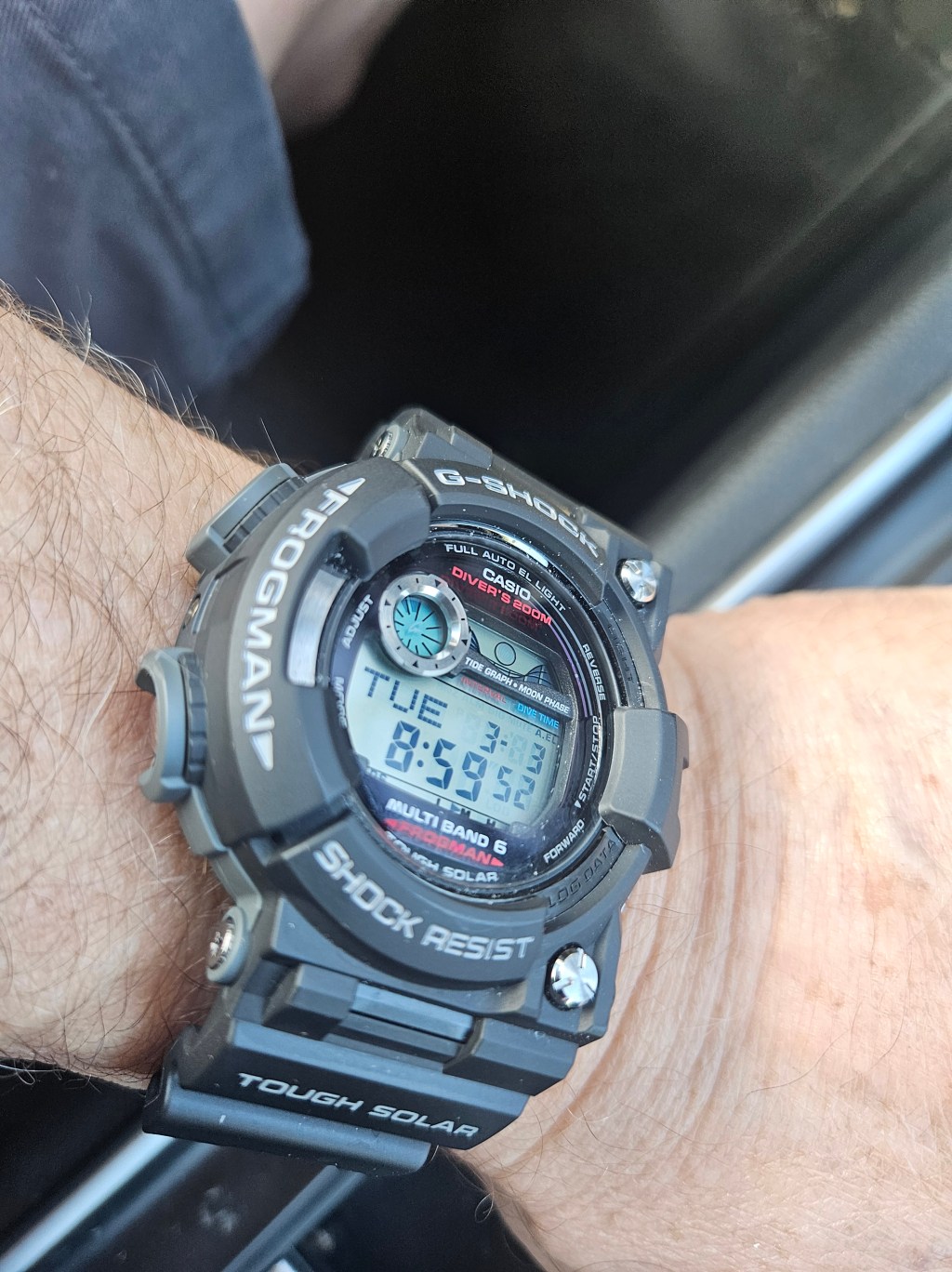
    One day the mechanical aristocracy disappears from your wrist and is replaced by something that would have horrified your former self: a G-Shock Tough Solar Multiband 6 Master of G Frogman. No winding. No servicing anxiety. No obsessive time adjustments. The watch feeds itself on sunlight and checks atomic clocks while you sleep.

    You have, in effect, traded the vintage European sedan for a flagship Lexus.

    The doors close with a reassuring thud. The engine hums like a well-fed housecat. The cabin seals you off from the fumes, noise, and moral chaos of Los Angeles traffic. Everything simply works. No drama. No ritual. No heroic suffering.

    You are now the Chillin’ Man.

    You do not apologize for your comfort. You have earned it. After years of horological asceticism, you have graduated to reliability, quiet luxury, and peace of mind.

    Occasionally someone will ask the inevitable question.

    “What happened to your mechanical watches?”

    You shrug with the serene indifference of a man who has crossed the desert and discovered air-conditioning.

    “What about them?”

  • The Watch You Love Is the One on Your Wrist (The Rest Are Fairy Dust)

    The Watch You Love Is the One on Your Wrist (The Rest Are Fairy Dust)

    I have painful news. We do not gather here to flatter one another’s delusions, so let’s drop the incense and speak plainly: you, me, and our inner watch cyborgs do not love our watches. We love saying we love them. We call them “beloved.” We insist they define our identity. We admire our “curated collections” as if they were doctoral theses in horological self-actualization. We stand before our watch boxes like minor kings surveying a conquered province. It feels noble. It sounds impressive. It is largely fiction.

    How do I know? Because of the evidence you provided. One of you tucked two dozen watches into a hidden trunk. Months passed. No withdrawal symptoms. No late-night longing. No tremor in the wrist. Just silence. These were not impulse purchases from a clearance bin. They were carefully researched, thoughtfully selected, celebrated arrivals. Each one represented taste refined, knowledge deepened, discernment sharpened. And yet, when placed out of sight, they might as well have been holiday decorations in July. That question now hovers over you like an uncomfortable relative at Thanksgiving: Do you love these watches—or do you love the idea of loving them?

    Here is what is happening. The inner watch cyborg is running the show. He is not sentimental; he is strategic. He manufactures urgency. He whispers about grails. He frames purchases as destiny. This is Cyborg Puppetmaster Theory in action: the internal algorithm that thrives on pursuit, not possession. The hunt is intoxicating. The checkout page is a sacrament. The shipping notification is foreplay. But once the box is opened and the novelty metabolized, the cyborg moves on. He feeds on anticipation and starves on contentment. The object was never the point. The chase was.

    And so we arrive at the diagnosis: Collection Delusion Syndrome—the condition in which a collector mistakes the performance of passion for the experience of it. The watches are polished, photographed, insured, cataloged, and then quietly exiled to a trunk where they gather dust without being mourned. The owner declares devotion, yet absence produces no ache. The romance was theatrical. The attachment atmospheric. The only watch that truly exists is the one on your wrist—the one that interrupts your day, absorbs your scratches, accumulates your hours. The rest are fairy dust with serial numbers.

    Let us be honest. This is not a dream. Real money left a real checking account. The fever swamp is funded.

    And now the confessor, staring at his untouched two dozen “prized” watches, considers the unthinkable: Perhaps I should let them go. Perhaps I should move along.

    Yes. Do so—if your inner watch cyborg permits parole.

  • Why the Small G-Shock Square GW5000 Beats the Giant Rangeman GW-9400

    Why the Small G-Shock Square GW5000 Beats the Giant Rangeman GW-9400

    I am not a delicate man. I’m built like Larry Csonka charging through a defensive line—thick wrists, burly forearms, the kind of limb geometry that usually demands “wrist presence.” On paper, the Rangeman GW-9400 should be my natural habitat: big, armored, survivalist, ready to rappel down a canyon at a moment’s notice. The smaller GW-5000U Square, by contrast, looks modest—almost restrained. If you were casting the role of “watch for the large man,” you would hand me the Rangeman without hesitation. And yet, I may very well buy the Square.

    Because this decision has nothing to do with testosterone per millimeter. It comes down to the most ruthless metric in watchmaking: how quickly your eye extracts the time without negotiation. The Rangeman is a dashboard—altimeter, barometer, compass—a field manual wrapped around your ulna. It is physically larger, louder, more armored. But its time display is portioned into compartments, trimmed down, crowded by supporting actors. The numerals are not the star of the show; they are part of an ensemble cast. The GW-5000U, by contrast, clears the stage. Big, centered digits. High contrast. No clutter. It understands something fundamental: a watch’s first job is legibility, not cosplay. Size without clarity is just acreage.

    Now, the Rangeman does offer more capability. Triple Sensor technology. Tactical presence. Expedition energy. All true. But capability is irrelevant if the core function requires squinting, tilting, or activating a backlight like you’re cracking a safe. A watch that grows in diameter while shrinking its time display commits a design sin. It mistakes bulk for usability. The GW-5000U may be smaller, but it is proportionally optimized. Its screen serves the hour, not the ego. It doesn’t pretend to be base camp. It tells the time—immediately, decisively, without drama.

    This is the lesson of the Bloat Paradox: the absurd condition in which a larger watch delivers smaller, less legible time information, proving that increased case size can inversely correlate with functional clarity. In the hierarchy of horology, clarity outranks spectacle. The square wins. The giant loses.

  • Why the G-Shock GW5000U Will Purify Your Soul

    Why the G-Shock GW5000U Will Purify Your Soul

    There is much talk of fasting these days—of autophagy, detox, purification of body and soul. The same fever has infected the watch world. Some enthusiasts advocate “watch fasting”: three days without a timepiece to cleanse the spirit of horological excess. I reject both proposals. When I attempt a dietary fast, I do not achieve enlightenment. I achieve dizziness, weakness, and the productivity of a fainting Victorian poet. Remove food and I unravel. Remove a watch and my brain enters a static-filled void. I lose focus. I pace. I glance at my wrist like a man who misplaced his passport.

    Extremes, in other words, are overrated. Instead of starvation, I recommend discipline. A week of plant-based, whole foods—no sugar, no alcohol, no nonsense—does more for the body than theatrical deprivation ever could. You nourish rather than annihilate. You purify without collapsing.

    The same logic applies to the wrist. Do not go bare. That’s just drama disguised as virtue. Instead, strap on the purest expression of timekeeping available: the Casio G-Shock GW-5000U. It is the plant-based diet of watches—unprocessed, essential, stripped of additives.

    The GW-5000U refuses to perform. It does not preen under café lighting or whisper about artisanal lineage. It sets itself by atomic signal, drinks sunlight for fuel, and absorbs impact with the stoic indifference of poured concrete. Steel inner case. Screw-down caseback. Resin shell that treats concrete like a suggestion. Its numerals are blunt. Its function unquestionable. You strap it on and the debate ends. No servicing calendar. No accuracy anxiety. No heritage cosplay. Just time—accurate, silent, delivered without commentary.

    Critics will protest that greatness requires romance: a sweeping seconds hand, a mechanical heartbeat, a nostalgic tic-tic murmur. That argument mistakes sentiment for superiority. The GW-5000U is a tool refined to its logical endpoint—solar-powered, radio-synchronized, shockproof, water-resistant, and priced for sane adults. It is the anti-vanity watch. In a hobby swollen with status theater and fragile egos disguised as “journeys,” this square slab of Japanese pragmatism stands there like a silent judge. It does not care if you notice it. That is precisely why you should.

    Wear it and something strange happens. The noise quiets. The acquisition itch cools. This is the Purist Reset—the ritual cleansing from horological excess, the return to first principles. When the GW-5000U occupies your wrist, every other purchase becomes negotiable. The spiritual contaminants of the hobby undergo their own autophagy. The mania thins. The mind steadies.

    There are reports—whispered in forums and dimly lit comment sections—of collectors who put on the GW-5000U and never felt compelled to rotate again. They rode off into a minimalist sunset, cured not by abstinence but by sufficiency.

    Before you rush out and buy one, however, a practical warning: its crystal sits exposed. It is honest. It will scratch if you are careless. Protect it with a thin 9H tempered glass shield—clear, precise, invisible. Think of it as sunscreen for the ascetic. Purity does not require recklessness.

    Do not starve. Do not dramatize. Eat clean. Wear clean. And let the square do its quiet work.

  • The Gospel of the Multiband 6 Solar G-Shock

    The Gospel of the Multiband 6 Solar G-Shock

    If you’re drawn to a Multiband 6 solar G-Shock, you may possess what could be called the engineer mind—the temperament that treats maintenance as failure and automation as a moral good. You don’t want a watch so much as a system instance or virtual machine running on your wrist.

    A proper watch, in your view, should set itself, power itself, correct itself, and never—under any circumstances—require the fussy rituals of mechanical ownership. Manual winding feels like typing commands that should have been automated. Battery changes feel like scheduled downtime. Service intervals feel like flawed architecture. What you want is operational silence: install once, forget forever.

    For you, reliability isn’t a feature; it’s a philosophy. Drift is offensive. Inaccuracy produces low-grade anxiety. Atomic synchronization delivers more than precision—it delivers relief, the quiet satisfaction of knowing the number is exactly right, the emotional equivalent of clean code and zero errors. 

    Solar power satisfies the same instinct. External dependency is weakness. Self-sustaining systems feel intelligent. Over time, the watch stops feeling like an object and starts behaving like a background process—always running, never demanding attention, never crashing.

    Status signaling holds no appeal. Flash invites conversation, and conversation about objects is noise. A Multiband G-Shock communicates competence the way a well-organized server rack does: quietly, efficiently, and without asking to be admired. Like a good waiter, it serves your needs without being intrusive.

    Adding to its appeal, its overbuilt case, shock resistance, and water tolerance reflect your respect for systems designed for field conditions rather than showroom lighting. It performs like good infrastructure—essential, invisible, and indifferent to opinion.

    You may tell yourself it’s just a tool, but the attachment runs deeper. You move through a world that feels increasingly unstable, and the watch becomes an ally in your search for order. Each morning glance is less a habit than a systems check. Did it sync overnight? Is everything aligned? That small confirmation carries disproportionate comfort: something, somewhere, is still working exactly as designed.

    This is the onset of Operational Silence Dependency—the quiet attachment that forms when you come to value a device not for what it does, but for what it never asks you to do. The ideal tool makes no demands, sends no alerts, requires no rituals, and never interrupts your day with the mechanical equivalent of small talk. It sets itself, powers itself, corrects itself, and disappears. Over time, you stop noticing its presence and start depending on its absence of problems.

    You’ll know the shift is complete when you wear it through everything—sleep, showers, travel, deadlines, minor crises—because taking it off feels less like removing a device and more like disconnecting a trusted process.

    The depth of the bond becomes obvious when “upgrades” appear. New models promise new features, but you hesitate. Bluetooth, for example, strikes you as a category error. You prefer Multiband for the same reason a systems administrator prefers a cron job to a phone call: one is infrastructure; the other is a relationship. Atomic sync happens quietly in the night—no pairing, no permissions, no firmware prompts, no cheerful reminders to “stay connected.” Bluetooth drags the watch into the emotional ecosystem of the smartphone: updates, battery anxiety, dropped connections, and the faint suspicion that something somewhere needs your attention.

    Multiband 6 is operational dignity—set once, corrected by physics and radio towers that don’t need passwords. To the engineer mind, atomic time isn’t just elegant. It’s morally superior. Bluetooth asks for interaction. Multiband delivers silence—and silence, in your worldview, is the sound of a system working perfectly.

    So you won’t be replacing your Multiband 6 watch with the new Bluetooth model. The current one has proven itself. Replacing it would feel less like upgrading hardware and more like retiring a colleague who has never missed a deadline.

    Over the years, the watch absorbs your history—projects completed, trips survived, long stretches of life that passed without drift or failure. At that point, it is no longer equipment. It is continuity on the wrist: an uncomplaining witness, a small island of order carried through a world that rarely behaves as predictably as your watch does.

    The story doesn’t stop here. Over time, something subtle happens. The watch stops being something you wear and becomes something you operate with. Your rhythms align. You wake, it has already corrected itself. You move through deadlines, travel, minor crises, and long uneventful stretches, and it keeps the same quiet pace—never drifting, never asking, never failing. You stop thinking about it the way a pilot stops thinking about a reliable instrument: not because it’s unimportant, but because it’s always right. Somewhere along the way, the relationship shifts from ownership to partnership. You handle the chaos; it handles the time. Together you form a small, efficient system—human judgment paired with mechanical certainty. In a noisy, unreliable world, the two of you run clean, synchronized, and uninterrupted, less like a man and his watch and more like a single unit that simply works.

  • The Great Rangeman Dilemma

    The Great Rangeman Dilemma

    You should be grading over a hundred student essays right now—papers waiting patiently for marginal comments, thesis corrections, and the quiet mercy of a final score. Instead, you are wrestling with a question of far greater cosmic importance, a problem so profound it makes theological disputes such as substationary atonement look like small talk: Should you buy the positive or negative display of the G-Shock Rangeman GW-9400?

    After hundreds of hours on Reddit and YouTube—an advanced degree in amateur Rangeman studies—you have learned the central truth of the universe. The negative display looks better. The positive display works better. And now you stand at the fork in the road where beauty and usability glare at each other like rival theologians.

    Choose the negative display and you will live with Legibility Anxiety—the persistent suspicion that your watch looks magnificent but requires negotiation every time you want the hour. Choose the positive display and you inherit Aesthetic Anxiety—the quiet sense that you chose practicality at the expense of tactical cool. Either way, you lose something essential.

    Of course, there is the nuclear option: buy both. But this only deepens the disorder. Now each morning becomes a moral trial. Whichever watch you choose indicts the other. You will experience Rotational Guilt, the daily awareness that satisfaction has been structurally engineered out of the system.

    Welcome to the Great Rangeman Dilemma—the condition in which a minor consumer choice expands into a metaphysical crisis because every option comes preloaded with future regret. Time disappears into comparison videos, comment threads, lighting tests, and wrist shots while your actual obligations—those hundred essays—sit quietly aging like milk on the counter. The dilemma is not about watches. It is about the mind’s ability to convert a simple decision into a no-win psychological contract where perfection is mandatory, satisfaction is temporary, and productivity flatlines.

    Do not berate yourself for failing to solve it. Many have entered this labyrinth. None have emerged with certainty.

    Now close the browser.

    Your students are waiting.