Blog

  • Death by Beauty: Looksmaxxing and the Collapse of Meaning

    Death by Beauty: Looksmaxxing and the Collapse of Meaning

    Thomas Chatterton Williams takes a scalpel to the latest mutation of social-media narcissism in his essay “Looksmaxxing Reveals the Depth of the Crisis Facing Young Men,” and what he exposes is not a quirky internet fad but a moral and psychological breakdown. Looksmaxxing is decadence without pleasure, cruelty without purpose, vanity stripped of even the dignity of irony. It reflects a culture so hollowed out that aesthetic dominance is mistaken for meaning and beauty is treated as a substitute for character, responsibility, or thought.

    I first encountered the term on a podcast dissecting the pronouncements of an influencer called “Clavicular,” who dismissed J.D. Vance as politically unfit because of his face. Politics, apparently, had been reduced to a casting call. Vote for Gavin Newsom because he’s a Chad. At first, this struck me as faintly amusing—Nigel Tufnel turning the cosmetic dial to eleven. Williams disabuses us of that indulgence immediately. Looksmaxxing, he writes, is “narcissistic, cruel, racist, shot through with social Darwinism, and proudly anti-compassion.” To achieve their idealized faces and bodies, its adherents break bones, pulverize their jaws, and abuse meth to suppress appetite. This is not self-improvement. It is self-destruction masquerading as optimization, a pathology Williams rightly frames as evidence of a deeper moral crisis facing young men.

    Ideologically, looksmaxxers are incoherent by design. They flirt with right-wing extremism, feel at home among Groypers, yet will abandon ideology instantly if a rival candidate looks more “alpha.” Their real allegiance is not conservatism or liberalism but Looksism—a belief system in which aesthetics trump ethics and beauty confers authority. Williams traces the movement back to incel culture, where resentment and misogyny provide a narrative to explain personal failure. The goal is not intimacy or community but status: to climb the visual pecking order of a same-sex digital hive.

    At the center of Williams’ essay is a quieter, more unsettling question: what conditions have made young men so desperate to disappear into movements that erase them? Whether they become nihilistic looksmaxxers or retreat into rigid, mythic religiosity, the impulse is the same—to dissolve the self into something larger in order to escape the anxiety of living now. As Williams notes, this generation came of age online, during COVID, amid economic precarity, social fragmentation, and the reign of political leaders who modeled narcissism and grifting as leadership. Meaning became scarce. Recognition became zero-sum.

    Williams deepens the diagnosis by invoking John B. Calhoun’s infamous mouse-utopia experiment. In conditions of peace and abundance, boredom metastasized into decadence. A subset of male mice—“the beautiful ones”—withdrew from social life, groomed obsessively, avoided conflict, and stopped reproducing. Comfort bred collapse. Beauty became a dead end. Death by preening. These mice didn’t dominate the colony; they hollowed it out. NPCs before the term existed.

    The literary echo is unmistakable. Williams turns to Oscar Wilde and The Picture of Dorian Gray, where beauty worship corrodes the soul. Wilde’s warning is blunt: the belief that beauty exempts you from responsibility leads not to transcendence but to ruin. Dorian’s damnation is not excess pleasure but moral vacancy.

    The final irony of looksmaxxing is that it produces no beauty at all. The faces are grotesque, uncanny, AI-slicked, android masks stretched over despair. Their ugliness is proportional to their loneliness. Reading Williams, I kept thinking of a society fractured into information silos, starved of trust, rich in spectacle and poor in care—the perfect compost for a movement this putrescent. Looksmaxxing is not rebellion or politics. It’s a neglected child acting out. Multiply that child by millions and you begin to understand the depth of the crisis Williams is naming.

  • Why I Must Become the Skinny Yoga Guy

    Why I Must Become the Skinny Yoga Guy

    As the clock keeps punching holes in the calendar and I drift into the middle distance of my sixties, I’m stalked by the uneasy sense that I am not the man I’m supposed to be. I carry thirty extra pounds like unpaid emotional invoices. I cave to food temptations with embarrassing regularity. I indulge in narcissistic spirals of self-pity. My body bears the archaeological record of a lifetime of weightlifting injuries. Something has to give. The question isn’t whether I’m a complex human being—of course I am—but which single image can give me dignity, courage, and self-possession as I face my obligations, stay engaged with this lunatic world, and fend off entropy. The image that keeps returning, uninvited but insistent, is this: I am the Skinny Yoga Guy.

    The Skinny Yoga Guy eats vegan, clean, and whole, not as a performance but as a quiet discipline. He hits his protein macros with buckwheat, pumpkin seeds, peas, soy, garbanzos, and nutritional yeast, without sulking or negotiating. He cooks plant-based meals anchored in Thai, Mexican, and Indian traditions, not sad beige bowls marketed as “fuel.” He doesn’t snack like a raccoon in a pantry; he sips cucumber water and green tea and moves on with his day.

    He practices yoga six days a week, a full hour each time, sweating without complaint. The body lengthens. The spine straightens. He appears taller, calmer, less compressed by life. There’s a faint health glow—less “Instagram guru,” more “someone whose joints don’t hate him.” The discipline reshapes his temperament. The short fuse and indulgent sulks fade. In their place emerges a man who notices other people, attends to their needs without sermonizing, and discovers—almost accidentally—that service makes him sturdier, not smaller.

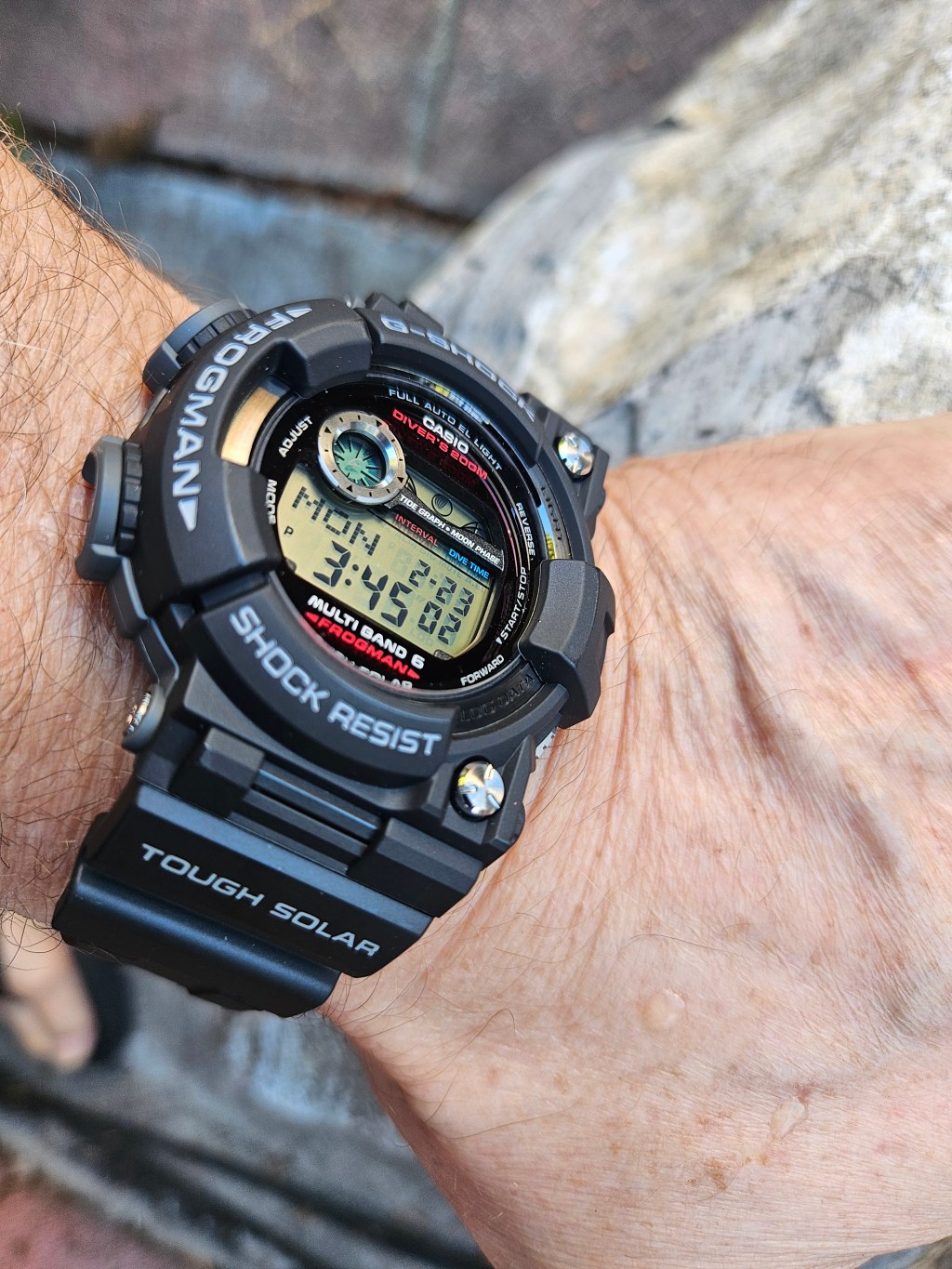
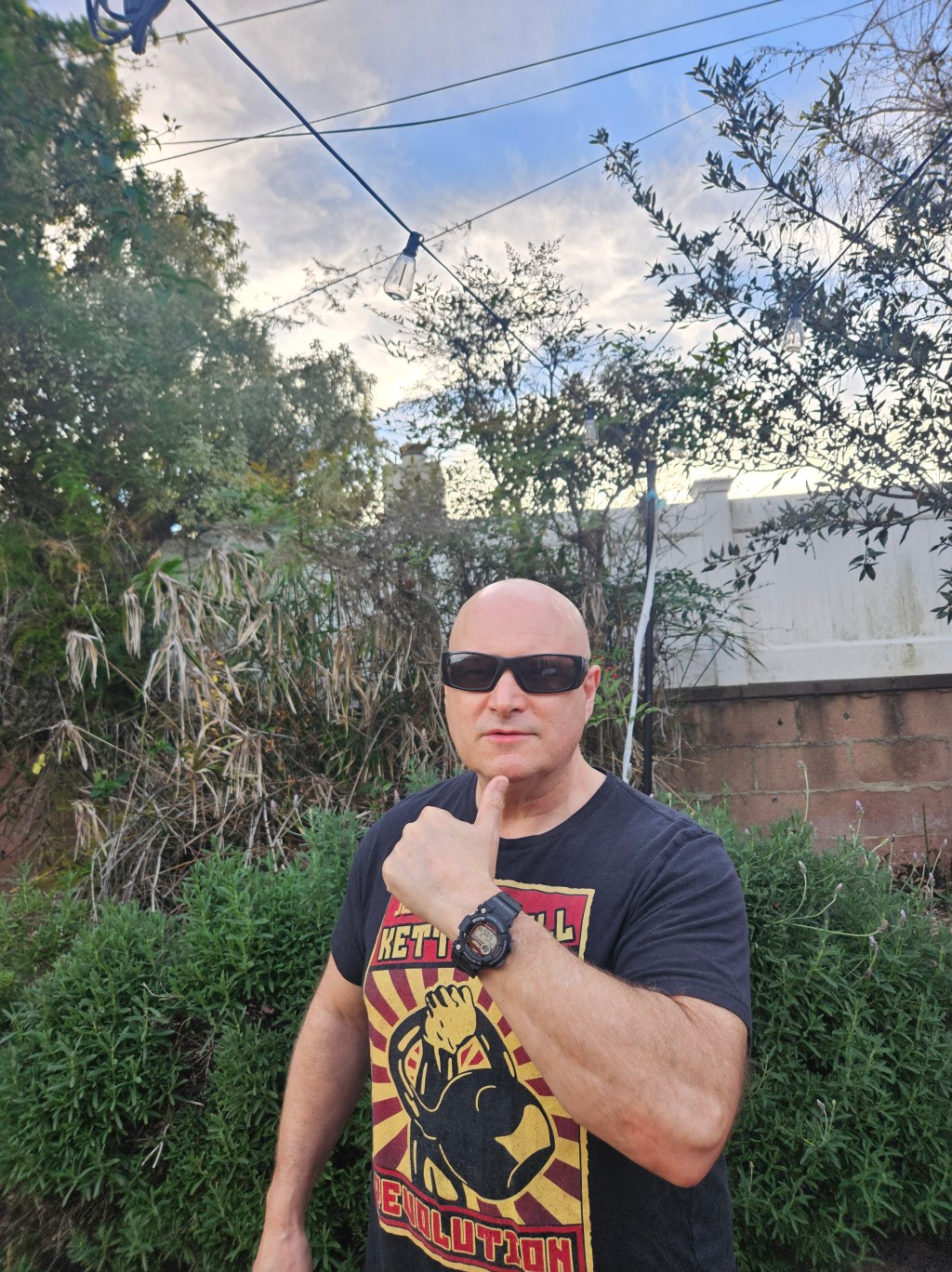
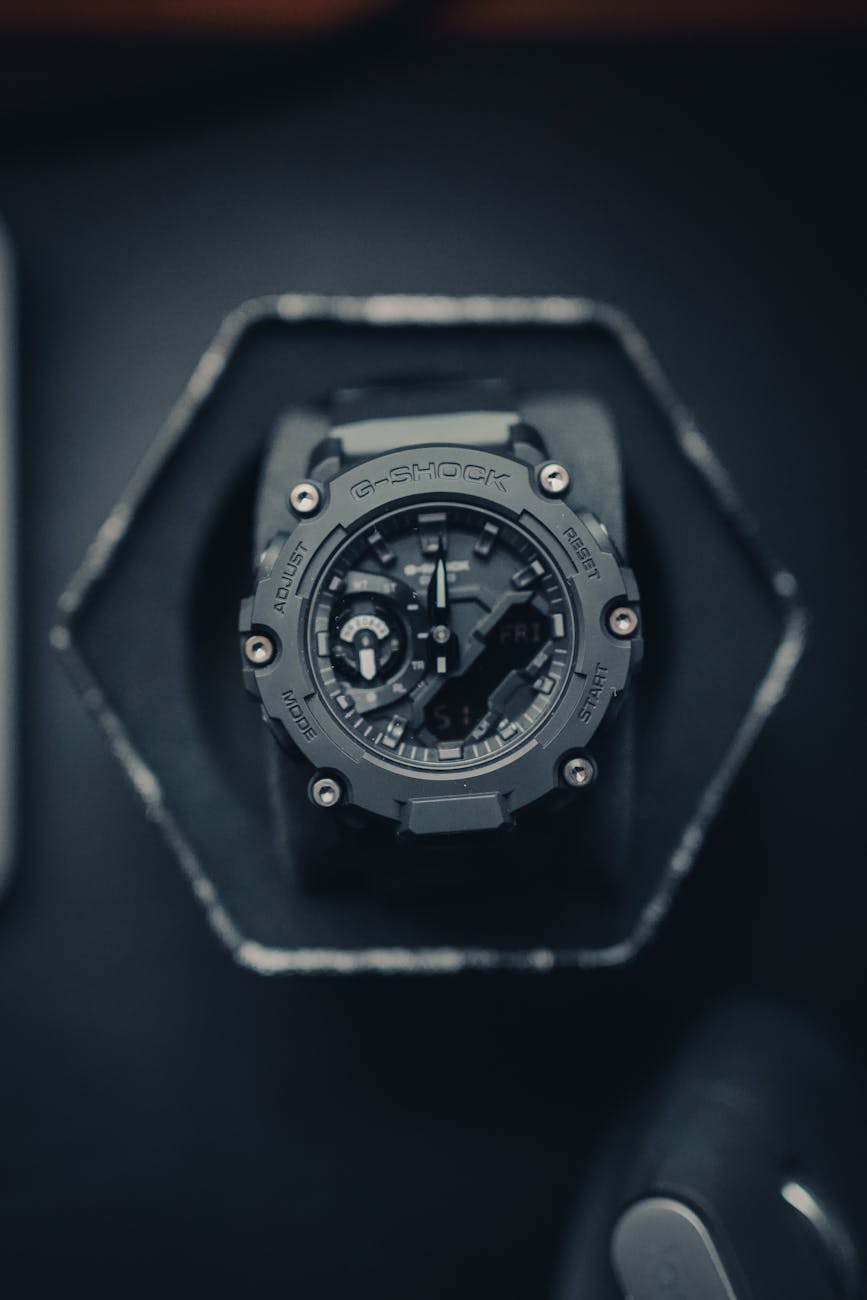
    In this revised operating system, the watch obsession quietly dies. No more chunky diver watches as heroic cosplay. No rotation. No drama. Just one watch: the G-Shock GW-5000. The purest G-Shock because it refuses theater. Shockproof, accurate, solar-powered, atomically synced. No Bluetooth, no notifications, no begging for attention. It does one thing relentlessly well: it tells the truth about time. It is reliability without narcissism.

    If the GW-5000 is indestructibility stripped of spectacle, then my assignment is clear: I must become its carbon-based counterpart. Less bloat. Fewer features. More uptime. Yoga becomes joint maintenance. Vegan food becomes corrosion control. No supplements that blink. No gadgets that chirp. No dietary Bluetooth pairing with guilt. Just a lean system designed to absorb impact, recover quickly, and remain accurate. GW-5000 firmware, now awkwardly attempting to run on two legs.

    The longing is real. I want to be the Skinny Yoga Guy—disciplined, light, healthy—wearing a single $300 G-Shock as a quiet marker of having stepped off the status treadmill. I no longer want validation from a $7,000 luxury watch. Wanting this man is easy. Becoming him is not. That requires character, not aspiration.

    My hunch is that I need to write my way into him. A novel titled The Skinny Yoga Guy. Not a parody, not a self-help tract, but a chronicle of real-time change rendered with mordant humor and unsparing honesty. The book isn’t the point. Transformation is. The novel would simply be the witness.

    So here I am, a larval creature trapped in my cocoon. I must emerge as a new creature. The challenge is issued. Whether the world is waiting for my metamorphosis is irrelevant. I am. And that, for once, feels like enough.

  • The Shingles Shot, the Vanishing Kettlebell Workout, and a Brief Descent Into Strap Madness

    The Shingles Shot, the Vanishing Kettlebell Workout, and a Brief Descent Into Strap Madness

    I got my shingles vaccine yesterday at noon and felt absolutely nothing afterward—so nothing, in fact, that I woke up the next morning feeling smugly invincible. I went to Trader Joe’s, bantered with the employees about the collective psychosis surrounding their limited-edition mini tote bags, came home, unloaded the groceries, and mentally penciled in a righteous kettlebell session in the garage. Then, right around 10 a.m., my immune system cleared its throat. A slow, heavy wave of fatigue rolled in, the kind that doesn’t ask permission. I took what I told myself was a “precautionary” nap. I made a deal with my body: if I felt fine in an hour, the kettlebells were back on. By 11, the aches had arrived, lethargy had unpacked its bags, and the deal was quietly voided. The iron would have to wait.

    Now, 28 hours post-shot, I’m more tired than I was this morning, which feels like a violation of some unspoken contract. In what I can only describe as a low-grade vaccine fever fugue, I apparently decided this was the perfect moment to perform strap surgery on my watch collection. The Seiko SLA051, 055, and 023 all lost their OEM waffle straps and emerged reborn on Divecore FKM. Yes, I’m aware that FKM is rumored to whisper chemical lullabies into the bloodstream. No, I’m not persuaded that wearing these watches a few hours a week is going to tip me into a Superfund site.

    In any case, I’m already planning to swap the FKMs for Divecore’s hydrogenated waffle straps in a few months. If there’s any exposure happening, it’s brief, intermittent, and vastly overshadowed by whatever biochemical fireworks the shingles vaccine is currently setting off inside me. For now, I’ll rest, hydrate, and let my immune system do its thing—apparently with a side hobby in horological rearrangement.

  • Learning About Rejection on a Flight to Miami

    Learning About Rejection on a Flight to Miami

    In the summer of 1972, when I was ten years old and convinced my destiny was to become a musclebound baseball god in the image of Reggie Jackson, I found myself on a flight from LAX to Miami, pressed against the window and staring out at adulthood like it was another continent. In the middle seat sat a blonde bombshell in her mid-twenties wearing pink hot pants with psychedelic purple-and-white stripes and legs so aggressively tanned they could have powered a citrus-processing plant. She wasn’t just attractive; she was a mood. She radiated the entire seventies—optimism, excess, invitation. I wasn’t merely drawn to her. I was drawn to the future she seemed to promise.

    On the aisle sat her conversational counterpart: a pencil-necked, dark-haired man of similar age with impeccable manners, minimal charisma, and the quiet dignity of a man who alphabetizes his spice rack. He was an accountant. She was in dental hygiene school. For five uninterrupted hours, the two of them performed their biographies live, with me as the captive audience. Mostly she spoke. He nodded, gasped on cue, and occasionally supplied a sentence fragment to prove he was still alive. She talked about school, snacks, weather, philosophy—everything. It felt like watching a reality show pilot that forgot to end. But I didn’t mind. She was animated. She was confident. She was hope in hot pants.

    At one point she announced that her ears needed to pop and offered both of us Dentyne gum, explaining that it helped with altitude. I briefly wondered if she thought we were participating in some sort of triathlon of inner-ear resilience. The accountant accepted the gum solemnly, like a man taking medical advice from destiny.

    When the plane finally shuddered to a stop at the gate, the accountant—buoyed by five hours of uninterrupted conversation and the survival glow of having endured it—asked her out on a date. She declined with practiced kindness, the sort of smile perfected by women who have said no thousands of times without ever raising their voice. He accepted the rejection gracefully, even apologetically, as if her disinterest were an inconvenience he had caused.

    My ten-year-old brain short-circuited. I felt like I’d witnessed something indecent. Rejection, I believed, was supposed to be private. Public rejection multiplied the shame. I flashed back to junior high dances where I’d cross the cafeteria, ask a popular girl to dance, watch her recoil as if I’d mistaken bravery for stupidity, then retreat to my friends’ laughter. Now I was seeing the adult version. How could this accountant—handsome, polite, numerically gifted—be rejected after such an extended airborne courtship? I sat there, my romantic assumptions collapsing like cheap sci-fi scenery. Maybe he was too bland. Maybe she had a chaotic love life waiting in Miami. Or maybe—this was the real lesson—she’d simply enjoyed a conversation to pass the time on a long flight. Whatever the reason, I absorbed his rejection as if it were my own. I remain convinced that somewhere in the universe’s permanent records, my name appears next to a small but enduring note: rejected by attractive woman. And yes, it still stings.

  • Flying First Class Is a State of Mind

    Flying First Class Is a State of Mind

    I was born in America in 1961, and if I had to explain this country to a foreigner in one image, I wouldn’t reach for the flag or the Statue of Liberty. I’d point to flying first class. Not the policy of it, not the logistics—just the concept. First class is America in an airline cabin. It grabs you by the collar and says, This is how we do hierarchy. We don’t hide it. We parade it down the aisle.

    Yes, we have our obnoxious luxury cars and coastal dream houses, but nowhere is class difference so intimate as on an airplane. You’re breathing the same recycled air as the people sipping champagne up front. You share the same narrow aisle, the same claustrophobic bathrooms, the same airborne flu incubator. 

    The difference is ceremonial. The first-class passenger is already settled—wrapped in a sherpa blanket, nibbling brie, greeted by flight attendants who address them the way courtiers addressed minor royalty. 

    Then comes the procession: coach passengers filing past, stealing glances, marching toward the back where crying babies, bare feet with ambitious toenails, and circulation-threatening seat pitch await. This is the real luxury—not the champagne, but the ceremony and the choreography. The pleasure is sharpened by contrast. As a first-classer, you’re not cruel. You don’t wish misery on anyone. But your comfort glows brighter because someone else is uncomfortable ten feet away.

    And that glow whispers. Not “you’re lucky.” Not “you’re comfortable.” It whispers the more dangerous phrase: you’re special. That’s the real drug of first class—not legroom, but psychological elevation. The sense that you cracked some hidden code of life, that you’ve unlocked a cheat mode where ordinary frustrations can’t touch you. 

    I once heard a comedian joke that in a plane crash, first-class passengers would survive while the rest of us perished. It’s absurd. And yet… it sounds exactly like something we want to believe.

    This is America. You don’t just earn money here. You earn the right to hear that whisper.

    I’ll confess something anticlimactic: I flew first class once, in 1994, thanks to my father, who sent me to his condo in Maui. I remember almost nothing about it. No ecstasy. No glow. Maybe I suffer from flight anhedonia—the inability to experience joy at 30,000 feet. 

    But I have felt the first-class sensation elsewhere. A friend once let me borrow his Omega Planet Ocean. I wore it to Trader Joe’s and found myself standing in line with organic arugula and the faint, ridiculous thrill of superiority. A luxury watch did what a luxury airline seat never could.

    I could afford such a watch. I owned a Tudor Black Bay once. I sold it quickly, like someone who realized halfway through a costume party that he’d come dressed as the wrong person.

    Now I’m sixty-four, and the urge to gloat has evaporated. I don’t want status anymore. I want clarity. I want restraint. I want a temperament that doesn’t need applause from inanimate objects. Wearing an expensive watch I don’t need feels less like success and more like cosplay—me auditioning for the role of a man who’s made it. The problem is, I know the actor too well. Under the costume is not a titan of confidence but an anxious, fractured soul with the spiritual DNA of Franz Kafka and the comedic timing of Richard Lewis. No amount of Swiss engineering is going to fix that. And pretending otherwise would only make me feel like a fool in very fine clothes.

  • How 2025 Made Me Believe in Movies Again

    How 2025 Made Me Believe in Movies Again

    I lost my love for movies sometime in the last decade, when Hollywood began to feel less like a dream factory and more like an actuarial office with better lighting. Everything started to look like a boardroom decision in costume. I can count on one hand the films I bothered to see in theaters over fifteen years: Avatar, World War Z, Black Panther, Get Out. A few streamed titles shook me awake—Uncut Gems and Good Time from the Safdies, Paul Giamatti’s bruised soul in Private Life and The Holdovers, Paul Thomas Anderson’s sunburned nostalgia in Licorice Pizza, Ryan Coogler’s Sinners. But 2025 hit differently. Four films—Eddington, One Battle After Another, Bugonia, and Weapons—did something rare: they stared directly into the national nervous breakdown. These weren’t escapist fantasies. They were dispatches from a culture unraveling—where institutions inspire no faith, conspiracies feel more plausible than facts, politics has become cosplay, and we live in sealed-off realities that collide without ever conversing.

    Eddington blindsided me. Joaquin Phoenix plays a bitter, alienated, anti-mask sheriff in a New Mexico town during the pandemic, and he’s so fully possessed by the role that I didn’t recognize him for several minutes. I went in braced to hate the film—expecting a grim slog through our worst collective memories. Instead, I got something braver: a devastating portrait of a society that has slipped its moorings and drifted into a lonely fever swamp. The film doesn’t mug for satire or cheap laughs. It trusts the material. Every scene tightens the vise on your attention. It’s the kind of movie nine hundred ninety-nine directors would have drowned in. Ari Aster somehow swims.

    One Battle After Another turns political polarization into tragic pageantry. Sean Penn’s Colonel Lockjaw—a grotesque ICE-agent archetype—faces off against Leonardo DiCaprio’s Rocket Man, who might as well be an Antifa folk demon. But the movie’s real target isn’t left or right; it’s the theater of identity itself. We’ve become a nation of people in costumes, fighting playground wars with adult consequences. Once your political tribe becomes your personality, nuance feels like betrayal. The film suggests a hard truth: a country run by permanent adolescents doesn’t collapse in flames—it collapses in tantrums. Penn has built a career on operatic excess, but Lockjaw may be his most disturbingly perfect creation yet.

    Bugonia is stranger still. Jesse Plemons—leaner, sharper, and channeling a high-IQ Dale Gribble—plays Teddy, a man-child whose conspiracy obsessions keep him tuned to late-night AM radio and convinced that a tech CEO, played by Emma Stone, is an alien in need of kidnapping and repatriation. Once tied up in his house, she attempts to weaponize corporate confidence as an escape strategy, and her faith in managerial language becomes its own punchline. Plemons is reliably excellent, but Emma Stone has crossed into something rarer: the kind of presence Daniel Day-Lewis had in the nineties, where the screen bends around her. The film’s bizarre logic and eerie beauty sent me straight into the arms of Yorgos Lanthimos’ odd, seductive universe.

    Weapons brings the nightmare home—literally. Set in the suburbs, it tells the story of a witch who makes a classroom of children vanish. The teacher is blamed. The principal responds with bureaucratic platitudes. The town spirals. Beneath the horror scaffolding is a sharp allegory about addiction and institutional cowardice: when a society loses its ability to think clearly, every crisis metastasizes. The adults talk in slogans. The children disappear.

    Taken together, these films diagnose the same disease. Chaos becomes pandemonium when a culture retreats into fantasy and calls it identity. We dress up our impulses as ideologies. We curate personas instead of building character. The center doesn’t hold—not because of some invading barbarian, but because we’ve all invited the barbarian inside and handed him the keys. The good news, if there is any, is that there are still filmmakers brave enough to tell the truth about the mess we’re in. In 2025, cinema finally stopped trying to soothe me—and started telling me what I already knew but didn’t want to admit.

  • Colonel Lockjaw and the Cosplay Watches of the Soul

    Colonel Lockjaw and the Cosplay Watches of the Soul

    If I had to confess to one of my worst flaws, it would be this: I’m a virtuoso at diagnosing other people’s defects and a coward when it comes to inspecting my own. I can spot hypocrisy at fifty paces, write a character analysis of your blind spots, and deliver a withering critique of your moral laziness—while remaining blissfully obtuse about the same diseases raging in me. It’s not insight. It’s evasion. Instead of interrogating my own failures, I distract myself by putting others on trial.

    The hypocrisy deepens because I despise people who refuse self-interrogation. Over the years I’ve kept my distance from plenty of them—friends, colleagues, acquaintances—because their lack of self-awareness felt repellent. I judged them for their blindness without noticing I was practicing the same sin with better vocabulary. My watch hobby was an early case study in this delusion. I spent years buying grotesquely oversized timepieces—wrist-mounted monuments to masculine cosplay. In my private fantasy, I was Sean Penn starring as Colonel Lockjaw. In reality, I was a middle-aged man dodging a mirror. Why confront a crisis of purpose when you can drop five hundred dollars on a costume watch and call it identity?

    Eventually I sobered up—sold the ridiculous pieces, learned what real watches are, and cleared out my collection the way a dieter purges Doritos and Twinkies. But the damage was done: I’d wasted three years of a hobby because I refused to ask what my compensation phase said about me. I demanded self-interrogation from everyone else. I granted myself a permanent exemption. Do as I say, not as I do—the oldest creed of the unexamined life.

    That failure has been haunting me lately, triggered by a memory from thirty-five years ago: an English Department meeting that turned into a circus. I was a young instructor, terrified of tenure committees and power hierarchies, sitting quietly while the veterans argued about whether personal narratives belonged in college writing. One professor—let’s call him Foghorn Leghorn—was a legendary drunk who showed up to meetings in a black leather bomber jacket and a cloud of whiskey fumes. With disheveled silver hair and black horn-rimmed glasses, he declared that personal narratives were “sissy” assignments and that students needed “real-life” skills like argument and analysis. Susan, a colleague with more backbone than the rest of us combined, said that autobiographical writing gave students something called “personal enrichment.” Foghorn exploded. “What the hell does that mean?” he barked. “Personal enrichment? What the hell does that mean?” Susan backed down—not because she was wrong, but because there’s no winning an argument with a belligerent man auditioning for his own demolition.

    Back then, I kept my mouth shut. I was young. I was a lecturer on a non-tenure track. I was scared. But in the decades since, I’ve had time to think about Susan’s phrase. Personal enrichment. What does it mean—and should I, as a writing teacher, care? The answer is yes, and yes again. Personal enrichment is the cultivation of skills no standardized test can measure: moral clarity, self-honesty, the courage to look at yourself without flinching. In other words, self-interrogation.

    I learned that lesson early in my career without knowing what to call it. Around the same time Foghorn was grandstanding, I assigned a definition essay on passive-aggressive behavior. Students had to begin with a brutal thesis—passive aggression as cowardly hostility—then unpack its traits and finish with a personal narrative. I wanted them to stop admiring dysfunction as cleverness. The best essay came from a nineteen-year-old whose beauty could’ve launched a sitcom. She wrote about her boyfriend, a man who looked like life had given up on him. He was unemployed, proudly unwashed, and permanently horizontal—camped in her parents’ living room like a hostile occupier. He drank her father’s beer, ate his food, parked himself in his chair, and stank up the furniture with equal enthusiasm. Her parents hated him. Especially her father. And that was the point.

    She resented her father’s authority, so she punished him the only way she knew how—by sabotaging herself. Romantic self-destruction as revenge. When we discussed the essay, she told me something I’ve never forgotten: writing it forced her to see her behavior with unbearable clarity. She kicked the boyfriend out. Then, clumsily but honestly, she confronted her father. A personal narrative—mocked by my alcoholic colleague—did what no grading rubric ever could. It changed a life.

    Fifteen years later, I assigned another narrative, this one inspired by Viktor Frankl’s Man’s Search for Meaning. I asked students to write about a moment when tragedy forced them to choose between self-pity and courage. The finest essay came from a young mother who’d been abandoned by her own mother at two years old. She grew up with a hole in her heart, then gave birth to a daughter and decided she would be the mother she never had. In loving her child, she learned to love herself. I’ve taught for nearly forty years. Her story has moved me more than anyone’s.

    That’s why I assign personal narratives more than ever. Not just because they resist AI shortcuts, but because they demand moral inventory. And here’s the final irony: Foghorn Leghorn—the loudest critic of self-examination—was the man who needed it most. Last I heard, he’d burned down his kitchen while making dinner, lost his family, and was holed up in a cheap hotel drinking himself toward oblivion. The mansplainer who sneered at Susan ended up a tragic footnote in his own cautionary tale. I hope he found sobriety. If he did, it began where it always does—with honest self-interrogation.

    As for me, I’ll keep assigning personal narratives. I’ll keep asking students to look inward with courage. And I’ll keep reminding myself that the hardest essays to write are not on the syllabus. They’re the ones you compose silently, about your own life, when no one is grading you.

  • Retirement Isn’t the Problem—Entropy Is

    Retirement Isn’t the Problem—Entropy Is

    A month ago I had my first physical therapy appointment with Ken, a young man who radiated competence and emotional distance in equal measure. He handed me a list of exercises, told me to perform them three times a day, informed me that surgery was unlikely, and ushered me out like a man closing a file. Efficient. Impersonal. I assumed that was just his professional style.

    Yesterday I saw him again, and the man had apparently been replaced by his more human twin. He was warm, chatty, and openly exhausted—in the specific way that only new fathers can be. Suddenly his earlier aloofness made sense. That first session wasn’t clinical detachment; it was sleep deprivation in a polo shirt. This time he walked me through a new routine using resistance bands anchored to my bedroom door—pec flys, side laterals, posterior delts, the whole greatest-hits album of shoulder rehab. Best of all, the new program comes with mercy: once a day, four days a week. A civilized schedule for a man who has already paid his dues.

    Then came the good news. Ken tested my mobility and announced I had gained fifty percent in a month. That sentence deserves a parade. He followed it with an even sweeter story: one of his clients suffered a full “100 percent” rotator cuff tear and healed without surgery over fourteen months. I told him that sounded like gospel music to me. Hope, when you’re injured, is a performance-enhancing drug.

    While typing up my report, Ken casually asked how I felt about retiring from teaching in eighteen months. I didn’t bother with bravado. I told him the truth: I’m scared. When you spend forty years building a work persona—something that animates your days, sharpens your thinking, and gives your life narrative tension—and then you remove yourself from the stage, you don’t just lose a job. You risk losing your gravity. People love to say they’ll “stay busy” in retirement. But human beings don’t thrive on busyness. We thrive on stakes. Without them, we drift. Not into disaster—into comfort. Into pleasure. Into slow-motion decay fueled by snacks and streaming services.

    I’ve tested the volunteer fantasy already. Years ago, after adopting a rescue dog, I thought volunteering with the organization would be meaningful. Instead, I found myself sitting in front of a pet store in Redondo Beach on a Saturday, surrounded by wonderful people and feeling absolutely unnecessary. They were kind. They were earnest. I was bored out of my soul. The group’s founder, Cathy Rubin—a therapist with X-ray vision—took one look at me and said, kindly and accurately, “Jeff, this isn’t for you.” She was right. I kept donating. I never went back to volunteer. Not everyone is wired for sainthood.

    So yes, I’m scared of retirement. I’m scared of my own antisocial tendencies, my talent for isolation, my ability to rationalize entropy as “well-earned rest.” I’ll keep writing. I’ll make the occasional YouTube video. I’ll perform small acts of public presence. But I know the truth: I’m going to have to fight like hell to stay alive in the deep sense—not breathing, but burning. Because entropy doesn’t kill you in one blow. It kills you in installments.

  • Searching for Gold’s Gym While Life Sends Me to Radiology

    Searching for Gold’s Gym While Life Sends Me to Radiology

    Last night I dreamed I lost everything that usually pretends to be me. I woke up on the grass of a high school football field wearing only gray gym shorts and an empty wallet—no phone, no keys, no biography. From there I drifted into a wealthy Los Angeles neighborhood and became a kind of genteel vagrant, squatting in rich people’s basements and back cottages in exchange for handyman work. I had no idea how I knew what I was doing, but in the dream I somehow inherited the skills of an Italian drywall contractor I once knew as a teenager. My one obsession was finding Gold’s Gym, which in this fevered geography had become a holy site—Oz, Mecca, and Lourdes rolled into one. The belief was simple and insane: if I could just work out there, I would be saved.

    I never reached the gym. Instead, I wandered through mansions, luxury malls, and restaurants dripping with spectacle—giant half-naked fashion models leering from every surface like pagan idols of commerce. The excess depressed me. All that gloss, all that money, and not a shred of peace. I didn’t want the riches. I didn’t want the scenery. I just wanted enough handyman gigs to scrape together the cash to hire a guide—some benevolent Virgil—to lead me to the sacred weight room. In the dream’s logic, salvation required a spotter for the bench press and the squat rack.

    Then I woke up and reality delivered its own sermon. My left shoulder—the one recently diagnosed with a torn rotator cuff—was throbbing like a bad memory. I shuffled through the morning ritual: steel-cut oats, coffee, three ibuprofen, email. There it was—my doctor recommending an MRI and a steroid shot. So I did what every rational modern patient does: I watched YouTube videos of people being fed into MRI machines like cautious astronauts. The claustrophobia hit immediately. That narrow tube might as well have been a coffin with better lighting. I thought, there is absolutely no way I’m volunteering for this kind of psychological hostage situation. Surgery isn’t even on the table—so why stage a horror movie? I’ll pass on the MRI. I’ll take the steroid shot. I’ll stick with the practical mercy of pain relief.

  • Are We Extras in Someone Else’s Luxury Watch Fantasy?

    Are We Extras in Someone Else’s Luxury Watch Fantasy?

    Six weeks with my fifteen-year-old twins is a better sociology course than anything you’ll find at UCLA. Their generation runs on shared experiences—amusement parks, concerts, parties—and the sacred ritual of turning those moments into cinematic TikToks. They love empathy. They love energy drinks. They love boba with the devotion earlier civilizations reserved for gods. They exchange hugs so theatrical they deserve SAG cards. They also love not driving. Why would they? They have concierge parents for that. The car is not transportation; it’s a mobile confessional booth where they talk, text, and disappear into playlists like monks retreating into sonic monasteries. Licenses can wait. I’ll be stunned if either one pilots a vehicle solo before age twenty-five.

    They dress alike, too—hoodies, high-rise jeans, baggy sweatpants. When I pick them up from school, I scan a sea of identical silhouettes and play a grim game of Where’s Waldo: Daughter Edition. It’s like they all emerged from the same fashion assembly line, stamped and released in bulk.

    Then there’s the strangest quirk of all: the generational terror of bare feet. We live in Southern California, where flip-flops are a constitutional right. But when my daughters’ friends come over, I’m ordered—ordered—to put on shoes. Feet are not feet anymore. They’re “dogs,” “grippers,” “claws,” a traveling carnival of anatomical horror. One girl saw my bare feet and reported back like she’d witnessed a crime scene. Since then, I suit up like a hazmat worker whenever teenagers enter the house.

    Watching their collective likes and dislikes has turned me into an amateur René Girard scholar. Girard argued that we don’t want things because they’re intrinsically wonderful; we want them because the tribe wants them first. Desire is social plagiarism. The tribe writes the script, and we perform it thinking it’s improvisation.

    But there’s a dark twin to mimetic desire: mimetic aversion. If the tribe hates something, we learn to hate it, too—even if we never felt a flicker of disgust on our own. Case in point: “I saw your dad’s dogs. Gross.” A moral judgment delivered about toes.

    Naturally, this has sent my twenty-year watch obsession into a philosophical tailspin. When we crave a watch, is it a private passion—or just tribal ventriloquism? Are we collectors, or are we obedient extras in someone else’s luxury fantasy? And if we’re that easily programmed, doesn’t it expose something mildly humiliating about us—our insecurities, our hunger to belong, our weakness for social approval dressed up as taste?

    Maybe understanding desire would clarify us. Or maybe it would only prove how unclassifiable we really are. Some mysteries resist labels.

    Still, in the watch world, mimetic aversion is practically doctrine. Quartz watches are treated like dietary betrayal. You used to grill rib-eyes and now you’re flipping soy burgers? Next you’ll be wearing Crocs and asking for decaf. Show up at the wrong meet-up with a quartz on your wrist and you won’t just lose respect—you’ll lose invitations, subscribers, and possibly citizenship. “Quartz?” they’ll whisper. “Traitor.”

    On the flip side, mimetic desire runs the show just as ruthlessly. Look at the waiting lists. Look at the resale prices. When you buy certain watches, you’re not buying steel—you’re buying absolution. A Rolex Sub isn’t a timepiece; it’s a baptism. The tribe anoints you with holy water and hums a choral anthem over your wrist.

    So yes, the watch hobby is soaked in mimetic desire and mimetic aversion. But here’s my heresy: if you’re a true watch obsessive, those forces barely apply to you. Because your relationship with watches isn’t tribal. It’s theological.

    A real watch obsessive is ruled by three forces.

    First, the Svengali Effect. A certain watch doesn’t attract you—it hypnotizes you. It hijacks your agency like a charming cult leader. You try to resist. You fail. The watch plants itself in your brain and grows there like an invasive eucalyptus until surrender feels like destiny. This isn’t imitation. This is possession.

    Second, Horological Fixation. At this stage, your watch stops being a timekeeping device and becomes a visual narcotic. You no longer use your watch to check the time—you commune with the object. The world fades. The wrist becomes a shrine. Eden relocates to forty-two millimeters of brushed steel.

    Third, Horological Transfiguration. You put on the watch and—boom—you’re not just dressed, you’re transformed. James Bond. Jacques Cousteau. Brad Pitt walking into a bar where the jukebox automatically switches to something heroic. The watch doesn’t accessorize you; it authorizes you.

    I’ve known watch obsessives for decades. I know the symptoms. I know the tells.

    So if you live under the Svengali Effect, Horological Fixation, and Horological Transfiguration, René Girard’s mimetic theory doesn’t really apply. The good news: you’re not a phony lemming chasing tribal approval. The bad news: you’re completely unhinged.

    Congratulations. You’re a true watch obsessive—authentic, independent, gloriously insane.

    Now put on your watch. You’ve been Clark Kent long enough. It’s time to rip open the shirt and let the cape fly.