Tag: fantasy

  • Your Status Drifts Like the Waves of the Sea

    Your Status Drifts Like the Waves of the Sea

    One grim Tuesday in fifth grade, our entire class was herded into the nurse’s office for the Ishihara Colorblind Test—a bright little carnival of humiliation disguised as medical science. Each of us took turns peering into a glowing lens, where we were supposed to spot numbers hidden in a mosaic of pastel dots. My classmates breezed through like they were decoding divine messages. I, however, saw nothing but decorative oatmeal.

    The nurse grew impatient. “Can’t you see anything?” she barked, her voice slicing through the sterile air like a paper cut. The class erupted in laughter. My fate was sealed: I was the day’s designated leper, the monochrome freak in a Technicolor world.

    At lunch, I sat alone with my half-eaten cheeseburger and tater tots, brooding over my sudden fall from grace. “Why,” I asked my internal life coach, Master Po, “is everyone making such a big deal about me being colorblind?”

    “Do not worry, Grasshopper,” he said in that maddeningly tranquil voice. “Today you are mocked, but by tomorrow you will be first picked at kickball, for your mighty legs will send the ball over the fence. People’s judgments are like waves upon the sea—brief, noisy, and forgotten.”

    “I’m not so sure about that,” I said. “Teddy Leidecker smelled like pee in kindergarten, and he’s still called Pee-pee Teddy. That wave’s been breaking for five years straight.”

    “Nature does not hurry,” Master Po said serenely, “yet everything is accomplished in its time.”

    “Try telling that to Teddy Leidecker,” I muttered.

    “You must not manage the gardens of others,” he said. “You have your own plot of weeds to clear.”

    “Really encouraging, Master.”

    He nodded. “You must clear them to reveal your original nature.”

    “What if my ‘original nature’ isn’t that great?”

    “Even if you dislike yourself,” he said, “you must nurture yourself. The sage helps even the repulsive.”

    “So what you’re saying,” I said, “is that even when I do stupid things, I can be a moral lesson to myself?”

    “Precisely, Grasshopper. You are blossoming before my eyes.”

    “Yeah,” I said, stabbing a tater tot. “Into what, exactly—a dandelion?”

  • Master Po vs. My Perfect Alibi

    Master Po vs. My Perfect Alibi

    In 1972, on the dust-choked battlefield otherwise known as the Independent Elementary playground, Miguel Torres and I were locked in a holy war over an alleged clipping penalty. Gary Kauffman—self-appointed referee, rules committee, and prophet of doom—had flagged me during tag football, a call that would hand my team the loss. Words got hot. “Cheater” ricocheted between us like a stray bullet. Then Miguel’s fists did the talking—left, right, a percussion solo on my jaw.

    I cried—not because I stood there like a department-store mannequin while his knuckles composed a sonata on my face, but because I was blind. I hadn’t read the storm system building in my friend—barometric pressure falling, hostility rising—and I was stunned that my protest could yank that much fury out of someone who’d traded Twinkies with me at lunch.

    The recess bell shrieked. We jogged back to class, me sniffling, my face a throbbing geography lesson. Mrs. Eckhart opened My Side of the Mountain, but I heard only the drumbeat in my skull and the soft crush of my pride underfoot. I retreated inward to the place my imagination had been furnishing for months: a quiet stone courtyard outside the Shaolin Temple, the same one that glowed from our black-and-white TV. The river whispered nearby. Incense drifted like daydreams. And there stood my spiritual guide, Master Po—blind as justice, sharp as a scalpel.

    “Master Po,” I said, still tasting the copper of humiliation, “you once taught me that weakness prevails over strength and gentleness conquers. Yet my team lost, my friend rearranged my face, and I stood there helpless. Where was gentleness then?”

    “Grasshopper,” he said, “you mistake stubbornness for virtue. You are the rigid branch that neither sees the distant hills nor hears the cooling wind—and so you snap. Begin by seeing. Begin by listening.”

    “What am I not seeing? What am I not hearing?”

    He tilted his head. “For one, you did not hear the expletives cannoning from your mouth—shrapnel of spit landing on your friend’s cheeks. For two, you did not see your own finger spearing his chest, drilling his solar plexus as if mining for a confession.”

    “So I was ticking off Miguel without even knowing it?”

    “Precisely, Grasshopper. You cherry-pick facts to star in your favorite film—You, the Noble Victim—while everyone else auditions for Villain. Myth-making is a miraculous tool for preserving self-esteem. It is also the shortest road away from The Way.”

    “I don’t myth-make.”

    He raised an eyebrow in the patient way only the blind can. “When you were six, you slept at your aunt and uncle’s and wet the bed. Instead of accepting the weather report from your own bladder, you blamed…the Pee Fairy.”

    I winced. “I remember. It was quick thinking.”

    “What else do you remember?”

    “That I repeated the lie until it became embroidered truth. I argued anyone who doubted me into silence. The Pee Fairy did it. Obviously.”

    “Exactly,” he said. “When you muddle truth long enough, you lose your own outline. You become your costume.”

    “How do I follow The Way?”

    “Do not costume yourself. Do not curate a personality for the world like outfits for the first day of school. Let time carve you. Emerge by erosion, not construction.”

    “I’m eleven,” I said. “Time carves slowly. Also, if I don’t finish my social-studies questions by sixth period, I’ll be carving them in detention.”

    He smiled. “By doing nothing, everything is done.”

    “Try that on Mrs. Eckhart.”

    “You have much to learn, Grasshopper.”

    Back in the fluorescent glare of fifth grade, Mrs. Eckhart’s voice returned, turning pages into wind through trees. I pressed a cool palm to my cheekbone, felt the ache, and wondered if wisdom always arrived late—long after the bell, after the punch, after you realize you were yelling at a friend and mistook your echo for righteousness. Maybe gentleness isn’t an instant shield; maybe it’s a habit you grow, a small current under the noise, the kind that keeps a rigid branch from snapping when the playground becomes a courtroom and you’ve already sentenced yourself to innocence.

  • Speedos at Sunset

    Speedos at Sunset

    The New York Times article, titled “Skimpy Men’s Swimming Briefs Are Making a Splash,” offers a solemn dispatch from the front lines of GLP-1 drugs, but I would guess that men—having exhausted every form of visible self-optimization—are now expressing their Ozempic-enabled slenderness via tiny, Lycra-clad declarations of status. We’re talking male bikinis, or what I like to call the ego sling.

    Apparently, if you’re dropping $18,000 a year to chemically suppress your appetite and shed your humanity one subcutaneous injection at a time, you deserve the privilege of looking like a Bond villain’s pool boy. I suppose this is the endgame: pay to waste away, then wrap what’s left in a luxury logoed banana peel.

    Luxury underwear companies, never ones to miss a chance to monetize body dysmorphia, are now marketing these second-skin briefs not as mere swimwear, but as power statements. To wear them is to say: “I’ve defeated fat, joy, modesty, and comfort in one fell swoop.”

    I’m almost 64. My aspirations remain high—ideally, I’d like to look like a special-ops operator on vacation in Sardinia. But I know my place. I wear boxer-style swim trunks, the cloth of the pragmatic and the semi-dignified. They’re not exciting, but neither is seeing a sun-leathered septuagenarian adjust a spandex slingshot over a suspicious tan line.

    There’s a difference between being aspirational and being delusional. The former means striving for vitality, strength, and energy. The latter means stuffing yourself into a satirical undergarment and pretending you’re a twenty-two-year-old wide receiver with a sponsorship deal.

    To my fellow older men: sculpt your body like it’s your spiritual obligation—but when it comes to swim briefs the size of a hotel mint, maybe opt out. Not every part of youth is worth reliving. 

    When I think of old guys clinging to their youth by wearing undersized swim trunks, I often think back to the summer of 2019 when my wife and twin daughters were in Maui and I was treated to one of life’s great grotesques: a compact man in his mid-seventies parading the beach in dark-blue Speedos with a woman young enough to be his granddaughter. She was Mediterranean gorgeous, twenty-something, and clearly imported as the ultimate accessory. He was trim, shaved, strutting across the sand like a hedge-fund satyr who believed that constant motion kept the Grim Reaper wheezing in his wake. He dove into the surf not like a man swimming, but like a man negotiating—bargaining with Time.

    You could smell his wealth before you could smell the salt air. A CEO, no doubt—half his life in boardrooms, the other half clawing at immortality. His creed was Hefner’s: work hard, play harder, and Botox anything that betrays the passage of time. I’m not here to moralize about his May-December arrangement. What fascinated me was the fantasy: money, discipline, and a bit of manscaping as talismans against entropy, as if youth could be distilled into a cologne.

    But the tableau reeked of mismatch—two puzzle pieces jammed together with superglue. Forced smiles, awkward touches: every moment chipped another sliver from the illusion until they looked less like lovers and more like hostages. This was not youth preserved; this was youth taxidermied. His confidence read as terror. His curated life, meant to inspire envy, collapsed into a sad performance—a tuxedo on a traffic cone.

    He reminded me of Joe Ferraro from Netflix’s Mafia: Most Wanted: born in Ecuador in ’62, raised in Toronto, obsessed with bodybuilding, crime, and women. He had it all—the Rolex Daytona, gold chains, sunglasses so huge they had their own weather system. Then came prison and deportation. Now in his sixties, Ferraro is a sculpted parody: sport coat draped like a cape, tight black jeans, hipster boots, eyes full of melancholy. He wants his life back, but he knows the casino is closed. Like the Speedo satyr, Ferraro can’t stop looking back, calcifying into a monument of salt.

    And salt is the right metaphor: Lot’s wife glancing back until she froze mid-regret. Neither Ferraro nor Speedo Man could let go of their “youth identities.” Without them, death feels too close. With them, they look embalmed while still breathing.

    I understand how hard it is to let go of the life you think you deserve. Spend a week in Hawaii, and you step into a parallel universe—Sacred Time. You board a $400-million jet, dehydrate for five hours, and land convinced you’re immortal. Within 24 hours you’re marinating in mai tais, demolishing lilikoi pies, and basking under sunsets scripted by God to flatter your ego. Clocks stop. Deadlines vanish. Sacred Time whispers: Death can’t find you here.

    Which is why leaving Hawaii feels like a cosmic eviction notice. You board the plane and return not just to California but to Profane Time, where bills, emails, and mortality resume their tyranny. For weeks after, you’re sun-drunk and disoriented, still hearing waves in your ears while the neighbor’s leaf blower revs like a dentist drill. Sacred Time is an opiate; reentry is cold turkey.

    Nostalgia is the next fix. For me, it’s the summer of 1977 at Don Castro Swim Lagoon. I was fifteen—half-boy, half-bicep—sunbathing like a pagan sacrifice to the gods of narcissism, The Happy Hooker hidden in my gym bag, my skin baptized in banana-scented cocoa butter. That lagoon was my Eden: the girls in bikinis, the musk of suntan oil, the hormone haze of adolescence. That era hardwired me to believe pleasure was a birthright.

    But nostalgia curdles. Today I’m older, paler, a few Adonis fragments left in the rearview. What once felt like a creed now feels like a rerun of Fantasy Island with bad lighting. The boy in me still demands his sunlit altar, but now he feels like a squatter. Am I still bronzing in Eden—or am I frozen in salt, looking back too long at a self that no longer exists?

    Enter the “Return to the Womb.” Aging produces this primal regression: a desire not just for beaches, but for obliteration of responsibility. For me, it smells like Florida—the state of my birth, equal parts Eden and punchline. Mango air, coconut breezes, sultry rain: a fetal simulation with Wi-Fi. But even I know it’s not vitality; it’s paralysis. It’s not Life Force—it’s brain rot in Tommy Bahama.

    During lockdown, I tasted this desire to return to the womb. Pajamas at noon, Zillow scrolling barrier islands, buckwheat groats as immortality. My body synced with the rhythm of a hot tub. I didn’t want to emerge. I still don’t. Which terrifies me—because Father Time is no cuddly mascot. He’s a cosmic accountant, and he wants receipts. What did you do with your time?

    Meanwhile, I’m bicep-curling nostalgia like it’s protein powder. For five years, I hounded my wife about Florida. She countered with Some Kind of Heaven, the documentary about The Villages. Watching geriatric Parrotheads do water ballet to Neil Sedaka was enough to kill the fantasy. It wasn’t Eden—it was a gulag of shuffleboard and scheduled fun. Leisure not as freedom, but as occupation.

    The film’s standout was Dennis Dean, an octogenarian grifter prowling bingo halls for rich widows. Watching him lie catatonic under a ceiling fan after another failed con, I realized my wife had played me like a Stradivarius. My Florida obsession died in that moment.

    So now I’ve scaled back. No more eternal-Adonis-in-the-tropics delusions. No Speedos. Just a week vacation in Maui or Miami, then back to Profane Time with my Costco protein powder and kettlebells. Still chasing immortality—but with at least a fig leaf of self-awareness.

  • We All Wanted to be Adopted by The Brady Bunch

    We All Wanted to be Adopted by The Brady Bunch

    In the hellfire of the summer of 1971—sun like a coin press and every pine needle a tiny oven—I was nine and certain the world owed me a miracle. My family and four others had staked a two-week claim on a rugged patch of Mount Shasta: we fished, water-skied, swatted hornets, and lazed beneath the buzzing halo of a massive battery radio that vomited The Doors, Paul McCartney, Carole King, and Three Dog Night into the pines. It should have been Eden. It should have been bliss. Instead it felt like the production meeting for a childhood trauma.

    One dawn I lay cocooned in my tent, not merely asleep but translating into the rarest dream of my short life. In that vivid pantomime I’d been plucked off our campsite and dropped into San Francisco, standing before a gleaming red cable car with the Brady Bunch beaming at me like a panel of missionary saints. Mike and Carol had already signed the papers. I was family now—promised the split-level, the avocado-green kitchen, my very own bunk. My brain supplied questions with the urgency of a petition: Would I get a room? Would Greg tolerate me? When would they shoot my induction episode?

    Then Mark and Tosh—the twin saviors of sobriety—tore the dream away like a curtain ripped mid-scene. “C’mon, man, fishing,” they croaked, their voices the sound of gravestones being lowered. Fishing? Fishing?! I had been adopted by television perfection and now I was expected to sniff out worms like a commoner. I sulked with the theatricality of a miniature tyrant, trudging the rest of the day with the scowl of a man exiled from paradise, my secret grief lodged like a splinter under the skin of my soul. There was no way to explain. “Sorry, I can’t bait a hook—my new stepfamily needs me on stage.” Right. I bit my lip and chewed on humiliation.

    My father barked like a sergeant and cut the melodrama down with a single order: “Get with the program. We’re living in the wild.” The wild, he meant, with its yellowjackets circling our biscuits and a lake full of indifferent fish. I wanted the Brady kitchen, not a fishing pole and a chorus of stings. The pointy little deaths of mosquito bites and the cheap tin of powdered pancake mix were the actualities. The dream stayed lodged; reality kept showing us its rough, unvarnished palm.

    That sulking boy at Mount Shasta believed his fantasy was a portal out of chaos—a personal miracle nobody else would imagine. The joke is that it wasn’t original. Millions of American children were fed the same sedatives: thirty-minute morality plays in which family harmony was manufactured to lipstick level. While we bathed in their canned warmth, the actors backstage were burning through lives: addiction, affairs, fights that would make our own messy households look like spas. The dissonance between stage-gleam and soap-opera sludge is almost religious in its cruelty.

    Should we expect actors’ private lives to line up with the squeaky-clean product they sell? Of course not. It would be as reasonable to expect Superman to sort his recycling. Hollywood is a factory of facades: glossy façades varnished over dysfunction. The Brady Bunch was the perfect exhibit—an engineered Eden whose actors were stuck inside their own human messes. Yet we kept praying to that televised altar because fantasy is sweet and often cheaper than facing the real family across your table.

    Decades later, the fantasy will still sneak up on me. Sometimes I dream my face is a square in that opening montage—cheeks plump, grin kerchiefed to perfection—living, forever, inside a clapboard postcard where problems resolve in thirty minutes. In the dream I am blissfully ignorant of the backstage carnage. I wake up with that small, ridiculous ache—a taste for a world that never existed, an appetite for a comfort that, like cheap candy, rots faster than it satisfies.

  • The Fallacy of False Priorities, Watch Edition

    The Fallacy of False Priorities, Watch Edition

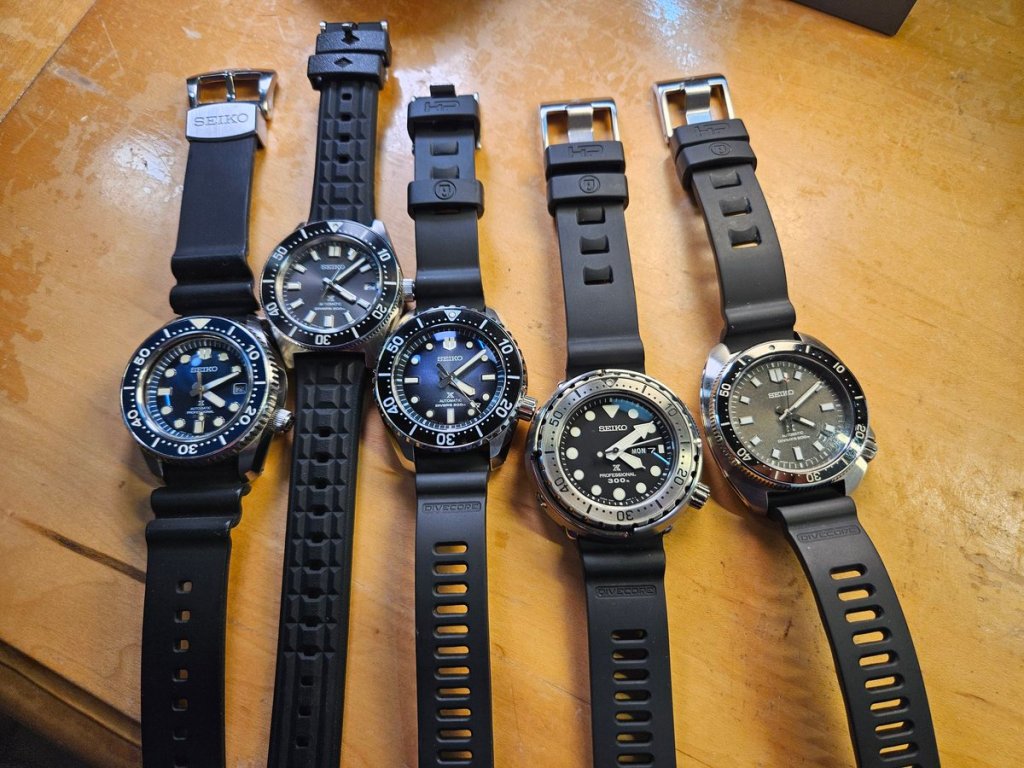
    “The double-minded man is unstable in all his ways.” Guilty as charged. Case in point: my tortured relationship with FKM Divecore straps.

    The Notre Dame study had me spiraling—researchers tortured the material with solvents, heat, and abrasion until they squeezed out PFAS “forever chemicals” and then warned these might leach into human skin. Ever since, I’ve gone back and forth, back and forth, like a malfunctioning metronome, on whether to keep wearing the straps I love more than any other rubber I’ve tried in two decades of watch collecting.

    Of course, no one wants to think of their wristwear as a poison delivery system. But context matters. First, FKM is highly stable under real-world conditions; the lab tests were more horror show than practical scenario. Second, it’s the manufacturing process that endangers workers, not the end-user. Third, if we’re ranking PFAS risks, drinking unfiltered water, eating from PFAS-coated packaging, or cooking on scratched Teflon are solid tens on the risk scale, while wearing an FKM strap is a lonely little one. That’s the Fallacy of False Priorities: panic over the trivial while ignoring the obvious.

    Even so, the issue isn’t a Nothing Burger. Divecore’s own Paul admits handling FKM worries him, and he’s working on alternative materials—silicone, vulcanized silicone, HNBR—to protect his workers and reassure consumers. That’s just smart business.

    Meanwhile, I’m not without options. My strap drawer holds factory Seiko silicones and urethanes, plus top-tier Tropic straps made of vulcanized rubber. They’re fine, but none hold a candle to the sleek perfection of Divecore FKM. I tried swapping them in, but they feel like consolation prizes—serviceable, never glorious.

    So I made a deal with myself: enjoy my pristine FKMs for now, and when the new HNBR or silicone Divecore straps arrive, I’ll switch. Sounds reasonable. Except once you’ve let the idea of PFAS seeping into your skin lodge in your brain, it refuses to leave. I’ve written about it on Instagram, made a YouTube video, and now I’m stuck in an obsessive loop, second-guessing every strap change as though I were rewriting my will.

    Which brings me back to my original point: the double-minded man is unstable in all his ways. And right now, that man is staring at seven watches, toggling between glory and paranoia, wishing he could strap on peace of mind.

  • The Warm Bath Illusion: Why Pleasure Culture Kills Relationships

    The Warm Bath Illusion: Why Pleasure Culture Kills Relationships

    When you’re married, you’ve closed the deal. You’ve made your public and private commitment to another person. Yet, as Phil Stutz points out in Lessons for Living, this loyalty oath collides with a culture that insists there’s always a better deal waiting. It’s our supposed “divine right” to find that deal, to “look outside ourselves for more.” In other words, FOMO infects the way we relate to our spouses. Stutz writes: “The result is a frenzy of activity, powered by the fear of missing something, which exhausts us emotionally and leaves us spiritually empty.”

    As a therapist to Hollywood’s wealthy actors and producers, Stutz sees people in perpetual pursuit of “bigger and better”—newer houses, flashier careers, younger spouses once they’ve “made it.” They want to “trade up,” convinced they deserve it. But what they crave isn’t a flesh-and-blood partner. It’s a “fantasy companion,” a frozen image of perfection that bears no resemblance to real life. As Stutz notes of one patient, a successful actor: “What he was really looking for was someone with the magical ability to change the nature of reality.”

    Why do so many of us want to change reality? Because reality is messy, uncertain, painful, and demands labor of mind and spirit. Consumer culture promises to scrub away that mess and deliver a “frictionless” existence. It sells us the Warm Bath: a world of perpetual pleasure and no conflict. But the Warm Bath is an adolescent fantasy—an illusion that reality will mold itself to our most immature notions of happiness.

    This fantasy always collapses. No “fantasy companion” exists, and even if one did, the Warm Bath curdles into hell. Experiences flatten, pleasures dull, the hedonic treadmill spins us into numbness, and from numbness we fall into rage—blaming the fantasy companion for failing to save us.

    Stutz argues we must abandon the fantasy of love—a stagnant “perfect” photograph—for the messier, real version: alive, unpredictable, and demanding effort. “To put it simply,” he writes, “love is a process. All processes require endless work because perfection is never achieved. Accepting this fact is not thrilling, but it is the first step to happiness. You can work on finding satisfaction in your relationship the same way you’d work on your piano playing or your garden.”

    So if you spend your days marinating in salacious fantasies and stoking your FOMO with consumer culture, you’re killing reality while feeding fantasy. And because you’re putting no work into your relationship, entropy sets in. Bonds fray, affection curdles, and instead of taking responsibility, you blame your partner and draft your exit strategy.

    To keep his patients from falling into this trap, Stutz prescribes three tools.

    The first is Fantasy Control. Fantasies, he warns, can grow “long and involved” until they compete with real relationships. Steely Dan’s “Deacon Blues” comes to mind. Its narrator is a suburban mediocrity who dreams himself into an edgy artist and seducer of women. Fans saw themselves in him, but the song is ironic: a portrait of a fallen man propping up a drab life with self-mythology. Such fantasies, Stutz says, “hold a tremendous amount of emotional energy.” The more energy you pour into a phantom partner, the less you have for your real one. When fantasies become sexual, the drain is worse. Stutz insists that when fantasies consume you, you must learn to interrupt them. “You’ll resent this at first,” he writes, “but each time you come down to earth you’re telling yourself that you are a committed adult who is strong enough to face reality. This will make you more satisfied with yourself, a precondition to becoming satisfied with any partner.”

    If you’re a boomer like me, this may sound like heresy. Raised in the 60s and 70s, we were taught to unleash the Id, to celebrate fantasies as expressions of the “true self.” The musical Hair didn’t just glorify wild locks but turned them into a metaphor of rebellion against authority. Hugh Hefner and Xaviera Hollander gave us ribald lifestyles to envy. Thomas Harris’s I’m Okay, You’re Okay blessed us with permission to indulge. And the cultural mantra was simple: “Let it all hang out!”

    But Stutz, a boomer himself, has watched fantasies devour his patients. His conclusion is blunt: curbing sexual fantasy is a crucial step toward adulthood and a stronger bond with one’s partner.

    The second tool is Judgment. Fixate on a fantasy partner and you suspend critical thought, surrendering to false perfection. You also sharpen your critique of your real partner until both fantasy and reality are grotesquely warped. To break free, Stutz says, you must recognize this distortion and choose a loving path over a fantasy path. “The process of loving requires that you catch yourself having these negative thoughts and dissolve them from your mind, replacing them with positive ones. You must actively construct thoughts about their good attributes, and let these thoughts renew feelings of attraction toward them.” This habit builds gratitude, restores attraction, and replaces helplessness with control.

    Reflecting on this, I recall Tim Parks’s essay “Adultery,” in which he describes a friend’s affair that destroyed his marriage. Parks likens sexual passion to a raging river that demolishes everything in its path, while domestic life is the quieter work of nest-building. The two impulses are locked in eternal conflict. Some people cannot resist hurling themselves into the river, even knowing it will consume them.

    To pull people out of that river, Stutz prescribes his third tool: Emotional Expression. Here self-expression works in reverse. Just as smiling can make you happier, acts of tenderness can make you feel tender. Stutz advises: when you’re alone with your partner, speak and touch them as if they are desirable. Do this consistently and not only will you find them more attractive, they’ll begin to find you more attractive too.

    It may sound counterintuitive. Who “works” for attraction? But that is Stutz’s point: love is work. Excessive fantasy, meanwhile, is infidelity—not only to your spouse, but to your adult self. Stay shackled to your adolescent hedonist, and like Lot’s wife, you’ll turn into a pillar of salt.

  • There Is No Such Thing as a Holy Grail Watch

    There Is No Such Thing as a Holy Grail Watch

    The watch-obsessive’s quest for the so-called Holy Grail of watches is not heroic—it’s theatrical, maudlin, and embarrassingly earnest. He speaks of it with reverence, as if he’s Sir Galahad in a NATO strap. But what he’s chasing isn’t a singular object of desire—it’s a shapeshifting chimera, a delusion dressed in brushed stainless steel.

    Today’s grail is a bronze diver with gilt indices. Tomorrow it’s a minimalist field watch with a sandwich dial. By the weekend it’ll be a 41mm titanium chronograph with a “stealth” finish. Each new acquisition is preceded by the familiar declarations: This is it. The one. The final piece. And yet, within weeks—days, even—that “final piece” becomes just another stepping stone in a never-ending wrist safari.

    There is no grail. There is only motion sickness.

    The watch obsessive, in his tortured enthusiasm, is less knight and more Tantalus. In Greek mythology, Tantalus is doomed to stand waist-deep in a pool of cool water beneath a tree dripping with ripe, fragrant fruit. But as he reaches out—just a bit more—the water recedes, the fruit retreats. His thirst is never quenched. His hunger never satisfied. Only the illusion of satisfaction persists.

    And so it goes with the watch addict. His fingertips brush the bezel. His nostrils catch a whiff of Horween leather. His YouTube thumbnails promise “GRAIL ACHIEVED” in all caps. But it’s never real. The moment fades. The watch, once unboxed and adored, begins its quiet drift into mediocrity. It no longer sings. It just ticks.

    And like a fool with a ring light, he’ll sit in front of his camera, describing the myth of Tantalus with tragic flair—his voice trembling as if he’s reciting Homeric verse—while wearing a watch he no longer loves, but can’t yet admit has failed him.

    Because admitting that would mean facing the truth: the grail isn’t late—it’s a lie.

  • The Timekeeper’s Curse: Why You’ll Never Be Satisfied with Your Watch Collection

    The Timekeeper’s Curse: Why You’ll Never Be Satisfied with Your Watch Collection

    To understand the tortured psyche of the modern Timekeeper, you must first meet his most conniving organ: the Cavebrain. This primal relic, forged in an age of spear tips and saber-toothed tigers, was never designed for eBay, Instagram wrist shots, or limited-edition dive watches with meteorite dials. And yet, here he is in the 21st century, a man both blessed and cursed with opposable thumbs, a PayPal account, and a psychological need for existential renovation every time he clicks Buy It Now.

    A high-ticket watch purchase for the Timekeeper is not a simple act of consumer indulgence—it is a rite of passage, a narrative arc, a full-blown identity reboot. He isn’t just buying a watch; he’s staging a personal renaissance, performing emotional alchemy with brushed titanium and spring-drive movements. He craves the sensation of getting something done—and if he can’t change his life, he’ll change his wrist.

    But a new acquisition can’t simply squeeze into the old watch box like another hot dog in an overstuffed cooler. No, it demands sacrifice. One or more watches must be winnowed down, exiled like loyal but unremarkable lovers who just didn’t “spark joy.” There is drama here—drama more potent than remodeling a kitchen or repainting the bedroom a daring eggshell white. This is a domestic upheaval that matters. The arrival of a new timepiece—let’s call it “the new kid in town”—requires a realignment of the soul.

    Now, for those poor souls unacquainted with Timekeeper theology, let me explain: He cannot simply collect indiscriminately. He is bound by the Watch Potency Principle, a dogma revered by enthusiasts. This principle states that the more watches a man owns, the less any of them mean. Like watering down bourbon, or stretching a heartfelt apology into a TED Talk, the essence gets lost. The once-sacred grails—the unicorns he hunted with obsessive glee—go sour in the dilution of excess. Only by restricting the herd to five to eight carefully curated specimens can he maintain potency and fend off emotional ruin.

    Of course, there’s a devil in the details. The Timekeeper suffers from a chronic affliction known as Watch Curiosity. He’s always sniffing around the next shiny object, eyes darting at macro shots on forums, lurking on Reddit, and falling prey to influencers wearing NATO straps and faux humility. Inevitably, he pulls the trigger on yet another must-have diver, thus initiating the ritual purge. A watch he once swore eternal fidelity to must now be cast out—not because it’s inadequate, but because he has convinced himself that it is. This self-gaslighting feeds a demonic loop known as Watch Flipping Syndrome, wherein watches are bought, sold, and rebought with the desperation of a man trying to time-travel through retail therapy.

    If the Timekeeper is lucky, if he can wrestle his impulses into a coherent, lean collection, he may briefly find peace. But peace is not his natural state. Beneath his curated restraint lies a restlessness, a gnawing sense that time—his most feared adversary—is standing still. His desire for a new watch is not about telling time; it’s about rewriting it. When he buys a new watch, he isn’t updating his collection—he’s updating himself. He wants change, achievement, rebirth.

    Enter the Honeymoon Period—a temporary euphoria where the new watch becomes a talisman of transformation. He floats, rhapsodizes, posts gushing tributes on enthusiast forums. He becomes a preacher in the Church of the Chronograph, recruiting others to experience this miracle. The watch didn’t just change his wardrobe—it changed his life.

    But, as all honeymoons do, the enchantment fades. The novelty rusts. What was once a grail becomes just another object—another timestamp on the long and winding road of emotional substitution. He finds himself, once again, alone with his Cavebrain, who, ever the unreliable life coach, whispers, “Maybe there’s something better out there.”

    Thus, the cycle repeats—endless, compulsive, costly. The Timekeeper is not a collector. He is an evolutionary casualty. A caveman in a smartwatch world, still looking for meaning in a bezel.

  • How Your Flintstones Moment Made You Pursue Higher Education

    How Your Flintstones Moment Made You Pursue Higher Education

    Charlene’s office had been a shrine to immaculate control—gleaming surfaces, aligned papers that looked like they’d been measured with a laser level, and an air of clinical precision that could make a Swiss watchmaker weep tears of admiration. But that day, the outside world was doing its damnedest to breach her fortress. A dust storm had rolled into Hobcallow with all the subtlety of a biblical plague. It was mid-afternoon, but you wouldn’t have guessed it. The sky was choked in an apocalyptic shade of brown, casting the office in a bruised sepia tone. The overhead lights flickered like they’d given up hope. Dust smeared the windows like greasy fingerprints on a crime scene, and Charlene—who waged holy war against dirt—cringed at every grain that dared defile her glass.

    If anyone could stare down Mother Nature and win on points, it was Charlene. You’d have bet your last protein shake on it.

    She tried to tune it all out and focus on her latest mission: turning you into some kind of intellectual demigod for her next newspaper feature. She tapped her pen on her notepad with the kind of sharp, deliberate rhythm that could cut glass. Then she leaned in, smiling like a predator who’d just cornered a wounded animal. “Tell me,” she said, “what were the defining moments that led you to pursue higher education?”

    The wind screamed outside like a banshee in heat, but you leaned back and let yourself drift. “There was this bouncer gig I had at seventeen,” you began. “Maverick’s Disco in San Ramon. Three bucks an hour—ten cents above minimum wage. Free soda, free peanuts. I thought I was rich.”

    You could still picture it: a swirling disco inferno of polyester pantsuits, platform shoes, and hair sculpted into helmet-grade updos. The Bee Gees were on loop, the dry ice fog never cleared, and the lights pulsed like a migraine. It was paradise—until it wasn’t.

    “At first,” you said, “I thought I’d struck gold. I got to flex my lats and mingle. But after a while, it all started blending together. The same couples, the same fights, the same sweaty desperation. One night, mid-shift, I had this epiphany—Fred and Barney cruising in their Flintstone-mobile, but the background just repeated: tree, rock, house, tree, rock, house. That loop ruined the cartoon for me. And suddenly, it was ruining my life, too.”

    Charlene’s pen was flying. You could tell she was high on narrative gold.

    “Maverick’s became my Flintstones moment,” you said. “Week after week, the same loop: wide-eyed people chasing magic and leaving with hangovers and broken heels. And I realized I was part of it—punching the clock, buying into the monotony. I needed something more unpredictable. So I chose college. I needed to break the loop.”

    Charlene looked like she was about to levitate from her chair. The dust storm outside didn’t matter—she was in a state of pure journalistic ecstasy.

    And then you got honest.

    “But look at me now,” you said, and your voice had that creeping bitterness you couldn’t quite stifle. “Degrees? Check. Stable career in higher ed? Check. And what have I built? A life of structure and repetition. Same workouts, same egg whites, same damn protein shakes, same naps, same Angels game every night. I wrapped myself in the very loop I thought I’d escaped. The Flintstones background just changed colors.”

    Charlene’s pen froze mid-air. Her gaze snapped to you with a gleam of ice behind it. That calculating smile returned—sleek, practiced, a smile that had shut down board meetings and ended more than one marriage. “We won’t tell them that part,” she said sweetly. “That’s just between us.”

    You felt the temperature drop, despite the swirling storm outside. It was the smile of someone who took pleasure in control—over narrative, over outcomes, over people.

    You glanced toward the window. The storm was still there, clawing at the glass like a desperate thing. But Charlene’s smile? That was the real weather system in the room.

  • The News Anchor of the Shallow End

    The News Anchor of the Shallow End

    A poolside pestilence—you knew him as Roland Beavers. He was the kind of poolside companion nightmares were made of. Picture it: a pudgy man in his early thirties with dishwasher-blond hair clinging lifelessly to a scalp that looked perpetually annoyed at its assignment. His physique was more Pillsbury than gladiator, his chin having taken early retirement sometime around 1996. And yet, this proud specimen insisted on strutting around the pool in lava-red terry cloth trunks so tragically undersized they clung to his hips like terrified hikers on a cliffside. The stretch marks? They splayed across his skin like graffiti sprayed by a disgruntled street artist.

    Naturally, Roland had an explanation at the ready for anyone who dared lock eyes with him long enough to hear it. Those stretch marks? Not from powdered donuts, perish the thought. No, they were the battle scars of a world-class daredevil—his words—earned from leaping off the cliffs of Acapulco. You could practically hear the collective eye-roll from the pool regulars every time he launched into one of his airbrushed tales of aerial glory.

    But Roland’s true calling wasn’t daredevilry—it was unsolicited poolside broadcasting. Armed with a crumpled newspaper, he’d take up his post like an aging news anchor, providing loud, unfiltered commentary on every blurb and headline, under the delusion that everyone within earshot was waiting with bated breath for his take on gas prices and tabloid divorces. His “audience,” meanwhile, muttered oaths under their breath, praying he’d take up knitting—somewhere indoors, ideally underground.

    You watched his social cluelessness peak during innocent pool games—playful couples tossing a football or frisbee back and forth. For Roland, this wasn’t just casual recreation to be observed; it was a direct invitation. He’d launch himself into the water with the grace of a bowling ball dropped from a rooftop, crashing into their game like a forgotten uncle showing up drunk at a family reunion. The couples would pause, stunned, then shuffle off with expressions reserved for people who talk during movies.

    And heaven help the women just trying to sunbathe in peace. Roland, ever the gallant poolside creep, took it upon himself to offer his “services” to any woman within spraying distance. Whether it was spritzing their backs with water or offering to rub in sunscreen, Roland never missed an opportunity to “help”—oblivious to the fact that his mere presence was enough to derail an entire afternoon of tanning and tranquility.

    These long, unwanted days at the pool weren’t just for his entertainment—they were an extension of the strange domestic theatre unfolding upstairs. His mother, Nadine, loomed over the scene from their apartment balcony, a woman built like she could bench-press a Buick, her muu-muu rippling in the desert breeze like a circus tent threatening lift-off. With her hair wound into curls so tight they looked ready to spring off and attack, she’d bark orders with the authority of a drill sergeant with a megaphone.

    “Slather on more sunscreen, Roland!” she’d bellow, veins throbbing in her neck like they were sending an SOS in Morse code. “Get inside and eat something! You’re wasting away!” This, despite the fact that Roland had a good 40 pounds he could have “wasted away” without anyone shedding a tear.

    You’d think all this doting and nagging might eventually motivate Roland to get a job—maybe contribute something to society, or at the very least give the rest of you a break. But no. Roland and Nadine were comfortably buffered by the settlement from a lawsuit tied to Roland’s brief, disastrous stint at flight school in San Diego. Apparently, his dorm mates decided his face needed some rearranging, and after a skull fracture and several court dates, Roland walked away with a broken head and a windfall large enough to fund his permanent poolside residency.

    So there he was—your unwanted mascot in red trunks—coasting through life on lawsuit money and his mother’s militant affections, interrupting your peaceful afternoons with unsolicited news updates and delusions of former glory. Thanks to the faded glory of his imaginary daredevil days and a bottomless box of Chardonnay, Roland Beavers remained the persistent echo of everything you were trying to escape.