Tag: fantasy

  • The Man Who Refused to Unpack

    The Man Who Refused to Unpack

    Chief among your apartment acquaintances in the godforsaken desert was Leonard Skeazy, an attorney from Santa Monica who had been lured out to this sun-scorched outpost by a fat signing bonus and a monogrammed office chair, yet couldn’t shake the gnawing resentment of having been exiled to what he considered a cultural wasteland. Leonard treated “style” not as a preference but as a full-blown religion. He wore custom-made Speedos purchased at a boutique in Santa Monica—yes, he actually made return trips to the city just to replace them when the pool’s chlorine dulled the jewel tones of his sacred spandex.

    With his long, curly hair and eerie, borderline-glasslike blue eyes, Leonard looked like a lounge singer who never graduated from the Holiday Inn circuit. He was a man of eccentric habits and hygiene choices that defied both logic and cologne. Despite being well into his thirties, he clung to the bachelor fantasy of meeting “the right girl,” though his criteria seemed more fitting for a dating pool in Cannes than in a desert town where a GED qualified you as a local intellectual.

    Leonard could be found most afternoons sprawled poolside, his skin glistening like a buttered croissant under the sun, blasting Kenny G from his battered boombox as if smooth jazz were some pheromonal weapon. His breath often carried the unmistakable bouquet of last night’s Chardonnay, perfectly matched by his habit of sneaking sips from boxes of white wine stashed like contraband in the fridge.

    Curiosity—and let’s be honest, a lack of better options—led you to visit Leonard’s apartment one day. It was a bachelor pad in the bleakest sense. Despite his high income, his apartment felt like a holding cell with Wi-Fi. The living room featured a single couch, a TV perched on cinder blocks, and—because tragedy loves detail—an ironing board, which he used religiously to press his endless collection of gaudy silk ties. The walls were as blank as his emotional availability, barren beige expanses that caught the flicker of the TV and projected ghostly shadows over the serpentine lines of his slithering tie rack.

    Then there was the bedroom. No dresser. No closet system. Just three open suitcases that served as a rotating archive of silk shirts, vintage cologne, and desperation. It was as if he’d never truly unpacked—a subconscious protest against the idea that he’d actually settled in this armpit of a town. The fridge, naturally, was a tundra of emptiness save for—you guessed it—more boxes of white wine. This was a man who had chased the scent of money straight into the middle of nowhere, only to insist he hadn’t actually arrived.

    Leonard was a ghost haunting his own life. A man who treated his presence in this town like an extended layover, still clinging to the fantasy that he’d be boarding a first-class escape back to the coastal glamour of a life he probably never really had. You couldn’t help but wonder: what kind of man gets seduced by a fat paycheck only to spend his days in self-imposed purgatory, where the only things thriving are his excuses and his growing graveyard of faded Speedos?

    You supposed it was easier for Leonard to pretend he was just “passing through” than to admit that he was, in fact, a permanent exhibit in this forgotten museum of stalled ambition—a relic draped in silk and denial, clinging to the illusion of a life that had long since evaporated.


  • False Prophets with Great Abs

    False Prophets with Great Abs

    You remembered the first episode of I Dream of Jeannie. Major Tony Nelson—square-jawed astronaut, man of science—crash-landed on a remote island after his space capsule, Stardust One, veered off course. There, buried in the sand like a cursed treasure, he found a mysterious bottle. And then—whoosh—a plume of bluish vapor, and out popped Jeannie: blonde, barefoot, bewitching, and hell-bent on fulfilling his every wish. Tony blinked. Maybe it was a hallucination. Maybe his oxygen-deprived brain was conjuring fantasies. Whatever the case, he wasn’t buying it. He was trained to distrust magical thinking, and Jeannie, glittering and obedient, was the definition of a dangerous shortcut.

    You, on the other hand, were no Tony Nelson. You were a teenage Olympic weightlifter and amateur bodybuilder, sprawled out in your bedroom flipping through a muscle magazine, fully hypnotized by the promise of the next miracle breakthrough. You had just finished an article on “progressive resistance training”—a phrase that gave you a warm little shiver of purpose. You divided the world into two kinds of people: those who were progressing and those who were stagnating in mediocrity. You were dead-set on being in the first camp.

    The article ended, but the real magic was in the ads: potions, powders, pulleys, and contraptions promising titanic biceps, superhuman abs, and the sculpted torso of a Greek statue. One ad hit you right in the hypothalamus—the Bullworker. A three-foot rod of steel and plastic, with green-handled grips and bowstring cables. It looked like a cross between a medieval torture device and a Jedi weapon. A bodybuilder in the ad flexed beside it, veins like roadmaps and pecs like dinner plates. It cost forty-five bucks—a king’s ransom. You had to have it.

    So you marched into the living room where your dad was nursing a beer and watching football. You handed him the ad.

    “What do you think?”

    Your dad—a flinty ex-infantryman with a buzz cut, a jaw like a chisel, and a fading “MICHAEL” tattoo on his biceps—glanced at the page like it was a bar tab he didn’t remember running up. “You want muscles?” he said. “Pull weeds. Mow the lawn. Clean gutters. Chop wood.”

    “Dad, I’m serious. This would supplement my real workouts.”

    He looked again, then sighed. “It’s junk. Slick marketing. But if you want to waste your allowance, it’s your choice.”

    You told him you were short on cash.

    “Then save up. Make sacrifices. And do your research. If you dig a little deeper, I bet you’ll want it less.”

    “Why?”

    “Haven’t you heard of Sturgeon’s Law?”

    “No.”

    “Ninety-nine percent of everything is bullshit. That includes this gadget. Remember that martial arts program you ordered? Twenty bucks for a pamphlet with stick figures doing karate poses. Bullshit. Due diligence, son—that’s your shield.”

    “What’s due diligence?”

    “Thorough investigation. Weighing the pros and cons. Kicking the tires before you buy the clunker. Most things don’t survive scrutiny. Always be quick to save your money and slow to spend it. You got that?”

    “Yes, Dad.”

    Not exactly in the mood for football after that, you trudged back to your room and cracked open another muscle magazine, drinking in the endless parade of promises. “Gain more muscle than you ever dreamed of,” one ad proclaimed.

    And Jeannie was back. Not in her bottle—she was in your brain now. She was the fantasy of every easy answer, every too-good-to-be-true claim. The allure of Jeannie wasn’t just her beauty or her servility—it was her offer of instant gratification, with no price tag except your dignity.

    That was the whole premise of the show: Tony Nelson didn’t trust Jeannie because he was smart enough to know that panaceas always come with fine print. But you weren’t that smart yet. You still believed—just a little—that this or that device, powder, or program might turn you into a demigod.

    You wanted your gains. 

    The Bullworker failed you–but it wasn’t just a piece of overpriced cable-tension nonsense. It was a monument to your teenage fantasy: that somewhere, somehow, a portable contraption could carve you into Hercules without the burden of sweat, setbacks, or iron plates. The device itself was a dud—a clunky plastic rod with big promises and no payoff—but the idea of the Bullworker had teeth. A chiseled physique, ready to go, no gym required? It was the dream distilled. What you got instead was a hard truth: even when an idea crashes and burns in practice, some illusions are simply too seductive to abandon.

  • Curling Ashtrays and Other Signs You’re Destined for Muscle Madness

    Curling Ashtrays and Other Signs You’re Destined for Muscle Madness

    Long before you were twelve and dominating Olympic lifts, before you sculpted yourself into a fourteen-year-old bodybuilder, the signs were there—you were already bitten by the iron bug. Every fiber of your being was obsessed with getting huge. You found strange inspiration in the unlikeliest of places: television commercials for dog food. Yes, dog food. Those ads were less about pets and more about performance enhancement in your impressionable, muscle-hungry brain.

    Gaines-Burgers looked like prime cuts straight from Mount Olympus. Gravy Train’s magical transformation from dry nuggets to savory stew made your jaw drop. If this stuff could pump a German Shepherd into a jacked beast, what was stopping you from sampling the ambrosia yourself?

    So you did what any logic-defying, delusional muscle aspirant would do: you marched up to your dad and declared—with all the conviction of a beagle spotting a squirrel—that you wanted to become a dog. Not metaphorically. Literally. That way, you could indulge in the canine cuisine of champions. Your father’s face went on a journey: confusion, horror, resignation. He’d seen a lot, but this—this was a new low.

    In a desperate act of culinary intervention, he took you to a local bistro and ordered you a French Dip with au jus, hoping that real food might reroute your deranged protein fantasies. The sandwich arrived, dripping in savory decadence. Your dad leaned in, eyebrows raised, voice tense with hope: “So, how do you like your French Dip?”

    You took a bite. Heaven. Your taste buds erupted like fireworks. And then—of course—you growled, dropped to all fours, and scratched at an imaginary flea with your hind leg, fully committing to the bit. Patrons stared. Your dad’s face turned a shade of red that Sherwin-Williams has yet to name. He looked like a man reevaluating every life decision he’d ever made.

    But you didn’t stop there. No, your devotion to hypertrophy was a full-spectrum obsession. You judged cereals by their muscle-building mascots. Quisp and Quake tasted the same, but you knew who the real hero was: Quake, the barrel-chested, pickaxe-wielding coal miner with a neck like a bridge cable. Quisp? A pencil-neck Martian who probably couldn’t curl a paperclip.

    So when those two faced off in the ultimate cereal showdown, you pledged allegiance to Team Quake. Those gear-shaped nuggets were more than breakfast—they were barbell fuel. Quisp’s saucer-shaped flakes turned to mush in milk faster than your patience at a shopping mall. Quake stood firm, stoic in the milky battlefield of your bowl.

    But then, disaster. America chose the Martian. Quake vanished. It wasn’t just a marketing decision—it was a betrayal. When Quake was discontinued, a part of your soul died. The cereal aisle became a graveyard of broken promises. Eating Quisp felt like betrayal. Worse: it felt like surrender. You imagined Quake crying out from some cereal Valhalla, mourned like a fallen hero.

    Still, the signs of your bodybuilding destiny didn’t end with cereal or dog food. They were everywhere. In your living room sat a ceramic ashtray the size of a manhole cover—your parents’ nicotine shrine. During The Incredible Hulk cartoons, you’d curl that ashtray like you were training for the Strongest Kid on Earth competition. It was your first dumbbell, your sacred relic of strength.

    Family vacations? Gymless wastelands. But you adapted. You curled suitcases, hoisted skillets, deadlifted detergent bottles, and pressed soup cans with religious fervor. You squatted potato sacks and benched dictionaries. Hotel staff stared. Your family sighed. You called it training.

    Eventually, you found a real gym. Barbells. Plates. Chalk. Grunts. It was everything you dreamed of. Your transformation from kitchen utensil lifter to iron disciple was complete. You weren’t just a bodybuilder in the making—you were a walking comic book origin story, forged in dog food commercials, French Dip delusions, and cereal-fueled vengeance.

  • Drunk on Barbara Eden

    Drunk on Barbara Eden

    You grew up in VA housing—repurposed army barracks known as Flavet Villages—in Gainesville, Florida. The buildings sagged with humidity and history, not far from an alligator swamp and a patch of forest that always smelled like something prehistoric had recently bathed. Perched on a branch at the edge of that forest was a Mynah bird, the same one, every evening. It became a ritual—your father and you, walking out at dusk to visit the bird and carry on what felt like real conversations with it. The swamp behind you would breathe out its musk, that potent stench of low tide and alligator dung. Most would gag. But for you, the smell was oddly soothing—earthy, primal, even sublime. It made you feel tethered to something vast and mysterious.

    One evening, while chatting with the Mynah bird under a bruised pink sky, you heard a distant radio drifting through the humid air. Juanita Hall was singing “Bali Ha’i” from South Pacific. Her voice wrapped itself around you like vapor. The song, with its haunting promise of a paradise just out of reach, was meant to stir longing—but you didn’t feel any. Your paradise was right there, next to your father, speaking to a magical bird on the lip of an enchanted forest. No ache. No yearning. Just presence.

    You didn’t understand longing—at least not yet.

    Longing came for you in 1965, when you discovered I Dream of Jeannie. Barbara Eden appeared on your screen in chiffon and sequins, smiling from inside her genie bottle—a velvet dream chamber lined with pink and purple satin brocade, the walls glowing with embedded glass jewels like shards of a pearl sky. You didn’t just want to meet Jeannie. You wanted to live with her. Inside that bottle. Forever. The ache you’d been spared during “Bali Ha’i” finally found you. You didn’t just want the bottle—you needed it. Later you learned it was actually a painted Jim Beam decanter. Appropriate. You were drunk on Barbara Eden, intoxicated by the fantasy of never having to grow up.

  • The Confessions of a Hot Tub Messiah

    The Confessions of a Hot Tub Messiah

    You were twenty-six in the hot August month of 1998 and for a shimmering chlorinated hour at a friend’s pool party at a lavish apartment complex in Livermore, California, you became the mythical, magical Hot Tub Stud. Your girlfriend wasn’t there. It was August, and she had already packed her bags to start her fall semester at Scripps College in Claremont California. It was ridiculous that you and your girlfriend Pamela would attempt a long-term relationship. You were each other’s first romance. You both were surely naive. Neither of you knew how doomed and unhealthy your relationship was. There were things about you–your neediness and lack of spontaneity to name two–that Pamela hated about you. Deep down, you knew she hated you, but you were too needy to acknowledge how repulsed she was by your neediness. You were also too needy to acknowledge that you weren’t so hot about her either. Sure, the chemistry was great. You guys desired each other every second, but it was impossible for you to truly love someone who recoiled at your broken, immature self. Deep down, you wanted to be admired and adored, and you knew Pamela would never be that person.

    Around 3 p.m., in the steamy, chlorine-scented haze of suburban hedonism, she appeared: Rachel, a petite brunette with long, flowing hair, skin like burnished chestnut, and dark, soulful eyes that suggested she’d read Anna Karenina and wept at the right parts. She wore a green bikini. She had depth. She had presence. And she was—unbelievably—into you.

    And not just into your pecs and biceps. She was drawn to your languid ease, your temporary state of post-Pamela serenity, that rare moment when you weren’t apologizing for your existence or scanning the horizon for emotional threats. You exuded something you rarely possessed: confidence. You didn’t try to be charming. You just were.

    You talked. She was an Ashkenazi Jew, like you—except fully, whereas you were only half, your dad a gruff Irish Catholic whose idea of spiritual intimacy was yelling at the TV. You told her it was a miracle you weren’t in therapy. She laughed. The real kind. She told you about growing up in a Jewish enclave in Dallas, her econ degree from San Francisco State, and the Marina District apartment she shared with roommates and dreams.

    In the swirling warmth of the hot tub, you slowly cradled her as she floated on her back, spinning gently in your arms like a sun-drunk naiad. You gazed into each other’s eyes like characters in a perfume commercial—if the perfume were melancholy, the top note regret.

    And in that moment, Pamela ceased to exist. You were ready to let Pamela become a dot receding into the horizon, propose to Rachel, adopt a rescue dog, and buy Rachel a two-bedroom Marina District condo with French doors and jasmine on the balcony. Your soul whispered scripture: “And the two shall become one flesh.”

    But just as you leaned into that soon-to-be-legendary kiss, your guilt, or maybe your emotional cowardice, threw a wrench into fate. You stood her upright and mumbled something about having a girlfriend.

    The look on Rachel’s face—that soft, diplomatic devastation—has haunted you ever since. She gave you a gentle out: “You’re probably confused.” And then she disappeared into the changing room like Eurydice stepping into the underworld, and you never saw her again.

    Years passed. Decades. And when life feels like a cruel joke told by someone with bad timing—when you’re depressed, flabby, or existentially irrelevant—you return to that hot tub. You imagine yourself sweeping Rachel off her feet, performing impromptu piano recitals, meeting her doting parents, and becoming the man you wanted to be in that moment: the Hot Tub Stud who followed through.

    But you didn’t. You blinked. You let Eden slip through your fingers, and like all paradise stories, it ended with exile.

    Still, for one hour, you were perfect. You were desired. You were whole.

    And you’ve been chasing that hour ever since.

  • The Comedians of Cell Block B

    The Comedians of Cell Block B

    Last night I dreamed I was in a bustling, overlit restaurant packed with the usual suspects—people chewing too loudly, waitstaff dodging elbows, silverware clinking like wind chimes in a windstorm. I was halfway through what I assumed was risotto when I realized two of my teeth had come loose, flapping in my gums like faulty hinges.

    Panicked, I waved down a waiter. He listened gravely, nodded with theatrical sympathy, then pointed toward a man in a white coat weaving through the crowd like a prophet leaving a revival. “That’s Dr. Beltrán,” he said. “Fixes teeth. Fixes lives. If you move now, you might catch him before he ascends to the exit sign.”

    So I followed. Fast forward to the next day: I’m in a waiting room that looked more like a casting call for eccentric sitcom roles. Among the crowd sat a married couple, both comedians. Raffi, a Canadian import with the weary charisma of someone who’s done too many festivals, and Tina, his statuesque, golden-haired wife, radiantly pregnant and visibly amused by the absurdity of her own life.

    Turns out Raffi and I had gone to college together, which gave our small talk the sheen of nostalgia. Tina, meanwhile, was the sort of woman you describe as a “former beauty queen” only because it sounds more manageable than “mythical being with a driver’s license.”

    Then the tone shifted. They told me they were serving life sentences. Yes—life sentences—for misreading pesticide instructions. About five years ago, they’d tried to fumigate their house for fleas and spiders but sprayed an industrial outdoor poison all over their bedroom carpet. Their organs liquefied. They almost died. When they recovered, they were arrested. The terms of their punishment? Eternal residence in a dungeon—an actual pitch-black basement beneath a towering apartment block. They were allowed out only for comedy gigs. Art, apparently, still mattered to the state.

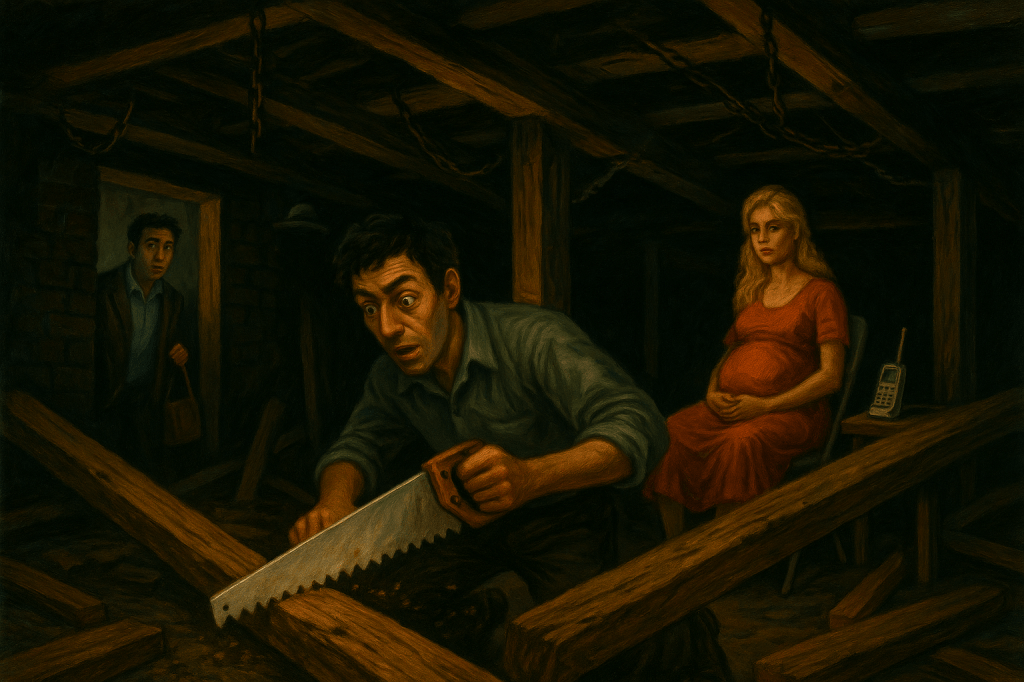
    Dental work complete, Raffi left for Canada to perform at a club. Tina, contractions ticking in her belly like a countdown timer, insisted on showing me the dungeon. The space was a horror. Not just black-as-night oppressive, but physically punishing—an absurdly low ceiling crisscrossed by thick beams of lumbar that made it feel like you were crawling through a collapsed IKEA warehouse.

    So I did what any good houseguest-slash-dream hero would do: I went to the nearest hardware store, returned with a comically oversized saw, and spent the afternoon hacking through beams like a man possessed. Tina cheered me on from a folding chair, one hand on her belly, the other clutching her flip phone, waiting for Raffi’s call.

    When I finished, the dungeon felt ever so slightly less apocalyptic. She looked at me and said, “I think the baby’s coming.” I nodded like I’d just finished installing a light fixture. My work here was done.

  • Meet the Timepiece Whisperer

    Meet the Timepiece Whisperer

    Chapter 6 of The Timepiece Whisperer

    At 6 a.m., I rose like a guilty priest on purge day and loaded my Honda Accord with a museum of failure. Each item whispered its own shame: busted radios that once sang, fans that blew nothing but despair, fossilized laptops gasping through Windows XP, iPads ghosted by iOS updates, a humidifier that wheezed its final death rattle in 2018, and a landmine of corroded batteries that could’ve earned me a write-up from the EPA.

    By 8:00, I was cruising down the 110 South, my car bloated with the technological detritus of a man who once believed that stuff—stuff!—might soothe an inner void. I exited Pacific Avenue and found myself crawling through a wasteland of rebar, chain-link fences, and brush thick enough to hide a body or two. It was less Los Angeles and more post-apocalyptic novella. A landscape haunted by discarded dreams and the occasional tented soul whose only offense was being born poor.

    After a slow-motion bounce over some railroad tracks, I veered down a bleak gravel path until I arrived at 8:50 to find a tarp flapping over what I assume someone dared to call a facility. It looked like a wedding tent designed by Satan’s party planner, squatting in front of a cinder-block warehouse that smelled like ozone and bureaucratic indifference.

    Ahead of me, a small line of sedans idled like supplicants outside a radiation baptism. Signs warned against bringing poisons, rotting food, firearms, explosives, and—oddly—crop waste. Another sign warned me not to exit my vehicle, eat, or drink, presumably because the combination of trail mix and lithium-ion residue could create a chemical lovechild that incinerated San Pedro.

    A silver SUV from Washington State attempted to cut the line, realized it had wandered into the wrong apocalypse, and peeled out in a plume of toxic dust that settled on our windshields like the aftermath of a low-budget nuke.

    By 9:00, the caravan had doubled. My rearview mirror showed a parade of shame stretching down the gravel like a funeral procession for the Age of Gadgets. Then she arrived—a smiling woman in an orange vest and clip-on radio. Clipboard in hand, she went car-to-car like a cheerful customs agent at the border of human depravity. When she got to me, I rattled off my cargo. Her nod was practiced. I suspect her real job was twofold: assess whether I was harboring illegal pesticides, and determine if I looked like the kind of man who’d stuff a body under an old humidifier.

    Eventually, I popped my trunk. Men in uniforms descended with the solemnity of pallbearers. They removed the items with clinical grace, not a single eyebrow raised at my hoarder shame. I thanked them. They nodded like undertakers who’d buried a thousand dreams before mine.

    Lighter by fifty pounds and several psychic burdens, I pulled away, my soul humming with moral superiority and the faint possibility of radiation poisoning. For a brief moment, I felt whole.

    Then came the craving.

    The Seiko Astron.

    The Watch Master had warned me. Had pleaded for restraint. But there it was again, the whisper in my mind, the itch in my wrist. By the time I got home, I was already spiraling. So I returned to the Watch Master’s house for counsel, but his front door was answered by a red-bearded mountain of a man who looked like he’d just wandered out of a Nordic crime novel.

    “Josh,” he said, extending a paw. “I’m the Timepiece Whisperer.”

    “What happened to the Watch Master?”

    “Dead. Stomachache. Went to bed and never woke up.”

    “And you’re… what, the sequel?”

    “That’s for you to decide.”

    Josh made me an iced coffee, honey and cinnamon. It tasted like guilt sweetened with denial.

    We sat at the kitchen table, a graveyard of coffee rings and philosophical despair.

    “So what’s troubling you, my friend?”

    “I’m almost sixty-four. I own seven watches. I want an eighth. Am I doomed?”

    He slurped his drink, crunched an ice cube, and nodded solemnly.

    “That depends. Are we talking about eight timepieces? Or eight identities, eight moods, eight regrets?”

    I blinked.

    He leaned forward. “If you’re still hunting, still haunted, then yes—eight is too many. You don’t have a collection. You have a symptom. But if you’ve made peace—if each watch has its rightful place in your little opera of masculinity—then eight is a symphony. A curated exhibit. A spiritual wardrobe.”

    Then he tilted his head. “The real question is: Are you wearing the watches, or are they wearing you?

    I wilted. I wanted to shrink into the upholstery.

    “I want the Astron to be the closer. I want to stop at eight. But history tells me I won’t. I go through the honeymoon, get bored, scratch the itch with another watch, and end up miserable. My collection isn’t a triumph. It’s a cry for help.”

    Josh chuckled, then howled, then nearly fell off his chair.

    “Now we’re getting somewhere. You think this is about timepieces? No, my friend. This is about you.”

    Then he called for backup.

    First came John, a zombie in slippers with bags under his eyes deep enough to hold grief. “Sell everything,” he said, “and get a Tudor Pelagos. End of story.” Then he stared at his slipper hole like it owed him money and shuffled off.

    Then came Gary, a cheerful human protein shake in a Lycra tracksuit.

    “Let the man buy the Astron,” he chirped. “Make it eight. Just get him a sponsor, a support group, maybe a hotline. The poor bastard needs this.”

    Then John stormed back, furious. “I said one watch!”

    Words escalated. Soon they were locked in a full-blown wrestling match, crashing into the walls like toddlers in a padded room. Josh laughed like a man watching Fight Club on loop and eventually threw both of them into the basement.

    He stood at the door, listening to the thumps and groans like it was jazz.

    “That,” he said, his eyes shining, “is the debate. One watch or many. Order or chaos. Simplicity or delirium.”

    I got up to leave.

    “What’s the rush?” he asked.

    “I’ve seen enough.”

    “You’ll be back.”

    “What makes you so sure?”

    Josh smiled. “Because you’re desperate.”

  • The Watch Potency Principle and the Man Who Couldn’t Count to Eight

    The Watch Potency Principle and the Man Who Couldn’t Count to Eight

    Chapter 2 from The Timepiece Whisperer of Redondo Beach

    The Watch Master accepted my Venmo transfer—five grand, no questions asked. He nodded like a monk receiving an offering, commending me for “putting my money where my mouth is,” as if throwing cash at the problem proved I was spiritually ready to shed my horological demons. Then he sent me home with a single directive: return the next night with all seven of my watches arranged in one box for evaluation.

    At precisely 10 p.m., under a bloated moon that cast an eerie glow across the red roof tiles of his dilapidated Redondo Beach bungalow, I stood in his living room. The Master’s pale, angular face looked freshly excavated from a tomb. He gestured for the box.

    He opened it. Seven divers—six Seikos and a lonely Citizen—gleamed under the yellowed light of a hanging stained-glass lamp.

    “Good,” he said, scanning the collection with the intensity of a mortician identifying a corpse. “All divers. That shows thematic restraint. You’re not a complete degenerate.”

    He picked up each Seiko, held it to his eye like a jeweler, then scoffed. “You baby these. When’s the last time you actually swam? Clinton administration?”

    He chuckled at his own joke, which I pretended not to hear.

    His bony fingers closed around the Citizen. “Hmm. Titanium case and bracelet. The others are all on straps. This inconsistency must be clawing at your OCD like a raccoon under drywall.”

    I nodded.

    “Sell it,” he said flatly. “It’s feeding your misery.”

    “But what about the Seiko Astron I’ve been eyeing? That one has a titanium bracelet too.”

    “Yes. And that’s not the least of your problems.” He sipped his black coffee—no cream, no joy. “You’re teetering on the edge of a collecting abyss. The Citizen’s already rotting your center. Add one more watch, and your soul will be lost to cluttered mediocrity.”

    “But the Astron—it’s beautiful,” I protested.

    “Of course it is,” he said, shrugging. “So is opium. Doesn’t mean you should buy a kilo.”

    I tried to recover. “It’s the Watch Potency Principle, right? The more watches you own, the more you dilute the power of each one.”

    He looked up sharply. “So you have read my work. Then why can’t you live by it? You recite the commandments, but break them before sunrise. Your brain and behavior are locked in bitter divorce.”

    “I just need a plan,” I said. “What do I do?”

    “Purge,” he said, as if uttering a sacred mantra.

    “Purge?”

    “Start with the titanium Citizen. Shed that one, then we’ll talk next steps.”

    “Our next move?”

    He sighed, pinched the bridge of his nose. “You’re exhausting. Come back tomorrow at ten sharp. And for God’s sake, don’t buy anything in the meantime.”

  • His Royal Hairdresser: A Dream in Kettlebells and Class Anxiety

    His Royal Hairdresser: A Dream in Kettlebells and Class Anxiety

    Last night, my subconscious staged an outdoor fitness class without my consent.

    I found myself in a park in Redondo Beach, the sun blinding, the grass impossibly green—an Instagram-filtered fantasy of Southern California wellness. I was mid-kettlebell swing, drenched in purpose and a light sheen of dream-sweat, when I realized I was surrounded. Dozens of adult learners had appeared from nowhere, kettlebells in hand, eager and expectant. Apparently, I was their instructor. No one had hired me. No one had asked. But the dream had spoken, and I complied.

    Midway through a set of Turkish get-ups, a British emissary arrived. She looked like a character from a post-Brexit spy novel: stern, sun-dried, calves like cannonballs, dressed in a starched khaki uniform that screamed military cosplay and mid-level bureaucrat. She informed me—in clipped tones—that she worked for Prince Charles and that, regrettably, I lacked the proper haircut to instruct kettlebell technique. Apparently, the heir to the throne had strong feelings about grooming standards in recreational fitness.

    I explained, gently but firmly, that I was bald. Smooth as an egg. No haircut necessary. She did not care. My objections were irrelevant. Orders were orders.

    We marched off to a nearby luxury hotel, the kind with carpeting so plush it slows your gait. Prince Charles was there, sitting cross-legged on a massive hotel bed surrounded by two open laptops, deep in what I can only assume was royal doom-scrolling. When he saw me, he snapped both laptops shut with the speed of a man hiding state secrets or Wordle stats.

    He gestured toward a massive, throne-adjacent salon chair, upholstered in padded leather and colonial guilt. “You need your hair parted down the middle,” he declared.

    Again, I protested—I was bald. But His Royal Highness was undeterred. He placed a comb on my scalp, and as if conjured by the Crown itself, hair appeared. Thick, black, center-parted. The haircut was bestowed.

    Feeling both knighted and absurd, I reached into my wallet and tipped him two twenties. He accepted the bills with the contempt of a man too wealthy for paper currency. It was as though I had handed him used Kleenex. He nodded, purely out of ritual, and turned back to his laptops, already erasing the memory of me from his mind.

    I returned to the park, my hair neatly parted, my purpose restored. I resumed leading my eager students in kettlebell swings, disappearing into the warm fog of belonging, convinced—for at least this dream—that I was a vital member of my sun-drenched community.

  • Late Night Linguine: What The Big Night Taught Us About Conan and Leno

    Late Night Linguine: What The Big Night Taught Us About Conan and Leno

    In Stanley Tucci’s criminally under-watched gem The Big Night (1996), two Italian brothers run a brilliant but nearly empty restaurant on the Jersey shore. Primo, the chef, is an artist of uncompromising culinary vision; he serves risotto that would make a grown man weep. But across the street, the tables are packed—at a red-sauce theme park run by Pascal, a bombastic hack whose food is as bland as it is crowd-pleasing. Pascal serves chicken parmesan to the masses. Primo serves culture, discipline, and slow-cooked soul. One sells out nightly. The other nearly starves. Sound familiar?

    This, friends, is the Conan O’Brien vs. Jay Leno saga, plated beautifully in pasta.

    Jay Leno is Pascal: Safe, Satisfying, and Instantly Forgettable

    Pascal’s restaurant thrives not because the food is good, but because it’s predictable. You know what you’re getting. He panders to his audience, flatters their expectations, and sends them home full but not transformed. He is, in short, Jay Leno with a meat tenderizer.

    Leno’s version of The Tonight Show was the late-night equivalent of chicken alfredo with a side of inoffensive jokes about airport security. He killed in the ratings. He never offended. He never challenged. He played it down the middle, night after night, in denim.

    Conan is Primo: Brilliant, Awkward, and Often Underappreciated

    Primo is the brother who won’t compromise. He won’t dumb down his food, won’t swap risotto for spaghetti and meatballs just to please a palate that doesn’t know what it’s missing. He’s the chef who would rather close the restaurant than sully the integrity of a dish. Conan O’Brien, likewise, built his comedy around absurdity, self-sabotage, and exquisite oddness. He gave us Masturbating Bears, Triumph the Insult Comic Dog, and the fever dream that was Walker, Texas Ranger lever pulls. Ratings? Meh. Relevance? Immeasurable.

    Conan didn’t want to “serve” the audience. He wanted to surprise them, confuse them, maybe even challenge them. He made comedy with the same attitude Primo brought to the kitchen: They may not get it now. But it matters.

    NBC as the Landlord: Just Pay the Rent, Please

    In The Big Night, the brothers face foreclosure. Their landlord doesn’t care about risotto. He cares about checks clearing. NBC was no different. When The Tonight Show with Conan O’Brien struggled in the ratings, the network didn’t see a delicate soufflé in progress. They saw empty tables and a full plate of Jay Leno standing by. So they evicted Primo and reinstalled Pascal, with all the subtlety of a bulldozer.

    The Feast We Deserved, the Chicken We Got

    The emotional climax of The Big Night is a final, silent meal—a simple omelet, cooked and shared after the titular “big night” fails to save the restaurant. There are no words, no triumph, no redemption—just brothers, food, and fatigue. It’s one of the great, quiet scenes in cinema, the kind that stays with you.

    And so it is with Conan. He didn’t get the kingdom. He didn’t win the war. But he got the last word. And his work—the strange, defiant, beautiful risotto of late-night—endures. Meanwhile, Leno’s legacy, like Pascal’s veal scaloppine, is likely to congeal into a nostalgic footnote: “He made people happy. I think?”

    Final Bill

    Pascal may have owned the block. But Primo owned the soul.
    Leno owned the ratings. But Conan owns the legacy.

    Late night, like food, is about more than filling time.
    It’s about what stays with you.

    And forty years from now, nobody’s quoting Jay Leno.

    But someone, somewhere, will be pulling the Walker, Texas Ranger lever. And laughing like hell.