Tag: life

  • Perkatory: My Caffeinated Descent into Madness

    Perkatory: My Caffeinated Descent into Madness

    Sumatra coffee is my bad boy of the coffee world—dark, mysterious, and utterly unapologetic. It doesn’t just wake me up; it smacks me across the face, throws me out of bed, and chases me down the street while I’m still in my pajamas. Imagine if a tropical thunderstorm decided to moonlight as a barista, bottling up its fury in a cup. That’s Sumatra—every sip as intense as being caught in a downpour while you’re half-asleep and regretting every life choice that led you to this point.

    Sure, I’m probably guzzling more Sumatra dark roast than is recommended by anyone with a functioning heart, but let’s be real: I’m an overworked college writing professor, buried under an Everest of student assignments that multiply like rabbits on caffeine. Add to that the never-ending demands of an irrational writing obsession with a book titled The Absurdictionary: A Compendium of Comical Curiosities. The result? I keep churning out content until my fingers bleed.”

    But let’s not get ahead of ourselves with the self-pity party. I could give you a long-winded lecture about how the digital age was supposed to bring us more convenience and free time, only to morph into a merciless sociopath that steals our time faster than you can say “work-life balance.” But instead, let me talk about a condition I have from loving coffee too much. 

    Every morning at 6 sharp, like some deranged caffeinated monk, I stagger to the kitchen, where the sacred rite of coffee-making begins. This isn’t just a routine—it’s a holy sacrament that grants me the powers of focus, confidence, and the kind of superhuman alertness that helps me work on one of my best-selling coffee table humor books or grade college essays. The taste of that bitter coffee kissed with a hint of milk and a drop of liquid stevia, is nothing short of ambrosia. By 7 a.m., after downing two 18-ounce cups, I’ve ascended to a higher plane—a realm where I’m not just a man, but a writing, essay-grading, piano-playing, kettlebell-swinging demigod. I go through my day, shower, lunch, nap—rinse and repeat—like a well-oiled machine of productivity, albeit one lugging around a trunkful of neuroses and the social skills of a startled raccoon.

    But there’s this nagging little itch I can’t quite scratch: coffee. It’s more than just a drink at this point; it’s an obsession. Do I love coffee too much? Maybe. Do I worship the ritual a bit too fervently? Definitely. Throughout the day, this thought keeps tiptoeing into my mind like a ninja with a vendetta: “I can’t wait till tomorrow morning when I can make coffee again.” And then, the existential kicker: “Is my life just one endless loop of killing time between coffee sessions?”

    Pat myself on the back: I’ve crossed into a special kind of hell—a hell I’ve christened Perkatory. It’s not quite purgatory, but it’s close. It’s that torturous stretch of time where I’m just existing, dragging myself through the mind-numbing hours between one glorious cup of coffee and the next. It’s a slow-burning obsession that has taken over my life, turning everything else into the dull, gray filler content I’d skip if life had a fast-forward button.

    I remember those bleak, pre-coffee days of my youth—days when Perkatory wasn’t even a thing. Back then, life was simpler, more innocent, and tragically devoid of the caffeinated highs I now chase with the zeal of a junkie trying to recapture that first, glorious hit. But let’s be honest: there’s no going back. Perkatory is here to stay, like that annoying roommate who never does the dishes and steals your leftovers. I’m stuck in this never-ending cycle of waiting, longing, and counting down the hours until I can get my next hit of that sweet, sweet java.

    If you want to suffer like I do, study carefully the meaning of my chosen condition:

    Perkatory (n.): That jittery limbo between your first and fourth cup of coffee, where you’re too caffeinated to sit still but too mentally deranged to function. In Perkatory, time dilates, emails multiply like rabbits, and your heart taps out Morse code against your ribcage while your brain drafts a screenplay, solves climate change, and forgets your Wi-Fi password—simultaneously. It’s a state of spiritual unrest fueled by dark roast and delusion, where productivity feels imminent but never actually arrives. You’re not in hell, exactly—you’re just in line for another cup.

  • A College Professor in Search of Flexecutivewear

    A College Professor in Search of Flexecutivewear

    I, for one, am eternally grateful for the fashion revolution that finally told tight loafers and itchy tweed to take a long walk off a short runway. Gone are the days when professionalism meant strangling your thighs in wool trousers and embalming your torso in starched cotton. Now, thanks to society’s blessed surrender to performancewear, I can be a fully functioning member of the information economy without developing trench foot or sweating through my pancreas. At long last, it’s possible to look like I’m closing deals while feeling like I’m on my way to foam roll my glutes. So yes, it’s time for a wardrobe overhaul—one built not on thread count but on strategic stretch and moisture management. We’ll call this divine aesthetic what it truly is: Flexecutivewear—because nothing says power move like a blazer with hidden ventilation panels and joggers that whisper synergy.

    A definition is in order:

    Flexecutivewear (n.): A genre of athleisure engineered for men who want to appear as though they’ve just wrapped a high-stakes boardroom negotiation and a punishing HIIT session—without actually doing either. It’s business-casual for the delusional alpha male: moisture-wicking fabrics, tailored joggers, and compression hoodies that whisper “venture-backed” while screaming “please validate me.” Flexecutivewear exists at the tragic intersection of performance and performance art, where every outfit is a pitch deck and every stretch is a soft launch.

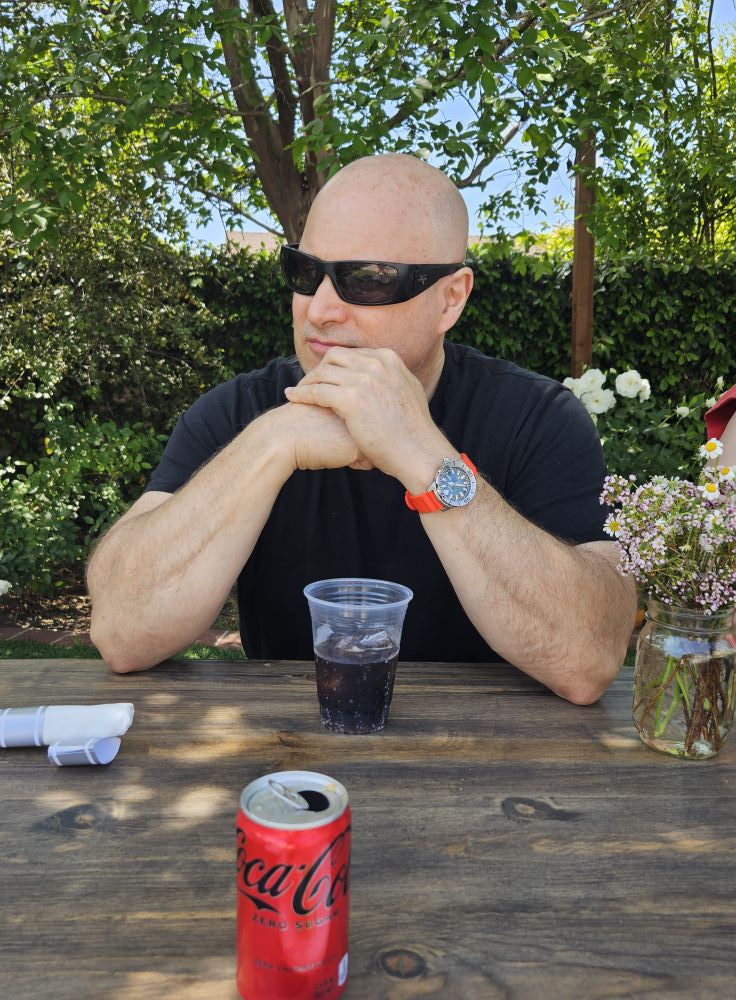
    No Flexecutivewear ensemble is complete without the obligatory diver watch on an orange strap—a bold timepiece that screams “I could be 200 meters underwater right now, but I’m actually just waiting for my cold brew.” The orange strap is crucial: it’s the high-visibility beacon of masculine daring, suggesting a rugged, adventurous spirit who might rappel down a cliff between Zoom calls. Never mind that the watch has never tasted saltwater and its nearest brush with danger was a CrossFit box opening. In the Flexecutive ecosystem, the diver watch is less tool and more talisman—a waterproof monument to imagined peril and aspirational virility.

  • Waiting for the Angels to Descend and Hand Me the Perfect Book Title on a Velvet Pillow

    Waiting for the Angels to Descend and Hand Me the Perfect Book Title on a Velvet Pillow

    After reading Emmanuel Carrère’s Yoga—a meandering, self-lacerating spiral of spiritual ambition, narcissism, and depressive collapse—I’ve found myself inspired, if not outright possessed, by the urge to write my own autobiographical novel. Not about yoga, of course. I have the flexibility of a rusted lawn chair. Mine would be about my lifelong addiction to exercise. Working title: Kettlebell.

    It has a certain Zen austerity to it. One word. Heavy. Spherical. Monastic. A blunt object and a metaphor all in one. A symbol of focus in a world engineered for entropy. While others turn to wine, weed, or weaponized mindfulness apps, I have turned to iron. Cold, unyielding, mildly concussive iron.

    Of course, I could flirt with cleverness—titles like The Church of Sweat or The Temple of Gains—but those reek of Instagram influencers and overpriced gym merch. Kettlebell is purer. But then again, Dumbbell tugs at me. It’s honest. It’s humiliating. It suggests what I secretly suspect: that I’ve spent a lifetime mistaking pain for virtue and resistance training for redemption. I am a Dumb Bell. A heavy object being swung around in circles, hoping to find peace through repetition.

    Still, perhaps I’m playing into the oldest self-help trap of them all—masquerading self-deprecation as enlightenment. Perhaps the search for the perfect title is simply a glorified avoidance ritual, a form of literary procrastination wrapped in velvet. Because deep down, I know the book isn’t just about fitness. It’s about how I’ve used discipline as anesthesia, reps as prayer beads, and physical exhaustion as a form of epistemology. I don’t know what God looks like, but I suspect He smells like workout chalk and vanilla protein shakes.

    Some mornings I feel like a garage-dwelling mystic, swinging kettlebells under flickering LED light, muttering mantras between sets. Other days I feel like an absurd parody of Sisyphus—except instead of rolling a boulder up a hill, I’m performing goblet squats in my tattered gym shorts, chasing transcendence in 30-second rest intervals.

    And now, on the brink of another workout, I’m wasting precious calories spiraling into a metaphysical title crisis. Maybe the perfect name will descend from the sky, borne aloft by angels in sweatbands and Lululemon, whispering, “This is it. This is your brand.” They will hand me the title on a velvet pillow. Or maybe I’ll figure it out in the middle of a brutal set, when my soul finally detaches from my body like a spent shell casing and whispers, “Just call it Garage Monk and be done with it.”

    One way or another, the iron awaits. And it does not care what the book is called.

  • From Corner Office Dreams to Carpool Reality: One Engineer’s Recession Watch

    From Corner Office Dreams to Carpool Reality: One Engineer’s Recession Watch

    I just got off the phone with my friend, a seasoned engineer marooned in the asphalt sprawl of Southern California, who sounded like a man peering over the edge of an economic cliff with a pair of shaky binoculars. The view? Grim. The engineering sector—usually a stalwart of rational planning and concrete outcomes—is now gripped by the wobbly-kneed fear of an incoming recession. Hiring freezes are spreading like a case of financial frostbite, and everyone’s waiting for the other steel-toed boot to drop.

    The culprits? Our beloved government’s carnival of tariff acrobatics—somersaults, swan dives, and the occasional flaming hoop—leaving the business sector in a state of chronic vertigo. With policy shifting by the hour and no clear sense of direction, companies are curling inward like startled armadillos, refusing to hire or spend, while consumers clutch their wallets like Victorian widows clutching pearls.

    Just a month ago, my friend had a juicy job offer on the table—complete with perks, prestige, and a corner office view of existential dread. He was mulling it over with the quiet satisfaction of a man whose talents were finally being recognized. But now? That same company has ghosted him like a bad Tinder date, citing “market uncertainty” and initiating a hiring freeze. Translation: they’ve lost their nerve and joined the swelling ranks of firms slamming shut the doors like it’s a zombie apocalypse.

    His current job, for now, is safe. But the interns? Sacrificed at the altar of “cost-cutting measures.” And his planned splurge—a shiny $50K car meant to serve as both reward and statement piece—has been downgraded to a practical vow of austerity. No V6 joyrides, no heated leather seats, just a cold reminder that in this economy, survival is the new luxury.

    “I’m just lucky to still be employed,” he said, with all the enthusiasm of a man clinging to a lifeboat made of unpaid invoices and canceled bonuses.

  • Lessons Learned from the Ring Light Apocalypse

    Lessons Learned from the Ring Light Apocalypse

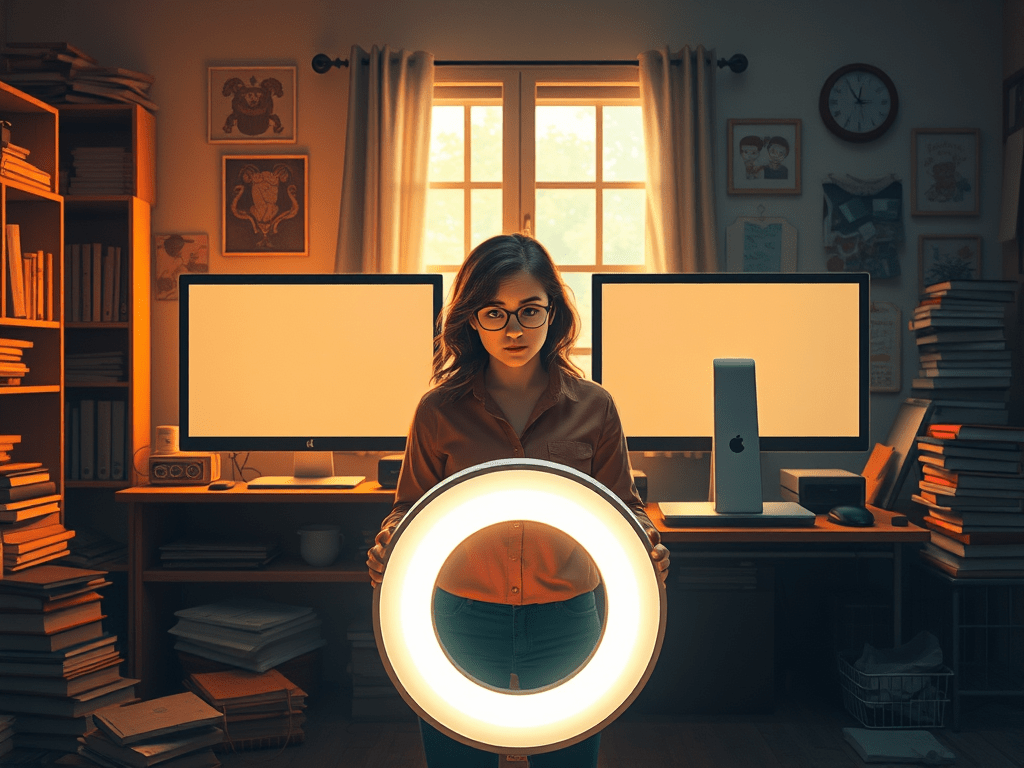
    During lockdown, I never saw my wife more wrung out, more spiritually flattened, than the months her middle school forced her into the digital gladiator pit of live Zoom instruction. Every weekday morning, she stood before a pair of glaring monitors like a soldier manning twin turrets. At her feet, the giant ring light—a luminous, tripod-legged parasite—waited patiently to stub toes and sabotage serenity. It wasn’t just a lighting fixture; it was a metaphor for the pandemic’s unwanted intrusion into every square inch of our domestic life.

    My wife’s battle didn’t end with her students. She also took it upon herself to launch our twin daughters, then fifth-graders, into their own virtual classrooms—equally chaotic, equally doomed. I remember walking past their screens, peering at those sad little Brady Bunch tiles of glitchy faces and frozen smiles and thinking, This isn’t going to work. It didn’t feel like school. It felt like a pathetic simulation of order run by people trying to pilot a burning zeppelin from their kitchen tables.

    I, by contrast, got off scandalously easy. I teach college. My courses were asynchronous, quietly nestled in Canvas like pre-packed emergency rations. No live sessions. No tech panics. Just optional Zoom office hours, which no one attended. I sat in my garage doing kettlebell swings like a suburban monk, then retreated inside to play piano in the filtered afternoon light. The pandemic, for me, was a preview of early retirement: low-contact, low-stakes, and high in self-righteous tranquility.

    My wife envied me. She joked that teaching Zoom classes was like having your teeth drilled by a sadist who lectures you on standardized testing while fumbling with the pliers. And I laughed—too hard, because it wasn’t really a joke.

    The pandemic cracked open a truth I still wince at: the great domestic imbalance. I do chores, yes. I wipe counters, haul laundry, load the dishwasher. But my wife does the emotional heavy lifting—the million invisible tasks of motherhood, schooling, comforting, coordinating. During lockdown, that imbalance stopped being abstract. It stared me in the face.

    For me, quarantine was a hermit’s holiday. For her, it was a battlefield with bad Wi-Fi. And while I’m back to teaching and she’s back to something closer to normal, I haven’t forgotten the ring light, the glazed stare, or the guilt that hums quietly like a broken refrigerator in the back of my mind.

  • The Astroturf Gospel and the Temptation of Lilikoi

    The Astroturf Gospel and the Temptation of Lilikoi

    It’s Mother’s Day, which means my wife and twin daughters are headed to my sister-in-law’s house in Los Alamitos—land of perpetual canopies, well-behaved shrubbery, and a backyard lined with astroturf so immaculate it feels like a corporate fantasy of grass. It’ll be a dry 83 degrees, the kind of weather that screams “perfect” but secretly smells like sunscreen, grilled onions,and the cloying ghost of dryer sheets wafting from the laundry room, where the rhythmic hum of tumbling towels offers the unsettling ASMR of suburban captivity.

    Lunch will be irresistible smash burgers, sizzling beneath a pop-up tent while two imprisoned dogs hurl themselves against the sliding glass door like furry protestors demanding civil rights. Their eyes will say, We are family, so that we mercifully let them free to sniff us and beg for food.

    I’ll eat my 2-pound burger without the brioche buns, which will trigger my brother-in-law Daniel to give me that look. You know the one. The “Oh, you’re dieting again” look, equal parts amusement and subtle mockery. I’ll explain that I began my latest odyssey—The Protein’s Progress—on April 10, and as of yesterday, I’m down 14 pounds. I will present this as fact, not brag. He will respond with his eyes, which will sparkle with skepticism, the kind that says we’ve seen this episode before.

    Once macros are discussed and dismissed, we’ll drift—inevitably—into our usual techno-futurist rabbit hole. Daniel will extol the revolutionary power of 3-D printers, which, according to him, can now build electric cars, houses, power generators, and possibly an emotional support animal, all at half the cost of corporate versions. He’ll pivot to ChatGPT, lamenting its encroachment on college classrooms and human employment in general, before predicting a future where we all live in 3-D-printed orchard communes—rudderless, jobless, and governed by self-appointed mayors fluent in blockchain and Blender.

    I’ll tell him this sounds less like an economic forecast and more like a limited series on HBO Max starring Pedro Pascal and an emotionally damaged android. We’ll laugh.

    Then comes dessert.

    I’ll admire the cakes I brought—one Paradise, one Lilikoi, both from King’s Hawaiian Bakery—and initially, nobly, decline. I will be strong. I will not cave.

    Then my sister-in-law will appear with a Costco-sized tub of Kirkland French Vanilla and start ladling it over thick slices of passionfruit-laced cake, and I will feel something in my chest shift. Not a heart attack—worse. It will be a spiritual failure.

    Excusing myself, I’ll go to the bathroom, stare into the mirror, and whisper, “It’s Mother’s Day. You’re allowed.”

    But the mirror will say, Are you, though?

  • Biceps and Biohazards: A Life on Nutritional Alert

    Biceps and Biohazards: A Life on Nutritional Alert

    I’ve been a bodybuilder most of my life. At 63, my muscles still bulge like I’m auditioning for a special forces propaganda reel—but even that doesn’t exempt me from the quiet humiliation of mortality. Lately, I’ve been staring into the abyss not with dread, but with diagnostics. My blood pressure, triglycerides, cholesterol—these numbers have become my new Greek chorus, whispering prophecies of heart disease, kidney failure, and other charming ways the body stages its final betrayal.

    I want to live long. I want to be healthy. I want to be around for my family, not just as a protein-shake-fueled statue, but as someone present, alert, alive. And so I try to eat right. I try to live clean. But in doing so, I’ve become a man who spends his days mentally auditing every almond. I walk through my own kitchen like it’s a minefield, knowing one wrong step—say, a 700-calorie bowl of Shredded Wheat with berries and walnuts—might plunge me into the void.

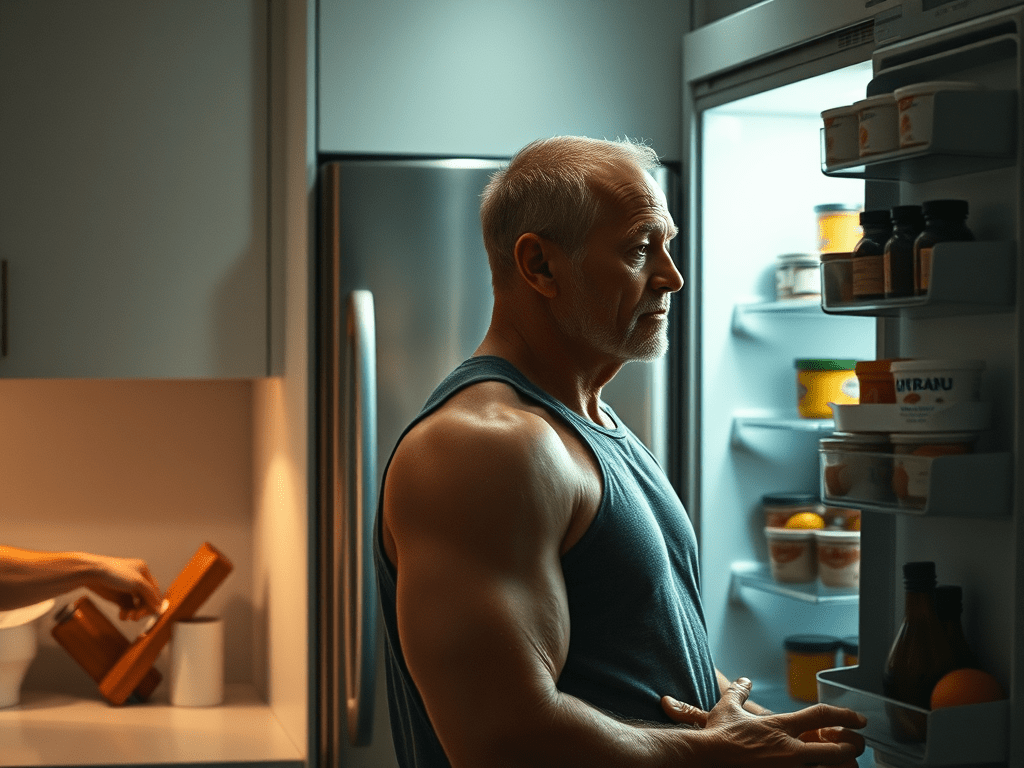
    This is what vigilance looks like now: standing in front of the fridge at 8 p.m., debating whether two Medjool dates and a dollop of whole milk Greek yogurt is self-care or self-destruction. I’ve got a body that could still turn heads at a funeral, and yet I’m haunted by the nutritional content of a single ounce of bourbon, as if one sip will hurl me into a Roman orgy.

    And so I ask myself: Is this it? Is a healthy life supposed to feel like I’m forever balancing on a dietary razor wire, eyes scanning for invisible enemies made of saturated fat?

    Where’s the joy in this script? Where’s the wonder, the enchantment, the spontaneity that’s supposed to come with vitality? Am I prolonging life or merely stretching the anxiety?

    These are the questions I ask while chewing a forkful of salmon and silently longing for a croissant. Yes, I want to live longer—but must I do it while fearing the yogurt that is staring at me from the refrigerator?

  • Gravefeather and the Temple of Iron

    Gravefeather and the Temple of Iron

    At 63, with fifty years of training behind me and enough injuries to fill a radiologist’s scrapbook, I don’t pay a therapist two hundred bucks an hour to dissect my existential drift. No, I take my angst to the garage and sweat it out under the cold, unforgiving eye of a steel kettlebell.

    This isn’t the gym-as-penance nonsense of my youth. I’m in it for the long haul now—grease in the joints, not fire. I train smart. No heroic max-outs, no flirtations with the ER. I chant my gospel, delivered by YouTube prophet Mark Wildman: “The purpose of working out today is to not hurt yourself so you can work out tomorrow.”

    Prepped with a concoction of 50 grams of protein (half yogurt, half whey, all optimism) and 5 grams of creatine, I step into the garage like a monk entering a steam-soaked temple. Within minutes, I’m sweating like a politician in a polygraph booth, slipping into that endorphin-laced trance where everything hurts and yet somehow heals.

    But my solitude never lasts.

    The parade begins: delivery drivers dropping packages by the gate like sacrificial offerings. They nod. We chat. They ask about my workouts. Sometimes they want kettlebell tips, which I deliver like the gym-floor Socrates I’ve become.

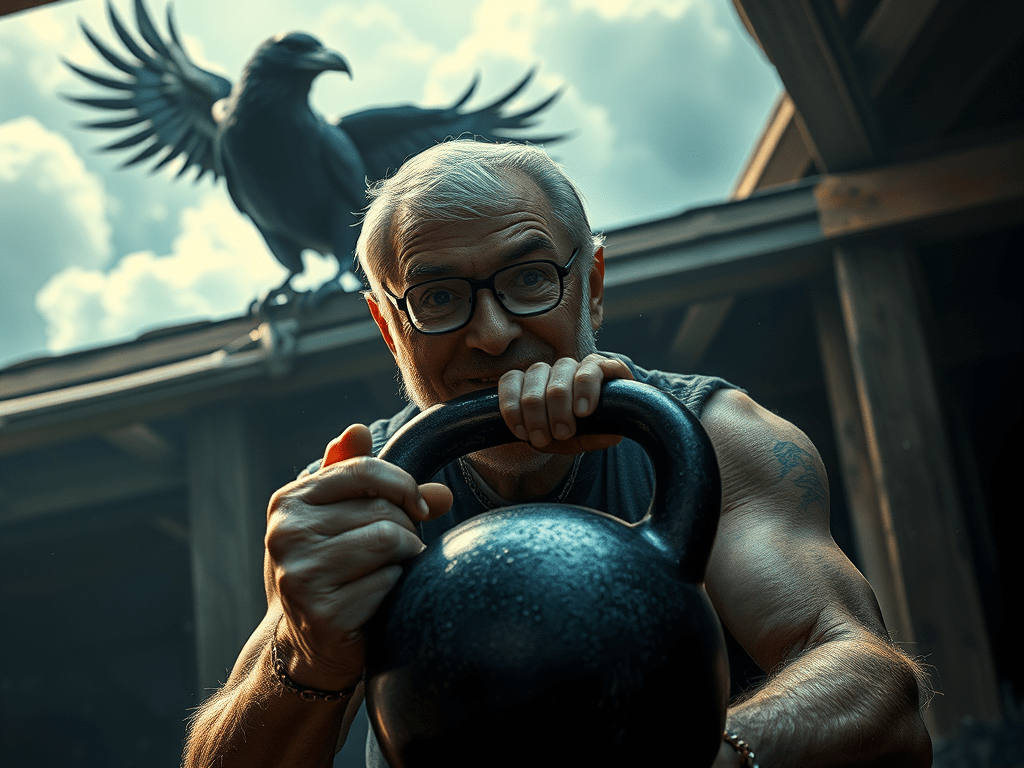
    Then come the other visitors—the crows. Not just crows. Hypercrows. Schwarzenegger crows. Hulking, obsidian-feathered beasts with the posture of Roman generals and the swagger of barbell-swinging demons. These things don’t fly—they strut. They don’t chirp—they taunt.

    One in particular has claimed me. I’ve named him Gravefeather, which feels appropriately mythic. He has the pecs of a cartoon strongman and the gaze of someone who’s seen civilizations fall and isn’t impressed. He parks himself on the fence or the garage roof, staring me down mid-swing with an expression that says, “Your form is garbage and mortality is laughing at you.”

    I know he remembers me. Crows do that. He remembers that I’m no threat. He remembers I talk to myself. He probably knows my macros. And when I lock eyes with him, mid-swing, sweat blurring my vision, I swear he’s thinking, “Nice hinge, old man. Shame about your knees.”

    Sometimes he’s perched twenty feet away while I’m gasping through Turkish get-ups, his eyes drilling into me with cosmic disdain. I hear him say, without speaking, “Enjoy your little routine, fleshbag. Entropy is undefeated.”

    But I argue back. I say, “Just because we’re mortal doesn’t mean we surrender to chaos. This is my sanctuary. I honor it. I will not be mocked by a sentient pigeon in a tuxedo.”

    Gravefeather cocks his head. He seems to consider this. Then, with the faintest nod of something like respect, he lifts off into the blue, cawing a tune that sounds like the chorus of a forgotten Paul McCartney song—melancholy, strangely triumphant, vaguely judgmental.

    And I return to the bell. I swing. I breathe. I endure. Gravefeather may be watching, but the iron remains mine.

  • “Abandon Ego, All Ye Who Enter Here.”

    “Abandon Ego, All Ye Who Enter Here.”

    Since hitting emotional rock bottom in a Miami hotel—where my subconscious, speaking through a spectral figure named Dangerfeld, lambasted me for my morbid overweight state—I’ve taken up the old, gristly religion of high-protein austerity. No refined carbs, no snacks, no joy. Just eggs, meat, and the low-humming despair of monk-like discipline. And lo, it worked. In 25 days, I descended from 247 to 232 pounds, a veritable shedding of sin through sweat and chicken thighs.

    Each day, I did kettlebells in the garage, then mounted the Schwinn Airdyne—known in the underworld as The Misery Machine—and burned over 900 calories while it shrieked like a mechanical banshee exorcising my demons through cardio. After one particularly grueling ride, I stepped onto the scale, breathless and giddy: fifteen pounds exorcised in under a month. A triumph. A cleansing. A sacrament.

    But then, from the smoky alcove of my brain where melancholy likes to lounge, came a voice. Calm, sorrowful, smug.

    “Sir,” it said, with bureaucratic precision, “I perceive that Mother’s Day is a mere three days away. There will be cake. There will be pastries. There will be family members wondering why you’re eating celery like a punishment stick while everyone else feasts. Surely, your in-laws will expect you to partake in the merriment. Surely, you understand the risk of catastrophic relapse.”

    And just like that, joy curdled into dread.

    How grotesquely narcissistic, I thought, that this sacred holiday devoted to mothers now existed as a threat to my calorie ceiling. How utterly solipsistic that I, the anti-glutton, could twist a moment of familial celebration into an existential crisis about frosting. The very thought of smiling through a family brunch while calculating the caloric impact of a Danish was enough to send me into a spiral of metaphysical nausea.

    I was ready to crucify my Inner Glutton in the name of bodily salvation, only to discover I’d built a second altar to my own dietary narcissism. I wasn’t conquering vice. I was simply trading one obsession for another—an endless, pathetic game of Morality Whack-a-Mole, where each virtue is a vice in disguise wearing protein powder as a wig.

    This, friends, is the loathsome absurdity of the human condition: Man cannot simply enjoy a scone. He must attach his eternal worth to it.

    And so I found myself lost once again—not in the forest, but in the pastry section—searching for a well-lit EXIT sign that read: “Abandon Ego, All Ye Who Enter Here.”

  • Podcrash

    Podcrash

    Last night, I was in my kitchen, casually sharing shrimp, cocktail sauce, and champagne with public intellectuals Andrew Sullivan and Reihan Salam. As one does. We dove headfirst into the big topics: public policy, identitarianism, the collapse of critical thinking in echo chambers, and the shaky health of democracy. Between bites of shrimp and sips of champagne, we reveled in our status as lifelong learners, trading stories about childhood, lost pets, first crushes, and bouts of existential despair. The shrimp bowl magically replenished itself, and the champagne glasses never emptied. It was glorious—three intellectual heavyweights, solving the world’s problems, toasting to friendship and intellectual curiosity. For a fleeting moment, I felt like I’d reached peak existence: camaraderie, enlightenment, and a deeply inflated sense of self-worth, all in one glorious, shrimp-fueled evening.

    Only it didn’t happen.

    I was dreaming, my subconscious hijacked by The Dishcast. This is my nocturnal routine: When I go to bed at night, I fall asleep to a podcast and, before long, I’m the star guest. There I am, delivering profound manifestos about the human condition, my opinions urgently needed and universally admired.

    When I woke up, the camaraderie still lingered, as if Andrew and Reihan had just slipped out the back door, leaving only a faint echo of laughter.

    This happens all the time. In my dreams, I’m not just a listener—I’m part of the podcast universe, slapping backs, sipping champagne, and dropping truths no one dared to utter. Reality, by comparison, is disappointingly quiet.

    Clearly, podcasts are taking too much bandwidth in my brain. I’m not alone. Like millions of others, I’ve practically taken up residence in the world of podcasts. My life runs on a steady soundtrack of conversations and monologues, piped directly into my ears while I swing kettlebells, pedal my exercise bike, grade uninspired writing assignments, cook, eat, and scrub the kitchen into submission. Podcasts are my companions for post-workout naps, my co-pilots on the commute, and my salvation during middle-of-the-night insomnia—the kind where you wake up at 2 a.m., stare at the ceiling, and hope a familiar voice can lull you back to sleep before dawn.

    In total, I must rack up over a hundred hours of podcast listening every week. I spend more time in the podcast multiverse than in the real one, and inevitably, these voices have taken up permanent residency in my brain. Some of these parasocial relationships I welcome with open arms; others, I tolerate with the resigned grumbling of a bad roommate. And then there are the hosts who commit unforgivable sins—becoming smug, tedious, or worse, preachy—earning themselves a one-way ticket to oblivion. In this universe, the delete button is my only weapon, and I wield it without mercy.

    Living in the podcast world as I do—where most of my waking and sleeping hours are dominated by disembodied voices—I’ve started asking some uncomfortable questions. Have I, like millions of others, surrendered my brain to the podcasters, letting them hijack my mental real estate to my own detriment? Am I so immersed in podcast life that I’ve lost all perspective, like a fish in water, oblivious to how wet it is?

    What am I really after here? Entertainment? Wisdom? A surrogate friend? Or just noise to drown out the endless chatter in my own head? Why do some podcasts stick while others fall by the wayside? Are my favorites truly brilliant, or just slightly less irritating than their competition? Is it their buttery voices, sharp wit, or the fact that they don’t seem to realize they’ve become permanent fixtures in my inner monologue?

    Could I live without podcasts? Would the silence reveal things about myself I’m not ready to confront? What do I call that blissful, cozy state when I’m wrapped in the warmth of a trusted voice? Podcastopia? Earbud Nirvana? Sonic Solace? And is it possible to “love” a podcaster too much, like when I know their pet’s name but can’t remember my sibling’s birthday?

    Am I escaping something? Is this obsession a creative pursuit or an elaborate scheme to avoid existential dread? And most importantly, does this insatiable consumption mean something is deeply, hilariously wrong with me? Or does it point to something more profound—a need for a new word to describe the bottomless, soul-deep immersion of chasing episode after episode like a digital hunter-gatherer?

    Yeah, I’ve got questions. But it might be too late. I may already be The Man Who Loved Podcasts Too Much.