Tag: life

  • Pillar of Salt: Why I Turned My Back on Bulk

    Pillar of Salt: Why I Turned My Back on Bulk

    As I trudged through the cavernous aisles of Costco, I felt less like a shopper and more like an explorer hacking through a consumerist rainforest with a mental machete. Everywhere I turned, industrial towers of peanut butter jars loomed like ancient ruins, and battalions of quinoa-based snack items assaulted me with their deceptive health halos. I wasn’t shopping—I was spelunking into the subconscious of the American appetite.

    Then came the Free Sample Fairies—syrupy-smiling heralds of indulgence—beckoning me toward thimble-sized offerings of strawberry smoothies, sushi rolls, and the inevitable ostrich jerky. It was a fever dream: a child’s fantasy of Eden where all cravings are granted instantly and without consequence. Except the consequences were vast, and they waited for me at home like angry creditors—an overflowing fridge, a groaning freezer, cupboards stuffed like hoarders’ closets. To make room for the new bounty, I had to speed-eat the old. Thus began the glutton’s loop: buying, bingeing, repenting, repeating. Costco wasn’t a store. It was an engine of expansion—of appetite, of girth, of existential despair.

    And I wept. Not just for myself but for my people. I wept because we worshipped this oversized temple of abundance as if our very worth hinged on how many gallons of mayonnaise we could carry home. We treated the act of bulk-buying like a civic virtue, a weekly pilgrimage that proved we were living the American Dream. But it wasn’t a dream. It was a performance. A flex. A suburban smoke screen designed to conceal the quiet desperation of too much, too often, too fast.

    So I returned home, hollow-eyed and bloated, and declared to my family that I could no longer continue this pilgrimage. Costco, I announced, was my personal Sodom—dangerous, seductive, and destined for dietary doom. I would henceforth shop only at Trader Joe’s: the humble monastery of portion control, the temple of restraint. My salvation, I told them, would be lined with frozen cauliflower gnocchi and 8-ounce jars of almond butter.

    My family wept. Not out of joy or agreement, but out of grief for the Costco bounty they would no longer see. No more colossal trays of croissants or five-pound bags of trail mix. I watched them mourn the death of excess. I saw it in their faces: longing for the Costco of yore. But I warned them—look back, and you become like Lot’s wife: bloated and salty.

    And then a miracle: They adapted. Slowly, painfully, they embraced the modesty of Trader Joe’s, portioned their expectations, and learned to live with less. They traded abundance for love, proving their devotion not with words but with fewer carbs. In their sacrifice, I found my strength.

    As I penned these reflections, a single tear rolled down my cheek. Whether it was sorrow, gratitude, or sodium withdrawal, I couldn’t say.


  • Teaching College Writing in the Pre-Canvas Days

    Teaching College Writing in the Pre-Canvas Days

    I’m glad academia has gone digital. No more heavy boxes of printed essays to lug home. No more gradebooks with smeared records.

    I remember we used to have to bring our grade and attendance records to campus during the semester break and get our records approved before we were truly free to enjoy our vacation.

    Like a beleaguered instructor sent on a doomed mission, I had to drag myself to the campus, lugging a mountain of paper that looked like it had survived the apocalypse.

    My stack of grades and attendance records—yellowed, dog-eared, and adorned with enough coffee stains and White-Out smudges to pass as a Jackson Pollock reject—was a bureaucratic nightmare in physical form. I found myself in line with a hundred other sleep-deprived, caffeine-fueled professors, each clutching their own messy masterpieces like they were carrying the Dead Sea Scrolls. The line outside the Office of Records was so long it could have served as an endurance test for Navy SEALs. To stave off starvation and existential dread, I had packed a comically oversized sack of protein bars and apples, as if I were preparing for a month-long siege rather than a simple bureaucratic ritual.

    There I was, supposed to be basking in the sweet, sweet nothingness of semester break, but instead, I was condemned to a gauntlet of waiting that made Dante’s Inferno look like a walk in the park. For what felt like hours, waited for the privilege of sitting at a table and enduring the laser-like glare of humorless bureaucrats who would scrutinize my records as if they were forensic experts analyzing evidence from a high-profile murder case.

    Once I finally managed to wade through the outdoor line, I advanced to the foyer for the second, even more soul-crushing phase of The Great Wait. Inside, rows of desks manned by expressionless drones awaited, each one peering over piles of grading records that seemed to stretch back to the dawn of civilization. Behind the staff of functionaries who examined the professors’ gradebooks were towers of file boxes stacked so precariously that a single sneeze could have transformed them into a cataclysmic eruption of dust and possibly asbestos.

    Eventually, I was summoned to one of the desks where an eagle-eyed Attendance Priestess scrutinized my records with the intensity of a customs officer suspecting I had smuggled contraband. She licked her fingertips with the solemnity of a high priestess preparing for a sacred ritual, only to cast me a look of such disdain you’d think I’d just handed her a wad of toilet paper instead of my gradebook.

    Finally, when the pinch-faced administrator deemed my records sufficiently unblemished and granted me the bureaucratic blessing to leave, it felt like I had just been handed the keys to the Pearly Gates. I didn’t walk to my car. I windsprinted because I feared the Attendance Priestess may have found fault with my records and would call me back to start the whole process all over again.

  • I Need to Talk to You About Neighborplexity

    I Need to Talk to You About Neighborplexity

    Sumatra coffee is my bad boy of the coffee world—dark, mysterious, and utterly unapologetic. It doesn’t just wake me up; it smacks me across the face, throws me out of bed, and chases me down the street while I’m still in my pajamas. Imagine if a tropical thunderstorm decided to moonlight as a barista, bottling up its fury in a cup. That’s Sumatra—every sip as intense as being caught in a downpour while you’re half-asleep and regretting every life choice that led you to this point.

    Sure, I’m probably guzzling more Sumatra dark roast than is recommended by anyone with a functioning heart, but let’s be real: I’m an overworked college writing professor, buried under an Everest of student assignments that multiply like rabbits on caffeine. Add to that the never-ending demands of being an author of coffee table humor books—books that, according to my editors, need constant revision and expansion to “stay relevant” and “generate a healthy revenue stream.” Translation: “Jeff, we need you to keep churning out content until your fingers bleed and your soul shrivels up like a raisin.”

    But let’s not get ahead of ourselves with the self-pity party. I could give you a long-winded lecture about how the digital age was supposed to bring us more convenience and free time, only to morph into a merciless sociopath that steals our time faster than you can say “work-life balance.” But instead, let me start my story before the Sumatra kicks in too hard, and I start ranting like a madman on a caffeine bender. Buckle up, because this ride is about to get bumpy.

    My tale begins with the Pattersons, my dear, respectable neighbors. For years, I lived in blissful harmony with these upstanding citizens—the kind of people who proudly displayed their New Yorker subscriptions and NPR tote bags like badges of intellectual honor. We had an unspoken pact, a mutual understanding that we were members of the Smart People’s Society, where the TV was reserved for documentaries, award-winning dramas, and the occasional indie film that required subtitles and a dictionary to understand.

    But then, one evening, as I casually glanced out my window—just a harmless peek, really—I saw something so grotesque, so utterly incomprehensible, that it shook me to my core. There, through the open window of my once-revered neighbors, I saw them glued to the screen—not just any screen, but one streaming a TV show so mind-numbingly lowbrow it made reality itself seem like a parody. My brain went into full-blown meltdown. Could it be? Were they actually watching Love Island?

    I blinked, hoping I’d misinterpreted the scene, but no—the horror was all too real. My neighbors, those paragons of taste and intellect, were indulging in what could only be described as televised garbage. I was struck down by a case of Neighborplexity: that gut-wrenching, mind-twisting moment when you realize you might not know the people next door at all. Suddenly, my world was flipped upside down. Had they always been this way? Were those book club meetings just a ruse, a clever cover-up for their secret love affair with trash TV? I felt like I’d just discovered that the Michelin-starred chef who lived down the block actually preferred dining on Spam straight out of the can.

    I thought we were united in our disdain for anything that wasn’t at least 95% fresh on Rotten Tomatoes. But now? Now, I wasn’t so sure. How could they betray me like this? Was every dinner party, every casual chat about the latest literary masterpiece, just a well-orchestrated charade? My mind spun as I tried to reconcile the image of these seemingly cultured, well-spoken people with the reality of them willingly watching—gasp—that show.

    What do I do now? How do I move forward? Can I ever look them in the eye again, or will I be forever haunted by this dark revelation, this unraveling of the fabric of my once-idyllic neighborhood? All because of one dreadful, unforgivable act of poor taste on TV. Love Island, of all things. The horror! The betrayal! The absolute audacity! I might need more Sumatra just to get through this.

  • Return to Purgatory: A Packing Dream from Hell

    Return to Purgatory: A Packing Dream from Hell

    Last night, I found myself trapped in a sprawling compound of crumbling houses that looked like they were built during the Carter administration and never cleaned since. A communal frenzy was underway: the packing of thousands—yes, thousands—of food items and random clothing for a temporary exodus. Why the mass exodus? Unclear. Fumigation? Apocalypse? A reboot of The Grapes of Wrath? Whatever the reason, it was purgatorial.

    The mood? Moronic cheer. My fellow inmates—let’s not flatter them by calling them neighbors—were sipping drinks, cackling, and treating this Herculean labor like a godforsaken block party. Meanwhile, I hovered at the edge of the scene, paralyzed by the Sisyphean logistics of it all. Every cabinet I opened unleashed another avalanche of expired beans and mismatched Tupperware lids. The collective merriment felt obscene, as if they were toasting the Titanic’s elegant descent into the sea.

    And just when I thought salvation had arrived—in the form of a 2 a.m. bathroom break—I awoke, staggered to the toilet, and stumbled back to bed hoping to reset my brain. No such luck. The dream resumed exactly where I left off, like I’d hit pause on Netflix and walked back into my own streaming nightmare. There I was again, back in the compound, surrounded by half-drunk revelers blissfully ignoring the sheer futility of their packing, while I stood, a one-man FEMA unit, dreading every box and can like they were symbols of existential despair.

    I suppose, in some Jungian corner of my subconscious, this was meant to be cathartic. Maybe a soul purge. Maybe a late-night psychological CrossFit session designed to wring out my nervous system like a filthy sponge. All I know is, I woke up feeling like I’d done emotional burpees for eight hours straight—but to my surprise, I was eager to get out of bed, made a pot of coffee like it was a holy sacrament, and gleefully planned a one-hour kettlebell workout. 

  • Rewind, Delete, Regret: The Cost of Editing Love

    Rewind, Delete, Regret: The Cost of Editing Love

    Eternal Sunshine of the Spotless Mind and Black Mirror’s The Entire History of You are thematically bound by a shared anxiety: the dangerous seduction of technological control over memory. In Eternal Sunshine, memory erasure is marketed as emotional liberation—a clean slate for the brokenhearted. Similarly, in “The Entire History of You,” the brain-implanted “grain” promises perfect recall, total clarity, and the ability to replay moments with photographic precision. Both stories probe a fundamental question: if we could edit our pasts—delete pain, scrutinize joy, control the narrative—would we be better off, or would we unravel?

    Both works reveal that tampering with memory doesn’t resolve emotional suffering; it distorts and magnifies it. In Eternal Sunshine, Joel and Clementine attempt to erase each other, only to circle back into the same patterns of love, longing, and dysfunction. Their emotional chemistry survives the purge, suggesting that memory is not simply data but something embedded in identity, instinct, and the soul. “The Entire History of You” flips the dynamic: instead of forgetting, the characters remember too much. Liam’s obsessive rewinding of moments with his wife becomes a self-inflicted wound, each replay deepening his paranoia and unraveling his sense of reality. The technology doesn’t heal him—it traps him in a recursive loop of doubt and resentment.

    The irony in both narratives is that the human mind, with all its flaws—forgetfulness, bias, emotional haze—is actually what allows us to forgive, to grow, to love again. Eternal Sunshine presents memory loss as a form of mercy, but ultimately asserts that pain and connection are inseparable. The Entire History of You warns that perfect memory is no better; it turns love into surveillance, and intimacy into evidence. In both cases, technology doesn’t enhance humanity—it reveals its brittleness. It offers a fantasy of control over the uncontrollable: the messiness of relationships, the ambiguity of feelings, the inevitability of loss.

    Thus, Eternal Sunshine serves as a philosophical and emotional precursor to “The Entire History of You.” Where one is melancholic and lyrical, the other is clinical and chilling—but both reach the same conclusion: to be human is to remember imperfectly. Whether we erase the past or obsessively relive it, we risk losing what actually makes relationships meaningful—our capacity to feel, forget, forgive, and fumble our way forward. Memory, in both stories, is less about accuracy than emotional truth—and trying to mechanize that truth leads only to alienation.

  • Why I Refuse to Journal Like a Good Little Introvert

    Why I Refuse to Journal Like a Good Little Introvert

    One of my most cherished moments of accidental transcendence happened somewhere between the cow-scented fields of Bakersfield and the fog-choked sprawl of San Francisco in the spring of 1990. I was climbing the Altamont Pass in a battered 1982 Toyota Tercel that handled like a shopping cart when The Sundays’ “Here’s Where the Story Ends” crackled to life on the radio. Harriet Wheeler’s voice—equal parts cathedral and confession booth—floated through the speakers, and suddenly I wasn’t commuting through California; I was levitating above it. I wasn’t driving—I was ascending. In that moment, I stumbled into something bigger than myself, gifted by two Brits, David Gavurin and his partner Wheeler, who recorded their luminous dispatches, then vanished from the stage like saints escaping the tabloid apocalypse.

    They made beauty, and then they walked away. No farewell tour, no social media mea culpas, no sad attempts at reinvention. Just a few perfect songs and the audacity to say, that’s enough. They’re my heroes—not for what they did, but for what they didn’t do. They resisted the narcotic of attention. They said no to the stage and yes to obscurity, which in our fame-gluttonous culture is the moral equivalent of monkhood.

    I, by contrast, never quite shut up.

    I’ve been peddling stories since high school, where I’d hold court at lunch tables, unspooling feverish tales of misadventure like a cracked-out bard. At 63, I still haven’t kicked the habit. But unlike the craven influencer class, I hope I’m not just hustling dopamine hits. I tell stories because I need to make sense of this deranged carnival we call modern life. It’s an instinct, like blinking or checking the fridge when you’re not even hungry.

    Some stories are survival tools disguised as art. Viktor Frankl wrote to preserve his sanity in a death camp. Phil Stutz prescribes narrative like medicine. And when I hear a brilliant podcaster dissect the absurdity of daily life, it feels like eavesdropping on salvation. It’s not just performance—it’s connection. Human beings, after all, are just gossiping apes trying to explain why the hell we’re here.

    Storytelling is the futile, glorious act of forcing chaos into coherence. It’s pinning butterflies to corkboard. Life is all noise—emails, funerals, fast food, missed calls—and stories give it a beat, a structure, a moral, even if it’s just “don’t marry a narcissist” or “never trust a man who wears sandals to a job interview.”

    So why not keep it to myself? Why not scribble in a journal and hide it in the sock drawer next to my failed dreams and mismatched batteries? Because I find journaling about as appealing as listening to my own Spotify playlist on repeat in a sensory deprivation tank. No thanks. I don’t want to be alone with my curated echo chamber. I want a café. A digital one, maybe, with only a few scattered patrons. But still—voices, questions, and the hum of others trying to make sense of it all.

    I’ll never be famous. I’ll never go viral. But if someone reads my ramblings and thinks, me too—then that’s enough. I’m not trying to be an algorithm’s golden child. I’m just trying to find some order in the mess. Just like I always have.

  • Luxury Is Relative: Tales from the Desert of Almost

    Luxury Is Relative: Tales from the Desert of Almost

    Fresh off the bus from the bustling Bay Area, I found myself marooned in Bakersfield, a sun-bleached corner of California that could only generously be described as a town. With zero friends and even fewer social obligations, I embraced my solitude like a monk embracing a vow of silence. My one-bedroom apartment became my sanctuary—no roommates, no forced small talk, just me and the sweet luxury of never having to negotiate over chores or TV channels.

    My companions? A stack of CDs featuring Morrissey, The Smiths, and other bands that sounded like a group therapy session set to a minor key. I was working on a novel Herculodge, my dystopian magnum opus in which society punishes the overweight with Orwellian fervor for failing to meet state-mandated body standards.

    When I wasn’t writing, I’d plink away on my Yamaha ebony upright, conjuring up self-indulgent sonatas that only the most pretentious of muses could appreciate. I didn’t read music so much as let it ooze out of me—luscious chords here, shameless glissandos there—while imagining some ethereal goddess materializing in my living room to stroke my ego as I struck a soulful pose.

    Compared to the misery of my college days in the Bay Area, my Bakersfield digs were practically a five-star resort. Back then, I wasn’t so much living as squatting in a hovel that had the audacity to pretend it was a room. The place featured a gaping hole in the wall strategically located at bed level, inviting in gusts of cold air so fierce they felt like the Bay’s fog had developed a personal vendetta against me. Sleeping wasn’t just uncomfortable; it was a survival sport. I’d huddle under layers like I was gearing up for an Everest expedition—jacket, hat, and sometimes gloves if the wind got particularly sassy.

    My diet was a tragicomedy in three acts: breakfast, lunch, and dinner. Cheerios were the headliner, while bean-and-cheese burritos played the understudy whenever I was feeling particularly adventurous. These “burritos” were nothing more than refried sludge wrapped in a tortilla that had all the elasticity of cardboard. The cheese? It was the kind that refused to melt out of sheer spite, clinging to the tortilla like it was serving a life sentence. Each bite was a bleak reminder that I wasn’t starving, but I wasn’t thriving either.

    Transportation was another chapter in my tale of woe. My chariot was a ten-year-old Toyota Tercel that was less a car and more a mobile disaster waiting to happen. It rattled like a haunted maraca, and driving it felt like piloting a coffin with wheels. The brakes let out a tortured groan every time I approached a stop sign, as if they were begging me to put the poor thing out of its misery. On the infamous Bay Area hills, I clung to the steering wheel with a white-knuckled grip, praying the Tercel wouldn’t decide to pack it in and roll backward into oblivion, taking out a few unsuspecting cyclists along the way. Fixing it was a twisted game of financial Russian roulette: repair the brakes or eat for a week—one of us had to suffer.

    Money was as scarce as warmth in that drafty hole I called a room. Every broken item (and there were many) required a DIY fix involving duct tape, a prayer, and whatever scraps I could scavenge. Even gathering enough change for a trip to the laundromat felt like winning the lottery. “Luxury” back then meant adding an extra spoonful of salsa to my sad burritos—living on the edge by upping the spice in a meal that was otherwise flavorless and depressing.

    Looking back, it’s a miracle I escaped that purgatory with my sanity—or whatever passed for sanity. That cold, drafty hole taught me resilience, but more than anything, it taught me how to laugh at the sheer absurdity of trying to survive in a city that demands gold while you’re barely scraping together tin.

    So here I was, newly settled in this desert hideaway, craving a hint of the luxury I’d been denied. On weekends, I tanned my lean, 195-pound frame by The Springs’ apartment pool—a so-called “luxury” pool that only deserved the title because the sign said so. No real friendships blossomed at that pool—friendships are messy and overrated—but I did collect some “acquaintances,” a bizarre cast of characters who could only exist in this sun-scorched limbo.

    I wasn’t thriving, but at least I wasn’t freezing or eating cardboard masquerading as food. And in a place like Bakersfield, that was about as close to paradise as you could hope for.

  • Beauty Without Performance: The Quiet Legacy of The Sundays

    Beauty Without Performance: The Quiet Legacy of The Sundays

    Harriet Wheeler and David Gavurin of The Sundays gave the world my favorite song of all time: “You’re Not the Only One I Know.”
    I didn’t just fall for that song — I tumbled headfirst into their entire body of work across three albums, each one a quiet masterclass in melancholy and grace. I saw them live twice, but the 1990 show at Slim’s in San Francisco left a scar on my heart that never quite healed. Somewhere between the ringing guitars and Harriet’s bittersweet voice, I understood something about beauty that hurt — the way only true beauty can.
    I bought a Sundays T-shirt that night, and decades later, my teenage daughter wears it like a badge of honor as if carrying the torch for a band she never saw but somehow still feels.

    Wheeler and Gavurin, true to form, refused to play the roles we demanded of them.
    After making their brief, brilliant splash on the music scene, they disappeared — not in disgrace, but in quiet triumph.
    No messy social media fade-outs. No tragic reunion tours at casino amphitheaters. Just two people choosing domestic obscurity over the ceaseless meat grinder of public performance.
    Rumor has it Harriet became a schoolteacher. I hope that’s true. There’s something magnificent about the idea of her trading in the spotlight for a chalkboard, living in the kind of real, unperformed life that fame devours.

    Meanwhile, their fanbase — myself included — obsessed for years, combing through blogs and Reddit threads for any sign of a comeback that never arrived.
    But the more I think about it, the more I admire Wheeler and Gavurin’s refusal to extend the brand of themselves indefinitely.
    The same beauty that made their music shimmer with timeless sadness likely steered them away from the terminal exhibitionism that seems to consume so many artists.
    Their art wasn’t a ladder to fame — it was a lifeboat out of it.

    They should know this much:
    The same Sunday’s T-shirt I once wore to death now lives on, worn proudly by my daughter, proof that real magic — the kind you don’t sell, the kind you don’t explain — doesn’t need an encore.

  • New Yorker’s Remorse Syndrome

    New Yorker’s Remorse Syndrome

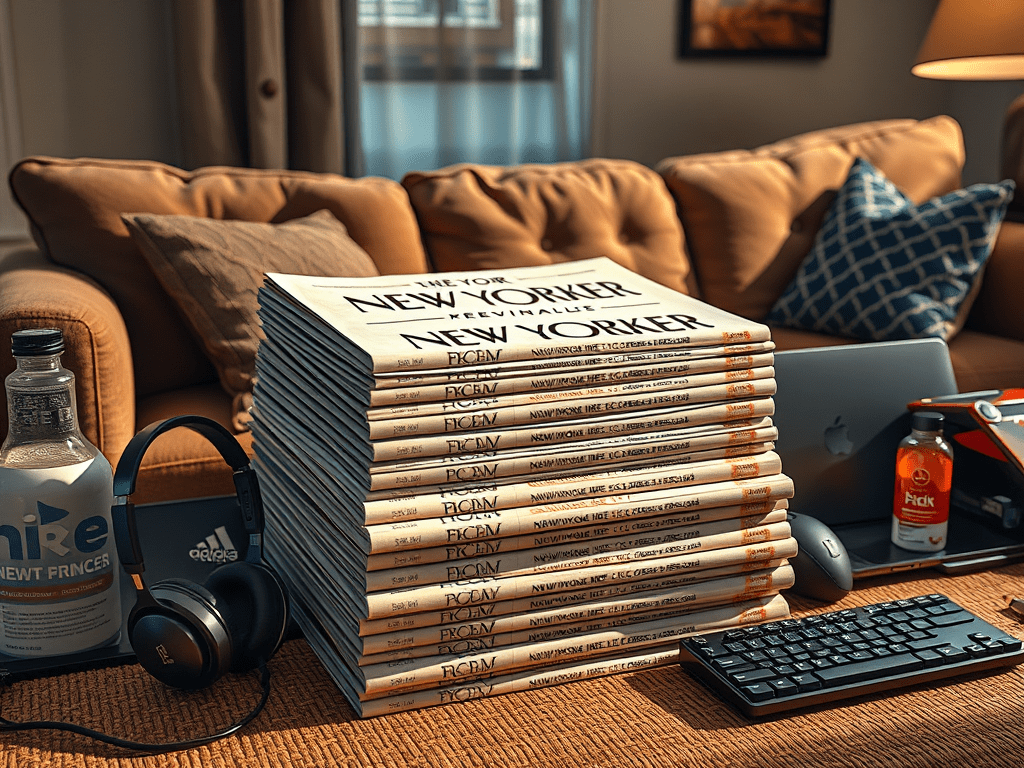
    It’s a charming form of cosplay, really — striding around as a “well-informed citizen” while sinking ungodly hours into consumer research. Watches, radios, headphones, laptops, Chromebooks, mechanical keyboards, high-end sweatshirts, orthopedic luxury sneakers, protein powders, protein bars, athletic-grade water bottles — an entire temple of optimized living, curated with clerical devotion.

    Meanwhile, out in the real world, society is fraying like an ancient flag in a hurricane. Yeats’ prophecy is no longer a chilling warning — it’s a project status update.
    The center isn’t holding. The center left the chat months ago.
    But instead of reckoning with the slow dissolve of civil society, it’s so much easier, so much kinder to the blood pressure, to compare toaster ovens with touchless air fryer settings.

    Yes, yes, I know — one must be informed. George Carlin gave us front-row tickets to the Freak Show. We owe it to the species, or at least to our own dim dignity, to bear witness.
    But honestly? Some days, it feels like sanity demands partial withdrawal. A news podcast here. A curated briefing there. Enough to feign civic engagement at parties without having to call a therapist immediately afterward.

    This brings me to the shrine of guilt at the center of my living room: the great, unread New Yorker stack.
    I have subscribed since 1985, back when Reagan was doing his best kingly impression and nobody had heard of an iPhone.
    The stack now functions less as reading material and more as a kind of grim altar — a silent accusation in glossy print.
    Friends glance at it and nod approvingly, as if my very possession of these magazines implies moral seriousness.
    I let them believe.
    Inside, I know better.
    I know that I am a fallen monk, a heretic of intellectual duty, choosing the velvet lure of consumer escapism over the weighty gospels of sociopolitical collapse.

    I have a diagnosis: New Yorker’s Remorse Syndrome — a condition in which one publicly performs allegiance to Enlightenment values while privately seeking refuge among comparison charts and Amazon star ratings.
    The mind knows what it ought to do.
    The heart, however, prefers shopping for the perfect water bottle while Rome burns quietly in the background.

  • How I Outsmarted the Algorithm and Found a Human Being at Lowe’s

    How I Outsmarted the Algorithm and Found a Human Being at Lowe’s

    Today, I embarked on a noble and deeply aggravating quest: buying a refrigerator.
    I knew exactly which model I wanted — the research was done, the decision made — and I almost bought it online. But Lowe’s website, in its infinite wisdom, offered no civilized scheduling options. Buy today, and you’re rewarded with delivery tomorrow, whether you like it or not. I needed four more days — a minor concession to the gods of logistics, apparently beyond the website’s feeble imagination.

    So I drove to the Lowe’s on Skypark in Torrance, muttering curses at the indignities of modern retail. I marched straight to the Refunds desk, where two clerks stood idle, marooned in a sea of boredom. I said, with the slight guilt of a man about to break protocol, “I know I’m supposed to go to Appliances and hunt down a salesperson, but can you help me?”

    And then — like a choir of angels tuning up in aisle five — one of them smiled and said, “Well, since Appliances is busy, I’ll help you.”
    Her words were a warm poultice slapped onto my stress-riddled soul, the perfect antidote to the week’s ordeal: a refrigerator emergency caused by my seven-year-old Kenmore, which froze over, sneered at my hair dryer attack on its blocked freezer drain, and essentially told me to go pound sand.

    Within ten minutes, the deal was done. I floated out of Lowe’s light as a helium balloon, buoyed by the rarest of modern mercies: competent, unsolicited human kindness.
    Yes, by the time my contractor widens the kitchen doorway to accommodate this new metallic beast, and I pay for the fridge, warranty, and the luxury of hauling my dead Kenmore to appliance hell, I’ll be out two thousand dollars.
    But for a fleeting, golden moment, I remembered that the world, battered as it is, can still be shockingly decent.