Tag: life

  • The Watch That Quietly Took Over Your Life

    The Watch That Quietly Took Over Your Life

    Every so often, a strange coup takes place inside a watch collection. One piece—sometimes a $50 Casio, sometimes a $5,000 Tudor—quietly stages a takeover. It doesn’t announce its intentions. It simply shows up on your wrist one morning… and then the next… and then every day after that. Before long, the rest of the collection sits in the watch box like retired generals, decorated but inactive. Without ceremony, without debate, you’ve acquired a Watch Buddy—the one piece that absorbs nearly all your wrist time and rewrites the rules of your ownership.

    What makes the phenomenon unsettling is that you didn’t go looking for it. This was not your grail, your research obsession, your late-night forum fixation. It just happened. Somewhere between errands, workouts, and ordinary Tuesdays, the watch proved itself comfortable, legible, reliable, emotionally neutral in the best way. You wake up one day and realize you’re living inside the Accidental Grail Effect: a lifelong favorite that earned its status the old-fashioned way—by being easy to live with. No mythology. No prestige theater. Just quiet competence and the absence of friction.

    Curiously, most enthusiasts don’t liquidate the rest of the collection once the hierarchy becomes obvious. The other watches remain in their slots, like supporting actors who make the lead look better simply by standing nearby. Their presence sharpens the contrast. The Watch Buddy doesn’t just win—it wins by comparison, day after day, until its dominance feels less like a choice and more like gravity.

    This is not a honeymoon. Honeymoons are loud, hormonal, and short-lived—social-media enthusiasm followed by the inevitable cooling. The Watch Buddy is something else entirely: a long marriage. The dopamine fades, the novelty disappears, and what remains is habit, trust, and emotional silence. From that point forward, the collector’s behavior changes. The chase slows. The fantasy of the next perfect watch loses voltage. Because once you’ve found the one you actually live in, the rest of the hobby begins to look like what it always was—auditions.

  • Monowatch Asceticism Meets the Skinny Yoga Guy

    Monowatch Asceticism Meets the Skinny Yoga Guy

    As the clock keeps punching holes in the calendar and I drift into the middle distance of my sixties, I’m stalked by the uneasy sense that I am not the man I’m supposed to be. I carry thirty extra pounds like unpaid emotional invoices. I cave to food temptations with embarrassing regularity. I indulge in narcissistic spirals of self-pity. My body bears the archaeological record of a lifetime of weightlifting injuries. Something has to give. The question isn’t whether I’m a complex human being—of course I am—but which single image can give me dignity, courage, and self-possession as I face my obligations, stay engaged with this lunatic world, and fend off entropy. The image that keeps returning, uninvited but insistent, is this: I am the Skinny Yoga Guy.

    The Skinny Yoga Guy eats vegan, clean, and whole, not as a performance but as a quiet discipline. He hits his protein macros with buckwheat, pumpkin seeds, peas, soy, garbanzos, and nutritional yeast, without sulking or negotiating. He cooks plant-based meals anchored in Thai, Mexican, and Indian traditions, not sad beige bowls marketed as “fuel.” He doesn’t snack like a raccoon in a pantry; he sips cucumber water and green tea and moves on with his day.

    He practices yoga six days a week, a full hour each time, sweating without complaint. The body lengthens. The spine straightens. He appears taller, calmer, less compressed by life. There’s a faint health glow—less “Instagram guru,” more “someone whose joints don’t hate him.” The discipline reshapes his temperament. The short fuse and indulgent sulks fade. In their place emerges a man who notices other people, attends to their needs without sermonizing, and discovers—almost accidentally—that service makes him sturdier, not smaller.

    In this revised operating system, the watch obsession quietly dies. No more chunky diver watches as heroic cosplay. No rotation. No drama. Just one watch: the G-Shock GW-5000. The purest G-Shock because it refuses theater. Shockproof, accurate, solar-powered, atomically synced. No Bluetooth, no notifications, no begging for attention. It does one thing relentlessly well: it tells the truth about time. It is reliability without narcissism.

    If the GW-5000 is indestructibility stripped of spectacle, then my assignment is clear: I must become its carbon-based counterpart. Less bloat. Fewer features. More uptime. Yoga becomes joint maintenance. Vegan food becomes corrosion control. No supplements that blink. No gadgets that chirp. No dietary Bluetooth pairing with guilt. Just a lean system designed to absorb impact, recover quickly, and remain accurate. GW-5000 firmware, now awkwardly attempting to run on two legs. Stripped down to one G-Shock, I can enjoy Monowatch Asceticism: the deliberate reduction of a watch collection to a single, purely functional timepiece as an act of identity purification. Ownership shifts from expression to discipline; the watch becomes less an accessory than a vow—proof that the wearer has stepped off the cycle of acquisition and into a life governed by restraint, durability, and quiet competence

    The longing is real. I want to be the Skinny Yoga Guy—disciplined, light, healthy—wearing a single $300 G-Shock as a quiet marker of having stepped off the status treadmill. I no longer want validation from a $7,000 luxury watch. Wanting this man is easy. Becoming him is not. That requires character, not aspiration.

    My hunch is that I need to write my way into him. A novel titled The Skinny Yoga Guy. Not a parody, not a self-help tract, but a chronicle of real-time change rendered with mordant humor and unsparing honesty. The book isn’t the point. Transformation is. The novel would simply be the witness.

    So here I am, a larval creature trapped in my cocoon. I must emerge as a new creature. The challenge is issued. Whether the world is waiting for my metamorphosis is irrelevant. I am. And that, for once, feels like enough.

  • The Dignity Liquidation Cycle: When Buying Feels Good and Selling Feels Necessary

    The Dignity Liquidation Cycle: When Buying Feels Good and Selling Feels Necessary

    If I were brutally honest, I’d admit that over the past twenty years, ninety-five percent of my watch purchases were impulsive. Which means ninety-five percent were evidence of arrested development with a credit card. I sold most of them at a loss—not because I needed the cash, but because I needed my self-respect. This is the Dignity Liquidation Cycle: the ritual of unloading recent purchases at a financial loss to restore psychological balance. The money forfeited becomes a self-administered fine, a tuition payment to the School of Impulse, and a symbolic attempt to reassert control over a mind that briefly wandered off without supervision.

    The harder question is not what I bought, but why I kept buying. My suspicion is cultural. I come from the Me-Generation, raised in 1970s California where desire wasn’t something to question—it was something to honor. Rob Lowe captured the atmosphere perfectly in Stories I Only Tell My Friends: the Counterculture as the Worship of the Self. Whatever the Self wants, the Self gets. No brakes. No compass. In Malibu’s sunlit dreamscape, people overdosed on pleasure, vanished into excess, and confused appetite with identity. When desire becomes sacred, reality becomes negotiable—and the bill eventually arrives.

    That wiring never quite left me. When I see a watch that speaks to me, my brain lights up like I’ve taken a controlled substance without the prescription. The surge is immediate and physical. Then comes the anger—not at the price, but at the loss of command. What does self-belief even mean if a rotating bezel can override your judgment? How do you grow into adulthood if your emotional economy still runs on the logic of a sixteen-year-old with access to a catalog?

    I don’t want rehab. I don’t want a hobby that has to be locked in a drawer for my own safety. I want a watch life that fits inside reality instead of pulling me out of it. Pleasure without compulsion. Enjoyment without drama. A collection that reflects judgment rather than appetite. In other words, I want the hobby to behave like an adult, even if the hobbyist occasionally does not.

    And here’s the punchline: even diagnosing the Me-Generation triggers nostalgia for being sixteen in Southern California in 1976, when the future felt endless and impulse felt like freedom. The danger is looking back too long. That way lies Lot’s wife, calcified in longing. So I change the channel. I close the YouTube reviews. Because the distance between “research” and “purchase” is about three videos—and I’ve learned the hard way that impulse has a very convincing voice when it sounds like happiness.

  • Mortality Attenuation: When the Hobby Survives but the Hunger Fades

    Mortality Attenuation: When the Hobby Survives but the Hunger Fades

    I’ve made more real friendships online over watches than I ever expected—full-grown adults bonding over bezel action, dial texture, and the shared conviction that the perfect collection is exactly one purchase away. It’s a peculiar fraternity: half hobby, half recovery meeting. We compare scars from impulse buys and premature flips. We confess, we relapse, we congratulate one another on restraint that lasts roughly twelve days. Then someone posts a new release, and the room goes quiet. We nod, knowingly. Maybe this time we’re cured, we say—the way a gambler says he’s just there for the buffet.

    My own delirium began in 2005, when I was forty-three and certain that mechanical watches were not merely instruments but therapeutic devices—tiny machines capable of repairing the larger, less cooperative machinery inside me. Twenty years disappeared in a blur of rotating bezels, “exit watches,” and divers purchased for hypothetical adventures that never rose above grading papers. The obsession didn’t feel excessive. It felt like maintenance.

    Then, at sixty-three, something shifted. Mortality didn’t shout; it tapped me lightly on the shoulder, like a polite but persistent waiter. The hobby didn’t vanish. The flame still burns. But the heat changed. The urgency drained away. After two decades of acquisition, a quiet truth settled in: no matter how precise the watch, it was still losing the only race that mattered.

    The sensation reminds me of a scene from Battlestar Galactica: a traitor is sealed behind glass, pleading as the airlock hisses and the crew looks on, solemn and unmovable. A ritual exile. That’s what aging feels like–not tragedy, not humiliation. Just the slow recognition that you’ve crossed into a different atmosphere. Those still inside the warm illusion of endless tomorrows don’t push you away. They simply drift forward without you.

    The pane lowers gently. You tap it, wave, even smile, but the cockpit of youthful urgency is sealed. No reentry. What remains is quieter work: dignity over display, usefulness over accumulation, meaning over inventory. You stop building collections and start building perspective. You become less of a buyer and more of a witness.

    This is the Mortality Attenuation Phase: the gradual reduction of acquisition fever as the finite horizon comes into view. The obsession doesn’t die. It simply loses its panic. The watches remain. The urgency does not. Objects can mark time. They cannot bargain with it.

  • When Wrist Presence Dies and Play Takes Over

    When Wrist Presence Dies and Play Takes Over

    In my early forties, I was intoxicated by wrist presence. I wanted watches so large they could signal low-flying aircraft. The bigger the case, the smaller my sense of self. These weren’t timepieces; they were emergency beacons for a man negotiating a quiet identity crisis. I wasn’t checking the time. I was broadcasting relevance.

    My vanity, however, was narrowly focused. I didn’t need a luxury car or a curated wardrobe. A sensible Honda Accord, a pair of jeans, a T-shirt, and a reasonably functional body were enough. The watch did the heavy lifting. It carried the narrative, the authority, the illusion of significance. For twenty years, this arrangement felt efficient: a minimalist life wrapped around a maximalist ego.

    Then, sometime in my sixty-third year, the chemistry changed. The thrill soured. The signature piece that once delivered a dopamine surge now felt like an old campaign slogan from a war already lost. I had entered what can only be called Vanity Burnout—the moment when the performance loop collapses and status objects lose their voltage. The competitive theater of self-presentation gives way to something quieter, less theatrical, and far more honest.

    I still love my divers. But the relationship has changed. They no longer feel like conquests. They feel like companions. The manic gleam is gone, and no amount of Instagram flexing or YouTube rumination will bring it back. The truth is blunt: every ticking second is a small reminder that the clock is not decorative. Time—the final minimalist—has stripped away the illusion of permanence and replaced it with perspective.

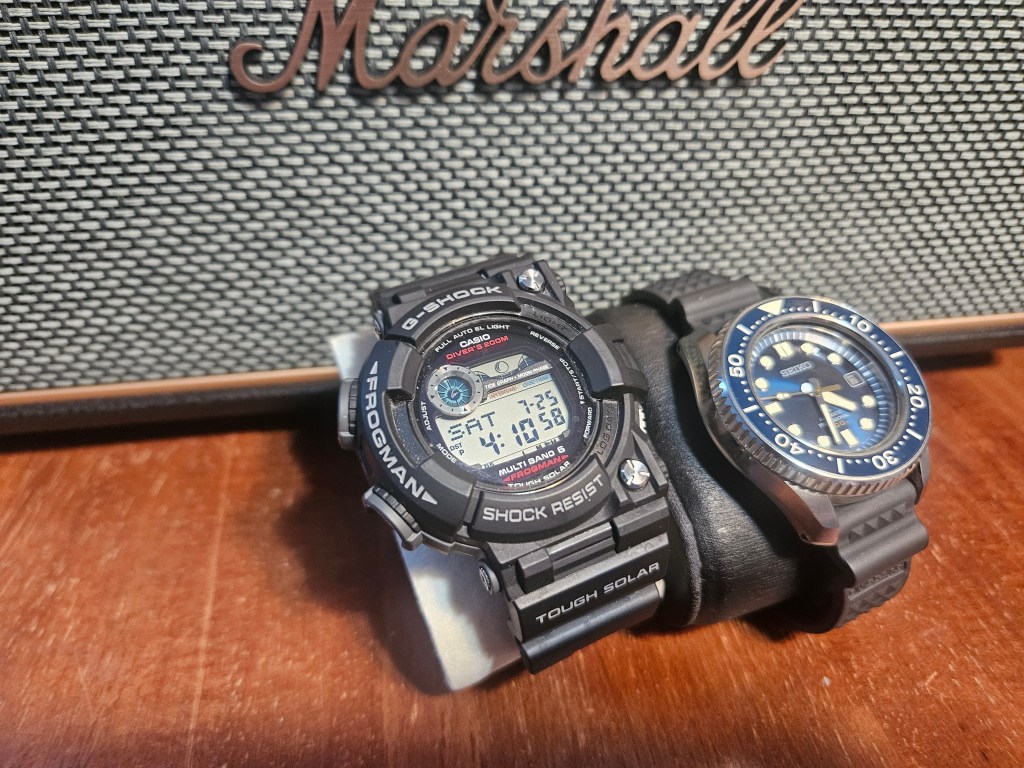
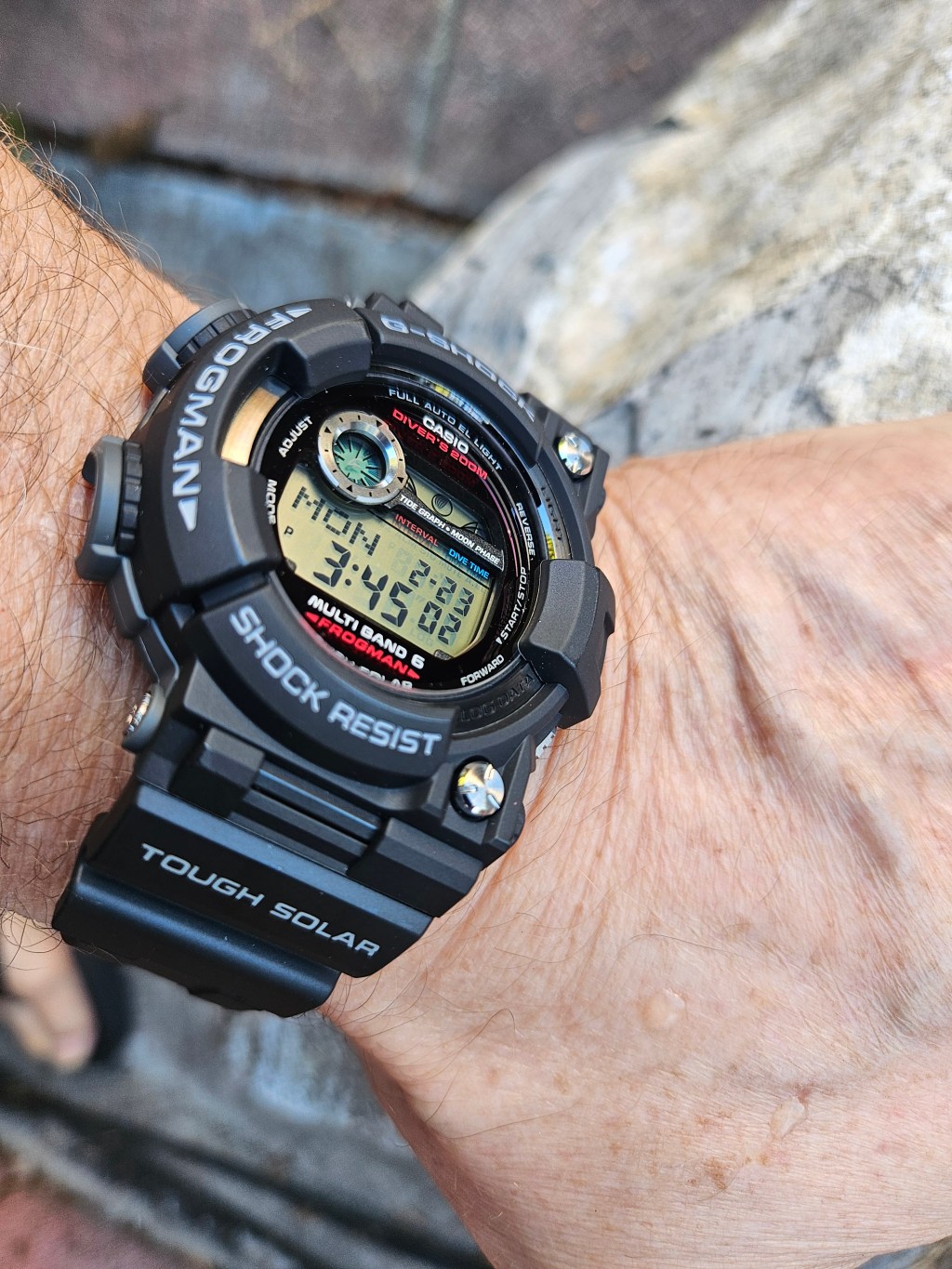
    And yet, in about a week, a G-Shock Frogman will arrive from Japan.

    It is enormous. It is loud. It borders on cosplay. By any rational standard, it contradicts everything I’ve just said.

    But this is not a relapse into status anxiety. Something else is happening. When the need to impress dissolves, the wrist becomes a private stage. The watch is no longer a signal to the world; it’s a toy for the soul. Certain territories remain protected—ritual, hobby, the small theater of personal delight.

    The vanity has burned off.

    The play instinct has not.

    And when I strap on that absurd, tactical Frogman, I won’t be announcing anything to anyone.

    I’ll just be smiling.

  • Beware of the Appetizer Watch

    Beware of the Appetizer Watch

    A week ago, you ordered a G-Shock Frogman from Sakura Watches in Japan. Five hundred dollars of stainless steel caseback confidence and amphibious authority. It hasn’t shipped. It hasn’t moved. It may not even be awake yet. And already you’re pacing like a father in a maternity ward.

    This is when the mind proposes a solution—reasonable, economical, almost virtuous. Why not a small interim purchase? Something modest. Something practical. Enter the Rangeman. Two hundred dollars. Which, compared to five hundred, is practically free. In fact, you’d be irresponsible not to buy it. You need something to wear. Something to distract you. Something to manage the emotional volatility of waiting.

    You have now encountered the Appetizer Watch: the elegant fiction that a secondary purchase is a financial non-event simply because a larger purchase already exists. The math is creative, the tone is prudent, and the outcome is predictable. Compulsion, dressed in the language of thrift.

    But then a harsher voice cuts through the negotiation. If you need a consolation prize while you wait, you are not a collector. You are a child in a checkout line demanding gum. You don’t want to greet your Frogman as a man who held the line. You want the hero’s entrance, not the emotional equivalent of, “I couldn’t wait, so I bought a snack.”

    Because you understand something deeper: if you numb the waiting, you weaken the arrival. This is the Anticipation Dilution Effect—the emotional law of acquisition. The longer the buildup, the sharper the impact. Buy a Rangeman now, and the Frogman lands with a shrug instead of a thunderclap. You didn’t wait for the moment. You softened it.

    So you wait. You refresh the shipping page. You rehearse the wrist shot in your mind. And somewhere inside, you see him—the impatient little creature banging a plastic spoon against the inside of your skull, demanding immediate gratification.

    Once you see that inner infant, you can’t unsee him. He lives there now. Not defeated. Not reformed. Just exposed—your permanent reminder that beneath the language of discipline and discernment sits a toddler with Wi-Fi and a credit card.

  • Every Watch Obsessive Has an Origin Story

    Every Watch Obsessive Has an Origin Story

    Every watch obsessive has a Watch Origin Story. It doesn’t matter whether the story is accurate, exaggerated, or stitched together from selective memory. What matters is that it explains everything. It gives the madness a beginning, a cause, a moment when fate tapped you on the shoulder and said, This is who you are now.

    The story functions as psychological ballast. Instead of admitting that the obsession grew slowly—from curiosity to habit to compulsion—the collector points to a single event: a grandfather’s heirloom, a childhood Casio, a promotion gift. A messy accumulation of impulses becomes a clean narrative arc. The hobby feels chosen, even destined, rather than accidental. That is the power of the Watch Origin Story: not historical accuracy, but emotional stability. It anchors the collector to a version of reality that makes the obsession feel meaningful instead of absurd.

    My own origin story began not with romance, but with humiliation.

    Years ago, I lost my classroom key at a university. This was not treated as a minor inconvenience. It was treated as a character defect.

    I was summoned before an administrator whose expression suggested I had been caught plagiarizing Aristotle. She informed me—slowly, ceremonially—that the one thing a college instructor does not do is lose his key. Her eyes moved over me the way airport security studies a suitcase that hums. My carelessness, she implied, had finally exposed my true nature: a professional lightweight, a man one misplaced stapler away from total institutional collapse.

    When the character autopsy concluded, I asked how one replaces a lost key.

    “You don’t just get a replacement,” she said. “It’s a process.”

    The word process fell like a prison door.

    I was instructed to drive to a remote facility on the outer rim of campus known only as Plant-Ops. There I would locate a locksmith. I would give him my personal information and twenty dollars in cash. No check. No receipt. The arrangement sounded less like facilities management and more like a controlled exchange of classified documents.

    “How will I know who he is?” I asked.

    “You’ll know him,” she said. “He’s the only person there.”

    Dismissed and morally diminished, I began the journey.

    The pavement gave way to dirt, then rubble, then a surface best described as geological suggestion. My car rattled through a landscape of sun-bleached debris and slow-moving tumbleweeds. Buzzards circled with professional interest. Without a watch, I had no sense of time, direction, or civilization. I was no longer in Southern California. I had entered a pocket dimension where entropy was the dominant administrative philosophy.

    At last, I reached Plant-Ops: a collapsing metal hangar that appeared to be losing its structural will to live.

    Inside stood the locksmith.

    He was small, skeletal, and deeply offended by my existence. Grease-stained apron. Glasses. A mustache clinging to his face like a final act of resistance. He glared at me while eating cold SpaghettiOs straight from the can, as if my arrival had interrupted a carefully scheduled moment of despair.

    I apologized for losing the key. I apologized for arriving. I apologized, indirectly, for modern society.

    He demanded twenty dollars in cash—up front—cut the key, and then leaned close to deliver a warning: he was retiring soon. His replacement, he said, was an idiot who could not make a proper key.

    I believed him.

    I fled.

    And on the drive back, a realization settled over me: life is unpredictable, systems fail, competence is fragile, and the world contains entire zones where time, direction, and institutional mercy disappear.

    I drove straight to a watch store and bought a G-Shock Rangeman.

    Compass. Altimeter. Barometer. Thermometer. Solar power. Tactical readiness.

    Because the next time I entered the Plant-Ops Zone, I intended to know exactly where I was—and how long I had left.

    That was the day I stopped wearing a watch.

    And started wearing equipment.

  • The Illusion of Variety: Why All My Watches Look the Same

    The Illusion of Variety: Why All My Watches Look the Same

    My wife looks at my watch box and delivers her verdict with the efficiency of a forensic accountant: they’re all the same. Dark dials. Rotating bezels. Nuclear lume. Rubber straps. To her, I don’t own a collection—I own nine copies of the same idea. A redundancy with slightly different logos.

    I protest, of course. This one has a warmer dial tone. That one wears thinner. The other has superior bezel action and lume that could guide aircraft at night. To me, each piece has a personality, a purpose, a place in the rotation. But the uncomfortable truth remains: they are all divers. I am not merely a watch enthusiast. I am a subtype addict. Once the diver aesthetic locked onto my brain, every future desire began passing through that single filter.

    The roots of this pathology go back to childhood, where my mother enabled my early training in the Illusion of Variety. My diet revolved around Cap’n Crunch in all its alleged diversity: plain, Crunch Berries, Peanut Butter, plus the rebranded cousins—Quisp, Quake, King Vitamin—each promising novelty while delivering the same sugar-coated destiny. I approached these cereals with the seriousness of a sommelier comparing vintages, convinced I was exploring nuance while eating the same bowl under different costumes. It was freedom without risk, choice without change. A sugary Groundhog Day.

    Looking back, the pattern is obvious. I didn’t want options; I wanted reassurance disguised as options. Real variety carries danger—the possibility of regret, mismatch, or disappointment. Sameness offers safety. Familiar shapes, familiar flavors, familiar outcomes. Bliss with guardrails.

    That same psychology now lives in my watch box. Different brands, different cases, different shades of black—but always the same architecture, the same toolish language, the same emotional terrain. To outsiders, monotony. To me, refinement.

    This is the Category Fixation Loop: the moment a collector discovers the one design language that feels right and thereafter interprets every new desire through that narrow lens. The hobby doesn’t expand; it tunnels. Each purchase feels like exploration, but the geography never changes.

    On one level, my watches are identical. On another, they are infinitely different. The contradiction is the point. Variety, safely contained inside sameness—the Cap’n Crunch strategy, now rated to 200 meters.

  • When the World Updates Without You: The Quiet Power of Mechanical Time

    When the World Updates Without You: The Quiet Power of Mechanical Time

    No one warned me, but I should have seen it coming: creeping toward your mid-sixties is less a rite of passage than a crisis of competence. Or, to be precise, it’s a progressive misalignment with the modern world. You drop references to Danish Go-Rounds, Screaming Yellow Zonkers, Tooter Turtle, Super Chicken, and All in the Family and watch blank faces stare back at you. You still assume that appliances are built with the sturdiness of yesteryear, only to find that today’s models disintegrate if you breathe on them sideways. This misalignment breeds a special kind of incompetence—egregious, preventable, humiliating.

    You can swallow vats of triglyceride omega-3 fish oil, but the short-term memory still slips away without mercy. You forget where you parked your socks (on the couch), that you meant to watch the final episode of that crime docuseries on Netflix, that a Costco-sized case of 12-gallon trash bags lurks in the garage, or that you already ground tomorrow’s coffee beans. The indignities pile up like unopened mail.

    These lapses, coupled with your fossilized references to extinct foods and beloved TV shows, render you a creature out of phase with the universe—an alien with wrinkles, blinking in confusion, flashing your unearned senior discount at the box office like it’s a badge of relevance.

    You can flex all you want against this verdict. Wolf down 200 grams of protein daily, clang kettlebells in the garage, and polish yourself into the semblance of a beaming bodybuilder who could pass for forty-four instead of sixty-four. But that delusion ends the second you get behind the wheel at night. Your depth perception is a cruel joke. The glare of headlights and streetlamps slices into your worn irises like laser beams, reminding you that biology—not discipline—is running the show.

    Like it or not, you’re aging in real time, a public spectacle of decline, the unwelcome prophet of mortality who shatters the younger generation’s illusion that time is indefinite. To them, you are as pleasant a presence as a neighbor’s dog barking at a squirrel at six a.m.—loud, unnecessary, and impossible to ignore.

    Congratulations–you’ve become the world’s unwanted alarm clock.

    But all is not lost. You have your watches. While the larger world moves faster than your reflexes and updates itself without your consent, the watch box waits patiently, offering a language you still speak fluently. You wind the crown. You change a strap. You turn the bezel and count the clicks like a monk fingering prayer beads. No notifications. No software patches. No judgment.

    This is Therapeutic Realignment: the quiet restoration that occurs when a man drifting out of phase with modern life anchors himself in a domain he can still master. Mechanical watches obey touch, attention, and ritual. Set the time and the movement responds. Rotate the collection and the day acquires structure. Flip the caseback toward the light and there it is—a small, disciplined universe of gears and springs, working without complaint, without irony, without asking you to download anything.

    These tactile routines create a sanctuary of competence in a world that increasingly makes you feel like a beta tester for your own existence. Where memory falters, the ritual holds. Where technology alienates, mechanics reassures. In this ecosystem, time stops behaving like a predator and becomes a companion. You move, if only briefly, from obsolescence to equilibrium. You are no longer behind. You are simply keeping time.

    Which is why the watch hobby is never just a hobby. It is a romance with mechanized time—a private jurisdiction where order still answers to your hand. While the young glance at their phones and treat time as a background utility, you study the slow sweep of a seconds hand or the living heartbeat inside your Grand Seiko. Through the sapphire caseback, time is no longer something slipping away. It is something alive, something contained, something you can hold steady—your own small sphere of Sacred Time in a loud and impatient world.

  • When Bold Becomes Desperate: The Toxic Green Frogman I Didn’t Buy

    When Bold Becomes Desperate: The Toxic Green Frogman I Didn’t Buy

    The limited-edition G-Shock Frogman GW-8200TPF-1 is called the “Three-Striped Poison Dart Frog,” a name that tells you everything you need to know. Its case and bezel are streaked in oily black and radioactive neon green, a visual homage to the rainforest amphibians whose skin carries enough toxin to tip a hunting arrow. The watch doesn’t whisper. It hisses. It looks less like a timepiece and more like something that escaped from a biohazard lab. And I have to admit: I could see it on my wrist.

    Which is precisely the problem.

    I am sixty-four years old. This watch belongs on the arm of a young man who still believes the world is a stage and he is the headliner. On me, it risks reading like a cautionary tale. I picture myself as the suburban retiree on a zebra-striped Harley, shirtless under a leather vest, ponytail fluttering, ears weighed down with fishing-lure jewelry. Not rebellion—neediness. Not confidence—pleading. In this light, the Poison Dart becomes what I now recognize as a Final Cry Watch: the late-career purchase meant to shout, I’m still dangerous, when the quieter truth is that one is negotiating a truce with time.

    And yet the attraction persists. That’s the uncomfortable part. Awareness does not cancel desire; it merely narrates it. A part of me even welcomes the idea of restraint—the sedation that comes from declining the spectacle, choosing dignity over fluorescent self-advertisement.

    In the end, what saved me was not wisdom but suspicion. That dramatic spray coating—how long before it fades, chips, or peels? And when the neon begins to die, what remains? Not a bold statement. Not a heroic relic. An Insult Watch—a once-loud object aging badly, like a midlife impulse left out in the sun.

    So the purchase died where many impulses should: in the quiet courtroom of anticipated regret. The Poison Dart remains what it probably was all along—not destiny, not transformation, just a bright, dangerous flirtation with caprice.