Tag: mental-health

  • Hawaiian Vacations Are About Stepping Outside the Clock and Cheating Death

    Hawaiian Vacations Are About Stepping Outside the Clock and Cheating Death

    Spend a week with your family in Hawaii and you slip into a parallel time zone—one that ignores clocks altogether.

    It starts the moment you survive five airborne hours in a 400-million-dollar jet. You land feeling like Superman, minus the cape and plus a mild dehydration headache. Within 24 hours, you’re barefoot, in swim trunks, marinating in mai tais, spooning loco moco into your face, and demolishing lilikoi pies. The weather is so perfect it feels like it was made to flatter you personally. Sunsets become private screenings. You have no deadlines, no alarms, no reason to measure the day except by the height of the tide or the level in your glass.

    In this dimension, you’re not just on vacation—you’ve stepped outside of time. And outside of time means outside of death. Some corner of your brain starts whispering that you’re untouchable. Immortal.

    That’s when the trouble starts.

    The thought of getting back on a plane becomes revolting. It’s not just leaving Hawaii—it’s leaving Sacred Time and returning to Profane Time. Back to the grind where schedules nag and mortality hides in every bathroom mirror.

    Even after you land at home, you’re not really home. You’re in a kind of sun-drunk denial, still hearing the ocean in your ears while the neighbor’s leaf blower whines outside. The older you get, the worse the hangover—because you know the clock is running, and the illusion of timelessness is an intoxicant more potent than any cocktail with a paper umbrella.

    And then it’s over. You reenter the machine. Days are counted in emails, not waves. The tan fades, and with it the fantasy that you’ve cheated the countdown. That’s the real brutality of reentry—not the weather, but the eviction notice from the one place that convinced you, however briefly, that you could live forever.

    So yes, I’m already searching for Big Island resorts. It’s not wanderlust—it’s a hunt for my next fix of immortality. And I know the danger. One day I might just stay.

  • Trees Bent by the Wind

    Trees Bent by the Wind

    In An Abbreviated Life, Ariel Leve recounts the shadow her mother cast across her existence—a narcissistic, volatile presence who trailed her daughter across continents. Her mother blurred boundaries, confiding adult affairs, romantic escapades, and private fantasies to her child, then lacing those disclosures with guilt trips and psychological sabotage.

    At eleven, Ariel was told she was going blind—a lie without evidence, a mix of cruelty and madness. This was not an isolated cruelty but the common cadence of her mother’s speech. At six, Ariel’s caretaker, Kiki, died of a stroke mid-flight, with Ariel in the cabin. Ariel stopped speaking for six months; a psychiatrist prescribed Valium.

    Her mother, often wearing a nightgown even to school functions, could deliver barbed declarations without breaking her routine. “When I’m dead, you’ll be all alone because your father doesn’t want you,” she told her young daughter, pausing only to reapply makeup. “Just remember that and treat me nicely.”

    Her father, in Bangkok, refused to take her in. Ariel lived in grief that he wouldn’t rescue her from the chaos. Decades later, a therapist told her that growing up with such a mother caused neurological damage—her brain, shaped by constant stress, had developed like a tree twisted by relentless wind. Trauma was not a lightning strike; it was climate. The result: a life stripped of adventure, self-acceptance, and trust. Ariel’s default mode became hypervigilance and retreat.

    Her partner, Mario, an Italian with no literary ambitions, no awareness of New York publishing, and no taste for bagels, embodies the opposite—balanced, unselfconscious, open to life. He steadies her, if only temporarily.

    In one conversation, her father asked if she could let go of the past. Could she destroy her demons? Ariel was unsure. A novelist told her discipline could harden one’s “emotional arteries,” making childhood wounds less decisive. Ariel countered: some are “front-loaded with trauma,” not victims but soldiers—scarred, but still standing.

    Neuroscientist Martin Teicher affirmed her point: childhood abuse alters brain wiring. Adaptive coping mechanisms in childhood turn maladaptive in adulthood, creating an adult mismatched to their world. The traumatized blunt emotion not with a scalpel, but a sledgehammer—shielding themselves from joy as well as pain.

    For Ariel, this explains a life “within brackets.” She sees herself in the patterns Janet Woititz described in Adult Children of Alcoholics: mistrust, emotional volatility, self-loathing, and a skewed sense of normalcy.

    Her chosen remedy: EMDR therapy for PTSD. Nine months of “the light saber”—eyes tracking a green light, headphones delivering sound, memories replayed until they lose their grip. Sessions leave her exhausted. There is progress, measured in patience with Mario’s daughters, in small openings toward joy. But she does not present herself as cured—only as a permanent convalescent.

    Her memoir probes the ethics of trauma. How accountable are the wounded for maladaptive behavior? Can faith or philosophy save them, or does failure deepen self-blame? Are they sinners, soldiers, or something in between?

    Leve’s life raises a tension between two extremes: the nihilist’s surrender—“nothing can be done, so I’ll live recklessly”—and the motivational credo—“discipline and positivity conquer all.” The truth lies somewhere in the messy middle.

  • Return to the Womb

    Return to the Womb

    I’m three months shy of turning sixty-four, which means I’m old enough to know better and still young enough to entertain delusions. This is a warning to the under-sixties: prepare yourselves. At some point in your late fifties, strange desires start slithering into your psyche like vines through the cracks of a neglected greenhouse. With every new creak of the knees and fresh batch of funeral notices, a part of you will yearn for what I call the Return to the Womb.

    No, not literally—though if you could slide back into a warm amniotic bath and unplug the Wi-Fi, you just might. I’m talking about a psychological regression: the desperate, half-sane longing to be swaddled in tropical heat, to dissolve into mango-scented breezes, and to vanish into a seaside stupor under a drizzle that feels vaguely divine. The dream? To marinate in comfort, far from the cacophony of deadlines and dental appointments, in a climate designed by God for the perpetually tired.

    I was born in Gainesville, Florida in 1961, and to this day I remember the fetid perfume of alligator swamps—a heady, sulfuric funk that now strikes me as oddly comforting. Like Vicks VapoRub for the soul. Is it any surprise that I scroll Zillow listings for barrier islands in South Carolina, Georgian marshlands, and steamy Floridian enclaves? I’m not looking for a home. I’m looking for a feeling—a fetal, lizard-brained feeling that I’ve convinced myself might still be hiding in the heat.

    But here’s the rub: I don’t trust this impulse. This Return to the Womb isn’t a noble call to simplicity. It’s a siren song, crooned by the dark twin of the Life Force—the same demon that tells you to skip your workout, order DoorDash, and stream ten hours of King of the Hill in a comfort-food trance. It whispers of paradise, but it’s peddling paralysis. It’s not vitality. It’s a prelude to decay, dressed in Tommy Bahama and sipping a piña colada.

    Writers like Steven Pressfield and Phil Stutz have been wise to this force for years. Pressfield calls it the Resistance. Stutz names it Part X. Adam Smith, bless his powdered wig, simply called it the need for “self-command”—the daily decision to wrest meaning from entropy, to choose virtue over sloth, action over inertia.

    During the pandemic lockdown, I got a taste of this regression. Sitting masked in my accountant’s office in February 2021, she asked if I was thinking of retirement. Was I thinking of it? Lady, I was living it—in pajamas, in slow motion, surfing real estate listings for stilt houses on Key Biscayne while sipping overpriced Nespresso and pretending buckwheat groats were the secret to immortality. My body had synchronized with the rhythm of a hot tub. I wanted nothing more than to stay submerged.

    Four years later, I still want it. I still want the warm drizzle, the midnight ocean swims, the faint smell of coconuts mingled with chlorine and sea rot. And yet—I know. I know. I know that the moment I submit to this dream of endless hammock-lounging is the moment the soul begins to curdle.

    Phil Stutz, in Lessons for Living, writes about Father Time as a pitiless, judgmental figure—not the kindly old man of greeting cards, but a stern cosmic accountant. He doesn’t care how many steps you walked or how clean your macros were. He wants to know: Did you spend your time on Earth doing something that mattered?

    As someone who’s worshipped at the altar of diver watches for two decades, who has pondered the geometry of bezels and the metaphysics of lume, I took this personally. Time is not just money. Time is judgment. Time is an indictment.

    And the Return to the Womb? It’s a slow lobotomy in paradise. It’s “brain rot” dressed as a beach vacation. It’s the comforting lie that you’ve earned an escape from purpose. But the truth is, the older I get, the stronger this impulse grows. And that, frankly, terrifies me.

    Still—and here’s the kicker—as I type this, I want it. I want the coconuts. I want the warm rain. I want the mangoes. I want the beach walks at twilight where nothing hurts and no one needs anything from me.

    We are mad creatures, aren’t we? Our intellect sees the trap. Our soul feels the pull. And some part of us, no matter how wise or weathered, still wants to disappear into the dream.

  • The Voice of Glum: Watch Addiction, Loudermilk, and the Daily Battle Within

    The Voice of Glum: Watch Addiction, Loudermilk, and the Daily Battle Within

    The TV show Loudermilk is part sitcom, part group therapy, and part existential smackdown. Ron Livingston plays Sam Loudermilk, a grizzled music critic and recovering alcoholic with the face of a hungover basset hound and the social graces of a man allergic to kindness. He barrels through life offending everyone within a five-foot radius, insulting his fellow addicts with toxic flair. But beneath the wreckage lies a strange tenderness—a story not just about addiction, but about people trying to survive themselves.

    Loudermilk lives in a halfway house with a cast of human tire fires, and the comedy burns hot: irreverent, profane, and deeply affectionate. The show loves its damaged characters even as it roasts them alive. Naturally, I love Loudermilk. Love it like a convert. I’ve become a low-key evangelist, promoting it to anyone within earshot—including the assistant at my local watch shop.

    This isn’t just any watch shop. I’ve been going there for 25 years. The Owner and the Assistant know me well—well enough to have witnessed the slow, expensive progression of my watch addiction, including the day I came in twice because the first bracelet adjustment “didn’t feel quite right.” It’s my barbershop. My confessional. My dopamine dispensary.

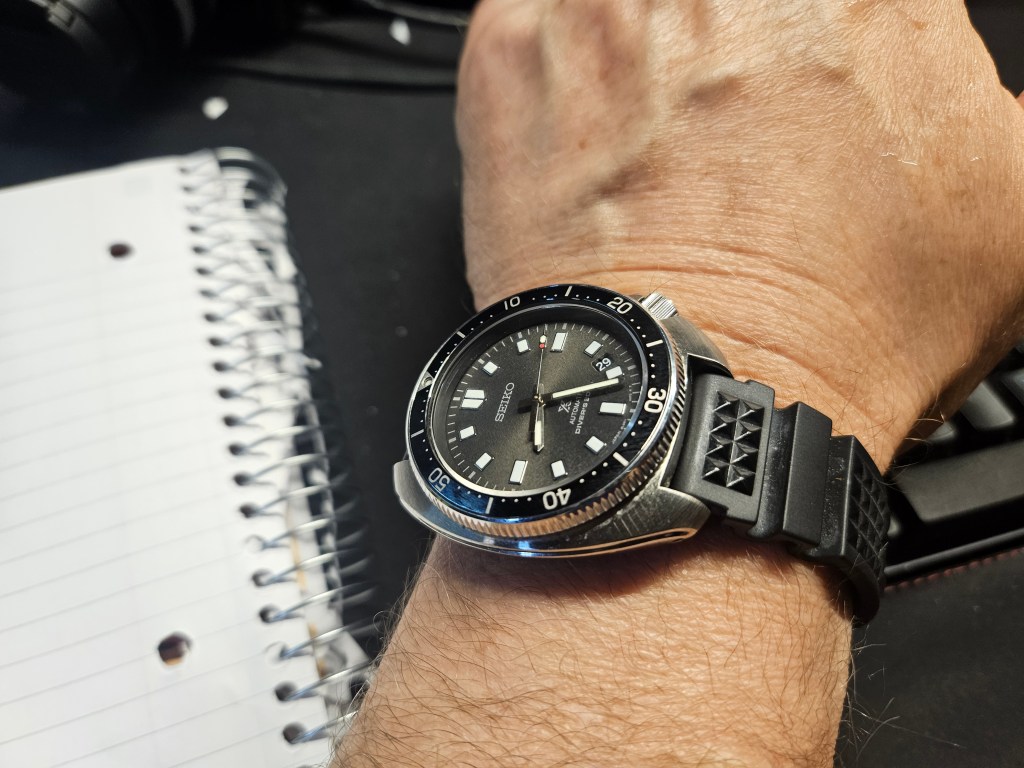
    So one afternoon, I’m there getting a link removed from my Seiko diver and I bring up Loudermilk. I describe the show’s gallery of screwups—addicts clawing toward redemption by way of insults, setbacks, and semi-functional group hugs. The Assistant looks up from his tools and tells me something personal. He watches Loudermilk too. And he gets it. He’s thirteen days sober and goes to five meetings every morning—not because he’s a morning person. He tells me that in his culture, drinking into one’s eighties is just called “living.” But for him, it was a slow-motion self-immolation. Now, he’s trying to claw his way back.

    Before I can respond, a woman with a chihuahua tucked under her arm chimes in from across the shop. She too is a Loudermilk fan. “What a shame it got canceled after three seasons,” she laments. The Assistant counters—there’s still hope for a revival. They argue lightly, both fully engaged, two strangers momentarily bonded over their shared love of a comedy about pain.

    I say goodbye and step out of the store. That’s when it hits me.

    I love Loudermilk because I see myself in it. I am an addict. Not just of watches, but of distraction, validation, control—whatever lets me delay the moment when I must confront the snarling voice inside me.

    Writers like Steven Pressfield and Phil Stutz describe this inner saboteur with chilling clarity. Pressfield calls it Resistance, the destructive force that undermines your better self. Stutz names it Part X, the anti-you that wants you to abandon meaning and pursue comfort. Both insist the enemy must be fought daily.

    And I know that voice. It’s lived in my head for decades.

    Once, at an English Department Christmas party, a colleague called me “Captain Comedown.” I don’t remember what I said to earn the nickname, but it tracks. I’ve got that bleak edge, the voice that sees futility everywhere and calls it wisdom. But a better name than Captain Comedown comes from my childhood: Glum, the joyless little pessimist from The Adventures of Gulliver, whose go-to phrase was: “It will never work. We’ll never make it. We’re doomed.”

    That’s my inner monologue. That’s my Resistance. That’s my Glum.

    Every day I wrestle him. He tells me not to bother, not to try, not to hope. That joy is a scam and effort is for suckers. And some days, I believe him. Other days, I don’t. But the battle is constant. It doesn’t end. As Pressfield says, the dragon regenerates. My job is to keep swinging the sword.

    And maybe, just maybe, buying a new watch is my way of telling Glum to shut up. It’s a shiny, ticking middle finger to despair. A symbolic declaration: The world still contains wonder. And precision. And brushed stainless steel.

    But there must be cheaper ways to silence Glum. A walk. A song. A friend. A laugh. Even a half-hour with Loudermilk.

    Because, irony of ironies, what addicts like me really want isn’t the next hit. It’s relief from the craving.

  • The Dopamine Dial: Why Your Grail Watch Can’t Make You Happy

    The Dopamine Dial: Why Your Grail Watch Can’t Make You Happy

    To understand the madness of the modern watch addict, you’d do well to consult Dopamine Nation by Stanford psychiatrist Anna Lembke, a book that should be shelved somewhere between philosophy, neuroscience, and quiet screaming. Her central thesis? In an age of relentless indulgence, the line between pleasure and pain is not only blurry—it’s the same neurological pathway. You’re not escaping pain with your latest acquisition. You’re feeding it.

    “The smartphone,” she writes, “is the modern-day hypodermic needle.” And the drug? Dopamine—delivered in neat little parcels: TikToks, tweets, memes, and yes, wrist shots of watches you don’t own (yet). If you haven’t met your poison of choice, don’t worry. It’s just a click away.

    Lembke makes the uncomfortable truth clear: The more dopamine hits we seek, the more our brain adapts by reducing our baseline pleasure response. What once thrilled you—your grail watch, your Rolex Explorer, your Seiko with the Wabi-Sabi patina—now barely registers. You’re not chasing pleasure anymore. You’re just trying to feel something.

    Watch addicts, of course, understand this intimately. The pursuit of horological perfection starts out innocent enough: a G-Shock here, a vintage diver there. But soon you’re tumbling into the abyss of boutique limited editions and message board enablement, haunted by the need to stay relevant. Because here’s the twist: It’s not just about the watches. It’s about being seen. You post, you review, you flex because if you stop, you vanish. No new watches = no new content = digital extinction.

    And extinction, in a social-media world, feels like death.

    Lembke warns us that addiction thrives in secrecy, in the exhausting double life. The watch addict may present as a tasteful minimalist to family and friends, while secretly rotating 19 watches, five straps deep, waiting for the next “drop.” The addiction is fed by access, and we live in an access economy. New releases are no longer annual events—they’re hourly temptations. The vortex is bottomless. The supply creates the demand.

    Even worse, modern society normalizes this behavior. Everyone is scrolling. Everyone is upgrading. Our addiction to novelty is passed off as taste. Our frenzied consumption masquerades as identity. Lembke borrows from Philip Rieff to explain the deeper shift: “Religious man was born to be saved; psychological man is born to be pleased.” The modern watch collector doesn’t believe in salvation. He believes in configuration.

    But here’s the cruel irony: The more you seek to be pleased, the less capable you are of being pleased. In Lembke’s words: “Hedonism, the pursuit of pleasure for its own sake, leads to anhedonia—the inability to enjoy pleasure of any kind.”

    What’s the solution? A dopamine fast. Lembke prescribes it like a bitter medicine: Remove the source. Reset the brain. Let it reestablish homeostasis. For the watch addict, this means one thing: a watch fast.

    And yes—it’s brutal. I’ve been a watch obsessive for over twenty years. My longest fast? Six months. And I nearly went feral. New releases tempt. Friends enable. Algorithms whisper. Strap swaps and vintage reissues beckon like sirens. Even the FedEx truck starts to look like a personal tormentor.

    So you get creative. You stash watches in the safe and “rediscover” them. You buy new straps instead of new watches. You try to redirect the compulsion toward something productive: fitness, music, sourdough, monkish austerity. Anything but another chronograph.

    But the real cure, oddly enough, may be conversation—actual human connection. At watch meet-ups, we start out discussing bezels and spring bars, but within ten minutes we’re talking about life: real estate, parenting, knee surgeries, emotional burnout, dinner recipes. We talk for hours. But barely about watches.

    The truth slips out in these moments: we want to be free. We crave community more than we crave sapphire crystals. What began as a shared obsession has become a trap, and these conversations, paradoxically, offer relief from the very addiction that brought us together.

    Imagine a bunch of watch enthusiasts at a watch meet-up and we’re talking about everything but watches. Wrap your head around that.

  • Relevance or Death: The Watch Collector’s Dilemma

    Relevance or Death: The Watch Collector’s Dilemma

    In her darkly hilarious comedy special Father, Atsuko Okatsuka shares the origin story of her career in punchlines. Her schizophrenic mother once “kidnapped” her in Japan and whisked her away to the United States without warning, severing her ties to her father in the process. The trauma was so disorienting, so profound, that Atsuko now mines laughter for survival. She tells us, with a comedian’s grin and a survivor’s twitch, that she performs to fill an infinite hole in her soul with the validation of strangers.

    That hole is not unique to her. It’s a universal pit—bottomless and demanding. Validation comes in many flavors. For some, it’s esteem and admiration. For others, it’s expertise, artistry, the warm glow of audience approval. For Atsuko, it’s laughter. For others, it’s the faint buzz of a “like” on a post about a wristwatch.

    Let us now consider the watch obsessive, a different breed of relevance-seeker, but a kindred spirit nonetheless. He isn’t doing five-minute sets at the Laugh Factory, but he is performing—on Instagram, on forums, on YouTube, in the comment sections of strangers’ macro shots. He presents his taste, his “knowledge,” his ever-shifting collection. But underneath the sapphire crystals and brushed titanium is the same primal whisper:
    Do I still matter?
    Do they still see me?

    Here’s the tragic twist: he may already have the perfect collection. It gives him joy. It’s balanced. It fits in a single watch box. By all logic, he should stop. Buying another watch would be like adding a fifth leg to a table—wobbly and unnecessary. But he doesn’t stop. He can’t stop.

    Why? Because if he stops collecting, he stops posting. If he stops posting, he stops being seen. And in a world addicted to scrolling, disappearing feels like dying.

    Relevance is the new oxygen. And social media is a machine that runs on novelty, not legacy. The digital hive forgets fast. “Gangnam Style” is now a fossil. “Call Me Maybe” is background noise at the grocery store. To stay visible, you must be new. You must be shiny. You must offer dopamine.

    And what happens when the watch addict manages his demons, reaches peace, and stops feeding the machine?

    He becomes boring. He becomes silent. He becomes irrelevant.

    And the parasocial bonds he once had—those illusory friendships, those mutual obsessions—fade. The sense of exile is real. It doesn’t matter that the exile is self-imposed. The pain still lingers.

    That fear—that primordial fear of irrelevance, of being cast out from the tribe—can be so powerful it masquerades as passion. It convinces the watch obsessive to keep flipping, keep chasing, keep posting. Not out of love, but out of fear.

    So the question becomes: Are we collectors? Or are we hostages? Do we love horology? Or are we simply terrified of vanishing?

  • Uncut Bezels: Watch Addiction and the Cult of Chaos

    Uncut Bezels: Watch Addiction and the Cult of Chaos

    Watch obsessives have more in common with Howard Ratner than we care to admit. Yes, that Howard Ratner—the unhinged gem pusher played with twitchy brilliance by Adam Sandler in the Safdie brothers’ cinematic panic attack, Uncut Gems. Ratner operates in the Diamond District behind bulletproof glass, drowning in sparkle and debt. We operate behind the bulletproof delusions of horological obsession, buried in brushed steel and moonphase complications.

    Like Ratner, we gamble—not at sportsbooks, but with FedEx tracking numbers. We tell ourselves, this is the one as we refresh the delivery status of the next “grail” watch. The package might as well be glowing, Pulp Fiction-style. And like Ratner chasing a cursed Ethiopian black opal mined from the bloodied crust of the Earth, we twist ourselves into financial and emotional pretzels to score that one special piece—the wrist-mounted miracle that will finally quiet the voices.

    Spoiler: it never does.

    Ratner is a man who thinks more is the cure. More bets. More jewels. More chaos. The watch obsessive runs the same play. We soothe our midlife despair not with therapy or silence, but with spring drives, meteorite dials, and limited edition bronze cases. Our collections don’t grow—they metastasize.

    Like Ratner, our problem isn’t the world. Our problem is internal. The call is coming from inside the skull. He can’t stop because he doesn’t want to stop. The thrill is the point. Every acquisition, every wrist shot, every gushing forum post—just another hit of synthetic joy to distract from the gnawing void. We call it a hobby. Let’s not kid ourselves. It’s dopamine addiction disguised as design appreciation.

    Uncut Gems is a cinematic espresso shot laced with panic. My wife and brother couldn’t sit through thirty minutes. Too stressful, they said. Too jittery. I’ve watched it three times.

    But of course I have. I’m a watch addict.

    I live in Ratner’s world. The caffeinated chaos? That’s not discomfort. That’s home.

  • Cavebrain, Clickfinger: How Evolution Doomed the Watch Addict

    Cavebrain, Clickfinger: How Evolution Doomed the Watch Addict


    In the early 1990s, I saw comedian Rob Becker perform Defending the Caveman in San Francisco—a one-man anthropology class disguised as stand-up. His central thesis, stitched together from kitchen-table spats with his wife, was that men are hunters, women are gatherers, and this prehistoric wiring still runs our modern relationships like a bad operating system.

    His proof? Shopping.

    For the gatherer, shopping is a leisurely daydream. Wandering the mall for six hours and imagining buying things she can’t afford is an enriching sensory experience—like spiritual window-shopping. For the hunter, shopping is a surgical strike. He wants pants. He buys pants. He leaves. The suggestion to “just browse” makes his eye twitch.

    “Let’s get the hell out of here,” says the man. He has completed his mission. He has felled the beast.

    That moment—man as single-focus, tunnel-visioned, goal-oriented predator—explains a great deal about the pathology of watch addiction. We are still cavemen, just hairier and worse at squatting. And we don’t hunt food anymore. We hunt wristwear.

    We see a watch online and a brontosaurus steak lights up in our brain. Locked in. Target acquired. Our dopamine circuits spark like faulty Christmas lights. We must have it. There is no tranquility, no peace, until the object is in our possession.

    The problem? Our primitive instincts weren’t designed for the digital age. Back then, acquiring a new object meant trekking through wilderness, battling saber-toothed tigers, and earning your meal. Today, it’s clicking a “Buy Now” button while half-watching a YouTube review at your ergonomic standing desk, surrounded by a sea of unopened Amazon boxes.

    Our brains still think we’re walking 40 miles to spear a mammoth. In reality, we’re reclining in office chairs with lumbar support, ordering $2,000 divers like they’re takeout sushi. The hunt requires no sacrifice, no sweat, no real effort. And so it never satisfies.

    You get the watch. You admire it. You post a photo to Instagram. Then—you twitch. You fidget. Your brain says, “Good job. Now go get another.”

    We are not content in the cave. Evolution didn’t design us for stillness. It designed us to be hungry. To prepare. To hoard. So we keep hunting. And the cave fills with stainless steel trophies until the glint attracts low-flying pterodactyls that dive-bomb us in our sleep and try to pluck the Omega off our wrist.

    We are maladapted creatures. Our eyeballs evolved for survival. Now they doom us. We were built to scan the horizon for danger. Now we scan Hodinkee, Instagram, Reddit, eBay, WatchRecon, and Chrono24 until our dopamine is a wrung-out dishrag and our bank account is an obituary.

    We’re trapped in a glitch—stone-age instincts, 5G bandwidth. Our visual fixation, once essential to survival, now chains us to a cycle of desire and regret. Thousands of watches flood our screens in a single hour, and our brains are too old and too soft to resist. The only real solution is exile. But exile from what? Our jobs, our networks, our entire digital lives?

    There is no cave to retreat to. Just another tab open.

  • Dorian Gray Wears a Diver

    Dorian Gray Wears a Diver

    I turn 64 this October. By all logic—and illogic—I should reward myself with a seventh watch. Something different. Something elegant. Something that whispers, you’re still in the game. Not another diver—I already have six of those aquatic symbols of masculine resolve. Maybe a sleek Grand Seiko. Or a snotty, sapphire-dialed Euro snob with just enough heritage to make me feel like I matter. Or more likely, a Citizen Satellite Wave Attesa Chronograph.

    But here’s the rub: I don’t have time.
    Literally.

    Buying another timepiece at this stage of life feels like auditioning for a band that stopped playing decades ago. The idea of adding yet another horological trophy to my drawer feels less like celebration and more like denial—of mortality, of limits, of the inconvenient truth that, like it or not, I’m on the back nine. The dopamine buzz of acquiring another shiny object is no longer innocent. It reeks of delusion. It’s a middle-aged man’s sugar pill. A form of spiritual Botox.

    Desire at this age should mellow. Shouldn’t it? Shouldn’t I have graduated to some Zen-like state of detachment, where I sip tea and listen to birdsong and chuckle softly at the foolishness of wanting things?

    Instead, I find myself lusting after lacquered dials and ceramic bezels with the unbridled thirst of a teenage boy at a mall kiosk. It makes me feel like Dorian Gray—but in reverse. I strap youth onto my wrist while the portrait in the basement, the one of my soul, grows grotesque. Not just wrinkled, but warped. A decaying ghoul of greed and vanity, clutching a watch roll and whispering, just one more.

    Another sobering thought: Getting another beautiful watch won’t make me happy. It will make me bitter because as pleasurable as it will be to behold it on my wrist, I will know deep down that this pleasure pales in comparison to the dopamine-rush I get from watching it displayed on YouTube videos. Much of the pleasure is in my head, not on my wrist. 

    These are not healthy thoughts for a birthday.

    And yet, here we are. When you’re a consumer with a conscience, you live in a state of cognitive dissonance. You want the toy. You hear the whisper of death. You long to be mature. You also want the damn Seiko. Buying stuff, especially beautiful, useless stuff, is supposed to be fun—frivolous, even. But once you’ve glimpsed the truth—the metaphorical rot in the basement—you can’t unsee it.

    That’s the thing about aging: it doesn’t always give you peace. Sometimes it just gives you clarity. And clarity can be a buzzkill.

  • Don’t Feed the Soul-Hole: 4 Rules for Making YouTube Content Without Losing Your Mind

    Don’t Feed the Soul-Hole: 4 Rules for Making YouTube Content Without Losing Your Mind


    Here’s what I’ve learned while preparing my latest YouTube video essay—”Don’t Confuse a Watch Collector with a Watch-Hoarding Demon”—which, by the way, still sits unrecorded because I haven’t found a quiet moment required to talk to a camera.

    Lesson One: Open with Housekeeping—But Make It Deranged.
    Begin your video not with a dry agenda but with something ridiculous and revealing. Tell your viewers how a simple search for watch straps turned into a midnight rabbit hole of vintage Camry trim packages or why you contemplated buying a Tudor Pelagos just to avoid folding laundry. Let them see your obsessions in their full neurotic bloom. Self-disclosure laced with comedy is more potent than any clickbait title.

    Lesson Two: Stop Feeding the Soul-Hole.
    The point of making videos is not to audition for emotional validation from strangers on the internet. That’s a black hole with no floor and no mercy. Seeking approval from the algorithmic gods only deepens the void. Instead, aim to share something real—stories, absurdities, and small slices of insight—with humility, clarity, and a firm grip on the absurdity of it all. You’re not here to be liked. You’re here to connect.

    Lesson Three: In the Age of Dopamine Overload, Be Useful.
    We live in an attention economy that’s basically a carnival of shrieking hucksters promising eternal youth through vitamin gummies and AI lifehacks. Most of it ends up being digital noise. Your job isn’t to out-scream them; it’s to offer substance. My strength is argumentative essays, so that’s where I stake my claim. Find your strong suit, sharpen it, and share it—preferably without a TikTok dance.

    Lesson Four: Welcome Dissent Like a Grown-Up.
    The comment section should not be a food fight. It should be a place where people can politely disagree without biting each other’s heads off. We live in a culture where disagreement is taken as a personal attack—like someone spit in your oat milk latte. But real disagreement, handled well, is a gift. It forces us to clarify, refine, and rethink. Without opposition, your ideas become flabby and self-congratulatory. Iron sharpens iron—just make sure it’s civil.