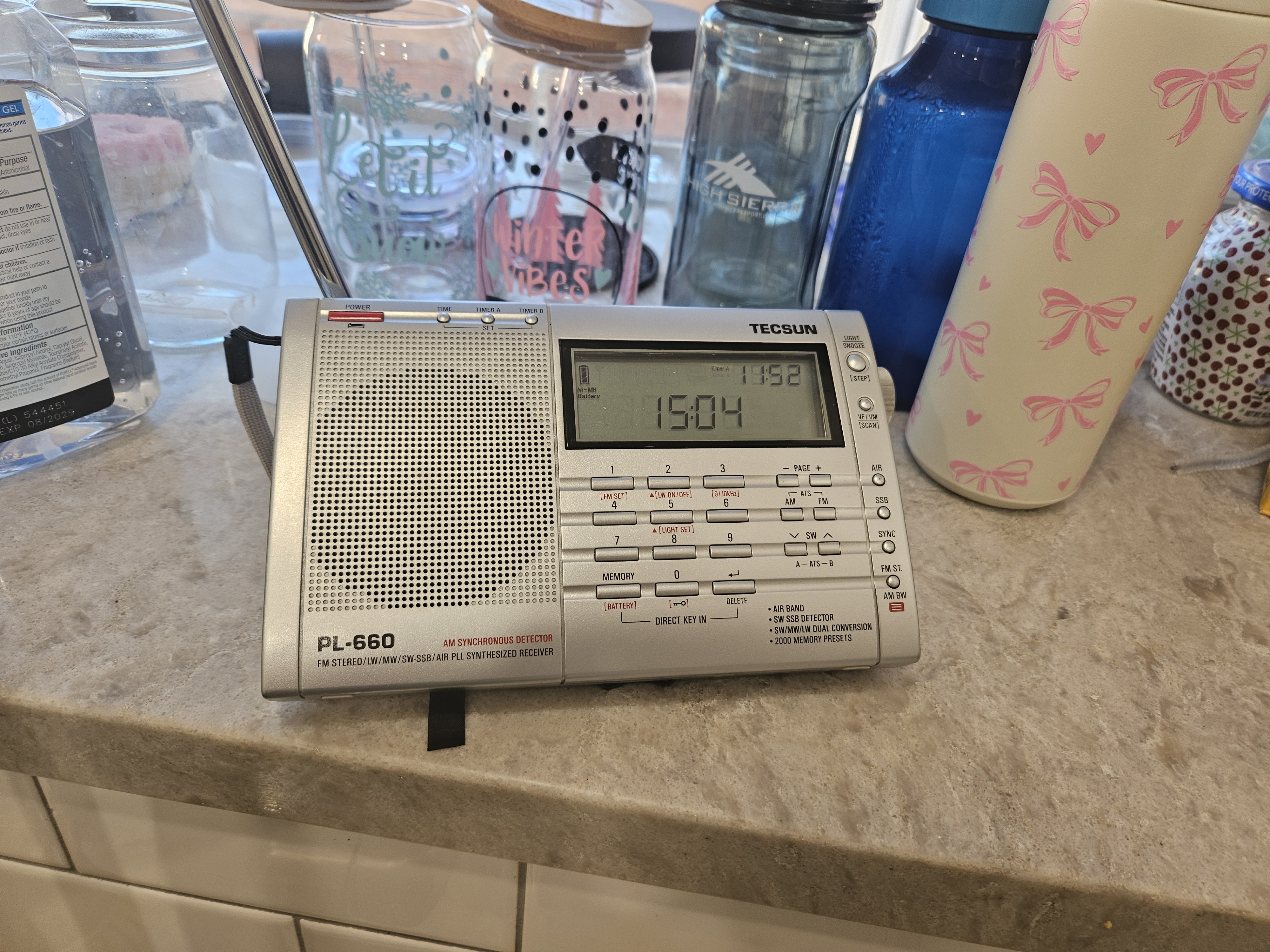
I’m fully aware that my love for radios borders on the irrational. When I see a certain type—say, the Tecsun PL-680 or PL-660—something in my brain short-circuits. I’m instantly enchanted, as if I’ve just glimpsed an old friend across a crowded room, and at the same time, I’m comforted, as if that friend just handed me a warm cup of coffee and told me everything was going to be alright.
A radio isn’t just a device; it’s a symbol, though I haven’t quite worked out of what exactly. Maybe it represents the art of slowing down—of sitting in a quiet room, wrapped in a cocoon of music or in the company of voices so familiar they feel like beloved houseguests. Or maybe it’s something more primal, a sanctuary against the chaos of the world, a frequency through which I can tune out the profane and tune into something sacred.
The word that comes to mind when I hold a radio is cozy—but not in the kitschy, scented-candle, novelty-mug kind of way. This is deeper than that, more akin to the Dutch word gezelligheid—a term that encompasses coziness, warmth, companionship, and the ineffable comfort of simply being. Radios don’t just play sound; they create atmosphere. They transport me back to Hollywood, Florida, sitting on the porch with my grandfather, the air thick with the scent of an impending tropical storm, the crackle of a ball game playing in the background like a heartbeat of another era.
Many have abandoned radio for the cold efficiency of streaming devices and smartphones. I tried to do the same for over a decade. I failed. Because gezelligheid—that feeling of simple, enduring pleasure—isn’t something you can replace with an algorithm. Some things, no matter how old-fashioned, still hum with life.
If you’re like me, listening to classical music on your Tecsun PL-990 or PL-880 while reading a book is a real pleasure. You could listen to the same radio station on a computer or streaming device and it wouldn’t feel the same.
Your preference for listening to content on a high-performance radio rather than an Amazon streaming device likely stems from a combination of tactility, ritual, and authenticity.
Tactility and Presence – Your radios are physical instruments with dials, knobs, and antennas, requiring interaction to fine-tune the signal. This act of engagement makes the listening experience feel more intentional, compared to simply clicking on a streaming app.
Ritual and Skill – Tuning into a hard-to-get FM station on a high-performance radio, especially under varying atmospheric conditions, feels like an acquired skill. When reception is challenging, getting a clean signal feels like a small victory—something a streaming device doesn’t provide because it simply works or doesn’t.
Authenticity and Directness – With FM radio, you’re receiving a direct broadcast, a real-time transmission from a tower to your receiver, unmediated by algorithms, compression, or internet connectivity. It feels like you’re catching a live signal out of the air, whereas streaming feels filtered through corporate infrastructure.
Immediacy and Atmosphere – FM radio has static, subtle signal fluctuations, and environmental influence—all of which make the sound feel more alive compared to a clinically perfect digital stream. There’s a romance in the imperfection, much like the sweep of a mechanical watch’s second hand versus the precise ticking of a quartz.
Connection to Your Watch Preferences:
If you’re a radio person, you may also be a watch enthusiast, in which case there’s a strong parallel between your love for high-performance radios and mechanical watches:
Mechanical watches and FM radios require physical mechanisms to operate—whether it’s gears and springs or ferrite antennas and signal processing. Quartz watches and streaming services, on the other hand, rely on microchips, batteries, and external data to function.
Both require skill and engagement—adjusting a radio for the best reception is akin to winding a watch, adjusting its timing, or understanding its movement. There’s an art to it.
Both provide a sense of tradition and independence—A mechanical watch keeps ticking without batteries, just as an FM radio pulls a signal out of the air without needing an internet connection. Both feel like they give you a direct, unfiltered experience rather than a pre-packaged digital one.
Your attachment to radio over streaming—and mechanical over quartz—likely comes from a deeper appreciation for analogue, self-sufficient technology that requires a human touch. It’s about the process as much as the result.
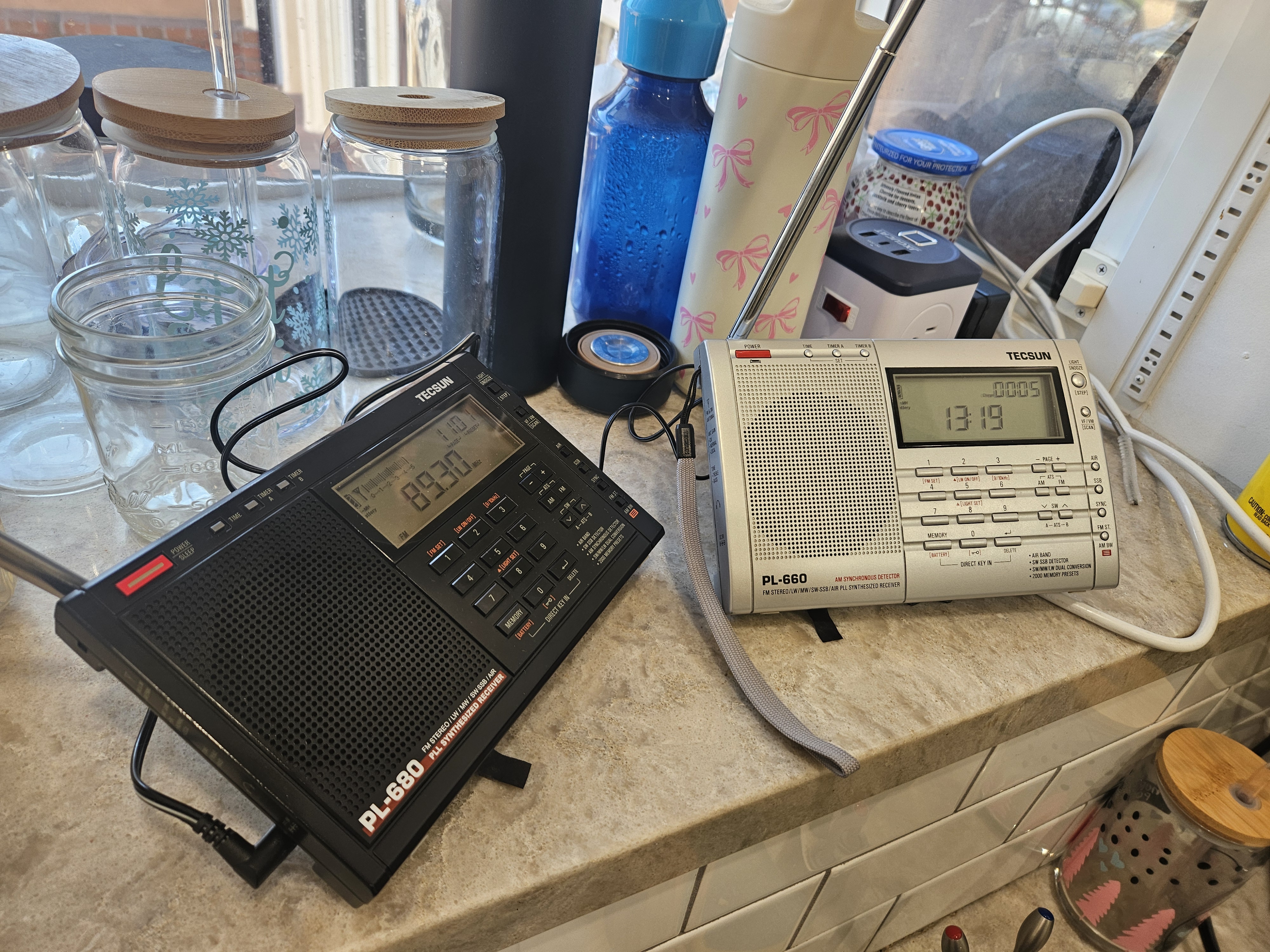
Against every shred of common sense I possess, I’ve joined several Tecsun radio forums—a decision akin to a sugar addict moving into Willy Wonka’s Chocolate Factory and sleeping under the chocolate river. It’s not just unwise; it’s a slow, delicious path to ruin. Within minutes, the forum zealots were chanting in unison: “You must own a PL-660 or PL-680! These are relics from the Pre-DSP Glory Era, back when Tecsun radios were free from the infernal chuffing, muting, and choppy tuning that plague DSP models. Think smooth analog cruising versus a hyper-caffeinated, turbocharged sports car.” Naturally, I bit the bait.
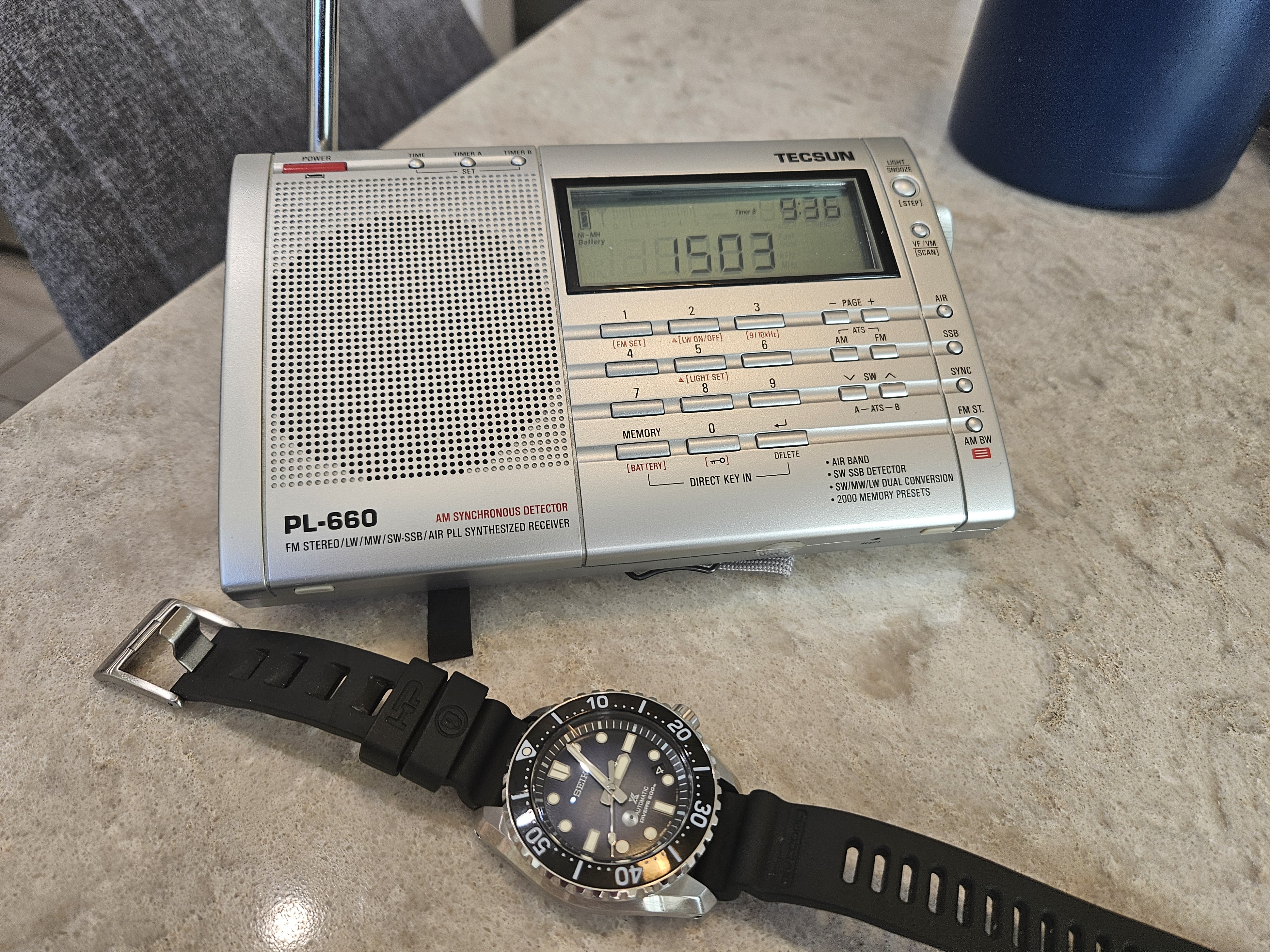
The timing was serendipitous—or dangerous, depending on your perspective. During the height of my radio obsession, circa 2008, I owned a black Tecsun PL-660, and it was the crown jewel of my collection. But, as is the curse of all obsessions, I sold it during a fleeting moment of sanity, a decision that haunted me. When the January 2025 Los Angeles Fires reignited my passion for radios—because what better time to tinker with antennas than during a climate apocalypse?—the one radio I truly mourned was the PL-660.
Enter eBay, the Pandora’s box of impulse purchases. I tracked down a silver PL-660 from a seller in Canada. At $68, it felt like a steal. Add $30 for shipping, tax, a Tecsun adapter from Anon-Co, and four AA rechargeable batteries, and suddenly my “steal” was a $140 splurge. But what’s money when you’re reuniting with a long-lost love?
When the silver PL-660 arrived, it was nearly pristine, as if frozen in time. The box, manual, and accessories were all there, minus the adapter. I tested its AM and FM performance and, unsurprisingly, found it nearly indistinguishable from my PL-880—a radio I’d been coddling like a newborn in my bedroom. Sure, the 880’s speaker has a richer timbre, but the 660 holds its own. AM reception? The 660 might edge out the 880, but given the ever-shifting electrical interference in my house, testing it felt like comparing snowflakes in a blizzard. FM? Practically identical.
And yet, here’s the kicker: I prefer the PL-660. Why? Nostalgia, for starters. It’s been 15 years since I last held one, and its reunion felt like meeting an old friend who hasn’t aged a day. But it’s more than sentimentality. The PL-660 exudes Pre-DSP mystique, wearing its analog pedigree like a hero’s badge of honor. Add to that the rumors swirling on the forums about the PL-680 taking its final lap before extinction, and I developed a textbook case of FOMO.
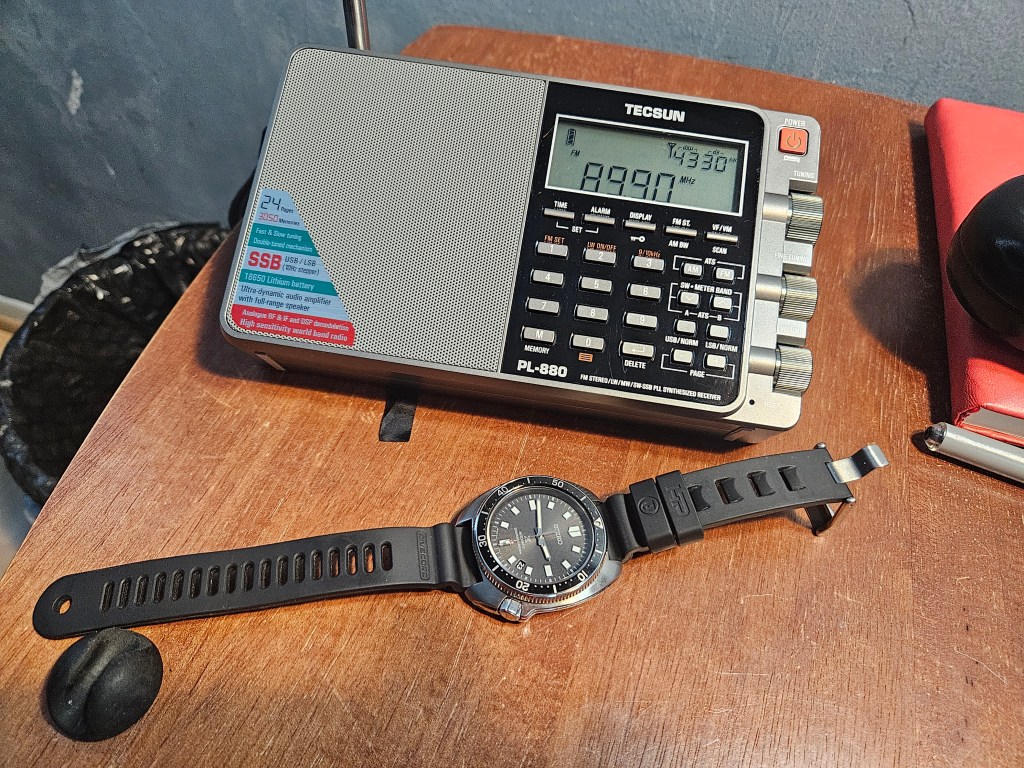
Aesthetically, the 660 is a triumph. The PL-880, while a solid performer, looks like it was designed by two committees: one in charge of the radio chassis, the other tasked with slapping on an oversized speaker as an afterthought. In contrast, the PL-660 feels like it was forged from a single, unified block of silver (or black, if you’re lucky enough to find one). It’s monolithic, almost talismanic, with a heft that whispers, “This is not a toy.” Holding it feels like gripping a miniature obelisk of radio perfection.
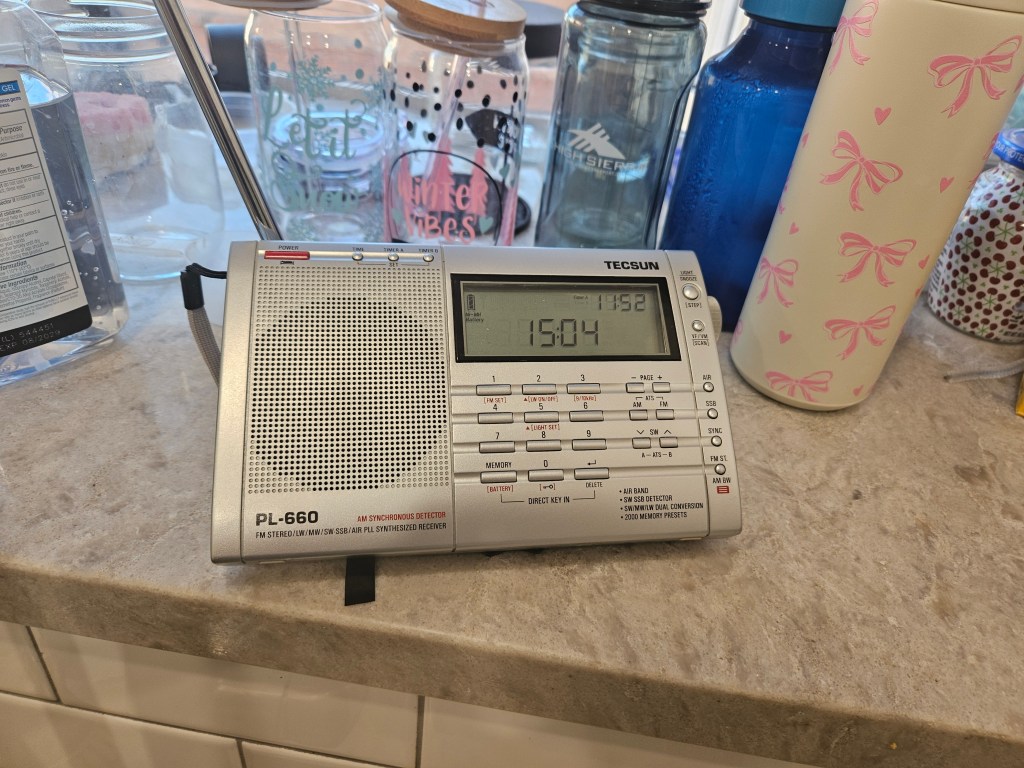
Naturally, I’m already scheming to buy a second PL-660 or perhaps its sibling, the PL-680, to keep as a “backup”—because if you love a radio enough, redundancy becomes an art form. And, because I can never leave well enough alone, I know I’ll spend the coming weeks obsessively swapping locations, putting the 660 in the bedroom, then the kitchen, then back again, until my brain short-circuits. Who needs stability when you can have perpetual indecision?
In fact, I barely made it to my office to write this without feeling pangs of longing for the 660, which I’d left momentarily in the kitchen. Thirty minutes apart, and I was already waxing poetic about its brilliance, muttering, “Dude, you really love radios.” And it’s true—I do. Probably too much. But that’s the magic of radios: they’re not just devices; they’re companions, time machines, and portals to a world that feels more tactile and real than anything on your smartphone.
Do I still love my PL-880? Of course. It’s a marvel of engineering, a steady presence in my life. But the PL-660? That’s my muse, my reminder of why I fell in love with radios in the first place. The 660 isn’t just a radio; it’s a reflection of who I am—an overthinking, signal-chasing, nostalgia-driven mess. And I wouldn’t have it any other way.
I wanted a Tecsun in my bedroom—not some soulless streaming device, but a real radio, one with warmth, charm, and that inexplicable magic that only live broadcasts can offer. The idea was simple: a companion for afternoon naps and late-night reading sessions set to the soothing sounds of classical or jazz. After all, what better antidote to our algorithm-driven existence than the analog embrace of a good radio?
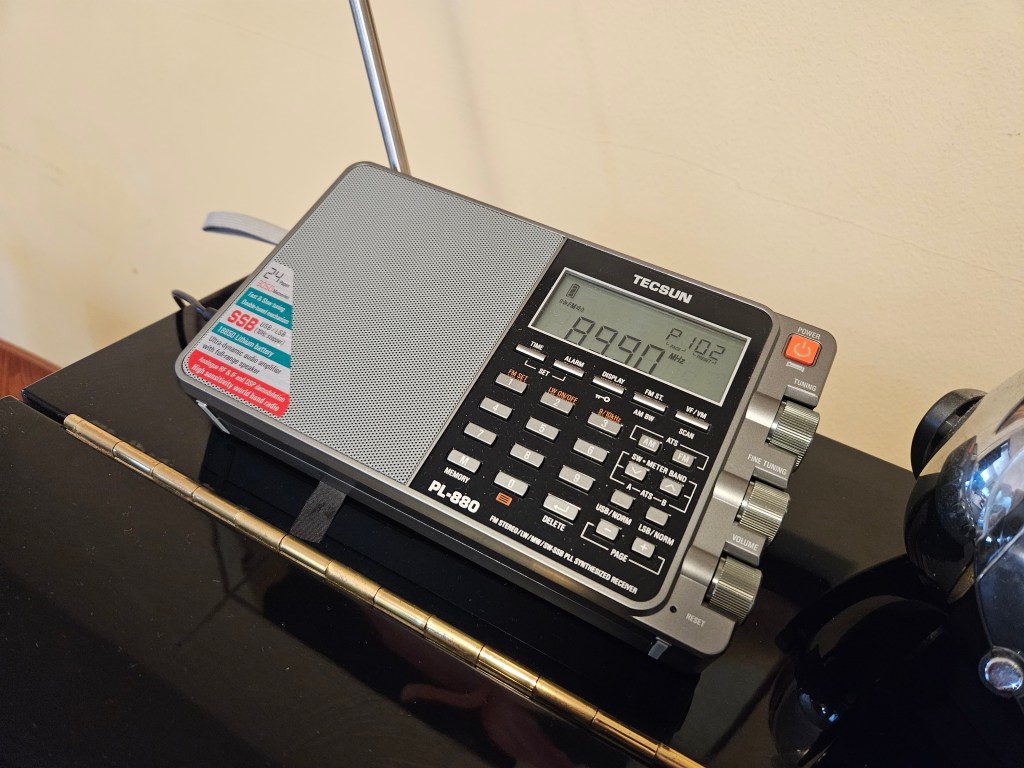
Back in my radio-obsessed heyday around 2008, I foolishly sold my beloved Tecsun PL-660. Call it hubris, call it a lapse in judgment, but I’ve regretted it ever since. To atone, I snagged a used PL-660 for the kitchen and, for my bedroom sanctuary, opted for a Tecsun PL-880—a model lauded as a minor deity among radios.
Now, let’s talk about my brief but painful dalliance with the PL-990. I ordered it from the reputable Anon-Co, expecting greatness, only to be greeted by an AM band as dead as a doorknob. Heartbreaking. Back it went, and in its place came the PL-880, slightly used but fully tested. And let me tell you, the speaker on the 880 is a revelation—warmer and more inviting than the 990’s. It’s like stepping into a cozy jazz club versus a sterile concert hall.
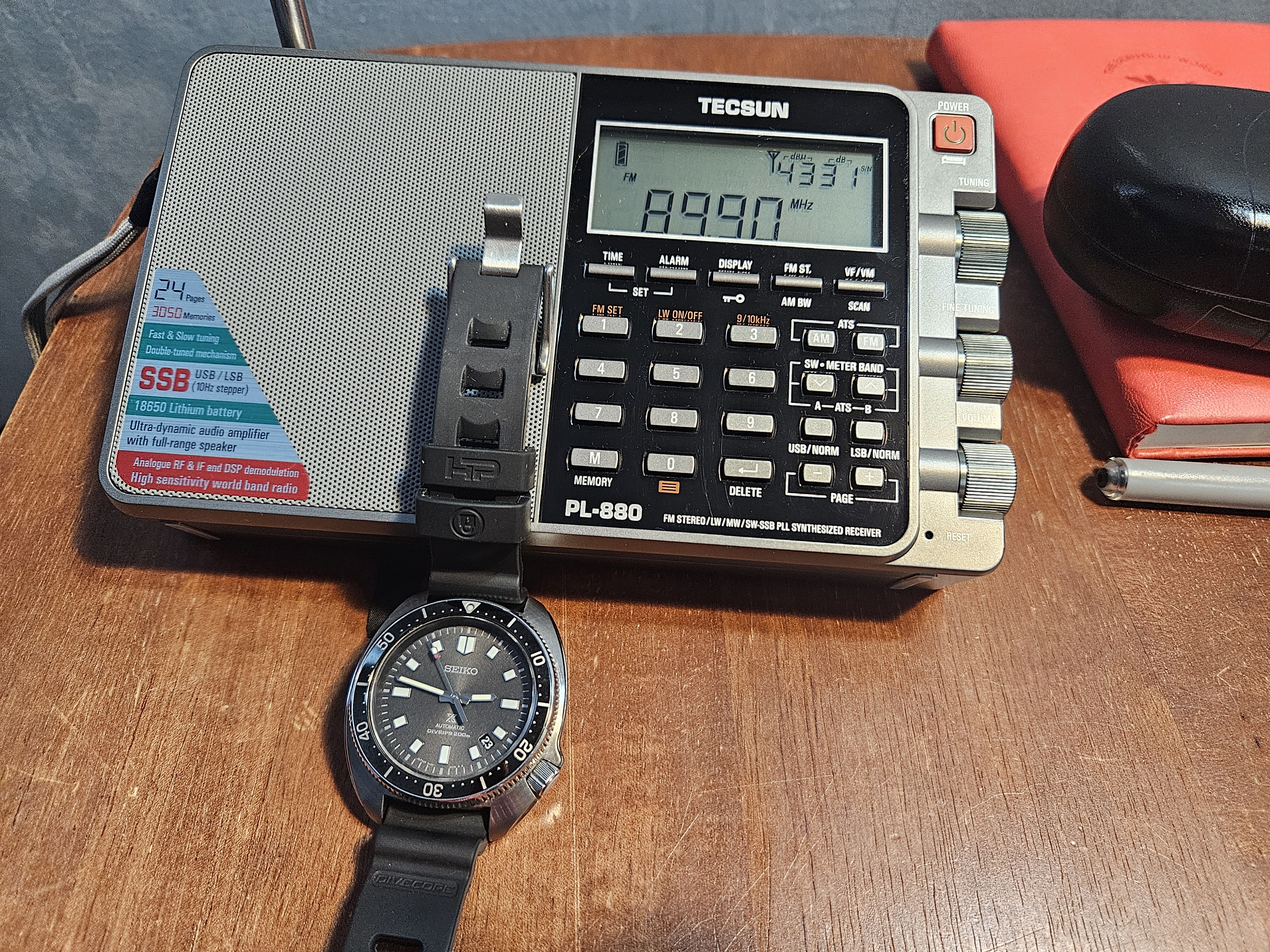
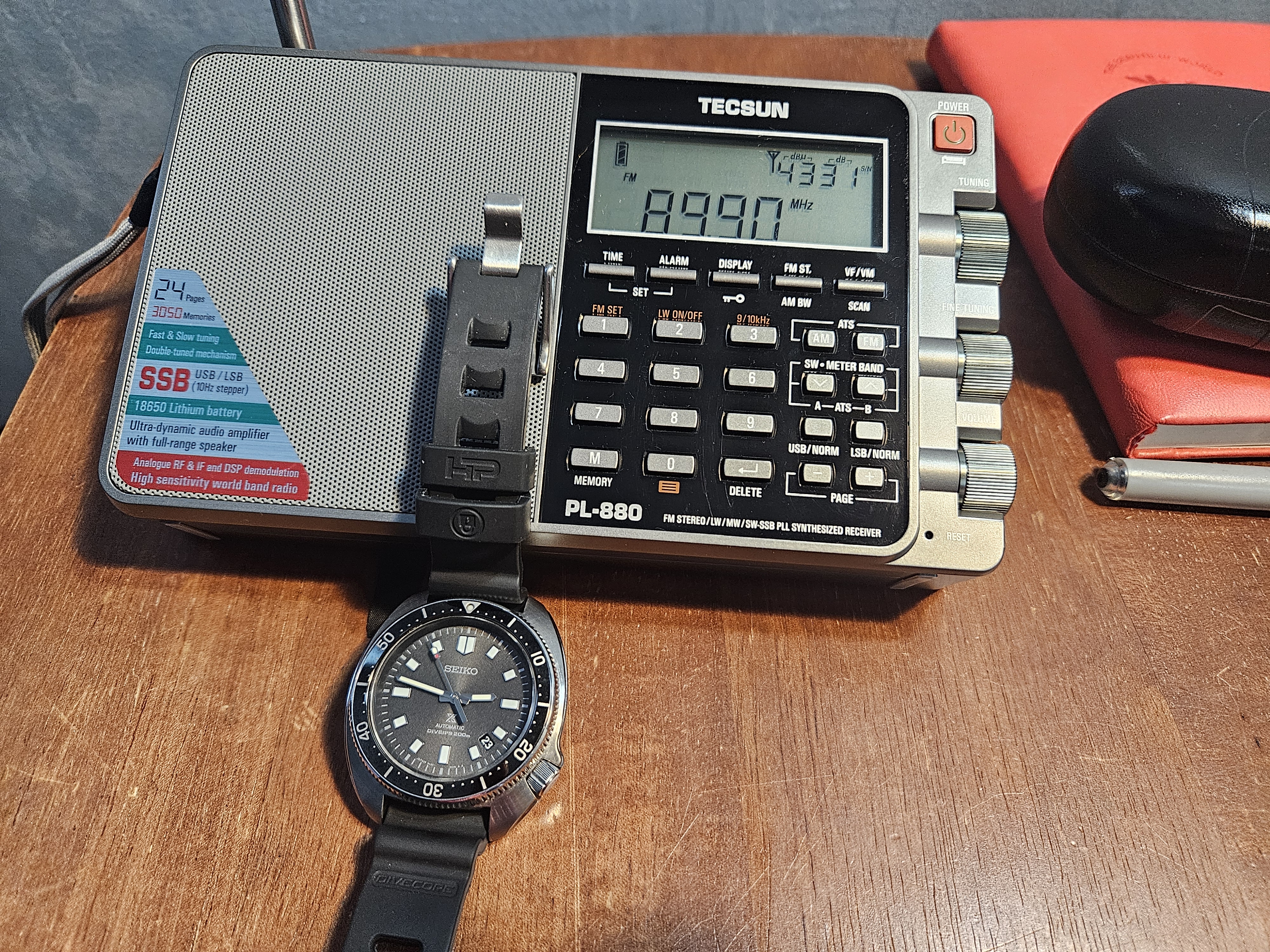
The 880 arrived ready for action, with AM and FM defaults already set to North American standards—no fiddling required. On “DX” mode, the AM band delivers stunning clarity with zero floor noise or interference. It’s a joy to listen to, unlike 95% of the radios cluttering the market that barely rise above the status of glorified paperweights. FM performance is similarly impressive, though 89.3 gave me a little attitude when placed too close to the wall. A quick relocation to the bed or a spot away from the wall solved that, but the rest of the FM dial? Flawless. KCRW 89.9, in particular, comes through like it’s broadcasting from my nightstand, even while the battery charges.
Speaking of AM, charging compromises its pristine reception, so I stick to battery power for those late-night AM sessions. Setting presets and navigating pages took a bit of patience—about 15 minutes of trial and error—but the interface is intuitive enough that even if you mess it up, direct entry is a breeze.
In short, the PL-880 does exactly what I hoped it would: it fills my room with rich, crystal-clear sound, providing a listening experience that feels both luxurious and intimate. Sure, the PL-990 looks great and has fantastic build quality, but for my purposes, the 880 checks every box at a fraction of the cost. Why throw extra cash at a feature set I don’t need?
Here’s the thing about being radio-obsessed: a radio isn’t just a gadget. It’s a companion, a quiet presence that connects you to a wider world while anchoring you in your own space. The PL-880 is just that—a welcome friend who’s already earned its place in my home.
The following is from my now defunct Herculodge blog. I realized when I did radio testing again in 2025 that RFI (radio frequency interference) is a far greater challenge than it was in 2008. I need to play my radios on batteries, not AC adapters, and keep them away from walls, which is a shame because I really want the Sangean HDR-19, a wall adapter-only radio, which has gone up in price about $80 since even a couple of months ago.
Since the Los Angeles Fires tore through Southern California in January 2025, I realized my household was embarrassingly underprepared for live news coverage. Streaming devices and smart speakers suddenly felt flimsy when the sky turns orange. I needed something sturdier, more reliable—like a good, old-fashioned radio.
Enter Sangean, a brand I trusted a decade ago. I fondly remembered their radios delivering a warm, bass-heavy sound—pleasant, if not exactly hi-fi. My ancient PR-D4 still hums along in the garage, proof that Sangean builds workhorses. So, naturally, I picked up their new DSP-chip PR-D12, curious to see how it stacked up against its analog ancestor.
The verdict? The D12 is brighter and more balanced than the D4, though the warmth I loved has cooled a bit. FM reception is a mixed bag. From Torrance, Pasadena’s 89.3 comes in strong with three bars and crystal clarity on the D12. On the D4? Same signal strength but with a thin veil of static, unless I awkwardly angle the antenna like I’m searching for alien life.
But then things get weird. 91.5, my go-to classical station, sings smoothly on the D4 but sputters on the D12—two weak bars and static, no matter how I threaten the antenna.
AM? Forget it. 640 AM is listenable but laced with floor noise on both radios. I twist and turn the radios to align the internal ferrite antennas like I’m cracking a safe, but the noise stays. Worse, AM talk radio voices sound like they’re broadcasting through a burlap sack. Long-term listening? Not a chance.
What the D12 does have going for it is user-friendliness. Four preset pages with five slots each make navigating stations painless—perfect for my wife, who refuses to wrestle with complex manuals that read like an SAT prep book. She’s happy with 89.3 and 89.9 blasting clear and loud, so the D12 earns its spot in the kitchen.
Still, I can’t shake the feeling I need something more commanding, like the soon-to-arrive Tecsun PL-990x. Maybe it’ll crack the code on AM audio bliss. Until then, the PR-D12 holds the line—solid, if not inspiring.
Moderate recommendation.
Update:
I told my fellow radio enthusiast friend Gary about how I could not listen to the AM sound on the PR-D12 or my PR-D4, and he expressed the same sentiment. He said the only AM he can listen to from his vast radio collection is his now defunct C.Crane CC Radio-SW, which is a clone of the Redsun RP-2100. This made me sad because many years ago I enjoyed listening to AM on my Redsun RP-2100, but I fried it when I put the wrong AC adapter in it. Getting good AM sound out of a radio is hard these days.
Second Update:
Three days after writing this review, I moved the PR-D12 to the garage where it sounds great on AM so I blame the kitchen, not the PR-D12.
(originally posted on my Herculodge blog (on the defunct Typepad platform. I’m including an update on this post.)
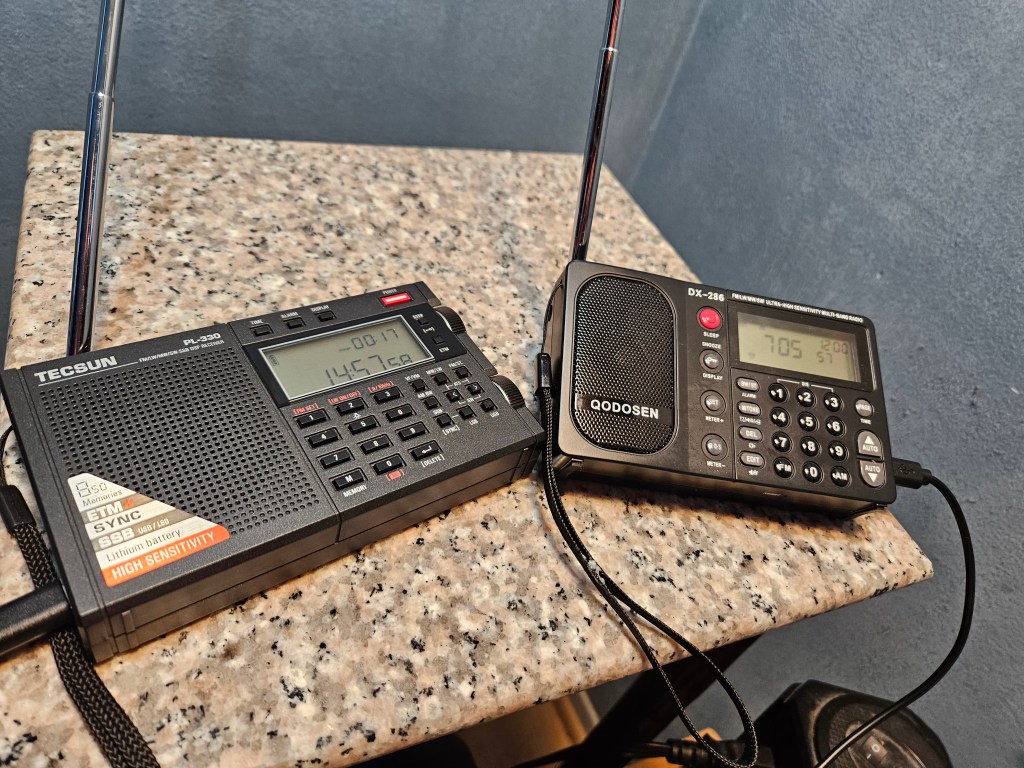
The Qodosen DX-286 arrived last Sunday, Day 5 of the Los Angeles Fires, and I wasted no time putting it under the microscope. I scrutinized its build quality, tested its FM and AM performance, and after some thoughtful listening, I decided it was going back.
To be fair, music sounded pleasant enough on the small mono speaker—soft, inoffensive, like background noise in a coffee shop. But voices? Hollow, thin, and oddly distant. It quickly became clear that this radio would only be tolerable if tethered to a pair of headphones. As for the physical design, the kickstand and battery door felt flimsy, as if one wrong move would snap them clean off. They inspired about as much confidence as a paper umbrella in a hurricane.
AM reception? Surprisingly solid. FM? Good but not amazing. Despite all the hype about the Qodosen’s so-called super-powerful radio chip, it was no better than the Degen/Kaito 1103 I had over a decade ago. Sure, it effortlessly locked onto 89.3 from Pasadena, but it fumbled with the weaker college station 88.9, struggling like a kid lifting his first dumbbell.
That’s when it hit me: I was never going to fall in love with this pint-sized radio. It felt like driving a rattling Mazda Miata through a wind tunnel—fun in theory, but exhausting in practice. So, I packed up the Qodosen and sent it back. I don’t blame Qodosen. I blame my unrealistic expectations and my failure to realize I didn’t want a radio this small for my bedroom.
In its place? The Tecsun PL-990X. Seven and a half glorious inches of luxury radio, a true cruiser compared to the jittery compact Qodosen. Don’t get me wrong—the DX-286 is a decent radio. I just realized I wanted something bigger, smoother, and built for the long haul.
Update:
I rebought the Qodosen about a month after writing my original Herculodge review. I realized the speaker is excellent, its AM is superior to my Tecsun radios, and that it’s a keeper. One issue: The kickstand broke, so I play it flat on its back.
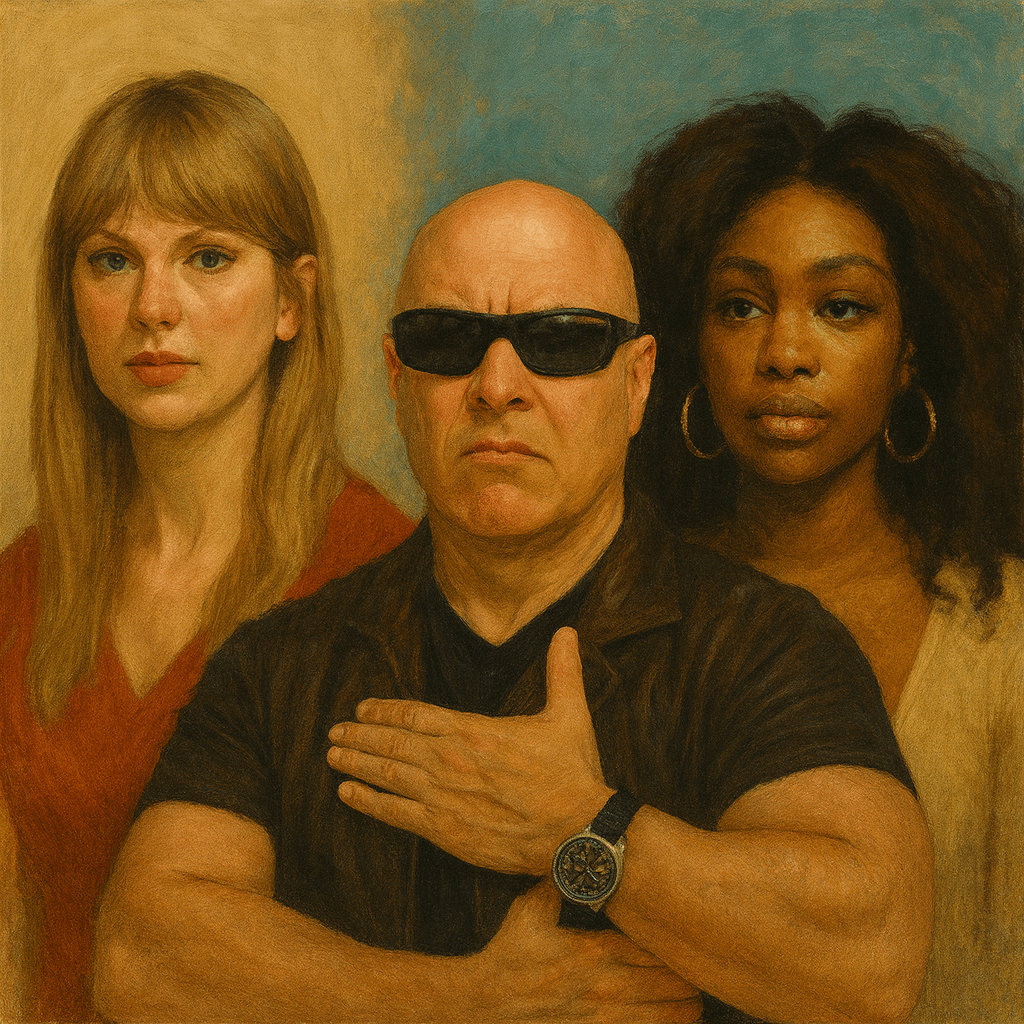
In my freshman writing class, I recently staged a little spectacle about thesis statements. To illustrate contrast, I pulled out two cultural heavyweights: SZA and Taylor Swift. Hyperbole was the hook. My admiration for SZA was real; my critique of Swift was exaggerated for theatrical effect. Still, my tirade sounded more like a roast than a teaching tool:
“While Taylor Swift may rack up 25% more Spotify streams than SZA, numbers don’t tell the whole story—unless, of course, you mistake a stadium chant for art. SZA sings with depth and raw emotion, while Swift wheezes through her catalog like an underfed Victorian orphan. SZA’s sound is bold, kaleidoscopic, and alive, drawing from the lush soul of the ’70s. Swift, meanwhile, serves up limp sonic garnish—music with the texture and excitement of a wilted celery stalk rescued from beneath the fridge. SZA makes adult art; Swift makes musical mac and cheese for the kid’s menu at Chili’s.”
In reality, I don’t think Swift is a wasteland of celery stalks and Victorian wheezing. I admitted to my students that Swift is likely a good person, a competent artist, and that I wish her well. My guilt lingered, though. Bombast is a teaching trick, but sometimes the fire singes the wrong target.
That guilt sharpened when I stumbled across Spencer Kornhaber’s “How Did Taylor Swift Convince the World That She’s Relatable?” over morning coffee. One line hit me like a cold shower: “The most consequential American singer of the past 20 years, Swift can claim commercial achievements that equal or surpass those of the Beatles, Madonna, and Michael Jackson.”
Relatability is her true superpower. Swift has broadcast her heartbreaks, doubts, and longings in ways that make her sound like a big sister or Greek chorus to her fans’ lives. Her brand isn’t just pop—it’s therapy with a backbeat.
Kornhaber nails it: “Listening to a Swift song is like eating a candy bar that transmits a personal essay into your memory. If you eat enough candy bars, it becomes a novel, and then a series of novels, and then (this is when you become a Swiftie) a virtual-reality, open-world video game you play with friends and strangers.” It’s a metaphor that could apply to any great artist. I thought of The Truman Show, where daily life becomes the commodity, the spectacle, the art.
Swift deserves her accolades. She is a master craftsman of polished, radio-ready memoir-pop. But her songs still strike me as a touch bland, like a dependable frozen dinner—satisfying but forgettable. My twin daughters agree. When a Swift track seeps out of SiriusXM Coffee House, we sigh in unison and silently wish it were SZA.
In 2006, I wandered into the Wild West of self-publishing and signed up with Typepad. Back then, blogs felt like a revolution: you could pour your obsessions straight into the digital void without begging gatekeepers for approval. I created three: Herculodge, where I indulged my radio fixation; The Breakthrough Writer, course content for my freshman comp class; and The Critical Thinker, the companion for my critical thinking students. Typepad cost me about $150 a year—a fair price for a soapbox in the dawn of the Blog Era.
But by April 2025, my soapbox had turned into a rickety stool. Typepad was wheezing like a geriatric dinosaur stumbling into an unfamiliar world: constant downtime, glacial load times, the unmistakable stink of neglect. Research confirmed my suspicion—it had been sold, stripped for parts, and left to rot. I canceled my subscription. Out of nostalgia, I kept Herculodge in basic mode, mainly because its archive of radio reviews was still linked to Thomas Witherspoon’s venerable SWLing Post, a site that embodies everything good about radio: community, continuity, and voices across the airwaves.
But in truth, Herculodge had gone dormant long ago. After the 2025 wildfires in Los Angeles, I went on a spree, bought a dozen radios, reviewed them all, and then, slowly, stopped. The flame flickered, and I moved on.
Yesterday the official death notice arrived: “We have made the difficult decision to discontinue Typepad, effective September 30, 2025.” Translation: pull the plug, bury the dinosaur.
This little obituary for Typepad drags me back to the Blog Era, when voices as sharp as Andrew Sullivan’s rose to the level of public intellectuals, while hobbyists like me tinkered in the shadows of niche obsessions, broadcasting to niche audiences. Blogs felt cozy, almost literary: you in a robe, cat on your lap, coffee steaming, ruminating about Virginia Woolf before hitting “publish.” Compare that to today’s Hot Take Era: dopamine-charged combatants spewing rage, preening for likes, and mistaking tribal points for thought.
The end of Typepad is the end of that quieter world.
I’ve since migrated to WordPress, which works better, loads faster, and hasn’t collapsed into irrelevance. I have mixed feelings about AI image generators: sometimes they hit the mark, but mostly they’re garish clip art pretending to be art. Still, I pay two hundred bucks a year to carve out a little order from the chaos, and it’s worth every cent. Cheaper than therapy, and with fewer platitudes.
Typepad’s death isn’t tragic—it’s just the final shovel of dirt on an era already gone.
In high school, I was a sap for Billy Joel’s “Just the Way You Are”—a sentimental earworm that lodged itself in my adolescent chest like a slow-burning ember of longing. But it was “The Stranger,” with its eerie whistle intro, that truly haunted me. That mournful melody had the same desolate magic as “The Lonely Man Theme” from The Incredible Hulk—the tune that played whenever Bruce Banner had to hitchhike into oblivion with nothing but his duffel bag and repressed rage.
Aside from that one album, though, I had little use for Billy Joel. His music struck me as sonic white bread—palatable, inoffensive, nutritionally empty. I still recall a vicious takedown in The San Francisco Chronicle where a critic dismissed Joel as a budget-bin Beatles knockoff. That assessment dovetailed nicely with my own smug teenage sneer. When a cousin of mine announced in the early ’80s that he was driving to L.A. to see Joel live, I smiled politely and thought, Enjoy your night of mediocrity, friend.
Then the decades rolled by, as they do. Billy Joel fell off my radar completely. Not a note, not a thought, not a twitch of nostalgia. The man might as well have joined Jimmy Hoffa in the cultural vault. But recently, a few podcasters I trust raved about a five-hour documentary—Billy Joel: And So It Goes—streaming on HBO Max. Out of curiosity (and procrastination), I pressed play.
And damn if it didn’t pull me in.
Joel’s life story is a full-blown psychodrama with the pacing of a prestige miniseries. He falls in love with his bandmate’s girlfriend, gets punched in the face when the betrayal surfaces, spirals into suicidal depression, checks himself into a psychiatric hospital, emerges emotionally bruised but determined, and—naturally—marries the very same woman. She becomes his manager. They hit the road. That alone is a screenplay waiting to happen.
The documentary then charts his wreckage-strewn romantic path: four marriages, battles with booze, perfectionism bordering on pathology, and the slow, soul-bruising realization that having half a billion dollars doesn’t guarantee someone to watch movies with on a Sunday night.
Much of Joel’s pain seems to flow from a frigid relationship with his father—a classical pianist who fled Nazi Germany only to land in the capitalist circus of America, which he promptly came to despise. He left for Vienna and left Billy with an emotional black hole for a torso. Joel wrote songs, not for fame, but to fill that void—to wring something warm from cold keys.
His mother didn’t help. She was likely bipolar, and Joel suspects he inherited some version of it—his life a pendulum swing between euphoric crescendos and basement-floor depressions. This emotional volatility didn’t soften him. If anything, Joel is grittier than I ever gave him credit for: a pugnacious Long Islander with a boxer’s jaw and the soul of a saloon poet.
That famously mushy ballad “Just the Way You Are”? He hated it. Thought it was soggy sentimentalism unworthy of an album slot. Only when the band added a Bossa Nova beat did he reluctantly agree to let it stay. And that song, of course, became his most iconic.
I came away from And So It Goes with a new view of Billy Joel—not as a sentimental hack or a Beatles Xerox machine, but as a bruised, brilliant craftsman. He’s not just a hitmaker. He’s a man on fire, trying to warm himself with melodies pulled from the wreckage of his life.
I know a few brave souls who have done the unthinkable. They’ve faced down the snarling beast of the Timekeeper’s Cavebrain—the primordial voice that whispers, “One more won’t hurt”—and emerged with nothing but a $79 G-Shock strapped to their wrist like a talisman of survival. These men are not collectors. They are survivors. Ex-chronoholics who now wear a single resin slab like a badge of sanity in a world overdosing on lume and limited editions.
And yet—here’s the twist—they still linger in the digital temples of temptation. They haunt the forums, stalk the subreddit threads, and scroll the Instagram wrist shots like monks in a wine bar. They do not comment. They do not buy. They simply observe, living vicariously through the endless dopamine-chasing of others. Their presence is ghostly, detached, almost ethereal.
These men have all, at some point, knelt before Father Time-Out, a shadowy ascetic who preaches from behind a cracked Casio:
“You were once a sinner in the temple of timepieces. You must now enter permanent exile. Perhaps, in time, you may guide others out of their chrono-hell. Become a lighthouse of restraint. Point them toward the True Path.”
And some do. These One-Watch Monks become minor saints of the community—offering cryptic encouragement, spartan wisdom, and the occasional photo of their battered DW-5600 glowing like a sacrament. They are revered not for what they wear, but for what they don’t. They symbolize what every timepiece addict secretly craves: freedom.
But not all monks stay in the monastery.
Sometimes, the Cavebrain resurfaces, soft-spoken but persuasive: “You’ve earned a second watch. Something modest. Something Swiss.”
And just like that, a relapse: the purchase of an Omega Seamaster “as a test,” a way to prove their control. They become Two-Watch Semi-Monks—respected, yes, but no longer holy. The mystique is gone. Their resin-born purity has been tarnished by a splash of steel and hubris.
They will say, “It’s just two watches.” But the Timekeeping Community knows better. It always starts with one exception.
Still, we do not mock the fallen. We nod, we sigh, and we tighten our NATO straps. We know how easy it is to go from sage to sucker, from minimalist to maximalist, from monk to maniac—in just one click.





 Cinemorphosis