Tag: music

  • Becoming Led Zeppelin: A Fan’s Liturgy in Sweat, Hair, and Feedback

    Becoming Led Zeppelin: A Fan’s Liturgy in Sweat, Hair, and Feedback

    In the Bay Area of the 1970s, nothing was more quintessentially American than Led Zeppelin. Not apple pie, not hot dogs, not even fireworks detonating under the banner of freedom on the Fourth of July. No, Led Zeppelin was the national anthem of hormonal turbulence, a sonic passport to lust, rebellion, and ecstatic doom. At the center of this swirling pagan mass stood Robert Plant—shirtless, golden-maned, howling with the tortured elegance of a fallen angel whose job was to make teenagers believe that transcendence came through hips, heartbreak, and hair-whipping.

    Plant wasn’t just the house prophet of sexual revolution-era America; he was its prisoner. His voice didn’t just seduce—it ached. It howled. It bled. It was priapism as opera, libido turned operatic suffering. Meanwhile, Hugh Hefner—the so-called high priest of sexual liberation—was a fraud with a bubble pipe. With his crusty cardigan and smug, soft-core smirk, Hefner sold a sterilized fantasy built for TV sitcoms. Robert Plant, by contrast, sounded like he’d clawed his way out of the underworld in leather pants, carrying every orgasm and every regret with him.

    In Bernard MacMahon’s Becoming Led Zeppelin, we encounter Plant as the elder beast—still leonine, still mythic. He reclines in a richly shadowed room worthy of Masterpiece Theatre, his face now a craggy relief map of rock’s excesses. The documentary doesn’t dwell on the groupies, trashed hotel rooms, or aquatic legends of infamy. Instead, it gives us the roots: Plant’s soulful debt to Little Richard, Page and Jones’ studio stint with Shirley Bassey’s “Goldfinger”—that thunderclap of a song that still sounds like someone hurling a piano at the moon. Watching that scene took me straight back to 1973 Nairobi, where my father and I first heard Bassey belt that monster in a theater so loud it felt like the walls were peeling.

    There’s archival footage of Zeppelin playing to a crowd that looks less like Woodstock and more like a family reunion gone sideways. Grandmothers clutching their pearls. Children plugging their ears. No one knew what had hit them. This wasn’t just music—it was a mass exorcism.

    So no, Becoming Led Zeppelin won’t give you the tabloid filth. It won’t dive into the daisy chain of destruction that came with their rise. But it offers something more interesting: a portrait of a band that didn’t just soundtrack my youth—they were my youth. And Robert Plant, in all his howling, tormented glory, was its golden god of doom.

  • My Midyear Top 5 Music Obsessions of 2025 (So Far)

    My Midyear Top 5 Music Obsessions of 2025 (So Far)

    Let’s call this what it is: a midyear soundtrack to my emotional needs, taste refinement, and irrational belief that a great song can still restore one’s faith in the universe. Below are five songs from 2025 that didn’t just catch my ear—they staged a full occupation of my psyche.

    1. Billie Eilish – “Wildflower”

    Boomers love to chant, “They don’t make music like this anymore,” usually while polishing their vinyl copies of Rumours and sipping overpriced Malbec. To which I say: Have you heard “Wildflower”? Billie Eilish wrote a melody so hauntingly beautiful and emotionally precise it might just slap Stevie Nicks across the astral plane. “Wildflower” isn’t nostalgic—it’s timeless, and it makes the whole “they don’t make ‘em like they used to” argument sound like a radio station that’s lost its signal.

    2. Miley Cyrus – “Flowers” (Demo Version)

    Forget the radio-polished, empowerment-anthem version designed for spin class playlists and morning talk shows. The demo is the real deal. Stripped down and raw, it sounds like Miley walked into the studio, ripped her ribcage open, and hit record. It’s not just about self-love—it’s a reckoning. A breakup song without the mascara, just bone-deep clarity and vocal grit. If the original was a brand campaign, the demo is the heartbreak behind it.

    3. Lana Del Rey & Father John Misty – “Let the Light In”

    This track is so beautiful it feels like eavesdropping on two fallen angels trying to talk each other back into heaven. I’m humbled, elated, and borderline offended by how good it is. If I’d played this song for Anthony Bourdain who once told KCRW’s Evan Kleinman that during his Applebee’s-induced existential spiral he lost faith in the human soul. I wish I could have played him “Let the Light In.” Perhaps he would have reconsidered the cosmic bleakness of mediocre mozzarella sticks. Lana and Misty have composed a shimmering argument for the existence of the human soul. It should be piped into the waiting room between this world and the next.

    4. Strawberry Guy – “As We Bloom”

    Strawberry Guy continues his gentle tyranny over my playlists. “As We Bloom” is another heart-melting, dew-soaked track that could have been transmitted from the dream-state of a lonely Victorian poet. He has the rare talent of making everything feel sacred and a little tragic, like a faded birthday card found in a drawer during a move. In vibe and texture, he’s a spiritual cousin to The Innocence Mission, and I say that with reverence.

    5. Olivia Dean – “Touching Toes”

    This song made me forget my age, my responsibilities, and that I’m not, in fact, swaying in slow motion through a desert cantina in the 1970s. “Touching Toes” is sultry, jazzy, and unselfconsciously whimsical—pure auditory flirtation. It gives me the same odd, disorienting confidence that Maria Muldaur’s “Midnight at the Oasis” once offered: a delusion of magnetism and a sudden desire to wear silk and speak in metaphors. Olivia Dean makes me feel like maybe I am the moment.

  • Crying at the Sink: The Dishwashing Grammy Awards

    Crying at the Sink: The Dishwashing Grammy Awards

    Don’t ask me why, but there’s something about doing dishes after dinner that turns me into a soft-focus emotional wreck. Somewhere between the soap suds and the rinse cycle, I cue up Rickie Lee Jones’s “Living It Up”—one of my all-time favorite songs—and without fail, it punctures the heart like a stiletto dipped in nostalgia. Tonight, it brought on another weepy micro-moment, which means it’s time to officially give it The Most Likely to Make Me Cry from Too Much Beauty Award.

    This of course sent me spiraling into my own kitchen-sink Grammy ceremony, where I began handing out awards like a deranged emotional sommelier.

    • Todd Rundgren’s “Can We Still Be Friends” wins The Song That Makes You Recommit to Being a Half-Decent Human Being Award. It’s the sonic equivalent of an awkward apology after ruining Thanksgiving.
    • The Isley Brothers’ “Living for the Love of You” earns The Track Most Likely to Be Playing in Heaven When You Arrive Award—assuming heaven has good speakers and excellent taste.
    • Yes’s “And You and I” takes home The Sounds-Like-It-Was-Composed-by-Angels-on-a-Mountain-Top Award. I don’t know what dimension that song came from, but it wasn’t this one.
    • John Mayer’s “No Such Thing” is given The Makes You Happy to Be a Living, Breathing Fool Award. It’s that rare pop song that makes you want to fist-pump your own mediocrity.
    • The Sundays’ “You’re Not the Only One I Know” walks away with The Makes Sadness So Gorgeous You Forget to Be Upset Award. It’s a musical sigh pressed between lace and rain.

    I could keep going—my brain has a whole red carpet lined up—but I’ve got another episode of Sirens on Netflix to cry through. Turns out the best part of my day is a cross between dish soap, beautiful songs, and low-level existential unraveling. What a life.

  • Dreams of Debt, Pastries, and Postponed Purpose

    Dreams of Debt, Pastries, and Postponed Purpose

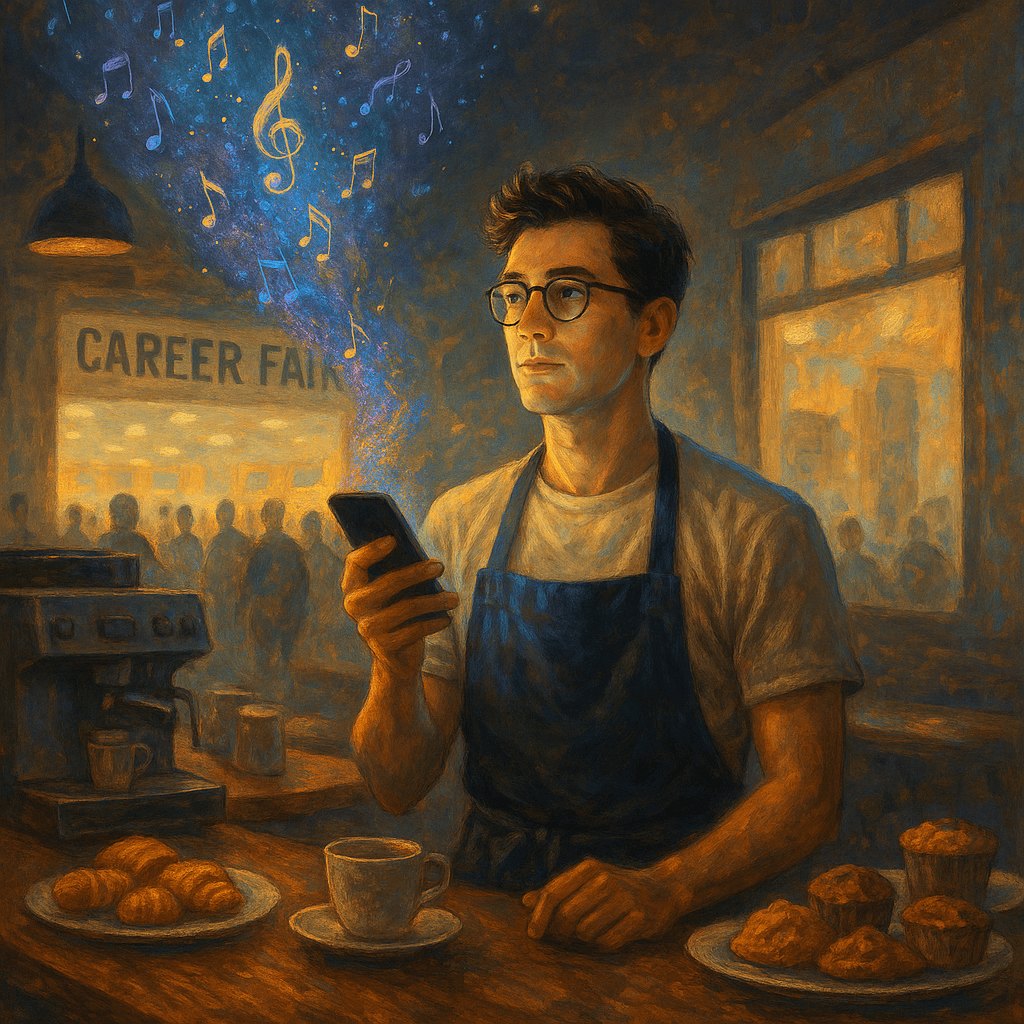
    I dreamed I was working in a café—one of those indie joints that sells artisanal pastries dusted with powdered irony—while slogging through my Master’s in English. Picture a barista apron slung over a grad student’s existential dread.

    I carried a phone that wasn’t just smart—it was sorcerous. With one tap, it summoned a stream of music from a satellite orbiting somewhere above Earth’s pettiness. This music wasn’t Spotify-tier. It was celestial—otherworldly symphonies that made Bach sound like background noise at a carwash. The entire café basked in it, as if rapture had been accidentally triggered over the scones.

    Then he appeared. A mysterious man—part career counselor, part trickster god—told me that if I attended a career convention, I could buy a van for my family. Not just any van. A magical, dream-fulfilling van priced at $400, which in dream economics is about the cost of a single textbook in grad school.

    The convention was a riot of lanyards and desperation. Voices swirled about the final class I needed to finish my degree: the dreaded seminar with Professor Boyd, a real professor from my waking life, whose lectures felt like intellectual CrossFit and whose office smelled faintly of despair and dry-erase markers.

    I never found the van man.

    The dream logic began to wobble. Doubt crept in like a late fee. I wandered through the convention’s gray carpeted purgatory and began rehearsing how I’d tell my family we would remain vanless, bound to our modest, immobile fate.

    And then—like a plot twist penned by a sentimental sportswriter—I ran into two Hawaiian brothers I hadn’t seen since Little League. We were kids once. They were legends. One of them, Wesley, struck me out four times in a single game, and I still remembered the way the ball moved like it had free will. Decades later, we were all adrift—middle-aged, mildly broke, and marvelously unsure of ourselves.

    We stood there, in that convention center of failed ambitions and discounted dreams, and talked about what we could’ve been. I told them they had enough charisma to turn their names into brands. I hugged Wesley and said, “You struck me out four times, and it’s a privilege to see you again.”

    None of us had a career. But we had memories. And love. And the unspeakable beauty of a satellite song that once played over cinnamon rolls.

  • The Sundays Can’t Come Back—They Never Wanted to Be Here

    The Sundays Can’t Come Back—They Never Wanted to Be Here

    I estimate there are maybe 50,000 diehard fans of The Sundays left on Earth—middle-aged romantics who imprinted on their music in their twenties like baby ducks and have carried that delicate soundscape in their bones ever since. These are the ones still haunting Reddit threads and aging fan forums, half-pleading, half-praying for Harriet Wheeler and David Gavurin to reemerge from their English countryside exile and record something—anything—before they fully dissolve into myth.

    I count myself among them. I think “You’re Not the Only One I Know” is the most beautiful song ever written, full stop. And yes, I have complicated feelings about its sudden afterlife on TikTok. On one hand, I’m glad new ears are discovering it. On the other, I want to slam the door and shout, “Get off my lawn—it’s my song.” Like any relic of private beauty, it feels stolen once it trends.

    But here’s the thing: The Sundays aren’t coming back. And they shouldn’t. Their music is a love letter to solitude. It’s woven from the threads of retreat, quiet heartbreak, and the refusal to participate in the world’s noisy charade. Every line aches with the voice of someone who’d rather be home. A comeback would be a contradiction—like resurrecting Greta Garbo to guest on a reality show. Their brilliance was their withdrawal.

    Take “You’re Not the Only One I Know”—the narrator, calmly stationed in a chair, shooing people away like pigeons. Or “Here’s Where the Story Ends,” where every attempt at connection curdles in the air. Or “My Finest Hour,” which ends not in triumph but in a gentle surrender to domestic retreat. These aren’t anthems for a reunion tour. They’re hymns of hibernation.

    The Sundays were never built for comebacks. Their art was a form of aesthetic convalescence, a music of shy resilience. Their narrators, like the band itself, are Edward Scissorhands types—fragile, inward, best left unbothered in their Victorian turret. If they returned, they wouldn’t be The Sundays. They’d be Tuesday Afternoon.

  • The Curdling Effect: How Great Songs Die in Grocery Stores

    The Curdling Effect: How Great Songs Die in Grocery Stores

    There was a time—long before streaming services, algorithmic playlists, and “sonic branding agencies”—when “Dark Side of the Moon” could take you on a soul-melting trip through space, madness, and time. In high school, Pink Floyd was our sonic sacrament. The cymbals shimmered like cosmic omens, and we let the guitars dissolve our angst into astral vapor.

    Then Circuit City got its grubby corporate mitts on it.

    Some goons in a boardroom decided that Pink Floyd’s transcendent opus would make a great jingle for discount televisions. The song was diced, commodified, and stuffed into every radio and TV break until what once felt like a journey into the abyss became the soundtrack to buying a laser printer. “Dark Side: didn’t just sell out—it was dragged through the spin cycle of capitalism and emerged shriveled and stained, like a silk shirt forgotten in a laundromat dryer.

    Same thing happened to U2. “I Still Haven’t Found What I’m Looking For” once carried a biblical ache, a spiritual yearning that made you want to climb a desert mountain and cry. Then one fateful day in 1989, I was in a fluorescent-lit supermarket, watching the vegetable misting system descend on some limp romaine, when I heard it—Muzak’d into oblivion. Bono’s ache had been lobotomized and looped over damp eggplant. I felt like I’d witnessed a holy relic turned into a toilet brush.

    There’s a name for this: The Curdling Effect. When a song becomes so omnipresent, over-marketed, or backgrounded that it curdles—its soul separating from its sound, leaving only a sentimental sludge.

    Sometimes entire bands curdle. Take Coldplay. They’re talented, sure, but somewhere along the way they became the official band of stadium urinals and car commercials. Every note now drips with forced uplift and corporate synergy. Once they soared; now they slosh around in the shallow end of their own overexposure.

    But here’s the miracle: some songs are immune. Some endure. Some never curdle.

    Take “Fade Into You: by Mazzy Star. It drips with longing, and its beauty doesn’t spoil, even after decades. This morning, driving my twin daughters to school, I heard Victoria Bigelow’s cover. It stopped me. Time slowed. The song had lost none of its haunting gravity. It was still a velvet fog of romance and surrender.

    And then came a moment of musical resurrection. Olivia Dean’s “Touching Toes” played on the car stereo. It reminded me of Maria Muldaur’s “Midnight at the Oasis,” a song I hadn’t thought of in years. Both had that sultry, half-smile sway that drops your blood pressure and restores your faith in kindness. I let people merge in traffic. I was chill. I was enlightened.

    I’m now curating a playlist: Olivia Dean, Maria Muldaur, and any song that keeps me from flipping off fellow drivers. I call it The Chill Driver Playlist—a sonic antidote to the Curdling Effect.

  • Confessions of a Neurotic Audiophile: Bargain Hunting My Way to $89 Sony Headphone Bliss

    Confessions of a Neurotic Audiophile: Bargain Hunting My Way to $89 Sony Headphone Bliss

    Three weeks ago, crammed into a flying aluminum sausage between Los Angeles and Miami, I found myself envying the travelers swanning around with $500 AirPods Max clamped over their smug skulls.
    Meanwhile, I was roughing it with a $10 pair of gas station earbuds, gamely trying to absorb Ty Cobb: A Terrible Beauty on Audible — Charles Leerhsen’s excellent biography about the famously complicated, mercurial baseball legend.

    It wasn’t just the status parade that triggered me. It was the simple, physical longing for some real insulation from the shrieking toddler in 34B and the endless snack cart rattle. Add to that my growing irritation with my usual setup: cheap wireless earpods for napping, which jam into my ears like corks in a wine bottle, utterly ruining my quest for a gentle, dignified snooze while listening to my favorite podcasters.

    When I got back to Los Angeles, I plunged headfirst into the shimmering, self-defeating abyss of headphone reviews.
    After hours of caffeinated obsession, I settled on the Soundcore Q85s — on sale for $99, and allegedly a bargain.
    They arrived dead on arrival. Not just sleepy-dead. Full weekend-at-Bernie’s dead.
    After 24 hours of desperate charging attempts, I admitted defeat, boxed the corpse, and sent it back.

    Then I struck gold — a sale on the Sony WH-CH720N noise-canceling headphones for a criminally low $89.
    I ordered them, and then — naturally — descended into the familiar buyer’s spiral:
    Had I gone too cheap? Should I have splurged on Sony’s crown jewel, the WH-1000XM4s, on sale for $248?
    Was I an idiot forever exiling myself from sonic paradise for a lousy $159 savings?

    Before I could drown in regret, the WH-CH720Ns arrived. I checked the fit–very comfortable for my big head. Then I downloaded the Sony app, dialed in noise-canceling, jacked the equalizer to “Bright,” and hit play.

    First test: Josh Szeps interviewing Facebook whistleblower Frances Haugen on Uncomfortable Conversations.
    I was so blissfully submerged in the sound that 72 minutes evaporated — I barely surfaced in time to stagger into my office hour Zoom call, looking freshly abducted.

    Later, drunk on my own tech triumph, I sampled music on Spotify:
    SZA’s “Good Days,” MorMor’s “Whatever Comes to Mind,” LoMoon’s “Loveless,” Nao’s “Orbit,” and Stephen Sanchez’s “Evangeline.”
    The music sparkled. The instruments had space to breathe.
    The sound was bright, crisp, separate — not the muddy sonic stew I’d suffered through before.

    Which left me wondering: What black magic could the Sony XM4s possibly possess to be worth more than double the price?
    Because right now, $89 felt like grand larceny — I didn’t buy these headphones, I stole them.
    And considering how easy it is to lose or destroy a pair of headphones in an airport stampede, maybe it’s time to quit while I’m ahead and leave the luxury models to the Instagram aristocracy.

  • The Long and Winding Decline of a Paul McCartney Impersonator

    The Long and Winding Decline of a Paul McCartney Impersonator

    My third pool acquaintance was Julian French, a man whose very existence seemed to be a tribute act to Paul McCartney. He was one of those poolside characters you couldn’t make up if you tried. In his late thirties, Julian’s resemblance to the legendary Beatle was so uncanny that you’d swear he moonlighted as a Paul McCartney impersonator in some dingy Las Vegas lounge, crooning “Hey Jude” to half-asleep tourists. He had it all: the same nose, mouth, chin, and those forlorn, droopy eyes that looked like they’d seen every heartbreak in the world. He even rocked the signature McCartney hair—a feathered mullet straight out of 1978, perfectly coifed and well-maintained, despite the sweltering desert heat.

    However, Julian was no rock god. No, he was a tad shorter, pudgier, and carried a complexion that looked like a battlefield of acne scars. Despite his flaws, Julian clung to his resemblance to McCartney like a man hanging off a cliff by his fingernails. His routine was as stale as a week-old scone: he’d slink into clubs in his black “Beatles jacket,” leaning against the bar with a half-grin that screamed, Yes, I know I look like Paul McCartney—please, someone, state the obvious. And sure enough, some tipsy woman would eventually stumble over, eyes wide with wonder, to ask, “Has anyone ever told you…?”

    For Julian, the club scene was nothing more than a factory line. The pick-up process was practically automated. His biggest challenge was pretending that he wasn’t bored out of his skull by the whole charade. He had to feign surprise when the 397th woman in the last year commented on his uncanny resemblance, as if she were the first brilliant soul to make this connection. In truth, Julian’s brain had checked out a long time ago, letting his face and “brand” do all the heavy lifting.

    As I got to know him better at the pool, Julian dropped a bombshell that was as ridiculous as it was tragic. His real name was Michael Barley. That’s right—he wasn’t born with the suave moniker of “Julian French.” Nope, that name was the result of a paid rebranding, like he was a faded lounge act looking to stage a comeback. And, of course, this wasn’t enough for our wannabe rock star. With his newly minted name and delusional dreams of fame, he’d taken off for London, where he could really “sell” his phony British accent and Paul McCartney shtick. Unfortunately, London wasn’t buying what he was selling, and after job rejections galore, he skulked back to Bakersfield, tail between his legs.

    But Julian didn’t land in any old city—he ended up in a trailer home in Bakersfield. Yes, you read that right: a trailer home connected to an elementary school, where his father was the janitor by day and a roving locksmith by night. Understandably ashamed, Julian decided he needed to put some distance between himself and his parents’ modest living conditions. But what really terrified him wasn’t the trailer—it was the slow, creeping realization that time was catching up with him. As his face got puffier and rounder, the once-proud resemblance to Paul McCartney was fading fast. Panic-stricken, Julian moved out, took a job at a local car dealership, and tried desperately to cling to the last remnants of his “Beatles glory.”

    When I met him, “Julian French” was an aging caricature, still clinging to his faux-British accent, still hoping that someone, anyone, would recognize the rock star lurking beneath his diminishing resemblance. But deep down, he knew the truth: every year, he looked less and less like McCartney and more like a guy who spends his days bumming around a used car lot and his nights reminiscing about the days when he could walk into a club and have women flock to him. Time, like the receding hairline of a rock legend, is a cruel thief.

  • Beauty Without Performance: The Quiet Legacy of The Sundays

    Beauty Without Performance: The Quiet Legacy of The Sundays

    Harriet Wheeler and David Gavurin of The Sundays gave the world my favorite song of all time: “You’re Not the Only One I Know.”
    I didn’t just fall for that song — I tumbled headfirst into their entire body of work across three albums, each one a quiet masterclass in melancholy and grace. I saw them live twice, but the 1990 show at Slim’s in San Francisco left a scar on my heart that never quite healed. Somewhere between the ringing guitars and Harriet’s bittersweet voice, I understood something about beauty that hurt — the way only true beauty can.
    I bought a Sundays T-shirt that night, and decades later, my teenage daughter wears it like a badge of honor as if carrying the torch for a band she never saw but somehow still feels.

    Wheeler and Gavurin, true to form, refused to play the roles we demanded of them.
    After making their brief, brilliant splash on the music scene, they disappeared — not in disgrace, but in quiet triumph.
    No messy social media fade-outs. No tragic reunion tours at casino amphitheaters. Just two people choosing domestic obscurity over the ceaseless meat grinder of public performance.
    Rumor has it Harriet became a schoolteacher. I hope that’s true. There’s something magnificent about the idea of her trading in the spotlight for a chalkboard, living in the kind of real, unperformed life that fame devours.

    Meanwhile, their fanbase — myself included — obsessed for years, combing through blogs and Reddit threads for any sign of a comeback that never arrived.
    But the more I think about it, the more I admire Wheeler and Gavurin’s refusal to extend the brand of themselves indefinitely.
    The same beauty that made their music shimmer with timeless sadness likely steered them away from the terminal exhibitionism that seems to consume so many artists.
    Their art wasn’t a ladder to fame — it was a lifeboat out of it.

    They should know this much:
    The same Sunday’s T-shirt I once wore to death now lives on, worn proudly by my daughter, proof that real magic — the kind you don’t sell, the kind you don’t explain — doesn’t need an encore.

  • Obscurity Without Shame: The Enduring Beauty of the Trash Can Sinatras’ “Obscurity Knocks”

    Obscurity Without Shame: The Enduring Beauty of the Trash Can Sinatras’ “Obscurity Knocks”

    It was 1990, and there I was — strutting down Hollywood Boulevard with my girlfriend, a walking cliché in a secondhand leather jacket, pretending to be too jaded for the tourists but secretly hoping to be discovered by a roving talent scout. We ducked into some grim little shrine to adolescent misery, shopping for Smiths T-shirts and anything else that might broadcast our manufactured melancholy.

    That’s when the store’s sound system offered up “Obscurity Knocks” by the Trash Can Sinatras — a song I was too full of myself to recognize as a direct warning shot.
    At the time, I was a preening, would-be screenwriter and novelist, drunk on my own imaginary press clippings, convinced that obscurity was a fate reserved for lesser mortals. I didn’t realize that the bright, bittersweet melody washing over those racks of ironic despair was, in fact, my personal horoscope: You, sir, will toil unseen. You will remain a hidden draft in life’s file cabinet. And — shocking plot twist — it will not kill you.

    Decades later, “Obscurity Knocks” still sits at the top of my all-time favorites list, not because it flatters ambition, but because it gently demolishes it.
    It’s a hymn to living for the work itself, to making peace with invisibility, to resisting the cheap, sugary high of external validation.

    It is one of those rare songs that manages to be both wistful and liberating at once — a graceful acceptance letter to a life lived outside the gravitational pull of fame. Far from being a bitter anthem of failure, it’s a clear-eyed celebration of choosing the harder, more honest road: living for one’s art rather than living off it.

    At first listen, the jangly guitars and breezy melody almost betray the lyrical gravity beneath. The music is light, but the words carry the weight of a reckoning. The narrator stands at the border between youthful ambition and mature resignation, surveying the life he has actually lived versus the life he once imagined. And yet, there is no rage, no tantrum, no grasping for lost relevance. Instead, there is something far healthier and more beautiful: an elegy without self-pity, a conscious decision to stay faithful to the things that matter.

    The song’s real bravery lies in its refusal to dress obscurity up as defeat. It suggests that real integrity means loving what you do even when the spotlight points elsewhere — when the record deals dry up, when the critics stop caring, when the audience forgets. In an era addicted to metrics — clicks, likes, views — “Obscurity Knocks” remains a defiant refusal to reduce one’s life to a scoreboard.

    Mortality hums quietly underneath the entire track. It’s not explicit, but it’s there, felt in the weariness behind certain lines, the subtle wear and tear of a life measured not by trophies but by quieter, richer achievements: loyalty to craft, private joy, the bittersweet pleasure of simply carrying on. It accepts the inevitable fading without collapsing into nihilism.

    There is longing, yes — the song aches with it — but it’s a clean, unsentimental kind of longing. It isn’t the longing for public adoration or manufactured relevance; it’s the deeper human longing to matter, to create something true before the clock runs out. In this way, “Obscurity Knocks” isn’t just about a music career. It’s about the universal experience of learning to live meaningfully in a world that will not give you a standing ovation for it.

    The Trash Can Sinatras don’t rage against the dying of the light; they tip their hats to it, shrug, and keep playing. And in that shrug, that beautifully unvarnished acceptance, they find a kind of glory that fame could never offer.

    Do the Trash Can Sinatras have a song more beautiful than “Obscurity Knocks”? Technically, yes — but only one, and finding it is like trying to locate the Holy Grail in a used CD bin. It’s a B-side called “My Mistake,” a painfully perfect little anthem about a young fool so drunk on love he trips over his own heart like it’s a barstool in a dark room.

    It’s a song that captures, with ridiculous precision, the exquisite humiliation of thinking you’re the protagonist in a grand romance when you’re actually just a blip on someone else’s radar — a mistake you won’t stop making until life has finished sanding the delusions off your bones.

    Postscript:

    After writing this post, I felt compelled to listen to “Obscurity Knocks” on YouTube and someone asked in the comment section: “Any other songs like this?” I answered: “Yes, ‘My Finest Hour’ by The Sundays.”