Tag: music

  • The Long and Winding Decline of a Paul McCartney Impersonator

    The Long and Winding Decline of a Paul McCartney Impersonator

    My third pool acquaintance was Julian French, a man whose very existence seemed to be a tribute act to Paul McCartney. He was one of those poolside characters you couldn’t make up if you tried. In his late thirties, Julian’s resemblance to the legendary Beatle was so uncanny that you’d swear he moonlighted as a Paul McCartney impersonator in some dingy Las Vegas lounge, crooning “Hey Jude” to half-asleep tourists. He had it all: the same nose, mouth, chin, and those forlorn, droopy eyes that looked like they’d seen every heartbreak in the world. He even rocked the signature McCartney hair—a feathered mullet straight out of 1978, perfectly coifed and well-maintained, despite the sweltering desert heat.

    However, Julian was no rock god. No, he was a tad shorter, pudgier, and carried a complexion that looked like a battlefield of acne scars. Despite his flaws, Julian clung to his resemblance to McCartney like a man hanging off a cliff by his fingernails. His routine was as stale as a week-old scone: he’d slink into clubs in his black “Beatles jacket,” leaning against the bar with a half-grin that screamed, Yes, I know I look like Paul McCartney—please, someone, state the obvious. And sure enough, some tipsy woman would eventually stumble over, eyes wide with wonder, to ask, “Has anyone ever told you…?”

    For Julian, the club scene was nothing more than a factory line. The pick-up process was practically automated. His biggest challenge was pretending that he wasn’t bored out of his skull by the whole charade. He had to feign surprise when the 397th woman in the last year commented on his uncanny resemblance, as if she were the first brilliant soul to make this connection. In truth, Julian’s brain had checked out a long time ago, letting his face and “brand” do all the heavy lifting.

    As I got to know him better at the pool, Julian dropped a bombshell that was as ridiculous as it was tragic. His real name was Michael Barley. That’s right—he wasn’t born with the suave moniker of “Julian French.” Nope, that name was the result of a paid rebranding, like he was a faded lounge act looking to stage a comeback. And, of course, this wasn’t enough for our wannabe rock star. With his newly minted name and delusional dreams of fame, he’d taken off for London, where he could really “sell” his phony British accent and Paul McCartney shtick. Unfortunately, London wasn’t buying what he was selling, and after job rejections galore, he skulked back to Bakersfield, tail between his legs.

    But Julian didn’t land in any old city—he ended up in a trailer home in Bakersfield. Yes, you read that right: a trailer home connected to an elementary school, where his father was the janitor by day and a roving locksmith by night. Understandably ashamed, Julian decided he needed to put some distance between himself and his parents’ modest living conditions. But what really terrified him wasn’t the trailer—it was the slow, creeping realization that time was catching up with him. As his face got puffier and rounder, the once-proud resemblance to Paul McCartney was fading fast. Panic-stricken, Julian moved out, took a job at a local car dealership, and tried desperately to cling to the last remnants of his “Beatles glory.”

    When I met him, “Julian French” was an aging caricature, still clinging to his faux-British accent, still hoping that someone, anyone, would recognize the rock star lurking beneath his diminishing resemblance. But deep down, he knew the truth: every year, he looked less and less like McCartney and more like a guy who spends his days bumming around a used car lot and his nights reminiscing about the days when he could walk into a club and have women flock to him. Time, like the receding hairline of a rock legend, is a cruel thief.

  • Beauty Without Performance: The Quiet Legacy of The Sundays

    Beauty Without Performance: The Quiet Legacy of The Sundays

    Harriet Wheeler and David Gavurin of The Sundays gave the world my favorite song of all time: “You’re Not the Only One I Know.”
    I didn’t just fall for that song — I tumbled headfirst into their entire body of work across three albums, each one a quiet masterclass in melancholy and grace. I saw them live twice, but the 1990 show at Slim’s in San Francisco left a scar on my heart that never quite healed. Somewhere between the ringing guitars and Harriet’s bittersweet voice, I understood something about beauty that hurt — the way only true beauty can.
    I bought a Sundays T-shirt that night, and decades later, my teenage daughter wears it like a badge of honor as if carrying the torch for a band she never saw but somehow still feels.

    Wheeler and Gavurin, true to form, refused to play the roles we demanded of them.
    After making their brief, brilliant splash on the music scene, they disappeared — not in disgrace, but in quiet triumph.
    No messy social media fade-outs. No tragic reunion tours at casino amphitheaters. Just two people choosing domestic obscurity over the ceaseless meat grinder of public performance.
    Rumor has it Harriet became a schoolteacher. I hope that’s true. There’s something magnificent about the idea of her trading in the spotlight for a chalkboard, living in the kind of real, unperformed life that fame devours.

    Meanwhile, their fanbase — myself included — obsessed for years, combing through blogs and Reddit threads for any sign of a comeback that never arrived.
    But the more I think about it, the more I admire Wheeler and Gavurin’s refusal to extend the brand of themselves indefinitely.
    The same beauty that made their music shimmer with timeless sadness likely steered them away from the terminal exhibitionism that seems to consume so many artists.
    Their art wasn’t a ladder to fame — it was a lifeboat out of it.

    They should know this much:
    The same Sunday’s T-shirt I once wore to death now lives on, worn proudly by my daughter, proof that real magic — the kind you don’t sell, the kind you don’t explain — doesn’t need an encore.

  • Obscurity Without Shame: The Enduring Beauty of the Trash Can Sinatras’ “Obscurity Knocks”

    Obscurity Without Shame: The Enduring Beauty of the Trash Can Sinatras’ “Obscurity Knocks”

    It was 1990, and there I was — strutting down Hollywood Boulevard with my girlfriend, a walking cliché in a secondhand leather jacket, pretending to be too jaded for the tourists but secretly hoping to be discovered by a roving talent scout. We ducked into some grim little shrine to adolescent misery, shopping for Smiths T-shirts and anything else that might broadcast our manufactured melancholy.

    That’s when the store’s sound system offered up “Obscurity Knocks” by the Trash Can Sinatras — a song I was too full of myself to recognize as a direct warning shot.
    At the time, I was a preening, would-be screenwriter and novelist, drunk on my own imaginary press clippings, convinced that obscurity was a fate reserved for lesser mortals. I didn’t realize that the bright, bittersweet melody washing over those racks of ironic despair was, in fact, my personal horoscope: You, sir, will toil unseen. You will remain a hidden draft in life’s file cabinet. And — shocking plot twist — it will not kill you.

    Decades later, “Obscurity Knocks” still sits at the top of my all-time favorites list, not because it flatters ambition, but because it gently demolishes it.
    It’s a hymn to living for the work itself, to making peace with invisibility, to resisting the cheap, sugary high of external validation.

    It is one of those rare songs that manages to be both wistful and liberating at once — a graceful acceptance letter to a life lived outside the gravitational pull of fame. Far from being a bitter anthem of failure, it’s a clear-eyed celebration of choosing the harder, more honest road: living for one’s art rather than living off it.

    At first listen, the jangly guitars and breezy melody almost betray the lyrical gravity beneath. The music is light, but the words carry the weight of a reckoning. The narrator stands at the border between youthful ambition and mature resignation, surveying the life he has actually lived versus the life he once imagined. And yet, there is no rage, no tantrum, no grasping for lost relevance. Instead, there is something far healthier and more beautiful: an elegy without self-pity, a conscious decision to stay faithful to the things that matter.

    The song’s real bravery lies in its refusal to dress obscurity up as defeat. It suggests that real integrity means loving what you do even when the spotlight points elsewhere — when the record deals dry up, when the critics stop caring, when the audience forgets. In an era addicted to metrics — clicks, likes, views — “Obscurity Knocks” remains a defiant refusal to reduce one’s life to a scoreboard.

    Mortality hums quietly underneath the entire track. It’s not explicit, but it’s there, felt in the weariness behind certain lines, the subtle wear and tear of a life measured not by trophies but by quieter, richer achievements: loyalty to craft, private joy, the bittersweet pleasure of simply carrying on. It accepts the inevitable fading without collapsing into nihilism.

    There is longing, yes — the song aches with it — but it’s a clean, unsentimental kind of longing. It isn’t the longing for public adoration or manufactured relevance; it’s the deeper human longing to matter, to create something true before the clock runs out. In this way, “Obscurity Knocks” isn’t just about a music career. It’s about the universal experience of learning to live meaningfully in a world that will not give you a standing ovation for it.

    The Trash Can Sinatras don’t rage against the dying of the light; they tip their hats to it, shrug, and keep playing. And in that shrug, that beautifully unvarnished acceptance, they find a kind of glory that fame could never offer.

    Do the Trash Can Sinatras have a song more beautiful than “Obscurity Knocks”? Technically, yes — but only one, and finding it is like trying to locate the Holy Grail in a used CD bin. It’s a B-side called “My Mistake,” a painfully perfect little anthem about a young fool so drunk on love he trips over his own heart like it’s a barstool in a dark room.

    It’s a song that captures, with ridiculous precision, the exquisite humiliation of thinking you’re the protagonist in a grand romance when you’re actually just a blip on someone else’s radar — a mistake you won’t stop making until life has finished sanding the delusions off your bones.

    Postscript:

    After writing this post, I felt compelled to listen to “Obscurity Knocks” on YouTube and someone asked in the comment section: “Any other songs like this?” I answered: “Yes, ‘My Finest Hour’ by The Sundays.”

  • Left Behind in a Dream: How Grunge Crushed My Jangle-Pop Heart

    Left Behind in a Dream: How Grunge Crushed My Jangle-Pop Heart

    In 1990, I was standing under the humming fluorescents of a dusty T-shirt and poster shop on Hollywood Boulevard, flipping through faded images of Morrissey, when a song hit me like a velvet brick: Obscurity Knocks by the Trashcan Sinatras.

    A wall of shimmering guitars spilled out of the speakers—jangly, melancholic, and so clearly descended from the holy Johnny Marr school of emotional resonance. It was as if Heaven Knows I’m Miserable Now had been reincarnated in a Scottish bedroom, passed through a reverb pedal, and handed to someone just wounded enough to understand.

    That same year, I fell headfirst into The Sundays’ Reading, Writing, and Arithmetic, and I’ve never quite crawled out. You’re Not the Only One I Know” may still be my favorite song of all time—part lullaby, part confessional, sung by someone who sounded like they were trying not to wake the ghosts in the room.

    In those moments, I was sure I was witnessing the dawn of a new musical epoch—an era where introspective, literate guitar pop would inherit the emotional crown left by The Smiths. I imagined mixtapes stretching into the next decade, filled with chiming guitars and lyrics that quoted Yeats and quietly ruined you.

    But then the mood changed.

    Nirvana showed up, kicked in the door, and everyone suddenly wanted to scream into the void instead of whisper into the ache. Nevermind dropped, and within what felt like minutes, everyone moved to Seattle, grew out their hair, and baptized themselves in feedback and flannel. The dreamy pop I loved didn’t just fall out of fashion—it was buried in a landslide of Grunge.

    The prophecy had already been written in “Obscurity Knocks”—and it delivered.

    But I refused to let go. While the world air-guitared to “Smells Like Teen Spirit,” I doubled down on Lloyd Cole, The Cocteau Twins, Lush, Chapterhouse, and The Go-Betweens. I curated sadness. I polished it. I stayed loyal to the bands that sounded like rain and minor chords and unspoken longing.

    Grunge? Too growly. Too aggro. Too much boot-stomping and not enough sighing into the mist.

    So what carries the flickering torch of that era for me today? What band whispers instead of roars, dreams instead of demands? One song comes to mind: Love Yourself by Lovejoy.

    It’s not a perfect mirror of those early ’90s tracks, but it has the same fragile DNA—the ache, the beauty, the subtle drama folded into melody. It’s as if someone reached back into my old shoebox of mixtapes, pulled out a strand of sound, and stitched it into something new.

    Call me stubborn. Call me sentimental. But I’ll be here, still thumbing through my old CDs, still worshipping at the altar of bittersweet jangle-pop, long after the amplifiers of Grunge have gone quiet.

  • Tuned In, Checked Out: Confessions of a Radio Enthusiast

    Tuned In, Checked Out: Confessions of a Radio Enthusiast

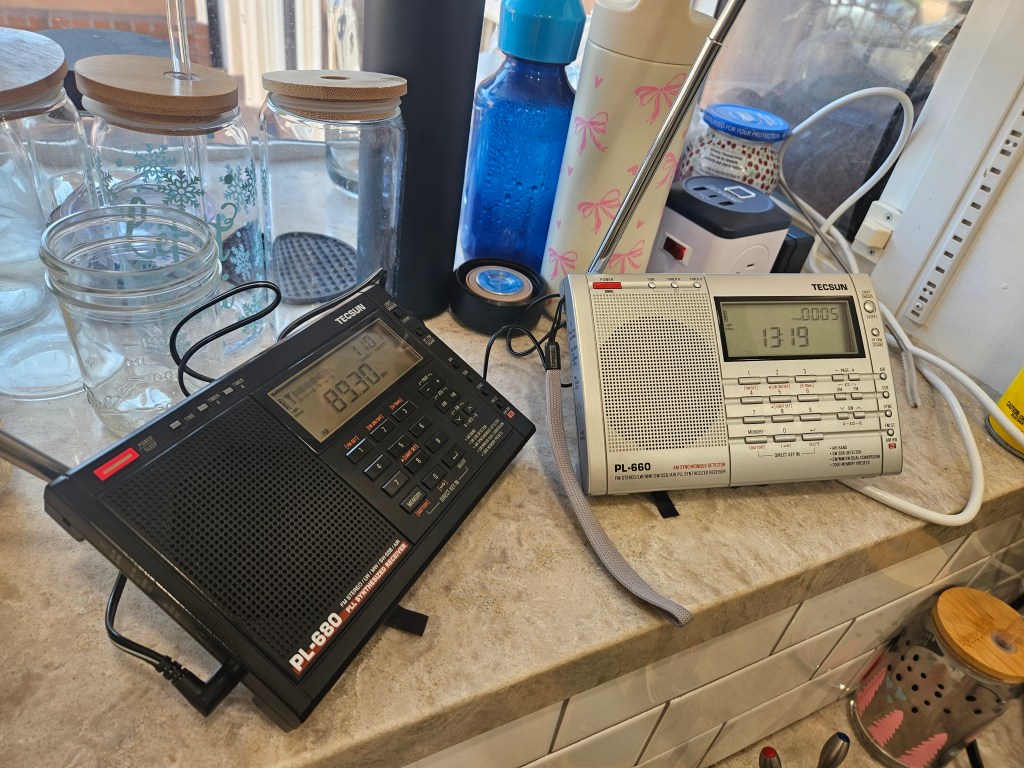
    When I catch sight of my black Tecsun PL-680—hulking, angular, unapologetically retro—I freeze like a Victorian child glimpsing a forbidden mechanical marvel through a shop window. My eyes widen, my breath catches. It’s the same reverence I once felt, age six, face pressed against the glass of a toy store, transfixed by the GI Joe helicopter with working rotors and the implied promise of war-zone adventure. Only now the battleground is a cluttered kitchen table, and the artillery is AM talk radio, jazz on shortwave, the solemn murmur of world news drifting in from another hemisphere.

    The desire to switch it on and be swallowed by its frequencies is so intense, it borders on insanity. I feel embarrassed by the depth of this longing, but not enough to stop. My smaller Tecsun PL-330 elicits the same pulse of joy—compact, stealthy, and with an antenna that telescopes like it’s reaching for God. These machines are not just radios; they’re sanctuaries. Each one is a cozy cockpit where I can retreat from reality and tune in to something more orderly, more measured, more mine.

    “On the spectrum,” my wife jokes, watching me cradle a shortwave receiver like it’s a newborn or a detonator. I laugh, but I know she’s not wrong. The way I look at these devices—mouth slightly open, posture slack, eyes glazed with devotion—is not what you’d call neurotypical. It’s the gaze of a man who has found something he understands in a world that too often makes no sense.

    I have no interest in being cured. Therapy doesn’t come with a frequency dial. Meditation never once pulled in Radio Romania International. And no mindfulness app can match the primal, analog thrill of catching a faint station through the hiss of the void.

    These radios are my proof—of eccentricity, yes, but also of what keeps me sane. They hum. They glow. They speak in languages I don’t understand but need to hear. And if that’s madness, I’m fine with it. I’ll be here with my Tecsun, smiling at static, laughing at myself, and tuning in to everything that doesn’t ask me to explain why.

  • Radio Reclaimed: The Proxy Friendship That Saves Your Sanity

    Radio Reclaimed: The Proxy Friendship That Saves Your Sanity

    A couple of months ago, as the Los Angeles wildfires raged, I found myself glued to a radio for live reports. A thought struck me like a lightning bolt: I had missed the radio. This ancient relic had been eclipsed by streaming devices, which, over the past decade, had somehow become my personal cocoon—a space where I meticulously curated my music and podcasts like a hyper-intelligent hermit with a PhD in self-isolation. I was alone, yes, but at least I had the comforting hum of algorithmically chosen tunes to keep me company. Then I realized: this wasn’t comfort. This was madness in a cocoon. My little silo, built to keep out the noise of the world, was also keeping out everything else that made me feel connected. I was losing my grip on reality, like the woman in “The Yellow Wallpaper” who could only see the world through the eyes of her claustrophobic madness.

    So, I did what any self-respecting, slightly paranoid adult would do: I bought a batch of high-performance radios, like the Tecsun PL-990, and I tuned back into the real world. I started listening to Larry Mantle’s voice again on LAist, to KJAZZ and KUSC—the classical music station that claims to be the most popular in the country. And after a few months of basking in their sonic embrace, I understood why KUSC is so beloved. It’s not just music; it’s a friend. The DJs don’t just announce the next piece; they drop in casual nuggets of composer trivia like old pals who just happen to know a lot about Bach’s temper. They are personal, conversational, and soothing, like a club of soundwave whisperers gently easing you into a state of calm with “your nightly lullaby” or music to “start your day.”

    KUSC doesn’t just play classical music. It plays the role of a companion—your anti-anxiety, anti-depression, virtual hug in the form of a radio signal. These aren’t just voices on the air; they’re voices that make you feel like you’re not alone, that someone is there to guide you through the chaos of your day. It’s the kind of subtle emotional manipulation you don’t mind because it’s just so comforting. If radio is going to survive the onslaught of streaming, it could do worse than to study KUSC’s Proxy Friendship model. There’s a lesson in that calm, gentle routine that could help even the most chaotic station become a lifeline in a world that feels like it’s constantly spinning off its axis.

  • Black Mirror’s “Joan Is Awful” and the Algorithmic Pact with the Devil

    Black Mirror’s “Joan Is Awful” and the Algorithmic Pact with the Devil

    If The Truman Show warned us about the dangers of involuntary surveillance masquerading as entertainment, Black Mirror’s “Joan Is Awful” updates the nightmare for the age of algorithmic narcissism and digital convenience. Where Truman was trapped in a fake world constructed for him, Joan willingly signs away her soul in the fine print of a Terms of Service agreement—an agreement she didn’t read, because who reads those when there’s AI-generated content to binge and oat milk lattes to sip?

    “Joan Is Awful” isn’t just a satire about streaming culture or artificial intelligence gone rogue. It’s a scalpel-sharp metaphor for Ozempification—our cultural surrender to the gods of optimization, where being frictionless is the highest virtue and being real is a liability. Ozempification isn’t just about weight loss. It’s about trimming down everything that makes us inconveniently human: messiness, contradictions, privacy, shame, even joy. We trade all of it for a pre-chewed, camera-ready version of ourselves that fits neatly into an algorithmic feed.

    Joan becomes the star of her own life not by choice, but by being optimized—flattened into a content-producing puppet who behaves like a mashup of the worst moments from her day. It’s not just that her life is turned into a reality show; it’s that the version of her that streams every evening is algorithmically engineered for maximum watch time and outrage. The real Joan is rendered irrelevant—just source material for a soap opera she has no control over.

    This isn’t dystopia, by the way. It’s Tuesday on Instagram.

    We live in a Truman Show remix where we’re both performer and voyeur, curating a persona for a crowd we cannot see and will never know. Like Joan, we sign away our likeness every time we click “Accept All Cookies.” Our deepest thoughts are mined, our image is harvested, our data is commodified, all in exchange for a life so smooth, so seamless, it might as well be a corporate press release.

    The chilling genius of “Joan Is Awful” lies in how no one seems particularly surprised by any of this. Her boyfriend leaves her not because he doubts her, but because the show made her look like a monster—and worse, a boring one. Her boss isn’t shocked; she’s just annoyed that Joan’s AI doppelgänger is bad for brand synergy. Even the therapist is part of the machine. Everyone has already accepted the premise: you don’t own your life anymore—Streamberry does.

    This is Ozempification in its final form. Not a sleeker body, but a sanitized self, scrubbed of complexity, repackaged for virality. Like reality TV contestants, Joan is hypervisible and utterly dehumanized, the protagonist of a story she didn’t write. And like so many of those contestants—remember the ones who cracked on camera only to be mocked in GIFs and memes—her breakdown is part of the entertainment. Joan’s humiliation isn’t a glitch; it’s the product. We want the breakdown. We crave the trainwreck. Because in a world that rewards optimized personas, the real human underneath is just noise to be edited out.

    In the end, Joan fights back, but only after enduring the full crucifixion of parasocial fame. It’s a cathartic moment, but also a reminder: she had to become completely unrecognizable—to herself and to others—before she could reclaim a shred of agency.

    The tragedy isn’t just that Joan’s life is broadcast without her consent. It’s that she ever believed she was still the protagonist in her own story. That’s the Ozempic Lie: that you can control the process while outsourcing the self. But once the machine gets hold of your image, your data, your likeness, it doesn’t need you anymore. Just a version of you that performs well.

    So yes, “Joan Is Awful” is awful. And Joan is all of us.

  • The Beatle, the Basement, and the Broken Dream: The Tragedy of a Paul McCartney Look-Alike

    The Beatle, the Basement, and the Broken Dream: The Tragedy of a Paul McCartney Look-Alike

    Reading Why We Write and seeing the world’s elite authors dissect the process that made them flourish forced me to confront a brutal truth: I am not a real writer.

    All those decades of grinding out abysmal, unreadable novels weren’t acts of literary craftsmanship—they were performance art, a cosplay so convincing that even I fell for it. I played the role of “the unappreciated novelist” with such dazzling commitment that I actually believed it. And what was my proof of authenticity? Misery and failure.

    Surely, I thought, only a true genius could endure decades of rejection, obscurity, and artistic suffering. Surely, my inability to produce a good novel was simply a sign that I was ahead of my time, too profound for this crass and unworthy world.

    Turns out, I wasn’t an undiscovered genius—I was just really, really bad at writing novels.

    Misery is a tricky con artist. It convinces you that suffering is the price of authenticity, that the deeper your despair, the more profound your genius. This is especially true for the unpublished writer, that tragic figure who has transformed rejection into a sacred ritual. He doesn’t just endure misery—he cultivates it, polishes it, wears it like a bespoke suit of existential agony. In his mind, every unopened response from a literary agent is further proof of his artistic martyrdom. He mistakes his failure for proof that he is part of some elite, misunderstood brotherhood, the kind of tortured souls who scowl in coffee shops and rage against the mediocrity of the world.

    And therein lies the grand delusion: the belief that suffering is a substitute for talent, that rejection letters are secret messages from the universe confirming his genius. This is not art—it’s literary cosplay, complete with the requisite brooding and self-pity. The unpublished writer isn’t just chasing publication; he’s chasing the idea of being the tortured artist, as if melancholy alone could craft a masterpiece. 

    Which brings us to the next guiding principle for Manuscriptus Rex’s rehabilitation: 

    The belief that the more miserable you are, the more authentic you become. This dangerous belief has its origins in a popular song–none other than Steely Dan’s brooding anthem, “Deacon Blues.”

    Like any good disciple, I’ve worshiped at this altar without even realizing it. I, too, have believed I’m the “expanding man”—growing wiser, deeper, more profound—while simultaneously wallowing in self-pity as a misunderstood loser. It’s a special kind of delusion, the spiritual equivalent of polishing a rusty trophy.

    To fully grasp this faith, I point you to The Wall Street Journal article, “How Steely Dan Created ‘Deacon Blues’” by Marc Myers. There, Donald Fagen and Walter Becker peel back the curtain on the song’s narrator—a man who could’ve just as easily been named Sad Sack Jones. He’s a suburban daydreamer, stuck in a dull, mediocre life, fantasizing that he’s a hard-drinking, sax-blowing rebel with women at his feet.

    Fagen admits the character was designed as a counterpoint to the unstoppable juggernaut of college football’s Crimson Tide—a gleaming machine of winners. In contrast, Deacon Blues is the anthem of the losers, crafted from a Malibu piano room with a sliver of Pacific Ocean peeking through the houses. Becker summed it up best: “Crimson Tide” dripped with grandiosity, so they invented “Deacon Blues” to glorify failure.

    And did it work. “Deacon Blues” became the unofficial patron saint for every self-proclaimed misfit who saw their own authenticity in his despair. He was our tragic hero—uncompromising, self-actualized, and romantic in his suffering.

    But then I read the article, and the spell broke. We were all suckered by a myth. Like the song’s narrator, we swallowed the fantasy of the “expanding man,” not realizing he was a con artist in his own mind. This isn’t a noble figure battling the world’s indifference—it’s a man marinating in his own mediocrity, dressed up in fantasies of scotch, saxophones, and self-destructive glamour.

    Walter Becker wasn’t subtle: the protagonist in “Deacon Blues” is a triple-L loser—an L-L-L Loser. Not a man on the cusp of greatness, but a man clutching a broken dream, pacing through a broken life. Fagen sharpened the knife: this is the guy who wakes up at 31 in his parents’ house and decides he’s suddenly going to “strut his stuff.”

    That sad, self-deluded basement dweller? That was the false prophet I’d built my personal religion around. A faith propped up by fantasies and self-sabotage.

    The man who inspired me wasn’t a misunderstood genius. He was a cautionary tale. A false path paved with jazz, liquor, and the comforting hum of failure.

    The slacker man-child isn’t just a tragic figure crooning in Steely Dan’s “Deacon Blues.” No, he walks among us—lounges among us, really—and I knew one personally. His name was Michael Barley.

    We met in the late 1980s at my apartment swimming pool while I was teaching college writing in Bakersfield, a place that practically invents new ways to suffocate ambition. A failed musician who had dabbled in a couple of garage bands, Michael was in his early thirties and bore such a stunning resemblance to Paul McCartney that he could’ve landed a cushy gig as a Vegas impersonator if only ambition hadn’t been a foreign concept to him. He had it all: the same nose, the same mouth, the same melancholy eyes, even the same feathered, shoulder-grazing hair McCartney rocked in the ’70s and ’80s. Sure, he was shorter, stockier, and his cheeks were pockmarked with acne scars, but from a distance—and, really, only from a distance—he was Paul’s sad-sack doppelgänger.

    Michael leaned into this resemblance like a man squeezing the last drops from a dry sponge. At clubs, he’d loiter near the bar in a black blazer—his self-anointed “Beatles jacket”—wearing a slack-jawed half-smile, waiting for some starry-eyed woman to break the ice with, “Has anyone ever told you…?” His pickup strategy was less a plan and more a form of passive income. The women did all the work; he just had to stand there and exist. The hardest part of the night, I suspect, was pretending to be surprised when they made the McCartney connection for the hundredth time.

    And then he disappeared. For six months, nothing.

    When Michael resurfaced, he wasn’t Michael anymore. He was Julian French—an “English musician” with a secondhand accent and thirdhand dreams. He had fled to London, apparently thinking the UK was clamoring for chubby McCartney clones, and when that didn’t pan out (shocking, I know), he slunk back to Bakersfield to live in his parents’ trailer, which, in a tragicomic twist, was attached to an elementary school where his father worked as the janitor and moonlit as a locksmith.

    But Michael—excuse me, Julian—was undeterred. He insisted I call him by his new British name, swore up and down that his accent was authentic, and we returned to our old haunts. Now, at the gym and in nightclubs, I watched him work the crowd with his faux-charm and faux-accent, slinging cars and cell phones like a man with no Plan B. His Beatles face was his business card, his only sales pitch. He lived off the oxygen of strangers’ admiration, basking in the glow of almost being someone important.

    But here’s the truth: Michael—Julian—wasn’t hustling. He was coasting. His whole life was one long, lazy drift powered by the barest effort. He never married, never had a long-term relationship, never even pretended to have ambition. His greatest challenge was feigning humility when people gushed over his discount McCartney face.

    Time, of course, is undefeated. By middle age, Julian’s face began to betray him. His ears and nose ballooned, his jowls sagged, and the resemblance to Paul McCartney evaporated. Without his one-note gimmick, the magic died. The women, the friends, the sales—they all disappeared. So, back to the trailer he went, tail tucked, learning the locksmith trade from his father, as if turning keys could unlock the door to whatever life he’d wasted.

    And me? I didn’t judge him. I couldn’t.

    Because deep down, I knew I was just as susceptible to the same delusion—the myth of the “Expanding Man.” That romantic fantasy of being a misunderstood artist, swaddled in self-pity, wandering through life with the illusion of authenticity. Like the anti-hero in “Deacon Blues,” Julian wasn’t building a life; he was building a narrative to justify his stagnation.

    And wasn’t I doing the same? By the late ’90s, I was approaching 40, professionally afloat but personally shipwrecked—emotionally underdeveloped, the cracks in my personality widening into canyons. I, too, was toeing that fine line between winner and loser, haunted by the possibility that I’d wasted years buying into the same seductive lie that trapped Julian.

    That’s the genius of the “Deacon Blue’s” Doctrine—a religion as potent as opium. It sanctifies self-pity, addiction, and delusions of grandeur, repackaging them into a noble code of suffering. It convinces you that stewing in your own misery is a virtue, that being a failure makes you authentic, and that the world just isn’t sophisticated enough to appreciate your “depth.”

    But here’s the truth no one tells you: eventually, life hands you your ass on a stick. That’s when you find out which side of the line you’re really on.

  • 3 College Essay Prompts for the Theme of the Erasure of the Real Self in Black Mirror

    3 College Essay Prompts for the Theme of the Erasure of the Real Self in Black Mirror

    Prompt 1:

    The Algorithm Made Me Do It: Ozempification and the Erasure of the Authentic Self in Black Mirror

    Prompt:
    Ozempification, a term drawn from the meteoric rise of the weight-loss drug Ozempic, refers not merely to physical transformation, but to the cultural obsession with algorithmic self-optimization—a reduction of the self into something that fits marketable templates of desirability, productivity, and visibility. In this sense, Ozempification is not about becoming one’s “best self,” but about conforming to the statistical average of social approval—a bland, performative version of humanity sculpted by metrics, surveillance, and commercial algorithms.

    In Black Mirror’s “Joan Is Awful” and “Rachel, Jack and Ashley Too,” examine how the process of Ozempification is portrayed as a crisis of identity and autonomy. How do these episodes dramatize the pressure to optimize or streamline one’s personality, body, or narrative to fit the expectations of corporate systems, streaming audiences, or digital avatars? And what is lost when the self is outsourced to algorithms or AI proxies?

    Sample Thesis Statement:
    While “Joan Is Awful” explores Ozempification through the algorithmic flattening of a woman’s messy humanity into a sanitized, marketable character, “Rachel, Jack and Ashley Too” presents a pop star whose real self is chemically sedated and algorithmically exploited to maintain a corporate-friendly brand—together, the episodes argue that Ozempification is not just an aesthetic pressure but a moral one, in which authenticity is sacrificed for compliance with machine-readable norms.


    Prompt 2:

    Plastic People: Ozempification, Femininity, and the Commodification of Pain

    Prompt:
    Ozempification, in its broader cultural usage, reflects a condition in which human identity is compressed into a palatable, profitable, and programmable version of itself, often mediated by AI, performance metrics, or pharmaceutical enhancements. Particularly for women, Ozempification demands that not only the body but also emotions, voice, and even pain must be flattened into consumable, cheerful data.

    Compare “Joan Is Awful” and “Rachel, Jack and Ashley Too” through the lens of Ozempification and its gendered implications. How are the women in these episodes coerced into performing streamlined versions of themselves for media systems that extract value from emotional trauma? How is rebellion framed—not as a revolution—but as a glitch in the system?

    Sample Thesis Statement:
    Both “Joan Is Awful” and “Rachel, Jack and Ashley Too” depict Ozempification as a uniquely gendered assault, in which female characters are turned into content-producing avatars that erase the messiness of their real emotions; the episodes critique a culture that demands women’s suffering be aestheticized, compressed, and sold back to audiences as inspirational entertainment.


    Prompt 3:

    Terms and Conditions Apply: Ozempification and the Surrender of Consent

    Prompt:
    In its metaphorical use, Ozempification speaks to a larger cultural trend in which people willingly or unknowingly sign away their depth, contradictions, and agency to systems that promise optimization. Whether through weight-loss drugs, algorithmic recommendations, or AI-generated personas, this phenomenon signals a loss of human autonomy dressed up as empowerment.

    In Black Mirror’s “Joan Is Awful” and “Rachel, Jack and Ashley Too,” analyze how Ozempification is less about force and more about engineered consent. How do these characters end up surrendering their identities to systems that claim to liberate them? What role does illusion—of control, of relevance, of success—play in facilitating that surrender?

    Sample Thesis Statement:
    Through Joan’s unwitting agreement to a soul-stripping user license and Ashley O’s drug-induced compliance with her brand’s transformation, both episodes reveal Ozempification as a process that cloaks dispossession in the illusion of choice, suggesting that in the age of algorithmic consent, autonomy is not taken—it’s given away in exchange for belonging.

  • When the DJ Lost His Mind & Played The Beatles’ “Hey Jude” for Three Hours Straight

    When the DJ Lost His Mind & Played The Beatles’ “Hey Jude” for Three Hours Straight

    It was a sweltering summer night in 1970, the kind of heat that melts your popsicle before you’ve unwrapped it and turns your family barbecue into a gladiator pit of passive-aggressive banter and steak smoke. Somewhere between my dad arguing about grill temps and my aunt trying to turn potato salad into a personality, the true spectacle of the evening wasn’t the charred meat or the mid-century familial dysfunction—it was what erupted over the airwaves.

    KFRC 610 AM, the mighty Top 40 beacon of San Francisco, had apparently been hijacked by a disc jockey teetering on the edge of reality. This radio shaman, perhaps emboldened by a bad acid trip or simply possessed by the spirit of Lennon and McCartney, played The Beatles’ “Hey Jude” on an endless loop for three solid hours.

    Not once. Not twice. Dozens of times.

    It was as if he’d discovered a wormhole in the Na-na-na-na-na-na-na dimension, and he was determined to drag the entire Bay Area through it, kicking and screaming—or, more likely, humming along with mounting psychosis. By the 12th replay, “Hey Jude” didn’t sound like music anymore; it was a mantra, a chant, a psychological experiment conducted in real time on unsuspecting citizens.

    At the time, DJs weren’t expected to be sane. Sanity was a liability.

    In fact, if your grip on reality was too tight, you probably worked in banking. Radio was for the unhinged, the beautifully deranged, the guys who played 9-minute prog-rock odysseys just to go smoke a joint or use the bathroom.

    One DJ at a rival station had a nightly tradition: every time he had to take a leak or inhale an entire bag of Cheetos, he’d cue up The Moody Blues’ “Nights in White Satin.” At nearly ten minutes long, it was the perfect alibi for sloth and snack breaks. And get this—listeners loved it. They called in and demanded it. That song didn’t just chart; it ascended like a slow-moving fog of existential poetry and flute solos.

    Suddenly, the 3-minute pop single was passé. Listeners wanted long, indulgent, vinyl-drenched feasts of music. “Suite: Judy Blue Eyes” wasn’t a song—it was an epic. It was our Ninth Symphony, a sprawling, self-important masterpiece that dared to be longer than your average sitcom episode.

    This was the golden era of the musical buffet, where DJs weren’t just tastemakers—they were lunatic conductors of cultural excess. Every drawn-out bridge and psychedelic outro was a sign that we had transcended the 45-rpm world of bubblegum pop and entered a new, freeform temple of indulgence.

    And if your DJ didn’t go off the rails every now and then, frankly, what the hell were you listening for?