Tag: travel

  • Exiled from Desert: A Bodybuilder’s Dream of Failure

    Exiled from Desert: A Bodybuilder’s Dream of Failure

    Last night I dreamed I lived in a place so stripped of imagination it had the confidence to call itself Desert, Arizona—as if the planners had looked at a map, shrugged, and said, “Why embellish? We’re in the desert. That’s our name.”

    In Desert, I was a bodybuilder. Not one of the marble statues you see in magazines, but a working stiff with a barbell and delusions of parity. My friends—my friends, I thought—were Serge Nubret and Robbie Robinson in their prime. Thirty years old, luminous, carved out of some superior mineral. We spent our afternoons at a man-made lake, discussing training splits, protein intake, and the eternal question of carbs—as if the fate of civilization hinged on oatmeal versus steak.

    For a while, I forgot who they were. That was the charm. They were just Serge and Robbie—men with opinions, not monuments with lats.

    Then I made the mistake that ruins most good things: I noticed the hierarchy. They were far beyond me in achievement. 

    One afternoon, the thought hit me with the force of a missed squat: I told them I didn’t belong. These were titans. I was a reasonably assembled civilian. I said as much—praised their greatness, confessed my inadequacy, pledged to work ten times harder to catch up.

    And just like that, the air changed.

    They didn’t argue. They didn’t correct me. They simply withdrew, as if I had violated an unspoken clause in the friendship agreement: Do not turn us into symbols. The moment I stopped seeing them as people and started seeing them as achievements, the spell broke. They eased me out of the circle with the quiet efficiency of men accustomed to dropping dead weight.

    A replacement arrived with the punctuality of a cautionary tale: a young Englishman in his early twenties, newly employed as a high school teacher, brimming with the kind of metabolic optimism that borders on arrogance. He made gains at a rate that suggested divine favoritism. Within weeks, he surpassed me. Within days of that, he lost interest in me. He graduated upward—into the company of Serge and Robbie—leaving me where all the surpassed are left: behind, holding yesterday’s program.

    That’s when I knew I had to leave Desert.

    My in-laws were waiting to drive me to Prescott Valley, a destination that sounded like a compromise. Before the journey, we stopped at an overnight smoothie station—an oasis for the nutritionally anxious. Imagine a row of blenders stretching into the horizon, bins of organic ingredients arranged like offerings, and travelers preparing their liquid penance before braving the heat.

    I approached the blender with the confidence of a man who has learned nothing.

    I added fruit. Then vegetables. Then protein powder. Then more of everything, because moderation is for people who have already succeeded. The machine whirred, strained, and then produced something biblical: a green, algae-like tendril that rose from the blender and clawed at the ceiling, as if trying to escape my dietary philosophy.

    The proprietor—a matronly woman in an apron who had seen too many men confuse excess with virtue—fixed me with a look that could curdle whey. “You overloaded it,” she said, with the calm authority of someone accustomed to cleaning up after ambition.

    Nearby, bodybuilder and YouTuber Greg Doucette produced a perfect smoothie with surgical precision and regarded me the way a pilot regards turbulence: an inconvenience best ignored. His competence was an indictment.

    We got in the car.

    As we drove away from Desert, the realization settled in: this wasn’t a relocation. It was a retreat. I had committed the small, accumulating sins of a man who wants the result without fully respecting the method. I ate buckwheat groats when I should have eaten steak and eggs. I entertained carbs with a softness bordering on affection. I mistook enthusiasm for discipline and variety for virtue.

    But the deeper failure wasn’t nutritional. It was philosophical. I had tried to stand among the great by admiring them as great, which is the surest way to exile yourself. I had reduced people to their achievements, and in doing so, reduced myself to a spectator.

    In Desert, that’s a disqualifying offense.

    And so I left, not because I was banished, but because I finally understood the terms of my own eviction: in a city that rewards precision, I had been imprecise—in diet, in discipline, and worst of all, in how I saw other people.
  • Your Electric Tea Kettle Isn’t Broken–Your Circuit Is Maxed Out

    Your Electric Tea Kettle Isn’t Broken–Your Circuit Is Maxed Out

    For three years, my kitchen and I lived in quiet harmony. The outlets behaved. The appliances coexisted. The breaker, that silent arbiter of domestic peace, stayed in its lane.

    Then the electric tea kettle staged a coup.

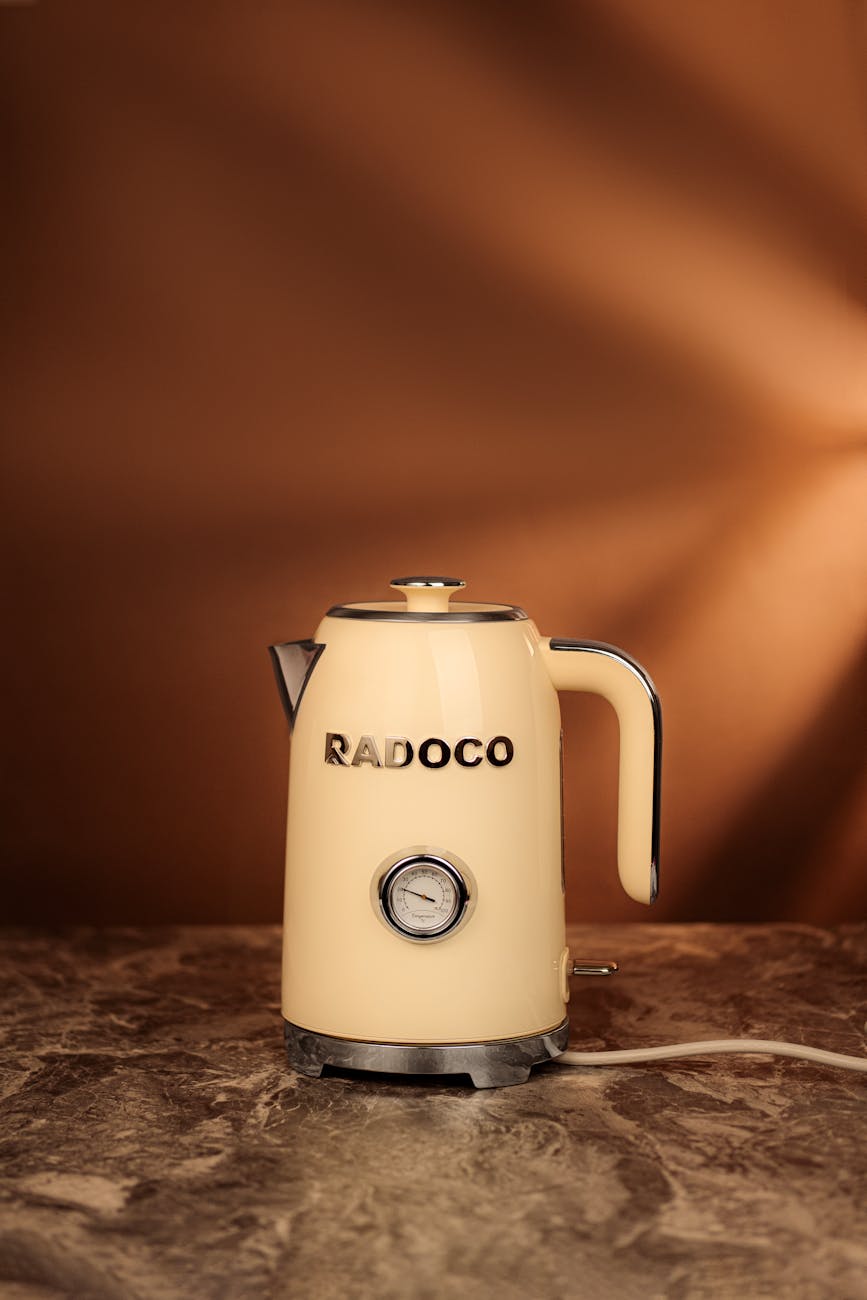
    It began innocently enough. I’d flip the switch to boil water—an act so mundane it barely registers as effort—and suddenly half the kitchen would go dark. The microwave surrendered. The toaster went mute. The refrigerator went dark. The breaker, like a bouncer tired of excuses, shut everything down with a single decisive click.

    At first, I suspected treachery in the wiring. Then I wondered if the breaker had grown old and irritable. But the evidence pointed, with increasing clarity, to the most polite appliance on the counter: the electric kettle.

    When I removed the kettle from the equation, the kitchen returned to its former civility. No trips. No outages. No drama. The tyrant had been identified.

    Here’s what I learned, and what most people don’t realize:

    An electric kettle is one of the most power-hungry appliances in your kitchen.

    As your electric kettle ages, its heating element becomes less efficient and it draws more amperage than it did originally. 

    I live in an old house that probably has a 15-amp circuit. My house needs an upgrade that includes dedicated 20-amp kitchen lines. 

    Most electric kettles draw around 1500 watts. On a standard 120-volt circuit, that’s roughly 12 to 13 amps—nearly the entire capacity of a typical 15-amp circuit.

    In other words, when you turn on an electric kettle, you’re not adding a polite guest to the party. You’re inviting a heavyweight who immediately eats most of the food and demands the stereo.

    For years, my kitchen tolerated the kettle. Then, seemingly overnight, it didn’t. Nothing dramatic changed. No sparks, no smoke, no cinematic failure.

    What changed was margin.

    Circuits don’t fail like lightbulbs. They drift. A little more load here. A little more resistance there. Maybe the kettle’s heating element aged and became less efficient, drawing slightly more current. Maybe I added a device or two without noticing. Maybe the breaker itself became more sensitive after years of heat cycles.

    Individually, these are minor shifts. Together, they push the system past its limit.

    Before:

    The circuit was operating just under capacity.

    Now:

    The kettle pushed it just over.

    And breakers don’t negotiate. They enforce.

    At this point, a reasonable person might reach for a surge protector. That would be a mistake.

    Surge protectors guard against voltage spikes—lightning, grid fluctuations, the occasional electrical tantrum. They do not increase how much power a circuit can handle.

    Plugging a kettle into a surge protector is like giving a sumo wrestler a nicer chair. It doesn’t make him lighter.

    My solution, for now, is a stovetop kettle.

    It feels like a step backward, but it’s actually a step sideways. The load shifts away from a single electrical circuit and spreads out through the stove. No breaker trips. No negotiations with the grid. Just water, heat, and a whistle that doesn’t require a reset button.

    There’s even a strange side benefit: boiling water now takes a minute of attention. You wait. You listen. The process regains a small measure of dignity.

    This summer when my electrician friend visits from Dallas, I’ll upgrade the kitchen circuits. Modern kitchens are built for modern demands—multiple 20-amp lines, distributed loads, appliances that can coexist without staging a power struggle.

    In other words:

    I’m not fixing the kettle. I’m upgrading the system that failed to contain it.

    If your breaker trips when you use an electric kettle, the problem is probably not mysterious, and it’s probably not dangerous—assuming the breaker is doing its job.

    It’s arithmetic.

    • Electric kettle: ~1500 watts
    • Circuit capacity: limited
    • Other appliances: already drawing power

    Add them together, and something has to give.

    We like to think our homes are stable, predictable systems. But they’re more like negotiations—between demand and capacity, convenience and constraint.

    My kettle didn’t break my kitchen. It revealed it.

  • The Night the Mechanical Diver Stayed Home

    The Night the Mechanical Diver Stayed Home

    Last night I escorted my family and in-laws to a breezy bistro in Redondo Beach, the kind of place where the ocean air does half the marketing. We sat on the patio while a two-man cover band—guitar and bass, faces cured by sun and time—worked their way through the canon: Gordon Lightfoot, Jim Croce, James Taylor. Their voices had the texture of driftwood. The songs arrived like postcards from a quieter century.

    For twenty years, a restaurant meant ceremony. I would strap on an expensive mechanical diver—the horological equivalent of cufflinks—and let it glint under low lighting as if I were auditioning for a role called “Man of Taste.” Five weeks ago, that instinct died without a funeral. In its place: a $110 Casio G-Shock GW-7900. No romance, no pretense, just a blunt instrument that tells time with the indifference of a wall clock. I wore it and felt, not diminished, but strangely settled. Our server had on a Casio Pro Trek. We exchanged a nod—the quiet recognition of two men who had defected from the same aesthetic regime.

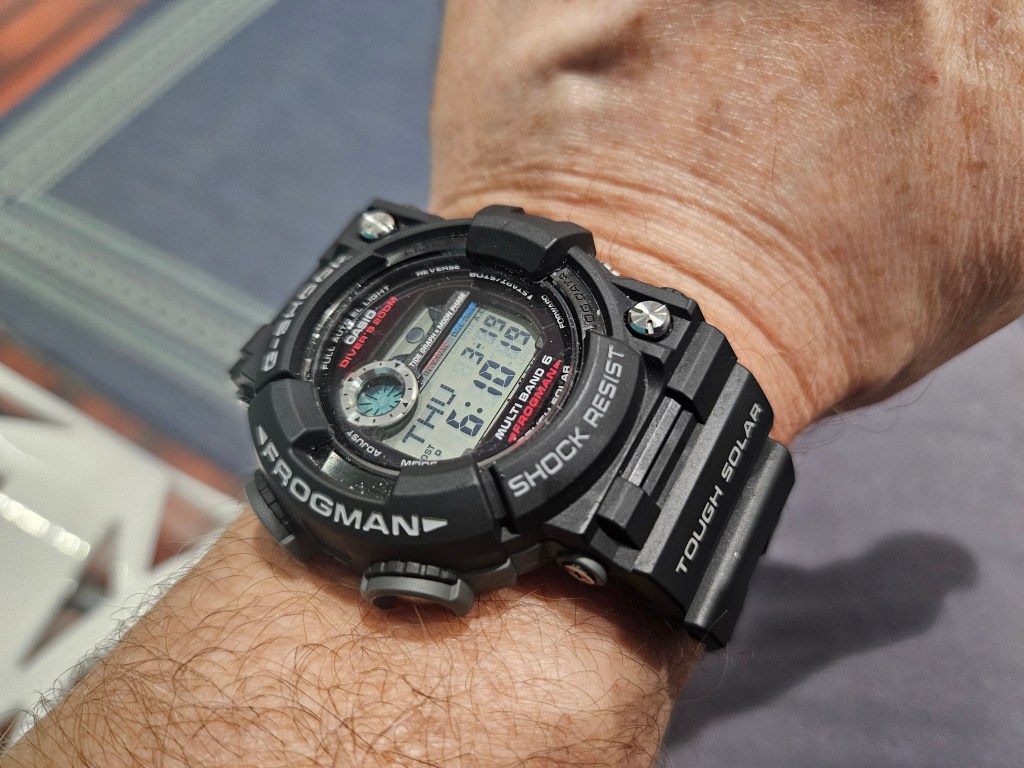
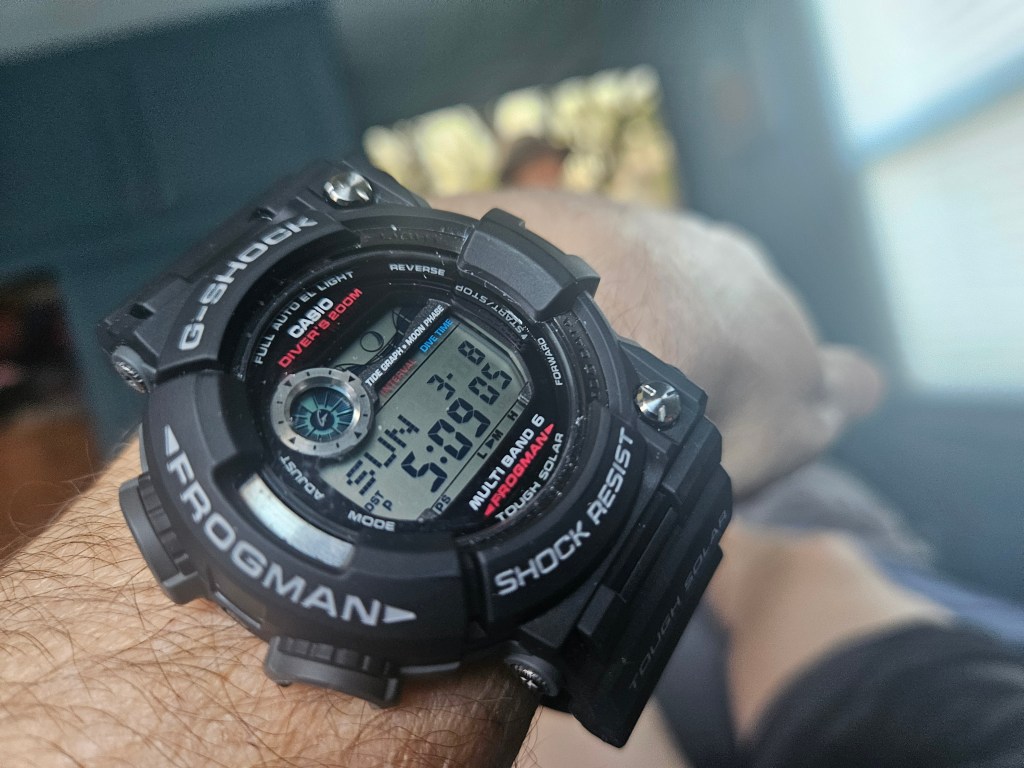
    Two weeks ago, I sold off a pair of mechanical divers. The absence registered as silence, not loss. Five weeks ago, I bought my first Tough Solar, Multiband-6 G-Shock—a Casio G-Shock Frogman GWF-1000. It feels like I’ve owned it for a decade. Time has warped, stretched, lost its usual proportions. My working theory is this: when an obsession mutates—when it takes a hard, unexpected turn—the brain lingers over the wreckage and the new terrain at once. Every moment gets over-processed, as if your mind is trying to reconcile two incompatible identities. The result is temporal inflation. Five weeks feel like ten years. Meanwhile, the watches I once coveted sit in their box like artifacts from a civilization I can’t quite remember belonging to.

    I’ve made a few videos documenting this conversion. To my mild alarm, a handful of people have followed suit—buying the GW-7900, aiming their watches toward the Fort Collins signal tower like amateur astronomers chasing a frequency instead of a star. It’s absurd, and yet there it is: evidence that I may have drifted, however briefly, into the low orbit of influence. Not authority. Not expertise. Influence—the most accidental and least deserved of modern currencies.

    The question now hovers: is this a phase or a verdict? Will some future mood—call it nostalgia, call it vanity—dust me with longing and send me back to my mechanical divers? Or have I crossed a line I can’t uncross, sealed inside a G-Shock logic that values precision over poetry? I don’t know. The future, like the tide, refuses to take requests.

    What I do know is this: today I’ll need to punish myself with extra work in the garage gym. Last night I demolished a crispy chicken sandwich on brioche while listening to “If You Could Read My Mind,” and the song’s quiet sorrow did nothing to slow me down. If anything, it provided a soundtrack for excess—the softest possible music for a thoroughly unrestrained appetite.

  • The Acrobats I Misjudged

    The Acrobats I Misjudged

    Sometime around 2018, I’d make the daily trek from the tennis courts to my office and pass the library lawn—a patch of campus that should have offered a quiet, pastoral glide into the workday. Instead, it hosted a recurring spectacle: half a dozen young men staging what can only be described as a low-budget Cirque du Campus. Shirtless or half-shirted, draped in genie pants or frayed denim cut-offs, they performed for an audience that did not exist. Their language was pure motion—flips that flirted with kung fu, kicks that negotiated with gravity, juggling routines that collapsed into chaos, and the occasional hacky sack circle, that ancient ritual of collegiate aimlessness.

    They were hungry—visibly, almost heroically so—for attention. Unfortunately, they possessed more appetite than assets. The enthusiasm was volcanic; the talent, less so. Their charm came in bursts, like a faulty engine. I found them unbearable. My morning walk, once a minor pastoral pleasure, was now hijacked by these blustering soltimbancos—performers without a stage, noise without necessity. I dismissed them with the easy confidence of a man certain he had outgrown foolishness.

    Today, I walked past that same lawn. Empty. Sunlit. Silent. The performance had ended without ceremony, as all such performances do. And I caught myself wondering—not with irritation, but with a strange, reluctant tenderness—what became of those boys.

    Because here is the inconvenient truth: youth is not a time for dignity. It is a sanctioned season of excess—of overreach, bad judgment, inflated self-regard, and public experiments in identity that collapse under their own absurdity. We try on personas the way they tried on those ridiculous pants: boldly, badly, and without permission. We embarrass ourselves in broad daylight and only later, with the benefit of distance, call it “growth.”

    So what changed? Not them. Me.

    Time performs a quiet surgery on the ego. It dulls the impulse to sneer and replaces it with something more complicated—recognition, perhaps, or even a flicker of respect. Those young men were not interrupting my peace; they were spending a currency I no longer possessed: the freedom to look ridiculous without apology.

    And so, to those lawn acrobats—wherever you’ve landed, whatever respectable disguises you now wear—I offer this: I hope life has been kind to you. I hope you found your footing, literal and otherwise.

    But for the sake of civilization, I must insist on one thing.

    Put a shirt on.

  • The Man Who Collected Timepieces and Ignored Time

    The Man Who Collected Timepieces and Ignored Time

    For more than twenty years, I lived inside the watch hobby like a man living inside a museum—reverent, obsessive, and curiously uninterested in the exhibits’ stated purpose. I rotated Seiko divers, admired their dials like stained glass, felt their rotors hum like distant machinery—and barely cared what time it was. That’s the joke with teeth: the one function watches exist to perform was never the center of my fixation. I wasn’t tracking time. I was courting it. Romance, nostalgia, the giddy satisfaction of gears responding to my wrist’s movement—those were my currencies. Timekeeping was just the pretext.

    G-Shock, in that world, was vulgar. Too digital. Too close to the smartwatch species I distrust—the glowing, needy devices that feel less like tools and more like supervisors. A G-Shock belonged on a mannequin posed mid-adventure, not on a human being trying to convince himself he possessed taste.

    And yet, sometime around 2010, the Frogman GWF-1000 slipped past my defenses. That asymmetrical case had a crooked charisma, like a boxer with a broken nose who still wins fights. I’d think about it, then shut it down with the usual litany: plastic, digital, not my tribe. I repeated those lines for years, the way a man repeats vows he secretly hopes to break.

    About a month ago, something in me stopped negotiating. The impulse didn’t arrive politely; it landed like a fever. I ordered the Frogman from Japan and watched it crawl through customs as if it were being interrogated for treason. Three weeks later, it showed up. I strapped it on.

    And there it was—presence. Not the polished, self-conscious presence of a luxury diver, but a blunt, physical authority. It didn’t ask for admiration. It assumed compliance.

    Then came the real disruption: Tough Solar and Multiband-6. Set it and forget it—except you don’t forget it, because it quietly corrects you. The watch syncs itself to atomic time, and suddenly you are no longer negotiating with approximation. You are pinned to reality. No drift, no romance, no mechanical shrug. Just accuracy, arriving nightly like a silent auditor.

    I didn’t expect the psychological effect. Being anchored to exact time produced a strange calm, the way a well-balanced diet makes you realize how erratic you’ve been eating. My mechanical divers—beautiful, expensive, lovingly chosen—never gave me that. They gave me narrative. The Frogman gave me certainty.

    The numbers didn’t help the old regime either. Five hundred dollars for the Frogman. A little over a hundred for the GW-7900 Rescue. Both delivered the same atomic truth. Meanwhile, my divers sat there—two, three times the price—offering charm, yes, but also drift, maintenance, and the faint suspicion that I’d been paying for the idea of precision rather than precision itself.

    Before I start sounding like a late-night infomercial for resin and radio signals, I need to detour—briefly, and deliberately—to a song that used to haunt my teenage gym sessions: “You Light Up My Life” by Debby Boone. It would float through the speakers while I benched and curled, all syrup and sentiment, and it filled me with such irritation that I lifted harder just to drown it out. The song wasn’t just bad; it was suffocating in its insistence on emotional purity.

    This matters because the watch hobby is full of that same conversion energy. The language of revelation. The before-and-after testimony. And men, in particular, are suckers for it.

    We don’t adopt hobbies; we convert to them. We don’t adjust our diets; we declare them. We don’t experiment; we renounce and rebuild. One week it’s mechanical purity, the next it’s quartz precision, then solar enlightenment. Each shift arrives with the force of a Damascus-road epiphany, complete with blind spots and overconfidence.

    I know this pattern because I’ve lived it—in watches, in fitness, in every arena where identity can be strapped on, laced up, or swallowed. Men love absolutes. We love the feeling of total overhaul. We love the idea of the metamorphosis so much we may have a figurine on our desk: Thing or Megatron–icons of brute conversion. We mistake intensity for clarity and call it transformation.

    So when I talk about G-Shock, I have to keep one hand on the brake. Because “being anchored to Real Time” has the flavor of conversion, and conversion is intoxicating. It makes you want to declare the past obsolete and the present definitive. It turns a purchase into a philosophy.

    And yet—facts remain stubborn. I’m typing this wearing the GW-7900 Rescue. Tomorrow will be the Frogman. The next day, back to the Rescue. The mechanicals sit in their box a few feet away, arranged with care, untouched—like last year’s tax documents: important, preserved, and no longer consulted.

    That doesn’t make G-Shock a religion. It makes it a correction. Whether I treat it as one or the other will determine whether this is clarity—or just another episode in a long history of well-dressed delusion.

  • Abducted by My Hygienist, Grounded by Reality

    Abducted by My Hygienist, Grounded by Reality

    My dentist—one year younger than I am, which in our age bracket feels less like a difference and more like a rounding error—peered into my mouth and delivered his verdict with clinical calm: two abrasions, self-inflicted, the result of brushing with the zeal of a man trying to erase his past. They would need fillings. Then, without missing a beat, he pivoted from my dental erosion to his own existential one. At sixty-three, he said, fatigue had begun to collect in the corners of his life. Travel, once a pleasure, had become an ordeal. He had lost interest in vacations altogether.

    He offered evidence. His sister-in-law had been stranded in Dubai while missiles stitched the sky over Iran. When she finally escaped, her flight climbed higher than usual to avoid the problem of being blown out of the sky—a detail that tends to sour the in-flight experience. Twenty hours later she landed in Dallas, dazed and displaced, only to discover she still needed to purchase a separate ticket to get home to Los Angeles. The modern vacation: a geopolitical obstacle course with snacks.

    I told him I understood completely. I, too, have entered the era of strategic energy management. I work out five days a week, yes—but I also schedule two naps a day with the seriousness of board meetings. Europe, at this point, feels less like a destination and more like a test of endurance. Cabo I can handle—two hours, a controlled burst. Miami, perhaps, if I marshal my resources. But a transatlantic flight? The return on investment collapses. The juice is no longer worth the squeeze.

    While we were discussing the slow recalibration of ambition, his technician went to work on my teeth with a collection of instruments that sounded like extraterrestrial diplomats arguing through a metal wall. Half sedated by the hum and whine, I drifted into the plausible conclusion that I had been abducted. Not metaphorically—literally. I was on a ship, somewhere above the atmosphere, being examined by beings who had mastered interstellar travel but still hadn’t figured out how to make dental procedures pleasant.

    Eventually, they released me—back into the chair, back into my life—with instructions to gargle fluoride and abstain from food and water for thirty minutes. The kind of post-op protocol that suggests the aliens, for all their advancements, remain deeply committed to inconvenience.

  • The Moral Danger of Divine Cheesecake

    The Moral Danger of Divine Cheesecake

    Last night I had a dream that unfolded with the logic and extravagance of a Fellini film set on a public beach. I discovered a stray dog wandering along the shoreline, a scruffy creature with the melancholy dignity of someone who had seen too much of the world’s indifference. The dog could speak. His first words were disbelief. He could not imagine that I, a random human loitering by the Pacific, intended to adopt him.

    To prove my sincerity—and perhaps to apologize for the miserable hand life had dealt him—I performed what can only be described as an act of culinary sorcery. With no apparent effort, I summoned two desserts out of thin air and placed them on a small café table facing the ocean. One was a mango cheesecake the size of a steering wheel, glowing with tropical radiance. The other was a monumental chocolate cake decorated with extravagant ribbons and shell-like ridges of frosting, the sort of cake that looks less baked than sculpted.

    The dog, clearly a creature of refinement, approached the cake with delicate reverence, nibbling with the restraint of a Parisian pastry critic. I told him not to worry—I knew of special utensils designed specifically for dogs who wished to eat cake with dignity. I would run downtown and return in minutes.

    That’s when the trouble began.

    When I returned to the café table, I found a woman plunging a bakery knife into my cake with the stealth of a pirate raiding a treasure chest. I launched into a lecture about theft and decency. Mid-sermon, another woman attempted a lightning strike on the mango cheesecake, hoping to slice off a piece before the moral police arrived. I drove her off as well.

    In that moment it dawned on me: these desserts were not ordinary desserts. They were supernatural artifacts. Something about their beauty radiated outward like perfume, alerting passersby that heaven had briefly opened a bakery on the beach. People could sense it. They were willing to bend their morals for a taste. And I had a darker suspicion—once someone tasted the cakes, the bending of morals might turn into a full collapse.

    The dog and I decided the beach was no longer safe for divine pastries. We relocated to the lobby of a nearby hotel, where the two of us quietly devoured the cakes like conspirators protecting a sacred relic. Strangely, the effect on us was the opposite of what I had feared. Each bite seemed to make us kinder, calmer, more decent versions of ourselves.

    Between bites, I told the dog he would never be homeless again. He would live with me forever. He thanked me with the solemn gratitude only a talking beach dog can muster.

    Then he asked the obvious question: how had I managed to summon cakes of such celestial quality?

    I admitted the truth. I had no idea what I had done or how I had done it. But one thing was clear: it was a one-time miracle. The bakery of heaven had closed its doors.

    The rest of our lives, the dog and I would have to live on ordinary meals—and the memory of that impossible dessert.

  • The Signal Hunter: From Vintage Radios to Atomic G-Shocks

    The Signal Hunter: From Vintage Radios to Atomic G-Shocks

    For a long time before I became a watch obsessive, I was a radio obsessive. This was the early 2000s, when my idea of a thrilling evening involved testing AM sensitivity and comparing FM clarity the way sommeliers compare Burgundy. I developed an unhealthy admiration for 1960s and 70s Sony and Panasonic radios—machines that looked as if NASA engineers had been given permission to design living-room furniture.

    That obsession never really left. I still keep half a dozen high-end Tecsun radios scattered around the house like electronic houseplants. One in the kitchen. One in the bedroom. One in the garage. Each quietly sipping signals from the air.

    Over the next two decades my attention drifted from radios to watches, and not modest watches either. I assembled a small stable of Seiko mechanical divers, some pushing well north of three thousand dollars. They were beautiful machines—tiny brass orchestras ticking away beneath sapphire glass.

    Then, about a month ago, something strange happened. I unplugged emotionally from the mechanicals and wandered into the strange, glowing world of G-Shock Multiband-6 atomic watches.

    And to my surprise, I’m having more fun with this hobby than I ever did before.

    These watches cost a fraction of my mechanical divers. Yet I’m connecting with them more deeply. That should bother me. It doesn’t.

    But let’s not dramatize this as some kind of betrayal of my mechanical diver heritage. This is not treason. It’s zoning.

    Think of it like Jay Leno’s Big Dog Garage near the Burbank airport. Leno divides his collection between vintage machines and modern ones. Two different eras. Two different moods.

    My watch world now works the same way.

    On one side of the garage sit my mechanical divers. They’re the horological equivalent of a 1959 BMW 507 convertible with a four-speed manual. When I strap one on, it’s like taking a country drive through nostalgia. The wind is loud. The ride is bumpy. The engine chatters like a coffee grinder full of marbles.

    And occasionally, that experience is glorious.

    But as the years pile up, those drives become less frequent. The wind noise, the rattling, the mechanical fussiness—eventually the romance demands a bit more patience than my bones want to give.

    Now walk across the garage.

    Here you’ll find the modern fleet: my Multiband-6 G-Shocks.

    These are the Honda, Lexus, and BMW sedans of the watch world. Smooth handling. Effortless precision. A cabin so insulated from chaos that time itself arrives wirelessly in the middle of the night.

    Moving between a G-Shock and a mechanical diver is like stepping from a luxury sedan into a vintage convertible. Two different universes. Neither one replaces the other. You simply choose which universe you feel like visiting.

    And as my eyes grow older and slightly crankier, I can already see where I may end up parking more often: something like the G-Shock Mudman GW-9500 with a big positive display.

    Positive display only, mind you. Negative displays are pure muscle-flex cosplay. I already get plenty of testosterone from the armored tank aesthetic of G-Shock design. I don’t need the digits hiding in a cave as well.

    But here’s the deeper truth.

    My attraction to Multiband-6 watches has quietly returned me to my radio roots.

    The vintage radio hobby and the atomic watch hobby attract the same personality type. They scratch the same itch.

    Both revolve around the quiet thrill of pulling invisible signals out of the air.

    In that sense, I am what I like to call a Signal Hunter.

    A signal hunter doesn’t simply collect equipment. He collects moments of reception. The tiny surge of satisfaction when a device—a Sony shortwave radio or a G-Shock atomic watch—locks onto something traveling through the ether.

    The world is whispering signals constantly. Most people never notice.

    But if you have the right instrument, the air suddenly comes alive.

    To improve my odds of catching those signals, I recently ordered an industrial pipe jewelry and headphone stand. Apparently many G-Shock owners swear that letting the watch rest overnight on a piece of metal—like a pipe or curtain rod—helps the antenna catch the atomic time signal more reliably.

    The moment I read this, resistance was futile. I ordered the stand immediately.

    Because suddenly I was six years old again.

    I had my Batman Bat-Signal flashlight. I had my decoder ring. And the universe was sending secret messages again.

    Syncing my G-Shocks has become a nightly ritual.

    And rituals are my natural habitat.

    Coffee. Oatmeal. Protein powder. Kettlebells. Mechanical watch winding. Atomic watch syncing.

    Different objects.

    Same impulse.

    Order the world. Listen closely. Catch the signal.

  • The Day Grief Turned Into Courage at Canyon High School

    The Day Grief Turned Into Courage at Canyon High School

    This happened about fifty years ago, so forgive me if some of the details have softened around the edges. Memory fades, but certain moments burn themselves into the mind so deeply that time cannot erase them. This is one of those moments.

    I was fourteen, a freshman at Canyon High School. It was during PE, just before lunch, and we were on the outdoor basketball courts. The courts sat beside a grassy field that sloped down into a steep canyon. A narrow trail zigzagged up the canyon wall toward a quiet residential neighborhood above us.

    The trail had its regular occupants: the self-appointed tough guys who preferred ditching PE to playing sports. They would lean on the canyon tiers like spectators in cheap seats, laughing at the rest of us for following the rules.

    One of them was a loudmouth whose name I’ve forgotten. Let’s call him Jeremy.

    That day Jeremy and his friends stood above us on the canyon trail, tossing dirt clods down onto the courts. Most of them missed, but one landed close enough to sting the air around my friend Mark Redman.

    Mark stood out among us. He was over six feet tall, lean and muscular, with long black wavy hair that brushed his shoulders. He ran track and threw the javelin. Quiet, mostly to himself. My friends had recently told me that Mark had just lost a parent. I don’t remember whether it was his mother or father, but I remember the grief in his eyes when I offered my condolences.

    When the dirt clod nearly struck him, Mark looked up and calmly told Jeremy to cut it out.

    Jeremy grinned and shouted something cruel back down. I don’t remember the exact words, but it was the kind of remark meant to wound—something low and cheap.

    Then something changed.

    Mark went perfectly still. His eyes locked onto Jeremy. The expression on his face shifted into something I will never forget: fury mixed with resolve, the kind of cold certainty that comes when a man has decided exactly what must happen next.

    Without a word he tore off his tank top, balled it up, and started climbing the canyon.

    The transformation stunned everyone.

    But it wasn’t only Mark who transformed. So did Jeremy. His grin vanished. His mouth hung open as he watched Mark coming toward him. In that instant he understood the situation perfectly. He could run, but Mark was faster. He could fight, but Mark was animated by a courage Jeremy would never have. So Jeremy did the only thing left to him.

    He stood there and waited.

    When Mark reached him, Jeremy made a weak attempt to defend himself—more out of pride than hope. It lasted only seconds. Mark pummeled Jeremy to the ground, delivered the message clearly, and told him never to treat him that way again.

    Then, without celebration or swagger, Mark walked back down the canyon, disappeared into the locker room, and left the rest of us standing there in stunned silence.

    Over the years I’ve thought about that moment often. Watching a grieving young man summon that kind of conviction gives me a kind of moral clarity that has stayed with me. In a world that often feels confused and chaotic, I remember the look on Mark’s face that day.

    Mark, wherever you are, I have never forgotten you.

  • When Giving a Watch to Someone Is the Ultimate Selfishness

    When Giving a Watch to Someone Is the Ultimate Selfishness

    Core members of G-Shock Nation revere the GW-5000U because it represents the moment the Square stopped flexing and started aging well. It carries the 1983 blueprint, but underneath the familiar shape lives grown-up engineering: steel inner case, screwback, soft resin that disappears on the wrist, solar power, Multiband 6. No tactical cosplay. No feature inflation. No desperate attempt to look extreme. It sits there dense, quiet, perfectly accurate, and emotionally undemanding. To the initiated, that restraint signals maturity. The owner is no longer chasing the next G-Shock. He has arrived. The GW-5000U isn’t admired for excess; it’s admired for restraint. In a hobby addicted to novelty, the greatest watch is the one that makes novelty feel unnecessary.

    Collectors buy the GW-5000U the way serious readers buy a hardbound classic they’ve already finished online. The object represents a principle. It is the philosophical center of the Square ecosystem—the pure form. Screwback steel, operational silence, atomic precision, no theatrics, no gimmicks. Owning it signals allegiance to a worldview: function over spectacle, permanence over churn, competence over excitement. The purchase isn’t about need. It’s about completion. Without the 5000U, the collection feels like a conversation circling its point. With it, the argument finally lands. The watch becomes less a tool than an anchor—an idea made physical, a quiet declaration that you are no longer collecting features; you are collecting coherence.

    And yet, as you contemplate its greatness, a physical reality intrudes. The watch is small. Your eight-inch wrists and decades of barbell diplomacy have produced forearms that turn the Square into a polite suggestion of a watch. You no longer care about wrist presence, but wearing something that looks like a borrowed child’s timepiece crosses a line. Philosophical perfection is one thing. Visual credibility is another.

    Then comes the rationalization. Your twin daughters. The GW-5000U would look perfect on them. It would teach them punctuality, discipline, operational thinking. It would introduce them to the beauty of silent precision. It would, naturally, make them chips off the old block. You present the idea with the enthusiasm of a man offering enlightenment. They respond with the facial expression normally reserved for unexpected homework. In that moment, clarity arrives. This isn’t mentorship. This is Proxy Justification—the collector’s sleight of hand, where a purchase he cannot defend for himself is reassigned to someone else while quietly serving his own emotional agenda. The language is generosity. The motive is displacement. He isn’t buying a gift. He’s buying wrist time by proxy.

    The realization lands hard and fast. The box remains unpurchased. The daughters remain uninterested. And you step back, a little embarrassed, a little wiser, and briefly sober. In a hobby built on elegant rationalizations, the rarest achievement isn’t the right watch. It’s the moment you recognize a bad story—and don’t tell it to yourself.