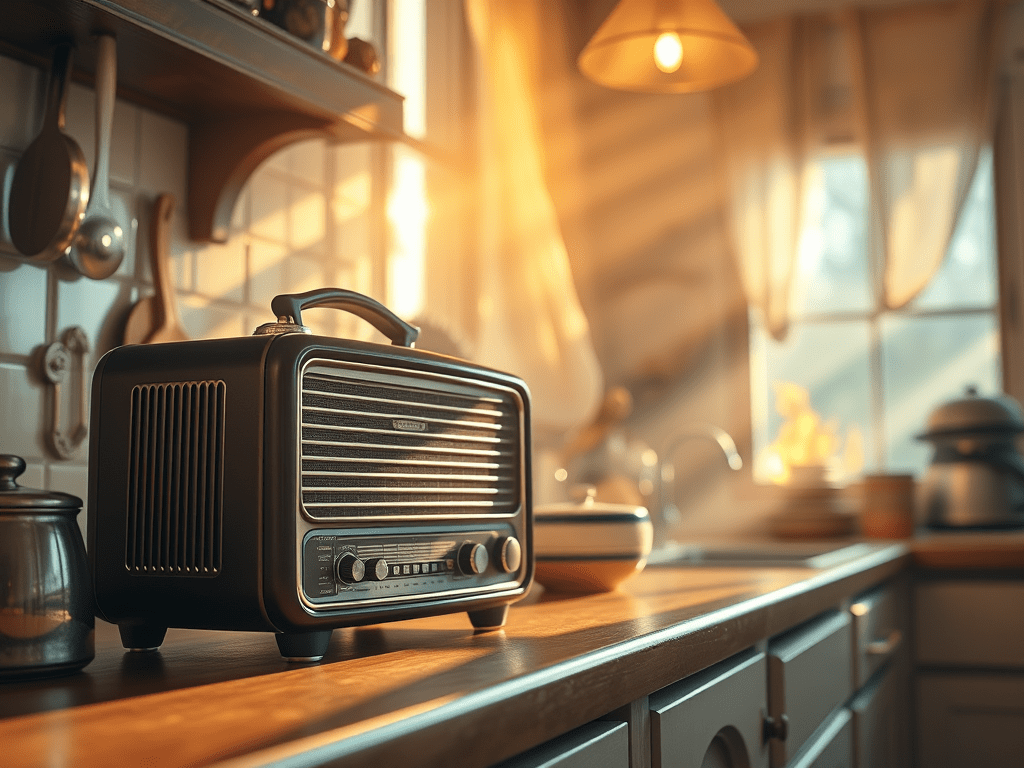
The 2025 Los Angeles wildfires, blazing with apocalyptic fury, prompted me to do something I hadn’t done in years: dust off one of my radios and tune into live local news. The live broadcast brought with it not just updates but an epiphany. Two things, in fact. First, I realized that deep down, I despise my streaming devices—their algorithm-driven content is like an endless conveyor belt of lukewarm leftovers, a numbing backdrop of music and chatter that feels canned, impersonal, and incurably distant. Worst of all, these devices have pushed me into a solipsistic bubble, a navel-gazing universe where I am the sole inhabitant. Streaming has turned my listening into an isolating, insidious form of solitary confinement, and I haven’t even noticed.
When I flipped on the radio in my kitchen, the warmth of its live immediacy hit me like a long-lost friend. My heart ached as memories of radio’s golden touch from my youth came flooding back. As a nine-year-old, after watching Diahann Carroll in Julia and Sally Field in The Flying Nun, I’d crawl into bed, armed with my trusty transistor radio and earbuds, ready for the night to truly begin. Tuned to KFRC 610 AM, I’d be transported into the shimmering world of Sly and the Family Stone’s “Hot Fun in the Summertime,” Tommy James and the Shondells’ “Crystal Blue Persuasion,” and The Friends of Distinction’s “Grazing in the Grass.” The knowledge that thousands of others in my community were swaying to the same beats made the experience electric, communal, alive—so unlike the deadening isolation of my curated streaming playlists.
The fires didn’t just torch the city—they laid bare the fault lines in my craving for connection. Nostalgia hit like a sucker punch, sending me down an online rabbit hole in search of a high-performance radio, convinced it could resurrect the magic of my youth. Deep down, a sardonic voice heckled me: was this really about better reception, or just another pitiful attempt by a sixty-something man trying to outrun mortality? Did I honestly believe a turbo-charged radio could beam me back to those transistor nights and warm kitchen conversations, or was I just tuning into the static of my own existential despair?
Streaming had wrecked my relationship with music, plain and simple. The irony wasn’t lost on me either. While I warned my college students not to let ChatGPT lull them into embracing mediocre writing, I had let technology seduce me into a lazy, soulless listening experience. Hypocrisy alert: I had become the very cautionary tale I preached against.
Enter what I now call “Ozempification,” inspired by that magical little injection, Ozempic, which promises a sleek body with zero effort. It’s the tech-age fantasy in full force: the belief that convenience can deliver instant gratification without any downside. Spoiler alert—it doesn’t. The price of that fantasy is steep: convenience kills effort, and with it, the things that actually make life rich and rewarding. Bit by bit, it hollows you out like a bad remix, leaving you a hollow shell of passive consumption.
Over time, you become an emotionally numb, passive tech junkie—a glorified NPC on autopilot, scrolling endlessly through algorithms that decide your taste for you. The worst part? You stop noticing. The soundtrack to your life is reduced to background noise, and you can’t even remember when you lost control of the plot.
But not all Ozempification is a one-way ticket to spiritual bankruptcy. Sometimes, it’s a lifeline. GLP-1 drugs like Ozempic can literally save lives, keeping people with severe diabetes from joining the ranks of organ donors earlier than planned. Meanwhile, overworked doctors are using AI to diagnose patients with an accuracy that beats the pre-AI days of frantic guesswork and “Let’s Google that rash.” That’s Necessary Ozempification—the kind that keeps you alive or at least keeps your doctor from prescribing antidepressants instead of antibiotics.
The true menace isn’t just technology—it’s Mindless Ozempification, where convenience turns into a full-blown addiction. Everything—your work, your relationships, even your emotional life—gets flattened into a cheap, prepackaged blur of instant gratification and hollow accomplishment. Suddenly, you’re just a background NPC in your own narrative, endlessly scrolling for a dopamine hit like a lab rat stuck in a particularly bleak Skinner box experiment.
As the fires in L.A. fizzled out, I had a few weeks to prep my writing courses. While crafting my syllabus and essay prompts, Mindless Ozempification loomed large in my mind. Why? Because I was facing the greatest challenge of my teaching career: staying relevant when my students had a genie—otherwise known as ChatGPT—at their beck and call, ready to crank out essays faster than you can nuke a frozen burrito.
 Cinemorphosis
Leave a comment