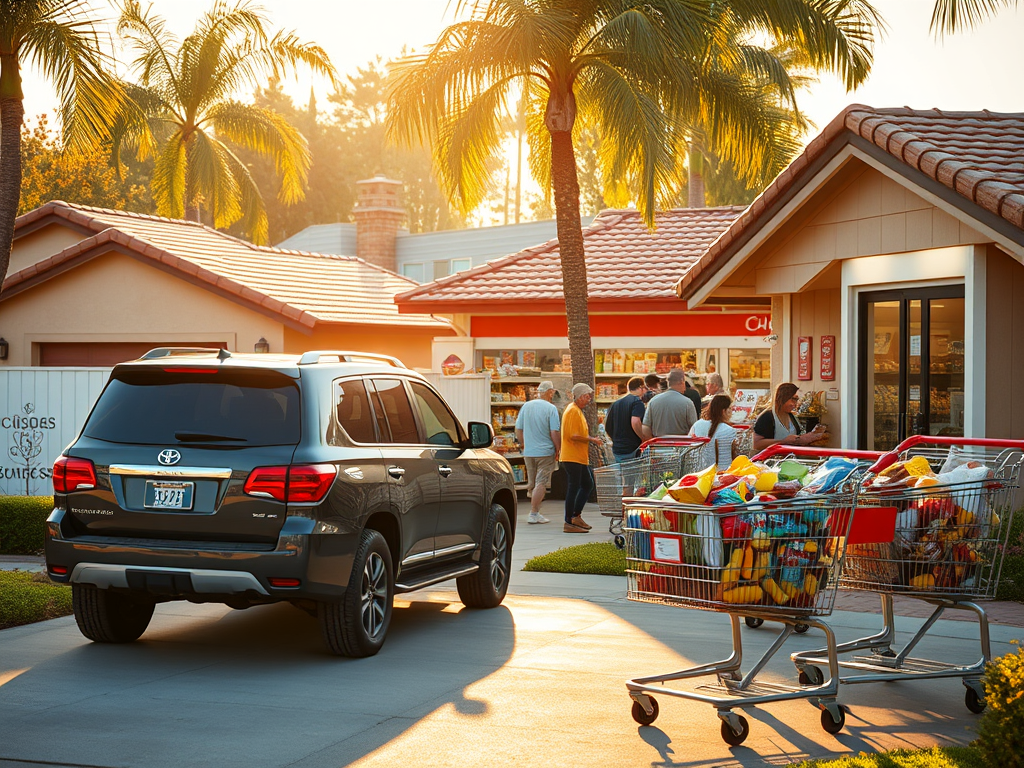
I live in the padded belly of the beast—a Southern California suburb so manicured and overpriced it feels like a gated community built on a diet of Zillow listings and delusion. Here, tiny homes crouch next to high-performing schools like obedient little dogs, and you can practically hear the sound of families hemorrhaging two-thirds of their salary just for the right to say they live in “one of the most desirable zip codes on Earth.” Never mind the suffocating health insurance premiums, the rent-sized car payments, or the phones that become obsolete faster than the milk expires. Somehow, despite all this, we still manage to gorge ourselves into oblivion.
And gorge we do—with the kind of unapologetic culinary nihilism that says: Why not chase your statins with a triple-decker guacamole onion ring bacon cheeseburger the size of a toddler’s head? These meals don’t nourish. They sedate. They carpet-bomb the body with a week’s worth of calories and lull us into a coma only broken by the siren song of the ice cream truck chirping its Pavlovian jingle.
Sedated and bloated, we require appropriate transport. Enter the all-terrain behemoths—SUVs that could ferry a minor league baseball team but are usually occupied by one distracted suburbanite and their half-finished iced mocha. These vehicles aren’t just cars—they’re padded rooms on wheels, egg-shaped mirrors of their drivers’ own expanding silhouettes, stuffed with sensors to correct for our chronic inattention and entertainment centers to distract us from the creeping dread that this might be it.
Their true purpose? A fantasy of freedom. A lifestyle accessory for people who dream of hitting the open road, yet refuse to drive more than two miles for a pedicure, a Panda Express run, or the latest Marvel sequel. Why venture beyond the safety of the suburb when out there lies gridlock, road rage, parking scarcity, and the occasional wildfire licking the edge of the 405 like it’s auditioning for a role in Dante’s Inferno: The LA Edition?
So we stay. We scroll. We snack. And when the walls of this sun-bleached hamster cage start closing in, we do what any respectable suburbanite does—we shop.
The heart of our civic religion is the membership superstore, a concrete cathedral where the faithful line up before opening like doomsday preppers. We flash our membership cards like VIP badges to the apocalypse, and once inside, the frenzy begins: cartloads of triplet-pack peanut butter, bulk tubs of sourdough pretzels, yogurt for an army, and the holy grail—those chocolate cream-filled sandwich cookies that whisper, You’ve earned this.
Ravenous and under-cabineted, many of us start devouring our haul in the parking lot just to make room for more. We don’t so much eat as conduct calorie triage, clearing shelf space in our bellies before the next Costco pilgrimage. And thus, a problem festers—one so normalized it’s barely acknowledged: obesity.
But we don’t call it that. Here, being overfed is reframed as being “well-lived.” Belly overhang becomes a badge of leisure. A neck absent from sight is recast as comfort. A visible jawline is regarded with suspicion, even disdain.
Yet behind this rebranding lies a biochemical horror show: insulin resistance, fat-marbled pancreases, and a Pavlovian addiction to sugary, creamy, sprinkle-laden beverages masquerading as coffee. Our organs are staging quiet rebellions while we sip iced mochas adorned like carnival floats.
I don’t sketch this grotesque portrait of Suburbia to mock my neighbors. I sketch it because I am them. I, Jeff McMahon, reside in this land of ambient adiposity and quiet desperation—a land I’ve come to call Suburgainia.
Suburgainia is a soft dystopia stitched together with frozen yogurt kiosks, massage chairs, and drive-thru frappuccinos. It is a place where convenience calcifies into inertia, and waistlines widen in lockstep with our sense of entitlement. It is where obesity isn’t a warning sign—it’s a lifestyle brand.
Losing weight in Suburgainia isn’t just about willpower—it’s an act of rebellion against a system meticulously designed to keep you soft, slow, and sedated. You can’t change what you refuse to confront, and the truth is this: our environment is a padded cell masquerading as paradise. The enemy isn’t just calories—it’s culture. It’s the drive-thru dopamine, the Costco-induced euphoria, the suburban sprawl that turns a three-block stroll into a vehicular event.
Real progress begins when we stop romanticizing these indulgences and start recognizing them for what they are: fat traps dressed in convenience, landmines stitched into the elastic waistband of modern life. Reclaiming our health requires more than kale and kettlebells—it demands clear eyes and an honest reckoning with the architecture of excess that surrounds us.
Somewhere beneath this quilt of belly fat and bulk-pack chicken bakes lives a man with arteries worth saving. But before I can meet him, I have to scale the fat mountain I’ve built—one step, one salad, one unsweetened iced tea at a time.
Will I make it to the summit without collapsing from myocardial betrayal? I don’t know. But I’ve started the climb. And for now, that’s enough.
 Cinemorphosis
Leave a comment