In the early 90s, my brother managed a spa restaurant at the Grand Wailea in Maui—a temple of eucalyptus steam and $18 cucumber water. His girlfriend, the head chef, ruled the kitchen with the calm authority of a health-conscious empress. I visited one summer and found myself one morning alone at breakfast, sipping coffee and trying to look like a man deep in thought rather than a tourist waiting on papaya boats.
At the table next to mine sat a striking brunette with the kind of diamond on her finger that doubles as a paperweight. She started talking. To me. Boldly, intimately, as if we were two old conspirators.
She was thirty-five, married, and bored. Grew up in Santa Monica. Modeled a little. Dabbled in chaos. Now she was married to a man forty years her senior—a retired Navy officer turned business tycoon currently swimming laps in the resort pool while his wife flirted with the help. She pointed out one of the servers, a freckled boy in his early twenties pouring her orange juice with the dreamy smile of a man about to be devoured.
“I’m sleeping with him,” she said, as casually as if she were announcing she’d tried the papaya last time and found it too sweet.
She spoke of her marriage like a real estate deal: mutually beneficial, emotionally vacant, and efficiently managed. Her husband financed her yoga retreats. She provided him with public companionship and discreet absence. After breakfast, she was off to a vegetarian cooking class to learn how to live forever.
She told me she was researching longevity, obsessed with health, and that she was trying to convince her husband to move to Sedona, Arizona—“the best place in the country to live a long life,” she said.
Back then, I filed Sedona away in the brain folder labeled someday. That place. The Holy Grail of Health. A desert Shangri-La where your body becomes pure and your soul gets exfoliated.
I didn’t make it there until a few weeks ago.
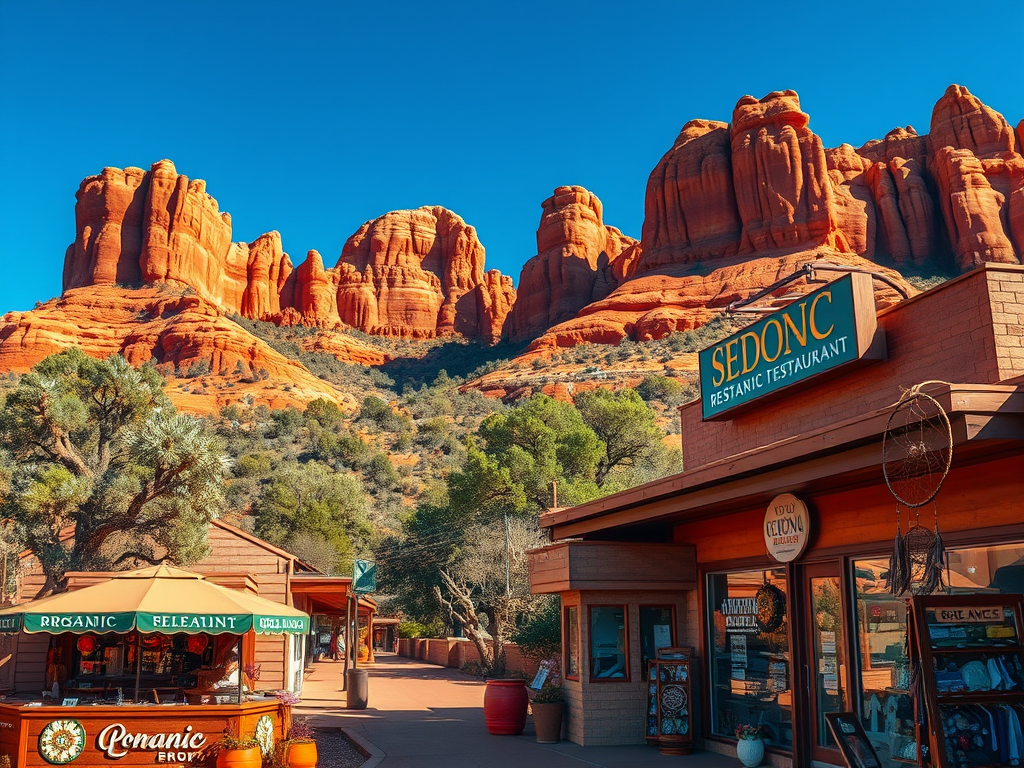
We drove in from Prescott, and I’ll admit it: the landscape is jaw-dropping. Red rock formations that looked carved by gods on steroids. Mountains with biceps. Cliffs that scowl. One ridge looked like Zeus doing a lat spread.
Then we hit the town.
One-lane highway. Organic restaurants. Shops selling mystical crystals and dreamcatchers made in China. Every storefront promising to “align your energy” or “awaken your inner light”—assuming you have a functioning credit card.
We took a bus tour. The guide cheerfully explained that tech billionaires ship their Lamborghinis in on trucks just to drive them through town for a week of synchronized flexing, tantric massages, and moon-circle manifesting.
The mysticism was so heavy-handed it became farce. At a matcha tea stand, a man with unblinking eyes dropped a sugar butterfly into my daughter’s drink and, with complete sincerity, instructed her to make a wish so the butterfly could “help it manifest.”
That was the moment.
That was when I realized I hated Sedona. Not the place—God no. The place is stunning. I hated the idea of Sedona.
Sedona the place is geology and wonder.
Sedona the idea is a branded hallucination.
It’s the lie that you can downshift your soul into first gear while screaming through town in a Lamborghini. It’s the peacock strut of spiritual materialism—buying essential oils and amethyst pendants as if they’ll excuse the $5 million home and the $10 million ego inside it.
Sedona wants you to believe you can live forever if you just buy enough gluten-free sage bundles and whisper affirmations into your Yeti thermos.
The sugar butterfly? It’s not a wish. It’s a warning.
 Cinemorphosis
Leave a comment