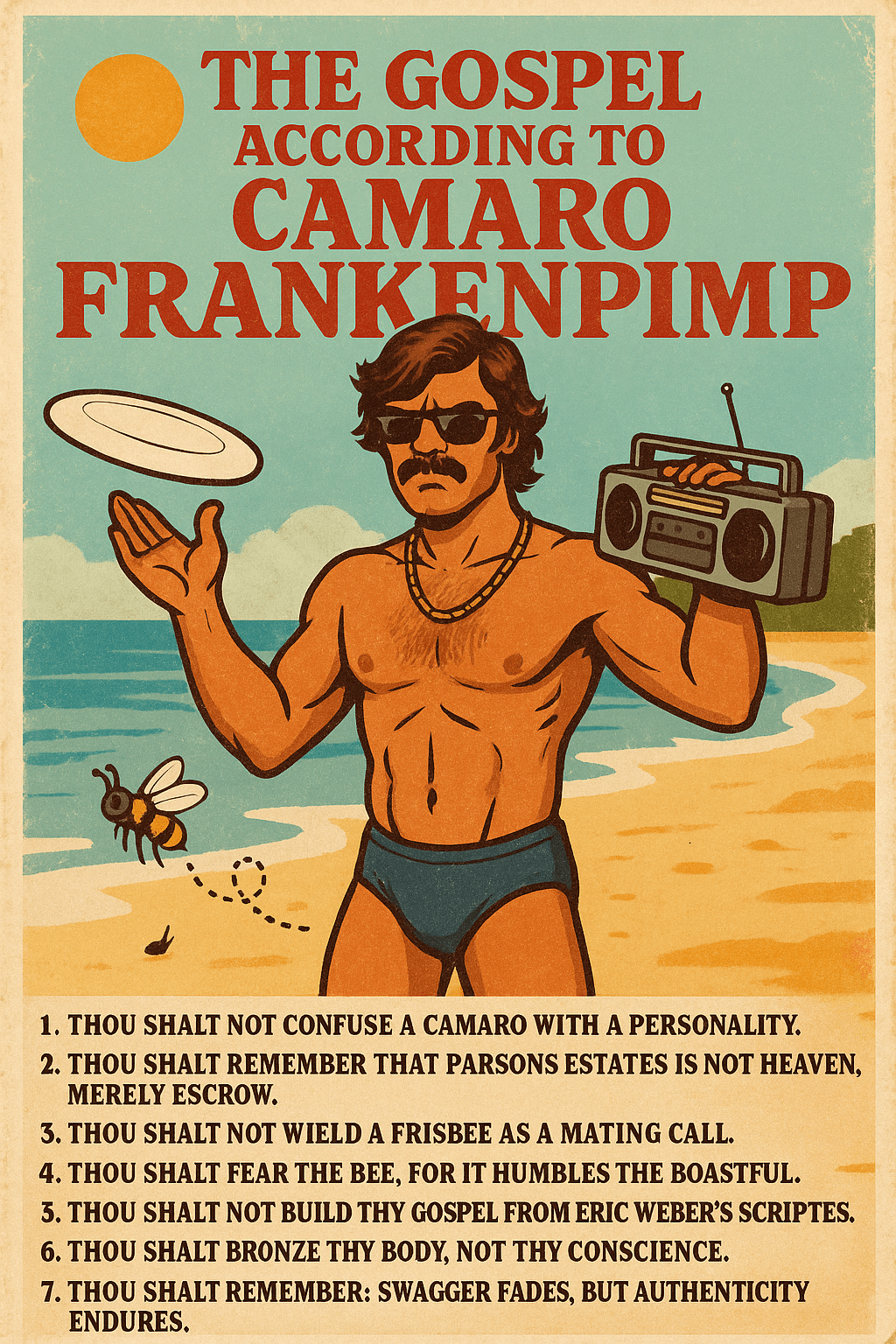
In the summer of 1977, my church was Cull Canyon Lake, and tanning oil was the sacrament. Every Saturday, I’d anoint myself in Hawaiian Tropic Dark Tanning Oil—zero SPF, 100 percent hubris. It smelled of coconuts and artificial paradise. When I think back to the hormonal heat haze of youth, I can still smell it: the scent of lust, vanity, and skin damage baking in the California sun.
That’s when I first saw him—the apostle of artificial cool. I didn’t know his name, so I christened him Camaro Frankenpimp. Late twenties, brown wavy hair, gold chain, Speedo so tight it threatened constitutional rights. His black ’76 Camaro—with its white racing stripes and glassy arrogance—glimmered in the parking lot like a totem of misplaced masculinity.
Camaro Frankenpimp strutted across the grass in his blue briefs, boombox blaring, white Frisbee spinning in hand, Playboy cooler close behind. He had perfected his entrance and rehearsed his lines. Every Saturday, I’d hear the same monologue:
He’d paid five hundred bucks for that custom paint job. His dad owned a chain of clothing stores in the Bay Area. He’d managed them since high school. He was waiting to hear from a Hollywood studio about a small part in a martial arts movie. And, the pièce de résistance, he owned a home in Parsons Estates. He dropped that name like a holy incantation, as though suburban real estate were the path to transcendence.
I later realized he’d memorized his script from Eric Weber’s How to Pick Up Girls!—the ur-text of sleaze, which instructed men to approach women like sales prospects: persistence over decency, bravado over authenticity. I’d seen the book passed around my high school locker room like contraband scripture. Camaro had apparently underlined every commandment.
He was successful, at least by his own shabby standards. Each Saturday, he had new blondes—interchangeable apostles in bikinis—tossing his Frisbee back like he was the messiah of mediocrity.
Then came the reckoning.
One afternoon, I watched from my towel as Camaro held court on his grassy knoll, his tanned body gleaming under the sun, boasting to two bikini-clad disciples. Suddenly, he howled like a wounded wolf.
“You stepped on a bee!” one girl cried.
The bee twitched in the grass, mission accomplished. Within seconds, Camaro was sweating, limping, and insisting he was fine. His skin shone like varnish; his foot ballooned to the size of a Christmas ham.
“I’m fine,” he kept saying, though panic had already claimed his eyes.
Moments later, he collapsed, chest heaving, mouth foaming. His body convulsed, the boombox still playing Fleetwood Mac’s “Dreams” in surreal counterpoint. By the time the ambulance arrived, Camaro Frankenpimp—the self-anointed prophet of Parsons Estates—was gone.
I went home shaken. My hero, the sun god of Cull Canyon, slain by a bee. That night, I sought counsel from Master Po.
“Why, Master,” I asked, “did such a magnificent man die so suddenly?”
“Choose your heroes wisely, Grasshopper,” said Po. “The man was no hero. He was a hollow idol, built of vanity and insecurity. He was all surface and no soul, all pose and no power. His death was not tragic—it was poetic. For it is written: he who cannot conquer himself will be conquered by the smallest of creatures.”
 Cinemorphosis
Leave a comment