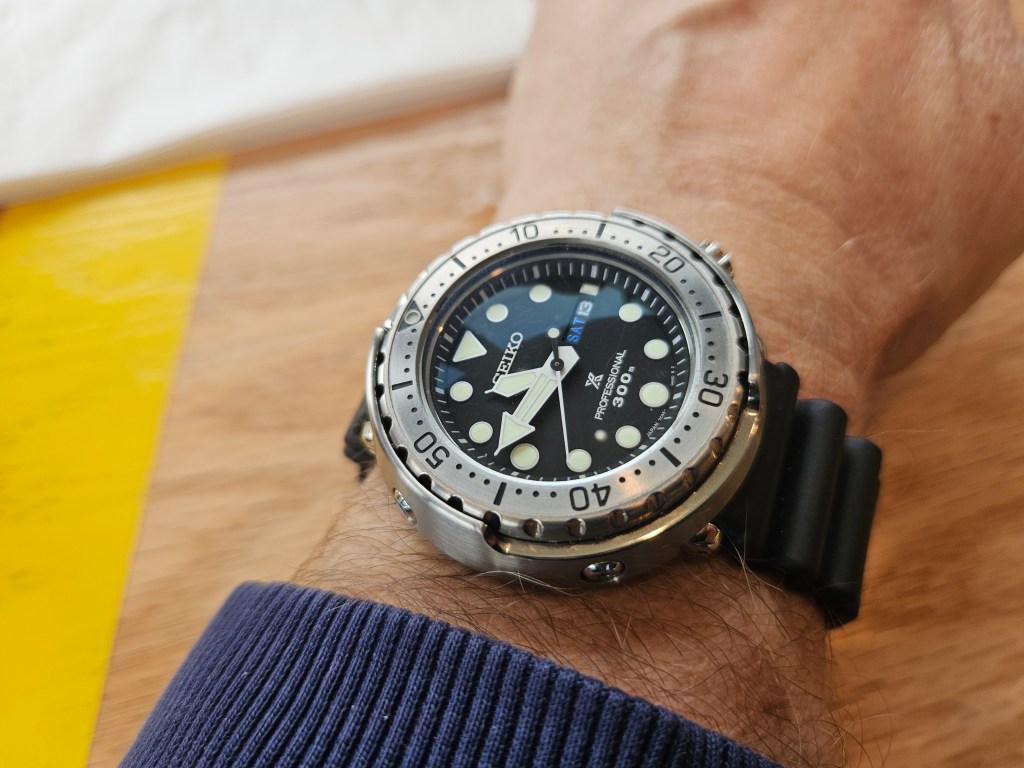
I am a connoisseur of fine timepieces. I notice the way a sunray dial catches light like a held breath, the authority of a bezel click that says someone cared. I’ve worn Tudor Black Bays and Omega Planet Oceans as loaners—the horological equivalent of renting a Maserati for a reckless weekend—exhilarating, loud with competence, impossible to forget. My own collection is high-end Seiko divers, watches that deliver lapidary excellence at half the tariff: fewer theatrics, just ruthless execution. Precision doesn’t need a luxury tax.
That same appetite governs my reading. A tight, aphoristic paragraph can spike my pulse the way a Planet Ocean does on the wrist. I collect sentences the way others collect steel and sapphire. Wilde. Pascal. Kierkegaard. La Rochefoucauld. These writers practice compression as a moral discipline. A lapidary writer treats language like stone—cuts until only the hardest facet remains, then stops. Anything extra is vanity.
I am not, however, a tourist. I have no patience for writers who mistake arch tone for insight, who wear cynicism like a designer jacket and call it wisdom. Aphorisms can curdle into poses. Style without penetration is just a shiny case housing a dead movement.
This is why I’m unsentimental about AI. Left alone, language models are unruly factories—endless output, hollow shine, fluent nonsense by the ton. Slop with manners. But handled by someone with a lapidary sensibility, they can polish. They can refine. They can help a sentence find its edge. What they cannot do is teach taste.
Taste precedes tools. Before you let a machine touch your prose, you must have lived with the masters long enough to feel the difference between a gem and its counterfeit. That discernment takes years. There is no shortcut. You become a jeweler by ruining stones, by learning what breaks and what holds.
Lapidary sensibility is not impressed by abundance or fluency. It responds to compression, inevitability, and bite. It is bodily: a tightening of attention, a flicker of pleasure, the instant you know a sentence could not be otherwise. You don’t acquire it through mimicry or prompts. You acquire it through exposure, failure, and long intimacy with sentences that refuse to waste your time.
Remember this, then: AI can assist only where judgment already exists. Without that baseline, you are not collaborating with a tool. You are feeding quarters into a very expensive Slop Machine.
 Cinemorphosis
Leave a comment