Shirley Jackson’s “The Lottery” endures because every community has its Old Man Warner—the pinch-faced guardian of tradition who defends the barbaric ritual of human sacrifice not because it makes sense, but because it has always been done. When someone questions the practice, he delivers his familiar verdict: “There’s always been a lottery. Pack of crazy fools.”
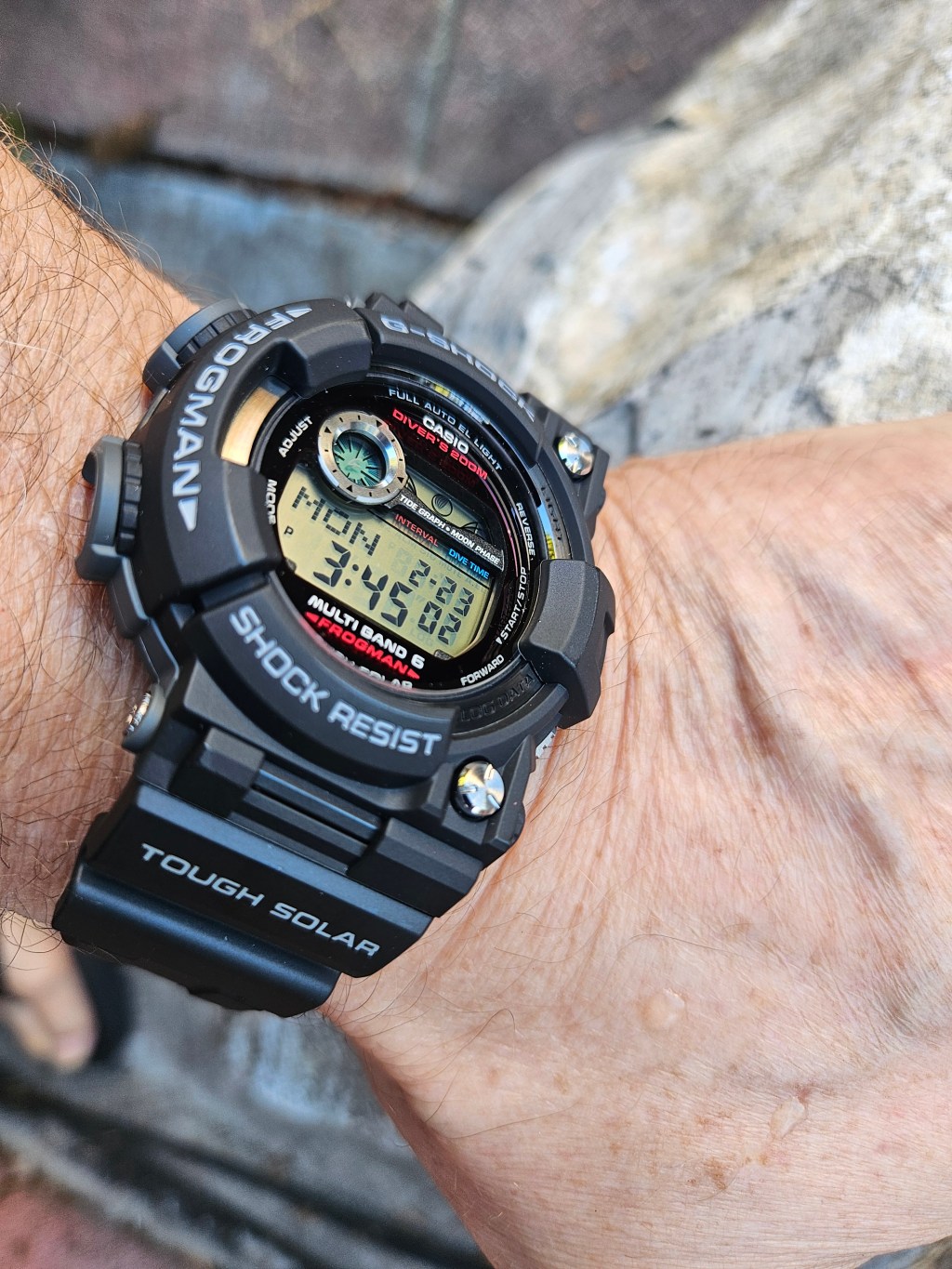
Since putting a G-Shock Frogman on my wrist and leaving my mechanical divers in their boxes, I’ve discovered my own Old Man Warner.
He lives in my head.
He is deeply offended that I am no longer winding, regulating, and emotionally tending to my mechanical watches. He blames outside influence. “G-Shock Nation,” he mutters darkly. “Pack of crazy fools.” He reminds me that I have always been a mechanical man. That I built an identity around springs and gears. That abandoning them isn’t a preference—it’s a betrayal.
This condition has a name: Inner Warner Syndrome—the internal voice of tradition that condemns any deviation from established practice, even when the change makes your life better.
And here’s the inconvenient truth.
The Frogman has made my life better.
When I open the watch box, the mechanical divers don’t whisper craftsmanship. They whisper obligation—winding schedules, accuracy drift, the quiet pressure to care. The Frogman, by contrast, asks nothing. It brings something I didn’t expect from a watch: serenity.
Which leaves me in an awkward middle ground.
My mechanical friends keep asking the same question: “How long is this phase going to last? When are you coming back to your real watches?”
My honest answer: I don’t know. The Frogman could be on my wrist for another week, another month, another year. I really don’t know.
Meanwhile, Old Man Warner continues his running commentary from the background: “Pack of crazy fools.”
This tension has a deeper structure. It isn’t about quartz versus mechanical. It’s about identity versus relief.
I’m living through Ritual Loyalty Conflict—the uneasy state that arises when a long-cherished practice stops delivering pleasure but continues to demand allegiance. The new path is easier: no winding, no fuss, no emotional maintenance. But the old ritual carried a story about who you were—disciplined, devoted, serious.
The discomfort isn’t practical.
It’s ceremonial.
I don’t miss the ritual itself so much as the identity it once confirmed. Every time the Frogman delivers quiet satisfaction, a small internal tribunal convenes to ask whether convenience has replaced character.
Because beneath the surface, Ritual Loyalty Conflict isn’t about watches at all.
It’s about the lingering suspicion that if something becomes easier—if it becomes peaceful—you may have abandoned not just effort, but virtue.
And somewhere in the distance, Old Man Warner is still shaking his head.
 Cinemorphosis
Leave a comment