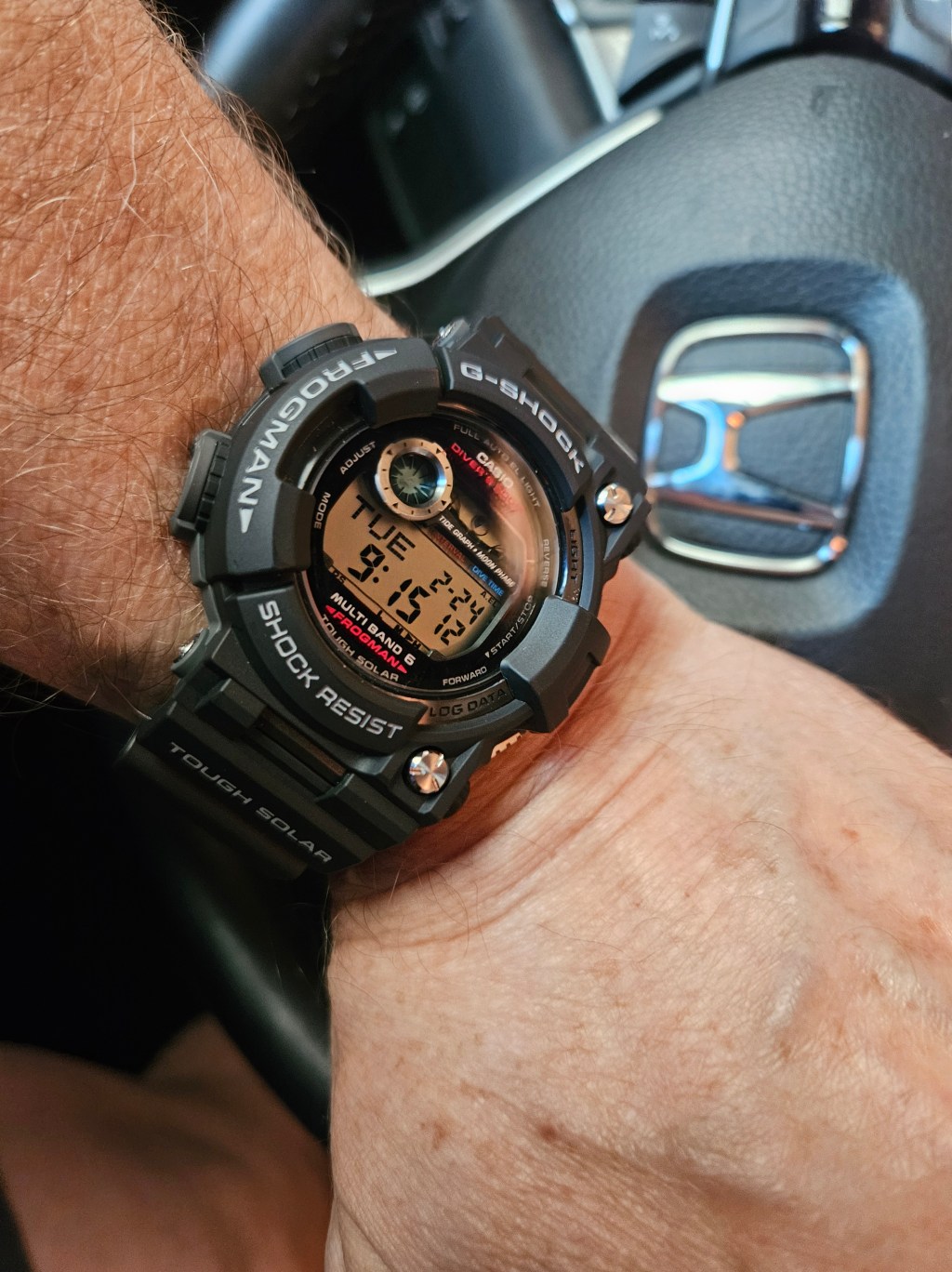
Spend enough time in the comment section of a G-Shock review and you’ll see the same confession repeated with surprising consistency: I own Rolex. I own Omega. I own watches worth thousands. But my G-Shock gives me more satisfaction.
Most people leave it there, baffled by their own admission.
The explanation, however, is not mysterious. It has a name: Utility Purity.
Utility Purity is what happens when a watch does exactly what a watch is supposed to do—accurate time, legible display, solar power, atomic synchronization, shock resistance, dependable alarms and timers—and refuses to turn the experience into anything more complicated than that. The effect feels like truth. No symbolism. No heritage narrative. No prestige hierarchy. Just performance. Luxury watches can be beautiful, but they also carry social meaning. A G-Shock feels like choosing function over theater—and for many people, that choice feels like integrity, especially after years of wearing objects that double as personal statements.
Utility Purity also delivers something rarer than accuracy: cognitive ease.
A G-Shock is psychologically light. No winding schedule. No time drift to monitor. No anxiety about door frames, desk edges, or metal bracelets scratching polished surfaces. No constant background calculation about risk and wear. The brain relaxes because the object doesn’t require caretaking. Luxury ownership often includes a quiet layer of vigilance. G-Shock satisfaction comes from the opposite experience—the relief of a tool that refuses to become a relationship.
There’s another benefit: freedom from social noise.
Luxury watches speak even when you don’t. They invite attention, assumptions, silent status calculations, and the occasional internal question: What does this say about me? A G-Shock shuts that conversation down. It’s socially neutral. Invisible. The pleasure becomes private. Much of the satisfaction comes from negative space—the absence of being evaluated.
Then there is the emotional power of reliability.
Atomic synchronization. Solar autonomy. Shock and water resistance. The message is simple: This will not fail you. Humans attach quickly to dependable systems. The watch becomes a small island of certainty—always correct, always ready, always indifferent to your moods. Mechanical charm offers personality. Utility Purity offers security. For many people, certainty is the deeper comfort.
Finally, Utility Purity produces a cleaner dopamine cycle.
Luxury acquisitions often follow a dramatic curve: anticipation, unboxing euphoria, validation, then the quiet descent into worry, justification, and the next rung of the ladder. G-Shocks operate differently. Lower cost. Lower risk. Fewer regrets. You wear them hard, not carefully. The emotional pattern shifts from I need to justify this to I can just use this.
And that difference matters.
Because in the end, Utility Purity isn’t about affordability.
It’s about the rare satisfaction of owning something that asks nothing from you—no protection, no explanation, no performance.
It just works.
And after a lifetime of managing objects that carry meaning, status, and expectation, that kind of silence can feel like freedom.


 Cinemorphosis
Leave a reply to 501 Pound Brain Cancel reply