Last night, while watching television with my wife in a room lit about as brightly as a submarine corridor, I made a small but unsettling discovery: I am not always in the mood to press the G-Shock light button just to see the time. Not because the button is difficult—it isn’t—but because every tap reminds me that I’m siphoning a little solar life from the battery. For a normal person, this would register as trivia. For someone like me, it becomes a moral drama about energy management.
Earlier that day both my G-Shocks—the Frogman and the GW-7900—were sitting at the dreaded Medium charge level. Medium is technically acceptable, but emotionally intolerable. So I placed them on the windowsill for four hours like two reptiles basking on a warm rock. By evening they had risen to the only status that calms my nervous system: High.
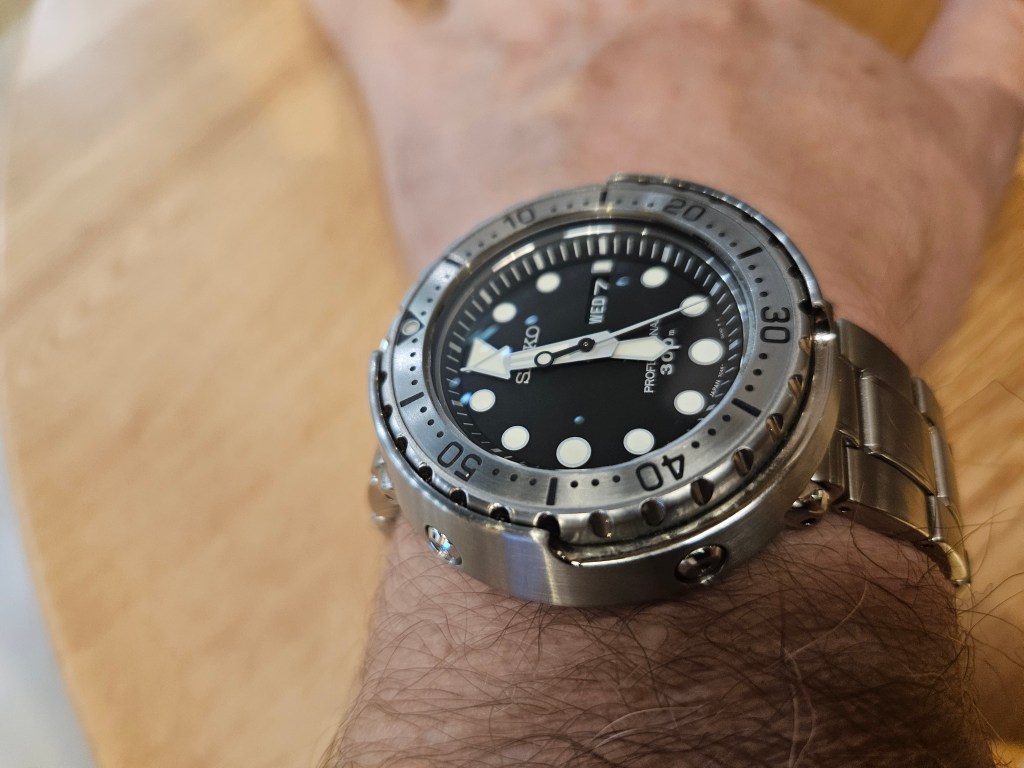
Wanting to give their solar batteries a night of rest—and perhaps to give my brain a rest as well—I hung the GW-7900 on the industrial T-bar stand so it could quietly chase atomic signals overnight. In its place I strapped on my quartz Seiko Tuna SBBN049. The room was dark, but the Tuna’s lume glowed like a tiny lighthouse. No button pressing. No anxiety about draining solar reserves. Just the quiet satisfaction of luminous markers doing their job without negotiation.
And something interesting happened: I rediscovered the Tuna.
While I’ve been cooling off from my mechanical divers, this quartz brute suddenly felt…perfect. Reliable. Legible. Calm. A watch that does not demand emotional supervision.
Then a second realization arrived.
The Tuna—already equipped with sapphire—might quietly occupy the exact niche I’ve been trying to justify filling with the sapphire Frogman, the thousand-dollar titanium idol currently whispering to me from the internet.
If the Tuna fills that lane, several pleasant consequences follow.
First, I stop the collection at eight watches, a number that still resembles discipline rather than pathology.
Second, I avoid introducing a sapphire Frogman that would inevitably start competing with my beloved Frogman GWF-1000, turning the watch box into a small arena of amphibious rivalry.
Third, the Tuna—currently receiving about as much wrist time as a museum artifact—gets to live again.
Fourth, I avoid spending nine hundred dollars on what is essentially a prestige upgrade: a watch whose improvements amount to slightly clearer digits and bragging rights for social media spectators.
Fifth, I avoid paying nearly a thousand dollars for a watch that, if I squint hard enough and tilt my head toward the light like a suspicious jeweler, looks almost identical to the one I already own.
What I’m really saying, ladies and gentlemen, is that I’m searching for an exit ramp.
Not an exit from watches entirely, but an exit from the compulsion to keep expanding the collection as if the next acquisition might finally calm the storm.
Because the truth is obvious. My eight watches already do everything a watch can possibly do. Another one at this point isn’t a tool—it’s an additional weight tied to the ankle of enjoyment.
Another watch becomes an anchor.
Another watch becomes kryptonite.
Another watch dilutes the potency of the ones I already love.
Of course, this is the speech I’m giving myself this morning. Whether I remain faithful to it is another matter entirely. A watch obsessive, after all, is simply a man locked in a polite but relentless argument with himself.
And perhaps that is the broader human condition. The very pursuits that bring us joy—hobbies, ambitions, passions—also contain the seeds of excess. Mishandled, they curdle. What began as pleasure turns into agitation.
These are the thoughts rushing through my brain today, pouring forward like a swollen river after heavy rain.
If it weren’t watches, it would be something else.
That much, I know for certain.
 Cinemorphosis
Leave a comment