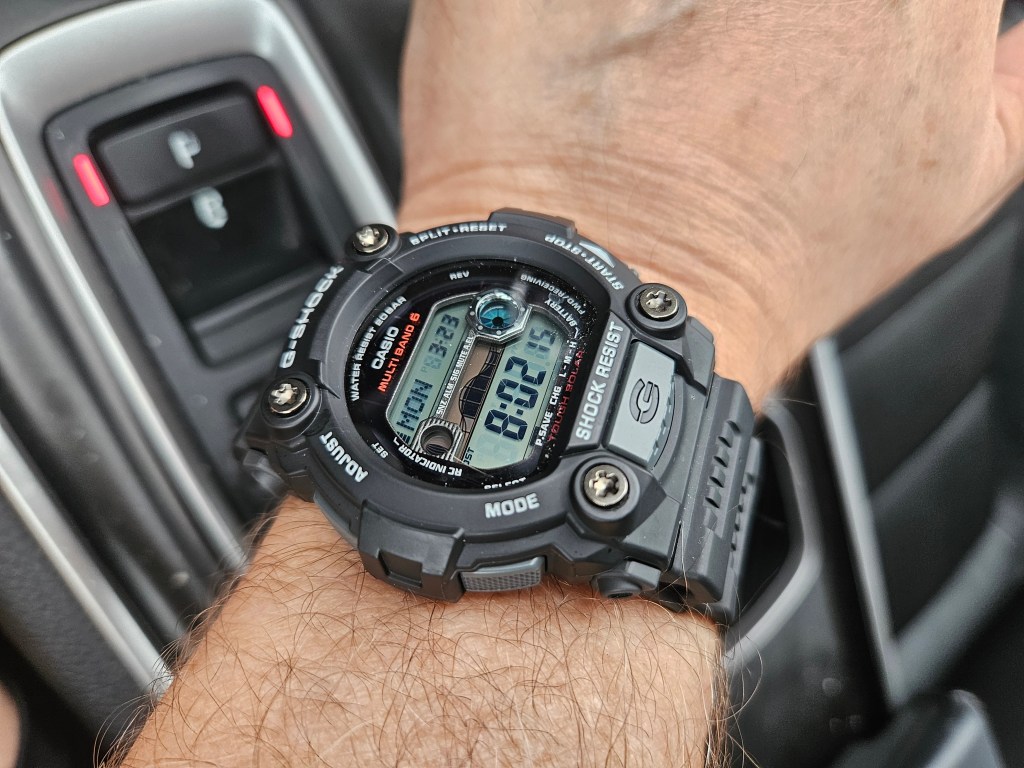
I love the digital displays on my Casio G-Shock Frogman GWF-1000 and Casio G-Shock GW-7900. They tell me the time with blunt authority. No interpretation. No ceremony. Just numbers that land in the brain like a verdict.
And yet, apparently, that isn’t enough.
Somewhere along the way I developed a new appetite—no, let’s call it what it is, greed. I don’t just want clear numerals anymore. I want absurdly large numerals. I want wrist-mounted billboards. I want a wall clock strapped to my arm so I can read the time from across the room like a man who refuses to participate in subtlety.
Naturally, the good people of G-Shock Nation pointed me toward the Casio G-Shock GW-9500 Mudman. The Mudman, they said, has the numbers. Big, bold, unapologetic digits that look like they were designed for someone who has lost patience with squinting.
And they’re right—mostly.
Mudman owners speak about their watch with a curious mix of affection and confession. They praise the size of the numerals, the rugged build, the sheer presence of the thing. Then, almost sheepishly, they admit that the display can blur at certain angles, that the duplex layering introduces a faint haze, that it’s not quite as clean as they’d like. They dock it a star. Four out of five.
Then they shrug and say they love it anyway.
That’s the part that matters.
Because it raises a question most of us spend years avoiding: is there such a thing as a five-star watch?
I’ve finally accepted the answer. There isn’t. There are only trade-offs you can tolerate without resentment.
I’ve been chasing a very specific fantasy: huge numerals, high contrast, perfect viewing angles, and zero cognitive load. A watch that doesn’t need to be read so much as absorbed. A watch that behaves like a wall clock—instant, effortless, undeniable. What I’ve discovered is that watches can deliver three of those qualities with confidence. They just can’t deliver all four at once.
My GW-7900 comes closest to frictionless clarity. Its display is stable, legible, and immediate. But the digits, while excellent, don’t quite scratch that billboard itch. The Mudman 9500 pushes in the opposite direction. It gives me the numbers—big, thick, impossible to ignore—but introduces a new problem: at certain angles, the display hesitates. Instead of receiving the time, I have to negotiate with it.
Then there are the Pro Trek models, with their crisp, high-contrast STN displays. Technically superior. Visually disciplined. And yet, in their refinement, they lose that blunt, wall-clock immediacy. They are precise, but not emphatic.
What fascinates me is how quickly Mudman owners make peace with imperfection. They acknowledge the flaws, subtract a star, and keep wearing the watch. That’s not compromise in the defeated sense. It’s acceptance. They’ve decided which imperfection they can live with, and they’ve moved on.
That realization forced me to confront what I’m actually chasing. It isn’t a watch. It’s a state of mind—frictionless time perception. I want to glance at my wrist and have the time imposed on me without effort, hesitation, or ambiguity. But a wristwatch isn’t built for that ideal. It’s constrained by size, power, durability, and the stubborn limits of display technology. Something always gives.
There is, to be fair, a strong case for the Mudman. Bigger numerals do make the time easier to read most of the time. Its toughness invites confidence. Its design has a certain muscular charisma. For many people, that combination outweighs the occasional moment of haze or glare.
But I’ve had to admit something about myself: I value consistency over peak performance. A watch that is occasionally perfect but intermittently irritating will wear me down. I don’t want to negotiate with my watch. I want to glance and know.
So the conclusion is both obvious and oddly liberating. There is no perfect watch. Once you accept that, the chase loses its urgency. You stop looking for the mythical five-star object and start making deliberate choices.
The real question isn’t, “Which watch gets me closest to perfection?”
It’s this: Which imperfection can I live with—and still enjoy checking the time a hundred times a day?
 Cinemorphosis
Leave a comment