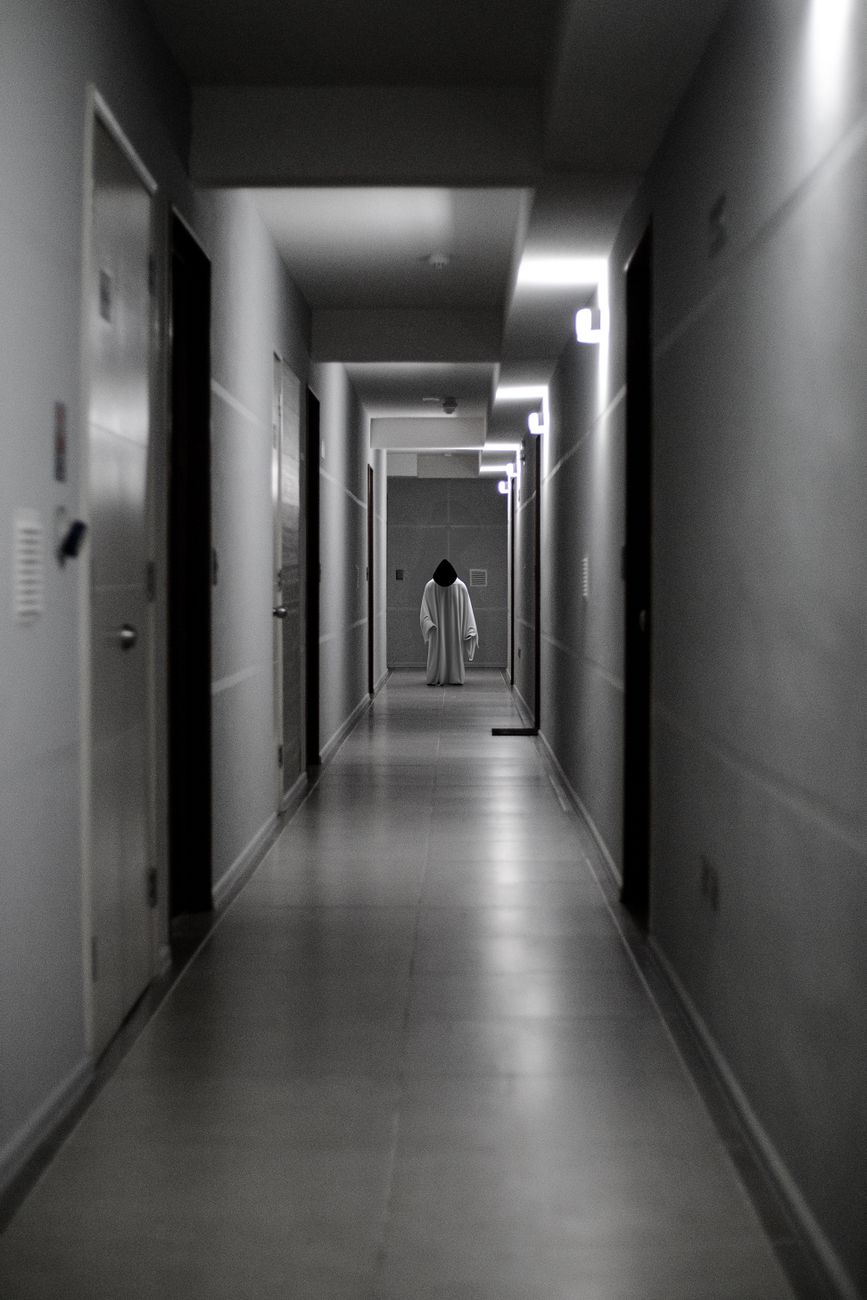
An unkempt, unemployed man in his sixties—I’ll call him D—lives on my street. He is painfully thin, wears a beard that seems less grown than surrendered to, and carries the thousand-yard stare of someone who has spent too many years trapped inside his own mind. He is the neighborhood’s resident ghost, the subject of whispered conversations held over hedges and driveways whenever his name comes up.
I rarely see him anymore.
With each passing year he seems to retreat another step from the world. According to my neighbors, he now walks his dog only after dark, as if daylight itself has become an adversary.
The last time we spoke was more than a decade ago. He told me his mother had emigrated from Ukraine. She was still alive then but has since passed away. He admitted he struggled with clinical depression. Once upon a time he earned his living in real estate. He loved photography. He struck me as intelligent, thoughtful, even pleasant. Nothing about him suggested the caricature of the neighborhood eccentric.
Depression, however, is not content merely to inhabit a person. Given enough years, it colonizes the landscape around him.
D’s house looks less like a residence than a psychological self-portrait.
Weeds have risen high enough to conceal much of the property, swallowing the front yard as if nature were quietly reclaiming it. Enormous rocks lie scattered across the lot—not arranged with the intention of landscaping but dumped haphazardly, as though an avalanche had paused just long enough to empty its pockets. A rusted car sits permanently marooned in the driveway, stripped of its engine, one of those eternal restoration projects that never progresses beyond the fantasy stage.
Then there is the roof.
Or rather, the absence of one.
Instead of shingles, enormous black tarps have been stretched across the house like bandages wrapped around a wound too deep to heal. The place resembles less a home than a disaster site awaiting inspectors who never arrive.
The neighbors tell me D has owned five yellow Labrador retrievers over the past twenty-five years.
Each one has had exactly the same name.
Reggie.
Perhaps it is sentiment. Perhaps ritual. Or perhaps depression dislikes novelty and prefers the comforting illusion that nothing essential has changed.
Reggie, unfortunately, is also a source of neighborhood diplomacy. D has a habit of letting him roam unleashed, which periodically inspires shouted exchanges with nearby homeowners who are less enchanted by canine freedom than D appears to be.
Recently, the family next door began an ambitious renovation. They moved out for a year while contractors demolished and rebuilt much of their home at a cost north of half a million dollars.
During one conversation, one of the neighbors revealed something I had never considered.
The tarps.
They aren’t merely ugly.
They are loud.
Every windy night they snap, crack, and whip against the roof structure with relentless fury, sounding less like construction material than a chorus of agitated ghosts auditioning for Poltergeist. Sleep becomes impossible.
So the neighbors arrived at a remarkably practical conclusion.
Since they were already spending roughly $600,000 rebuilding their own home, they decided to buy D a new roof.
The cost?
About $20,000.
It is an act of generosity, certainly.
It is also an investment in uninterrupted sleep.
When you’ve already committed well over half a million dollars to creating your dream home, another twenty thousand begins to look less like charity than an effective noise-canceling device.
Every neighborhood, it seems, has its own D.
There is always one house that refuses to cooperate with the local mythology of upward mobility. Every freshly painted facade, every manicured lawn, every luxury SUV in the driveway quietly tells a story of competence, prosperity, and orderly lives. Then there is the one property that interrupts the narrative like an uncomfortable footnote. It reminds everyone that not every life can be renovated with quartz countertops, drought-tolerant landscaping, and a designer front door.
Some houses broadcast success.
Others testify to defeat.
D’s house has become an architectural memoir of prolonged suffering, a place where depression has seeped from the mind into the soil, the weeds, the rusting car, and finally the roof itself.
Replacing the tarps with shingles will not rewrite that story.
A new roof cannot cure clinical depression. It cannot restore lost ambition, resurrect old dreams, or persuade a haunted man that tomorrow will be kinder than yesterday.
But it can silence the ghosts.
 Cinemorphosis
Leave a comment