Jeremy lives in Louisiana, but over the past decade he and I have shared the peculiar fraternity that develops among people who have spent far too much time thinking about watches. He has followed my YouTube channel long enough to witness my latest affliction unfold in real time.
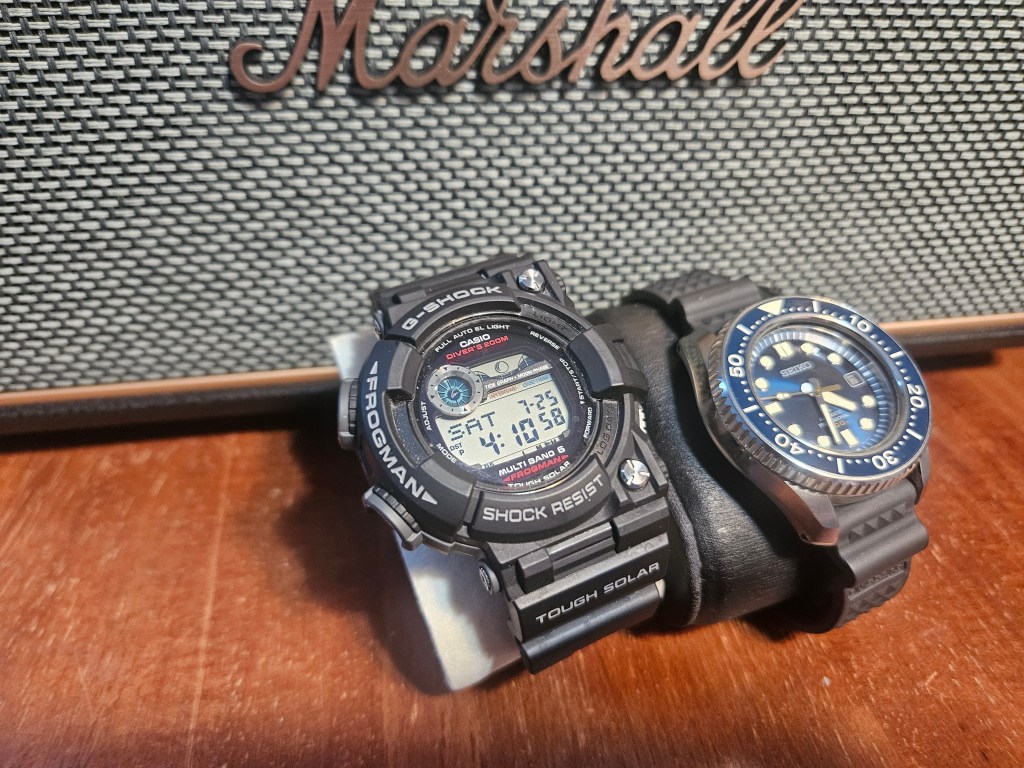
It began six months ago with a Casio G-Shock Frogman GWF-1000.
Then came the Rescue GW-7900.
Soon afterward I was fully initiated into the cult of Multiband-6. Every night while I slept, invisible radio signals synchronized my watches to atomic clocks, and every morning I awoke to the intoxicating certainty that the digits on my wrist displayed the exact time—not approximately, not close enough, but the precise time.
Jeremy watched this transformation with sympathy until he made the fatal mistake of buying a few Multiband-6 G-Shocks himself.
Recently he wrote to confess that his own hobby had entered a state of upheaval.
Not ruined.
Upended.
He had contracted the same addiction.
Like me, he had become enslaved to the quiet pleasure of glancing at a digital display that never needed correction. Like me, he found himself staring at mechanical divers worth several thousand dollars and struggling to justify putting them on his wrist. His collection, like mine, had suffered what I call The Great Divide.
Mine is specifically the G-Shock–Seiko Divide.
Jeremy’s divide is somewhat different. His luxury mechanical pieces wear both Swiss passports and Japanese ones, but the conflict is identical.
Two incompatible ideas of what a watch should be now compete for the same wrist.
Ironically, this essay began as something far more trivial.
I intended to make a YouTube video reviewing my Seiko divers on Divecore Waffle straps made from Hydrogenated Nitrile Butadiene Rubber. Three of my twenty-millimeter Divecore Waffles currently adorn my Seiko SLA055, SLA051, and SLA023. My SBDC203 remains on its original Seiko “Chocolate Bar” rubber strap, while my Seiko Tuna SBBN049 wears a twenty-two-millimeter Divecore Waffle.
I genuinely miss my Divecore FKM HP straps. They were magnificent. Yet the lingering discussion surrounding PFAS—the so-called “forever chemicals” associated with fluorinated materials—finally persuaded me that they were an unnecessary source of anxiety. My suspicion is that the straps are probably harmless. But “probably harmless” is an awkward companion for something strapped to your skin every day. Why carry even a hypothetical worry when the Divecore Waffles are every bit as handsome?
I had planned to spend twenty minutes discussing rubber straps.
Then I stopped myself.
Who cares about straps?
I already made peace with abandoning steel bracelets years ago.
The straps weren’t the story.
The story was that I had reached a point where every glance at my watch box required choosing between two entirely different philosophies.
My Seikos are objects of astonishing beauty.
Their dials possess depth, warmth, texture, and craftsmanship that industrial resin can never hope to imitate. On today’s used market my five Seiko divers are probably worth around nine thousand dollars. They are miniature works of art.
My G-Shocks, by contrast, are worth perhaps a thousand dollars altogether.
They are molded from industrial resin.
They resemble equipment more than jewelry.
They synchronize themselves every night.
They weigh almost nothing.
They display the exact time in large, unapologetic digits.
They ask nothing of me.
The Seikos appeal to my aesthetic imagination.
The G-Shocks satisfy my practical mind.
Guess which one wins about ninety percent of the time.
It would be easy to write one of those tiresome minimalist sermons declaring that I should have skipped expensive mechanical watches altogether and bought only affordable G-Shocks. Such hindsight is wonderfully economical because it edits out the actual life that was lived.
For more than twenty years I sowed my horological oats among mechanical watches.
There was obsession.
There was ecstasy.
There was irrationality.
There was financial excess.
There was genuine beauty.
There was hard-earned knowledge.
Without those decades, I would never appreciate the peculiar satisfaction of glancing at a Mudman GW-9500 and knowing that the time displayed is as accurate as physics presently allows.
Counterfactual histories are comforting fantasies. They allow us to imagine that wisdom could have arrived without tuition.
It cannot.
An hour before writing this, I was wearing my beloved Seiko Uemura. I admired its magnificent dial, then found myself squinting to determine the approximate time.
Approximate.
A few moments later I quietly removed it and fastened the Mudman to my wrist.
Jeremy understands exactly why.
My suspicion is that thousands of other watch enthusiasts do as well. Once you’ve crossed the Great Divide, you never entirely return. The two worlds continue to coexist, each beautiful in its own way, while your wrist quietly votes for only one.


Leave a Reply