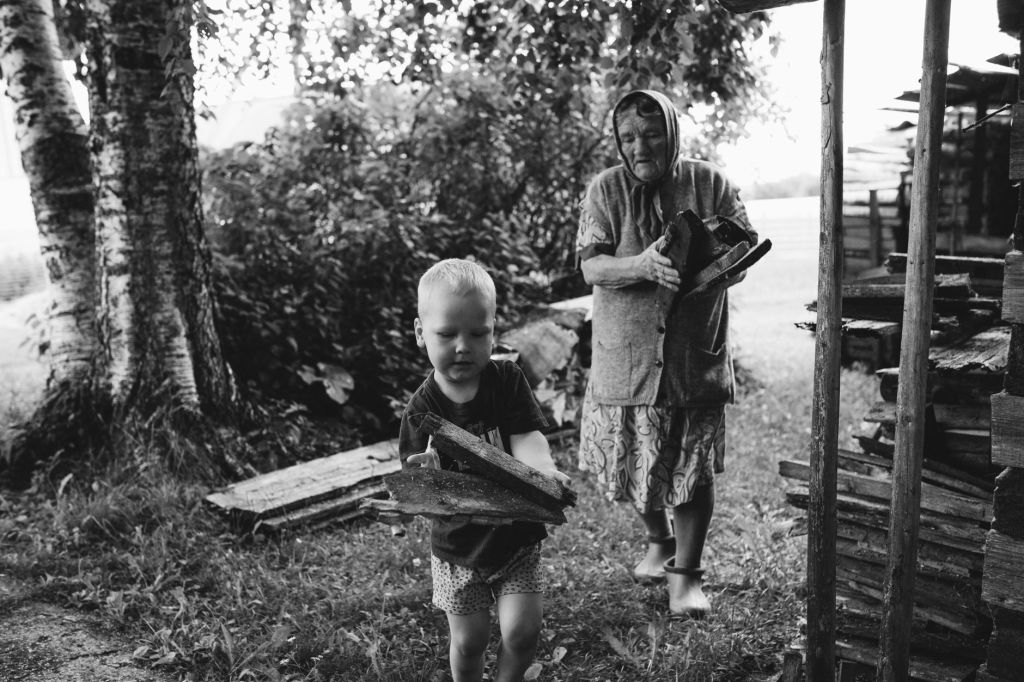
My great-grandmother Edna was born in Poland shortly before 1900. In 1904, when she was still a little girl, pogroms swept through her city and her parents were massacred. She was taken in by a cruel stepmother who treated her less like a daughter than a household slave.
Somehow, in 1911, Edna escaped. Still a girl, she crossed an ocean and arrived in New York.
The family she left behind would fare even worse. Much of it was eventually annihilated by the Nazis. Her older brother Ellis, his wife, and their two children were sent to Auschwitz. His wife and children were murdered there. Ellis survived, came to New York after the war, became a dentist, and eventually retired to Miami.
Edna married a man afflicted with severe arthritis. A doctor prescribed injections of gold, a treatment that sounds today like something devised by an alchemist with excellent malpractice insurance. The gold didn’t cure him. His condition worsened until he became an invalid, leaving Edna with the exhausting responsibility of caring for him.
By the time I met her, in 1968, her husband was dead and Edna was living in Leisure World in Seal Beach.
I was six.
I loved her immediately.
She spoke with a thick Polish accent and carried a melancholy that somehow made me feel safe. She cooked savory kasha dishes for me and let me sit beside her watching soap operas. Her favorite was As the World Turns. Edna, who had survived pogroms, an abusive childhood, immigration, family annihilation, and years caring for an invalid husband, could become magnificently agitated over the romantic judgment of a fictional woman on daytime television.
When some charlatan started courting one of the female characters, Edna would shake her fist at the television.
“Leave him!”
Apparently surviving the twentieth century did not prepare her to tolerate a bad boyfriend.
I found this deeply touching. Life had given Edna every conceivable reason to withdraw from the world, yet there she was, emotionally invested in some ridiculous soap-opera romance as though civilization itself depended upon this woman dumping the bum before the next commercial break.
Edna was ethnically Jewish, but as far as I could tell, she wasn’t religious.
And here begins what I call The Edna Challenge.
The Edna Challenge is the difficulty of reconciling Christianity’s diagnosis of universal spiritual deficiency with the memory of a nonreligious person who seemed morally whole without religion.
Edna didn’t strike me as someone waiting to be completed.
She possessed a fierce moral intelligence. Once, one of her great-grandchildren, a red-haired boy with serious behavioral problems, knocked my younger brother off a bunk bed. My brother landed hard and began crying, a large bump rising on his head.
Edna gathered him into her arms and rocked him.
Then came the verdict.
“He is not worthy of being my great-grandchild.”
There was no committee meeting. No therapeutic language. No discussion of developmental stages or impulse control. The Supreme Court of Edna had convened, heard the evidence, and handed down its decision.
I loved her all the more for it.
Her daughter Mildred, my maternal grandmother, wasn’t religious either. When I was eight, she told me plainly that she believed this earthly life was the whole story. No heaven. No afterlife. No celestial sequel.
Like Edna, Mildred seemed complete to me.
Neither woman appeared to experience herself as fallen, spiritually dead, estranged from God, or afflicted by some invisible metaphysical disease requiring a supernatural cure. They loved people. They made moral judgments. They endured suffering. They possessed humor, loyalty, anger, tenderness, and dignity.
I cannot look backward and identify the missing piece.
Then there’s me.
I’m a different beast altogether.
When I read Paul’s Letter to the Romans, I feel as though Paul has somehow obtained my psychological records. I know what I should do and don’t do it. I do things I have already decided I shouldn’t do. Appetite fights judgment. Vanity fights humility. Intention fights behavior. The person I am seems perpetually at war with the person I believe I should become.
Paul describes the divided consciousness, and I recognize the address.
I understand the hunger for salvation because I experience the condition for which salvation appears to be the remedy. I want the wholeness and holiness Paul describes. I understand what it means to feel incapable of repairing yourself with the same machinery that keeps producing the damage.
But then I remember Edna.
And Christianity’s universal diagnosis becomes difficult for me.
Perhaps Paul is right about me. But was he right about her?
A Christian can answer that Edna’s apparent wholeness doesn’t matter. Sin isn’t merely psychological distress or bad behavior. She could have been loving, courageous, morally serious, and emotionally integrated while remaining estranged from God at some deeper level.
I understand the argument.
But The Edna Challenge remains.
Because the diagnosis begins to describe something I cannot see.
Edna survived horrors I can barely imagine. Her parents were murdered. Her childhood was stolen. Much of her family disappeared into the Holocaust. Her brother walked out of Auschwitz without his wife and children. She crossed an ocean, built a life, cared for an invalid husband, became a widow, and grew old carrying memories I was too young to understand.
Yet she did not strike me as spiritually defective.
She struck me as Edna.
Meanwhile, her comparatively fortunate great-grandson sits decades later reading Romans and recognizing himself on every page.
Perhaps Christianity is right that both of us needed the same salvation.
Perhaps my memory of Edna tells me nothing about her deepest spiritual condition.
Or perhaps Paul discovered something extraordinarily true about certain human beings and mistook it for the universal condition.
I don’t know.
That uncertainty sits at the center of my struggle with religious faith. Before I can accept the prescription, I have to understand the diagnosis. And whenever I’m told that humanity suffers from a universal spiritual deficiency that only religion can address, I find myself returning to Leisure World in 1968.
There is Edna in her chair.
The television is on.
As the World Turns has presented another romantic scoundrel.
Edna shakes her fist at the screen.
And I find myself asking the question Christianity has not yet answered to my satisfaction:
What, exactly, was missing from her?
 Cinemorphosis
Leave a comment