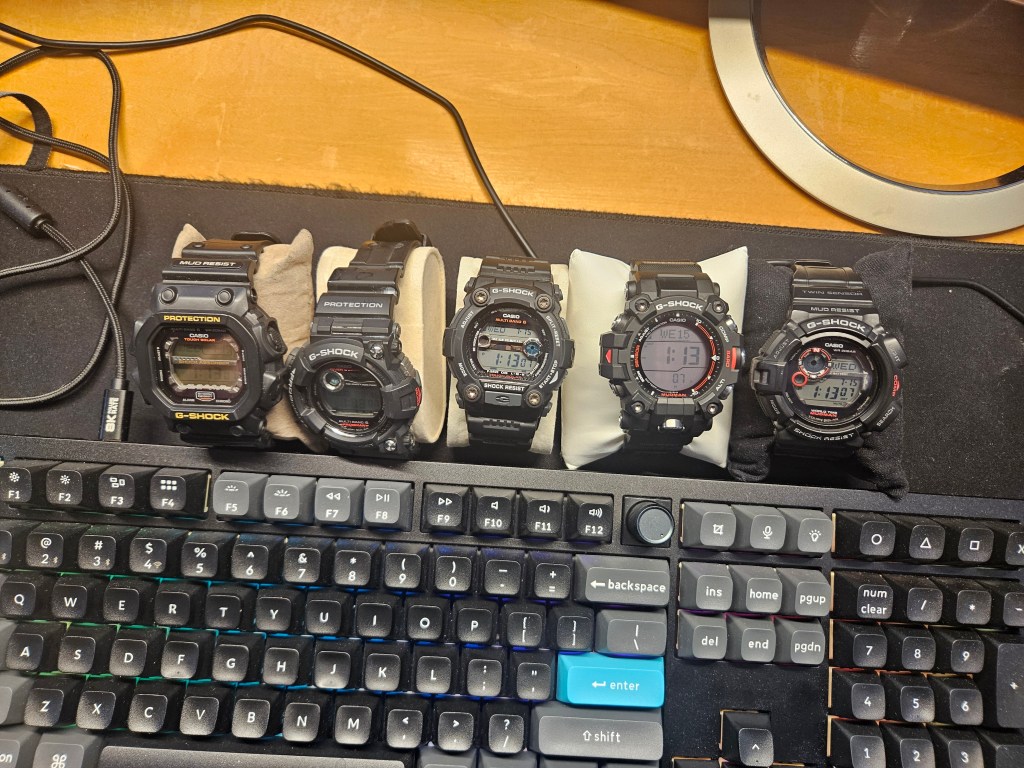
Six months ago, I bought a G-Shock GW-6900 and quickly convinced myself that it wasn’t for me. I already owned two G-Shocks—the Frogman and the Rescue—and two, I decided, were enough. I had achieved that mythical state every watch collector claims to desire and almost none can tolerate: contentment.
There was also the 6900 strap. It was just a little too short. Once I buckled the watch around my wrist, I had only two holes remaining. The watch fit perfectly well, but in the fevered jurisprudence of watch collecting, two unused holes constituted evidence for the prosecution.
So I put the 6900 back in its box, requested a return from Amazon, drove to my local UPS Store, and rid myself of the offending object within ten minutes. I felt enormous relief. Order had been restored. I owned exactly two G-Shocks. The collection was disciplined, coherent, complete.
Naturally, I then bought three more.
Over the ensuing months, the Mudman GW-9500 arrived, followed by the Mudman G-9300 and the King GXW-56. My austere two-watch collection had swollen to five, and I happily rotated among them while apparently forgetting the solemn principles of restraint that had compelled me to return the 6900.
Then, about a month ago, the 6900 began haunting me.
I started looking at photographs. I read discussions. I watched videos. I studied that strange face with its three circular indicators staring back at me like the instrument panel of a tiny Cold War submarine. Enthusiasts call the GW-6900 “The Three-Eyed Monster,” which is a perfectly good nickname. I prefer my own: the Triclops.
Soon the Triclops was everywhere. I couldn’t get it out of my mind. The watch I had dispatched to UPS with the efficiency of a man returning a defective toaster had somehow acquired an aura in its absence.
So I bought it again.
It is now in transit and should arrive in a few days.
I don’t remember whether the first GW-6900 I owned was the older version with the greenish electroluminescent backlight. I do know that the incoming watch is the newer GW-6900U-1, with its bright white LED. More important, I am strangely confident that this time I am going to connect with it.
I’ve experienced this phenomenon before: a watch leaves me cold the first time and captivates me later, even though the watch itself has barely changed. Other collectors have experienced it too. It’s tempting to dismiss the whole business as fickleness. We buy something, reject it, romanticize it, and buy it again. From the outside, this resembles the behavior of someone who should have his credit card frozen inside a block of ice.
But I think something more interesting is going on.
Collectors like to imagine that our reactions reside entirely in the objects themselves. A watch either speaks to us or it doesn’t. The dimensions are right or wrong. The dial works or it doesn’t. The strap fits or it doesn’t. We behave as if we were laboratory instruments registering objective measurements.
We’re not.
Timing matters. Mood matters. The condition of the existing collection matters. Most of all, our willingness to admit another object into that collection matters. Sometimes we encounter the right watch at the wrong time.
This is what I call the Acquisition Readiness Principle: the psychological state in which a collector becomes genuinely receptive to incorporating a new object into an established collection.
The first time the GW-6900 arrived, I was defending the sufficiency of my Frogman and Rescue. I wanted a small collection. I was guarding my wrist rotation like a suburban homeowner defending his property line. The 6900 wasn’t merely another watch; it was an intruder. Its slightly short strap gave me the excuse I needed to evict it.
Six months later, the watch is essentially the same. I am not.
Now there is a vacancy waiting for the Triclops.
This raises an obvious question: How can anyone possibly be “not ready” for a wristwatch?
The question itself exposes the magnificent lunacy of the hobby. We don’t merely buy watches. We audition them. We assign them roles. We decide whether they overlap with existing members of the collection. We worry about whether they will receive enough wrist time. We speak of watches “connecting” with us, as though a 50-millimeter lump of resin containing a quartz module were an emotionally complicated rescue dog.
A new watch therefore requires a certain receiving mode. We have to lower the drawbridge. We have to stop protecting the existing collection long enough to imagine another member belonging there. The object has not changed. The collector has.
Does this sound nuts?
Of course it does.
The most honest watch enthusiasts have long since abandoned the pretense that this is an entirely rational hobby. But perhaps the watches aren’t making us crazy. We’re doing that perfectly well ourselves. We take harmless little machines designed to tell us the time and burden them with identity, nostalgia, status, memory, personality, tribal affiliation, and elaborate theories of Acquisition Readiness.
Then we give the hobby a bad name.
It’s one of the things we’re most proud of.


Leave a Reply