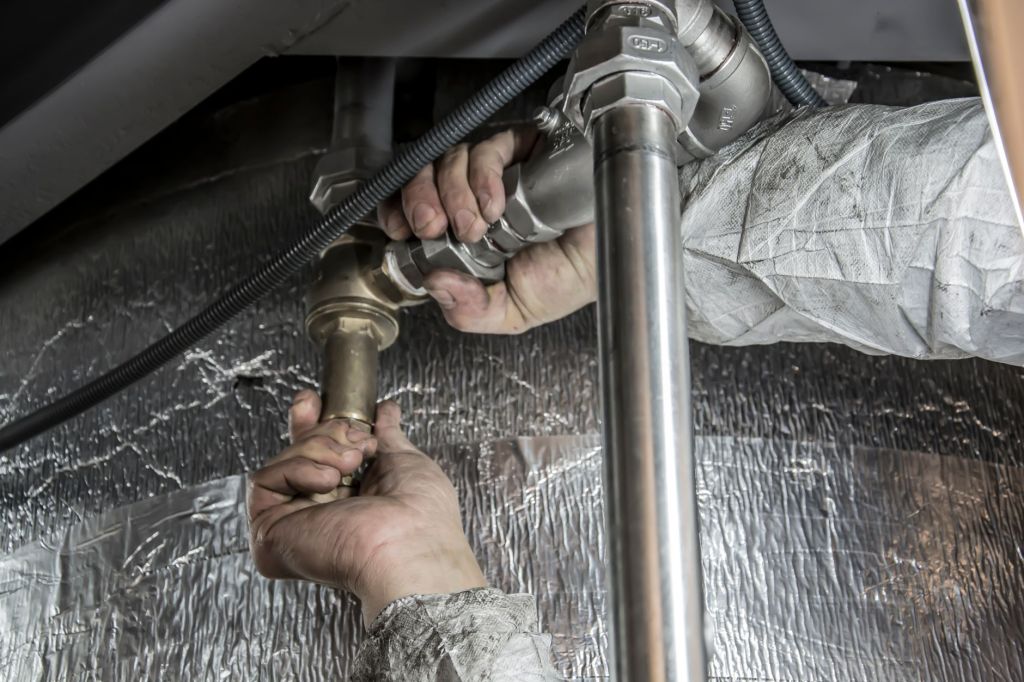
Our kitchen sink features what is called a brushed stainless-steel U-spout faucet centered over a steel basin. It has a single handle that adjusts the water temperature: down for cold and up for hot. Three and a half years ago, the faucet base came loose, so you had to hold the faucet with one hand and operate the handle with the other to keep the entire assembly from rotating round and round. I bought a RIDGID telescoping basin wrench with a built-in LED light. As I recall, my wife, who is more of an engineer than I am, got under the sink and tightened the nut.
A few days ago, the base loosened again. My wife, who is recovering from surgery, said I’d have to do it. I went into the garage, retrieved the telescoping basin wrench, and showed it to her.
“Do you remember how you used this?” I asked.
She looked at the device as if I had handed her the blueprints for a NASA space mission.
“I don’t even remember if I used that,” she said. “I might have tightened it another way.”
So I went on YouTube and watched demonstration videos. The device did not look user-friendly. One reviewer, a plumber, said it was kind of weird.
I thought I’d give it a try.
I first cleared everything from under the kitchen sink: liquid dishwasher detergent, dishwashing soap, kitchen cleansers, water filters, a mini-sized fire extinguisher, sponges, brushes, mineral oil, and other supplies that had accumulated over time. I put everything into several canvas Trader Joe’s shopping bags and placed a towel on the bottom of the empty cabinet.
Even emptied, the cabinet was difficult to maneuver in because of the garbage disposal and the under-sink water-filtration unit. Through trial and error, I learned that I could get farthest underneath by leaning on my left shoulder and angling my body in from the left. I held my phone camera inside the cavernous crevice and took a photograph of what I was aiming for.
The photo, taken from inside the cabinet looking upward toward the underside of the sink and countertop, showed three prominent assemblies crowded into a tight space. On the left was a dark circular component with a black hose. Near the center were braided metal water-supply lines and additional plumbing. To the right was the important part: a shiny, horseshoe-shaped metal mounting bracket pressed against the underside of the countertop, with a copper-colored threaded shaft and fastener extending downward from the faucet. Another black hose hung through the area, making the mounting hardware even harder to see and reach. The photograph made clear why the repair was so awkward: the faucet fastener was tucked high against the countertop amid hoses and plumbing, with almost no room to maneuver a wrench.
At about six feet and more than 230 pounds, I had limited mobility beneath the sink. Add my claustrophobia, which made me want to bolt out of the cabinet as quickly as possible, and I decided it was time to call my engineering friend Pedro.
I’ve known Pedro for more than sixteen years. He is much shorter than I am and about a hundred pounds lighter. He was coming over anyway to take a couple of computers I no longer used. He planned to give them to his sister, also an engineer, who had some use for them.
Unlike me, Pedro was able to make sense of the YouTube demonstration videos. He understood how to position the spring-loaded jaws around the mounting nut and flip the wrench head so the jaws would grip when turned in the tightening direction. As I held the faucet base steady from above, he tightened the nut from below.
He then thanked me for giving him the opportunity to learn how to use a basin wrench. As the landlord of a couple of properties, he explained that he might someday need to perform the same repair for his tenants.
But neither of us was convinced that this $70 wrench was the best way to go. RIDGID also makes a much cheaper tool, the $30 EZ Change plumbing wrench. Rather than using a spring-loaded jaw, it uses interchangeable sockets. You have to select the correct fitting, which may require some trial and error, but I’d rather deal with a socket than that jaw. Pedro felt the same way.
After the faucet crisis was over, Pedro and I spent an hour talking about the rivalry between Honda and Toyota, the problems with turbo engines, speeding tickets, and his preference for Linux over other operating systems. Eventually, he had to head home. As I carried an old iMac to his car and he carried an old laptop, I told him I’d be sixty-five in a couple of weeks.
“How old were you when I first met you?” he asked.
“Forty-seven,” I said. “My wife was pregnant with the twins when you took my writing class.”
Over those years, I watched Pedro go from state-champion boxer to firefighter to electrical engineer. He is now a landlord of several properties and the proud owner of a Lexus RC 350 F Sport in obsidian black. About a decade ago, my father-in-law recommended Pedro to a friend who hired him at his engineering firm. Because of his work ethic and ability to solve problems on the fly, Pedro quickly became the number-one employee. He is the go-to person for putting out fires and making sure projects meet their deadlines.
So it didn’t surprise me that what was, for me, an anxiety-laden nightmare involving an inaccessible nut beneath the kitchen sink was, for Pedro, a useful learning experience—a practical skill he could add to his landlord repertoire.
I am grateful to have Pedro as a friend. But I am also worried. What do I do three years from now when that nut comes loose again? Do I bring out the intimidating basin wrench with its spring-loaded jaw? Or should I buy the cheaper socket version?
By then, Pedro will probably have invented a device that allows anxious homeowners like me to tighten the nut from above the sink.


Leave a Reply