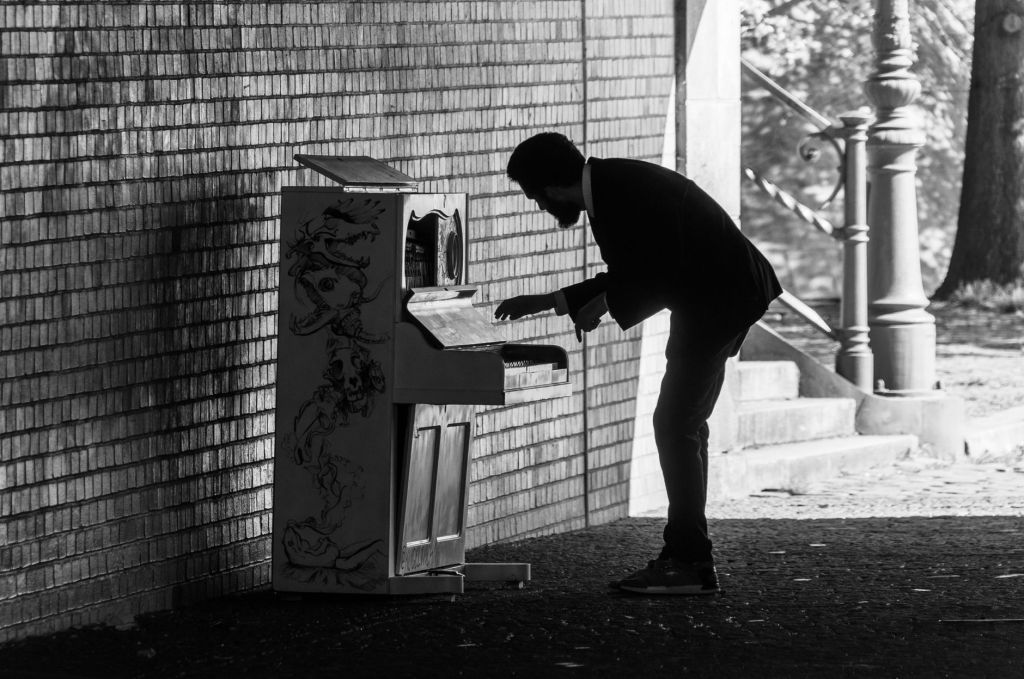
Just as fantasizing about saving the world from space aliens motivated Guy to reach his calorie-burning goals on his exercise bike, his parasocial relationships with podcasters gave him the illusion of belonging to a community. Being a paid subscriber conferred upon him a kind of fantasy friendship in which he was a member of the inner circle. But his fantasies didn’t stop there. They continued during his solitary piano recitals. He realized this after getting up from his nap and eating his ritualistic snack of yogurt, berries, and honey. It was time for half an hour of piano before he picked up his daughters from high school.
Playing the piano meant having an imaginary audience. For years, Guy had entertained a recurring fantasy that had become a monument to his own magnificence. He called this glorious state the Vanity Portal: the strange passage through which a fantasy of being admired unexpectedly opens onto a sincere desire to become good.
The fantasy took him back to 1983. He was twenty years old again, working at Jackson’s Wine & Spirits in Berkeley, where he had actually worked while attending college. But his fantasy had renovated the premises. The wine bar now sat conveniently beside a grand piano.
He was not merely an employee.
He was the entertainment.
He even had a stage name:
Lachyrmose.
There was a ritual to his piano appearances. He would be in the beer box, tearing apart cardboard cartons and doing the grubby work of a liquor-store employee, when customers at the wine bar began demanding music.
“Lachyrmose!”
He made them wait.
“Lachyrmose!”
Eventually, he emerged from the beer box looking like a survivor of industrial combat. Shreds of cardboard clung to his clothes. The sharp edge of a box had scratched his face. His arms bore little cuts and bruises. He was exhausted.
A state of enervation was crucial to the fantasy.
He could not simply be a gifted pianist. That would be insufficiently magnificent. He had to be a working-class hero who had just finished wrestling cases of beer before casually sitting down at a grand piano and revealing the soul of Rachmaninoff.
The customers grew quiet.
Lachyrmose began to play.
Melancholy music filled the wine bar.
In one particularly ambitious version of the fantasy, Peter Gabriel and Steve Hackett happened to be sitting among the customers. They were staying at the nearby Claremont Hotel and had wandered into Jackson’s for a little wine and relaxation.
Naturally, they were astonished.
Who was this young man?
Minutes ago, he had been dismantling beer cartons. Now he was producing music of heartbreaking beauty with a fully formed artistic voice. Gabriel and Hackett exchanged glances. They understood immediately that they had stumbled upon some rare creature—a bruised liquor-store employee with the soul of a nineteenth-century composer.
At this point, Guy’s elaborate fantasy had become so narcissistic that it bordered on the pathological.
But then someone else entered the fantasy, making it even more deranged.
A homeless woman.
Unlike Peter Gabriel and Steve Hackett, she came from an actual memory.
Guy remembered seeing her near Jackson’s wearing a red wig she had apparently found in a dumpster. She stood before the reflective glass of a newspaper rack, admiring herself in her new acquisition. The wig was garish and artificial, but she looked at her reflection with pleasure. For a moment, this discarded object had given her something beautiful.
In Guy’s fantasy, she joined the customers at the wine bar.
Settling onto the piano bench, he brushed some cardboard dust off his black T-shirt and began playing.
The homeless woman listened for a while and then fell asleep.
The melancholy piano music washed over her as she dozed in her ridiculous red wig. Peter Gabriel listened. Steve Hackett listened. The wine drinkers listened. But gradually, they ceased to matter.
When the recital ended, the woman woke up.
With tears running down her cheeks, she thanked Guy for the music.
Knowing she was hungry and destined to sleep in some back alley, Guy gave her a bag filled with deli sandwiches to take with her.
Of course, Gabriel and Hackett witnessed this too. They were already impressed by his piano playing; now they discovered that Lachyrmose was also a humanitarian.
Apparently, musical genius wasn’t enough.
Guy required sainthood.
But then the fantasy changed.
The woman thanked Guy for the recital and the sandwiches, and he told her that no thanks were necessary.
It was an honor to play for her.
And he meant it.
That was the moment when Guy passed through the Vanity Portal.
Something strange and mysterious happened. The fantasy ceased to be entirely about admiration. Peter Gabriel disappeared. Steve Hackett disappeared. The wine bar disappeared. Even Lachyrmose began to disappear.
There was only the woman in the red wig.
And Guy loved her.
Not romantically. Not sentimentally. He felt an overwhelming tenderness toward this forgotten person who possessed next to nothing, who had found a discarded wig and briefly admired herself in the glass of a newspaper rack.
In the fantasy, he told her that playing for her was an honor.
But the tears weren’t imaginary.
It was a week before Thanksgiving, and at the age of sixty-five, Guy was sitting at his piano, playing and crying.
His real tears prevented him from dismissing the fantasy as mere narcissistic theater.
Guy struggled with his Jewish and Christian backgrounds. He struggled with their doctrines, their claims about salvation, their diagnoses of the human condition, and the enormous theological machinery built around them. He could argue day and night about the reasons for his skepticism.
But in that moment at the piano, he experienced something he could only describe as the love of Jesus, who enjoined his followers to care for the least among us.
Not doctrine.
Not theology.
An impulse.
The desire to look upon someone whom the world barely saw and regard serving her not as an act of charity but as an honor.
And suddenly his ridiculous fantasy had revealed something he hadn’t known was there.
He wanted to be good.
He wanted a pure heart.
He wanted to be the opposite of Sour Man.


Leave a Reply