Category: Health and Fitness

  • The Don’t Forget Watch: A Monthly Appointment With Reality

    The Don’t Forget Watch: A Monthly Appointment With Reality

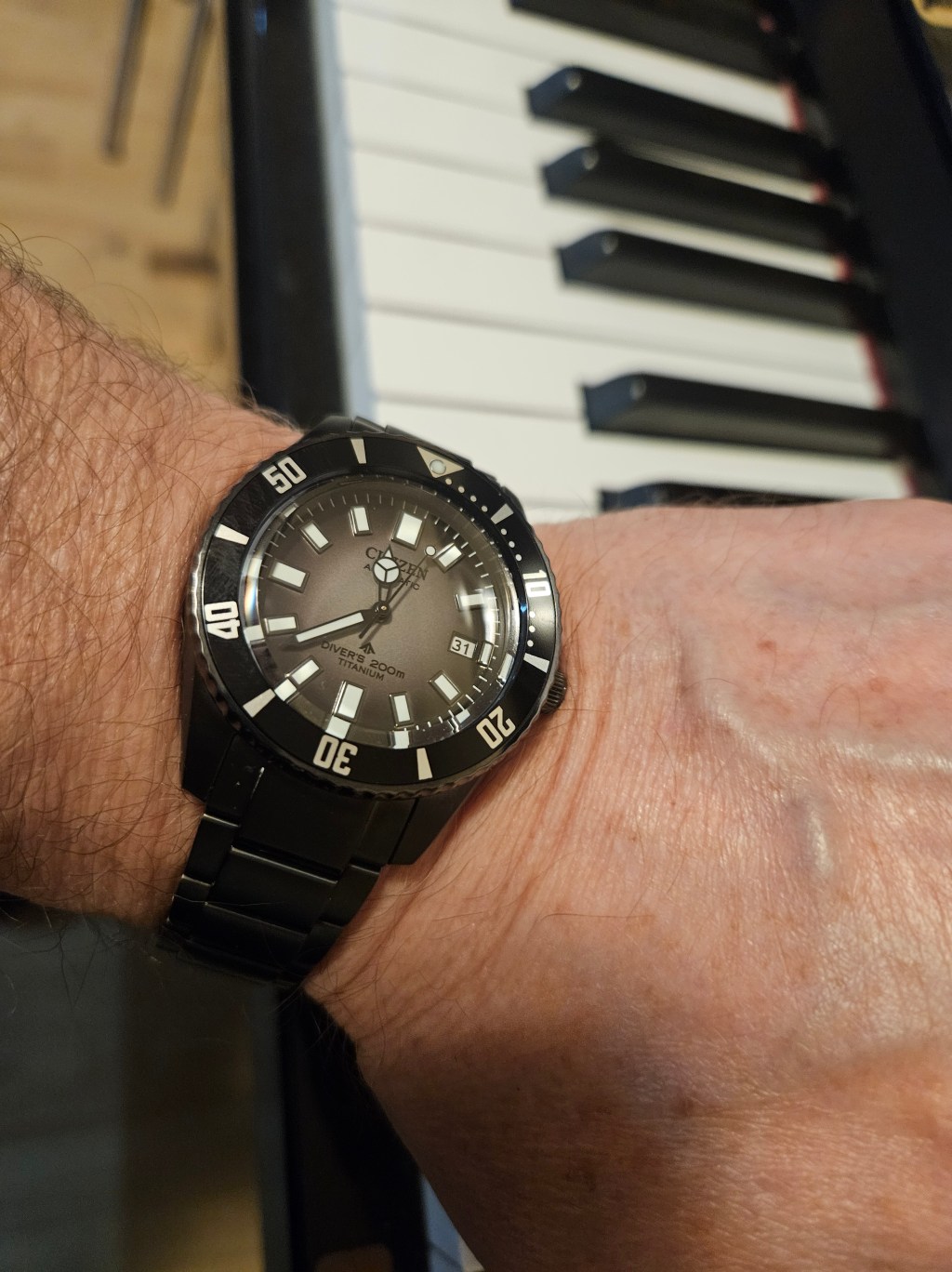
    Two weeks ago, you did something familiar and slightly suspicious: you re-bought a watch you had already owned. The return offender was a mint Citizen Fujitsubo gunmetal diver—DLC-coated, Super Titanium, sapphire crystal, and powered by a serious mechanical movement. At $325, the price was so low it felt less like a purchase and more like a rescue operation. It arrived quickly. It looked excellent. For a brief moment, you felt the warm glow of reunion.

    Then reality entered the room.

    Problem one: the G-Shock Frogman you’d already purchased was still in transit. The Fujitsubo pushed your collection to nine watches—a number that didn’t feel like ownership so much as property management. Nine watches suggested spreadsheets, rotation anxiety, and the faint sensation that you were running a boutique hotel for objects. Problem two: the Fujitsubo came on a titanium bracelet. This violated your recent identity shift into The Strap Man—a collector who rejects bracelets as unnecessary shine and embraces vintage straps as a manifesto of simplicity and restraint.

    So, despite the watch’s quality and absurd value, it became a psychological liability. You listed it on eBay for $389. Five days passed. Fifteen watchers. Zero bids. You relisted at $359. Three more days. Still nothing. And then, somewhere between refreshing the listing and checking the clock, the epiphany arrived: you weren’t trying to sell a watch—you were trying to sell your dignity at a discount. To sell this majestic timepiece at such a cheap price to a stranger would feel like being violated.

    So you took the Fujitsubo off of the eBay chopping block.

    This was no longer inventory to be sold. This was your Don’t Forget Watch.

    Its purpose is not rotation pleasure. Its purpose is memory. It exists to remind you that you are a watch addict, a flipper, a re-buyer, a man capable of buying the same object twice and then trying to unload it like contraband. It is not a source of shame. It is a quiet corrective. A cork in the bottle of your addiction. Once a month—on the first—you wear it. No debate, no analysis, no wrist-time optimization. It is a ritual of humility, a scheduled encounter with your own behavioral history.

    Yes, it’s on a bracelet. Yes, that complicates your Strap Man identity. But this is not stainless steel flash—it’s Super Titanium, light, matte, and appropriately subdued. More importantly, it is your only monochromatic gunmetal piece, which gives it a legitimate ecological niche inside the collection. This is not a fire-sale candidate. It is a fixed monument.

    Treat it accordingly.

    The Don’t Forget Watch is not there to impress you. It is there to steady you—to remind you that the real project is not building a collection, but reclaiming control, maintaining single-digit sanity, and moving forward without repeating the same expensive lesson.


  • The Taco Bell Effect: How Fast Food and Watches Keep You Hungry

    The Taco Bell Effect: How Fast Food and Watches Keep You Hungry

    My daughters wanted Taco Bell for dinner. I could have abstained, assembled a respectable salad, and preserved my nutritional dignity. Instead, I chose the chicken soft tacos—modest, reasonable, practically virtuous by fast-food standards. And Taco Bell, as always, performed its engineered magic. Somewhere in Irvine, a laboratory of flavor chemists continues its quiet mission: maximize salt, fat, texture, and novelty until the brain lights up like a slot machine. The tacos tasted fantastic. Dopamine rang the bell. I walked away feeling disciplined, even proud—two tacos and a side of sliced bell peppers. Look at me, a responsible adult navigating fast food with restraint.

    Then, about an hour later, the bill came due.

    My appetite didn’t return politely. It kicked the door in. Hunger surged with a strange urgency, as if the meal had not fed me but awakened something restless and unfinished. I ate an apple. Still hungry. I opened a bag of Trader Joe’s Organic Elote Corn Chip Dippers. Still hungry. I cut a thick slice of sourdough and buried it under peanut butter. The sensation wasn’t indulgence—it was pursuit, as though my metabolism were trying to collect a debt the tacos had promised but never paid.

    I was still hungry when I finally surrendered—not to satiety, but to sleep, the only reliable way to close the kitchen.

    Clearly, I had suffered from the Taco Bell Effect: the paradoxical state in which a highly engineered, intensely satisfying experience delivers maximum sensory pleasure and minimum lasting fulfillment, triggering a rebound surge of appetite shortly after consumption. Designed for flavor density, salt, fat, and rapid dopamine, the meal convinces you—briefly—that you’ve eaten well and even responsibly. Then, an hour later, your metabolism files a formal protest. Hunger returns louder than before, prowling the kitchen like a debt collector. The Taco Bell Effect isn’t overeating; it’s under-satiation disguised as satisfaction—a culinary confidence trick in which the experience feels indulgent, the calories look reasonable, and the aftermath sends you negotiating with apples, chips, and peanut butter while wondering how two tacos opened a hunger portal instead of closing one.

    The Taco Bell Effect and the compulsive watch purchase run on the same psychological circuitry: both deliver stimulation without closure. Taco Bell gives you flavor, salt, fat, and novelty, but not satiety; the experience excites the appetite rather than resolving it. A compulsive watch purchase works the same way. You get the hit—research, tracking, unboxing, wrist shots, forum validation—but the emotional hunger remains untouched. Instead of quieting desire, the purchase sharpens it. Within days, you’re browsing again, comparing again, chasing the next micro-difference the way a fast-food meal sends you back to the pantry. In both cases, the problem isn’t excess; it’s insufficient psychological fullness.

    The illusion that traps people is the calorie logic of the hobby: “It’s only one watch,” just as “It’s only two tacos.” But the real metric isn’t the size of the purchase—it’s the behavior that follows. A healthy acquisition produces satiety: you stop looking, you forget the market, you wear the piece without agitation. A Taco Bell watch, by contrast, is engineered for stimulation—limited editions, countdown drops, spec debates, influencer hype. It tastes intense but digests poorly. The result is the horological equivalent of metabolic whiplash: the dopamine spike fades, and the mind, still unsatisfied, starts hunting again.

  • Watch Hermit Mode

    Watch Hermit Mode

    At a certain point in the hobby, something subtle and irreversible happens: your internal rhythms begin to synchronize with the mechanical rhythms on your wrist. Time is no longer something you check; it is something you become. Welcome to Watch Hermit Mode—the state in which life is reorganized around precision, predictability, and the closed-loop efficiency of a well-regulated movement. The world outside is noisy, random, and inefficient. Your world is none of those things. Clothing becomes a uniform, routines run on fixed cycles, social invitations are flagged as system malfunctions, and discretionary hours are redirected toward higher-order maintenance: strap swaps, rotation optimization, wrist-time analytics, and the quiet satisfaction of knowing exactly how your collection is performing. Early mornings, early nights, and aggressive schedule defense are not quirks; they are operational strategy. What begins as efficiency slowly hardens into elective isolation. You are no longer merely wearing a machine. You are running its operating system.

    The symptoms appear gradually. First comes the 24-Hour Uniform Protocol. One outfit rules them all: sleep, gym, house, repeat. You go to bed in training shorts and a performance shirt, wake up in them, live in them, sweat in them, shower, and replace them with an identical specimen waiting like a spare part. Wardrobe changes are for amateurs and extroverts. You take quiet pride in your textile minimalism while lesser mortals stagger through multiple outfits a day like inefficient prototypes. Like a properly engineered movement, nothing in your system is ornamental. Every component has a function.

    Next comes the Saturday Night Diver Symposium. While your spouse and her friends are making custom concert signs for a desert music festival, you are at home performing strap swaps with surgical focus, refining a rotation calendar, and updating your annual wrist-time ledger. You know—without irony—that your Seiko Marine Master logged exactly 863 hours last year. This information feels important to you. It is less important to everyone else, who now watches you the way one observes a man who alphabetizes his spices by emotional significance.

    Your tolerance for human friction declines accordingly. Grocery shopping becomes a dawn operation conducted among the sleepwalking and the defeated. The early hour is not about convenience; it is about control. By the time the world wakes up, you have completed coffee, steel-cut oats, kettlebells, macro acquisition, and inventory storage. Bed at nine. Up at five. While the masses drift through their dreams, your system has already executed its morning cycle.

    The final stage is known domestically as Captain Cancel. Social plans are treated as hostile intrusions and neutralized with strategic intelligence: weather risks, parking deficiencies, epidemiological concerns, structural hazards, noise pollution, or the sudden discovery that a once-beloved comedian has not been funny since the Reagan administration. On the rare occasion you attend Taco Tuesday, you insert improvised ear protection, declare a medical issue, and Uber home to safety. The long-term result is operational peace. Invitations cease. The perimeter holds.

    If any of this feels familiar, the diagnosis is clear. You have optimized your life for accuracy, order, and solitude. The chaos of human variability has been replaced by the calm logic of regulated systems. In Watch Hermit Mode, you are not hiding from the world. You have engineered a better one—smaller, quieter, perfectly timed. The door is locked from the inside, the key discarded, and the movement is running beautifully.

  • Monowatch Asceticism Meets the Skinny Yoga Guy

    Monowatch Asceticism Meets the Skinny Yoga Guy

    As the clock keeps punching holes in the calendar and I drift into the middle distance of my sixties, I’m stalked by the uneasy sense that I am not the man I’m supposed to be. I carry thirty extra pounds like unpaid emotional invoices. I cave to food temptations with embarrassing regularity. I indulge in narcissistic spirals of self-pity. My body bears the archaeological record of a lifetime of weightlifting injuries. Something has to give. The question isn’t whether I’m a complex human being—of course I am—but which single image can give me dignity, courage, and self-possession as I face my obligations, stay engaged with this lunatic world, and fend off entropy. The image that keeps returning, uninvited but insistent, is this: I am the Skinny Yoga Guy.

    The Skinny Yoga Guy eats vegan, clean, and whole, not as a performance but as a quiet discipline. He hits his protein macros with buckwheat, pumpkin seeds, peas, soy, garbanzos, and nutritional yeast, without sulking or negotiating. He cooks plant-based meals anchored in Thai, Mexican, and Indian traditions, not sad beige bowls marketed as “fuel.” He doesn’t snack like a raccoon in a pantry; he sips cucumber water and green tea and moves on with his day.

    He practices yoga six days a week, a full hour each time, sweating without complaint. The body lengthens. The spine straightens. He appears taller, calmer, less compressed by life. There’s a faint health glow—less “Instagram guru,” more “someone whose joints don’t hate him.” The discipline reshapes his temperament. The short fuse and indulgent sulks fade. In their place emerges a man who notices other people, attends to their needs without sermonizing, and discovers—almost accidentally—that service makes him sturdier, not smaller.

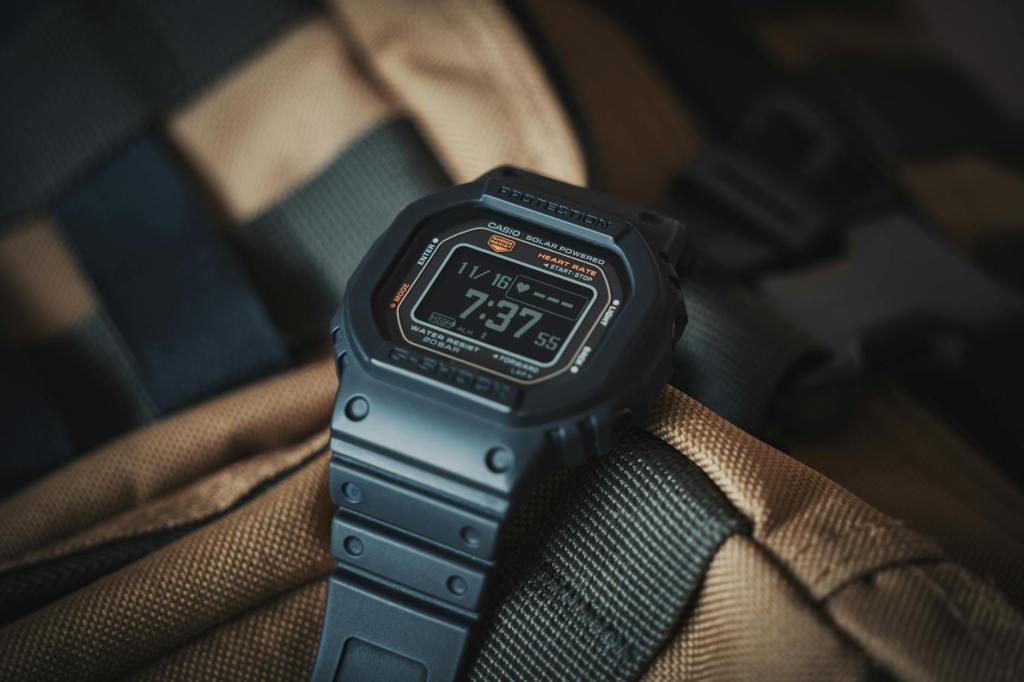
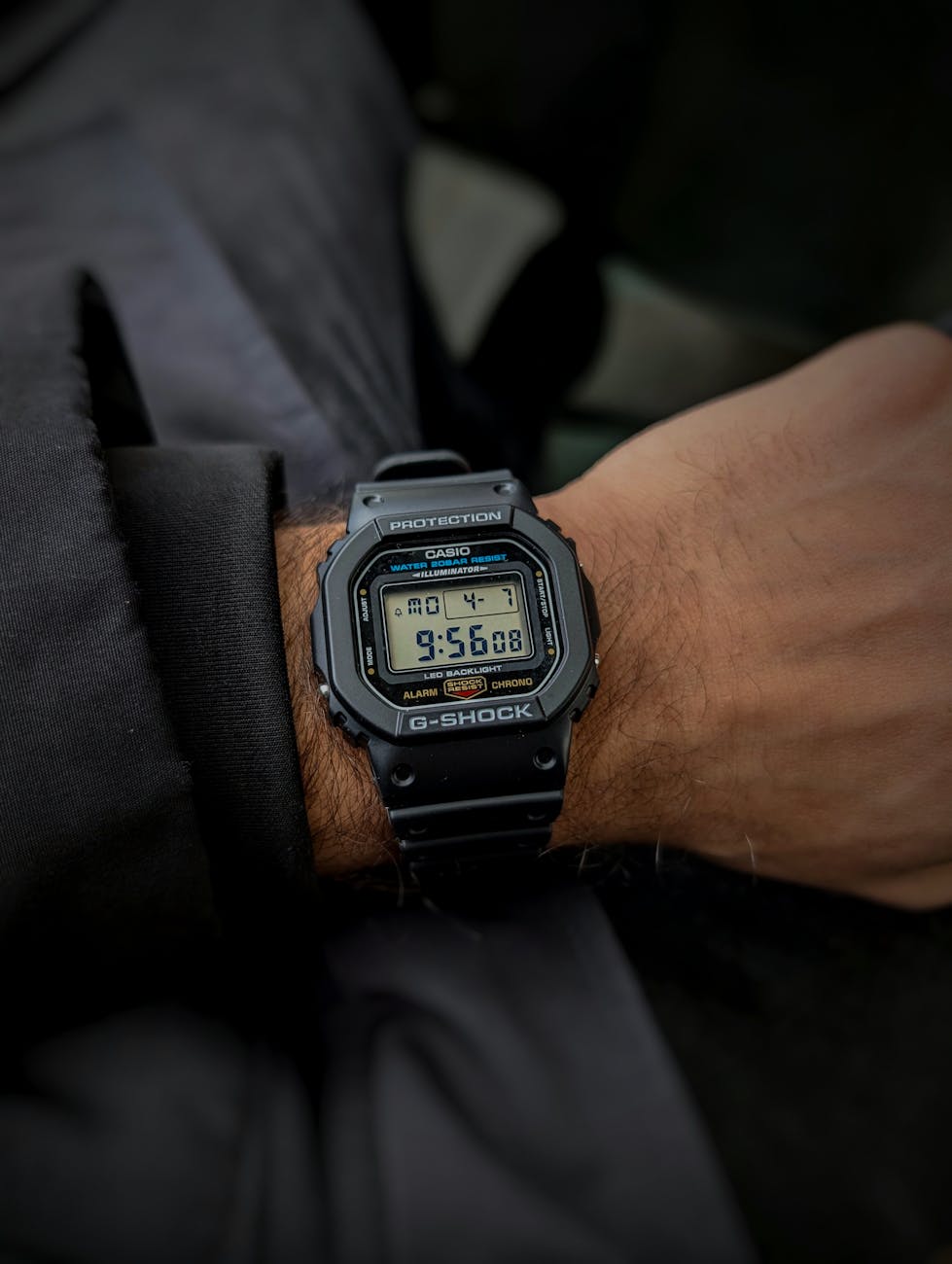
    In this revised operating system, the watch obsession quietly dies. No more chunky diver watches as heroic cosplay. No rotation. No drama. Just one watch: the G-Shock GW-5000. The purest G-Shock because it refuses theater. Shockproof, accurate, solar-powered, atomically synced. No Bluetooth, no notifications, no begging for attention. It does one thing relentlessly well: it tells the truth about time. It is reliability without narcissism.

    If the GW-5000 is indestructibility stripped of spectacle, then my assignment is clear: I must become its carbon-based counterpart. Less bloat. Fewer features. More uptime. Yoga becomes joint maintenance. Vegan food becomes corrosion control. No supplements that blink. No gadgets that chirp. No dietary Bluetooth pairing with guilt. Just a lean system designed to absorb impact, recover quickly, and remain accurate. GW-5000 firmware, now awkwardly attempting to run on two legs. Stripped down to one G-Shock, I can enjoy Monowatch Asceticism: the deliberate reduction of a watch collection to a single, purely functional timepiece as an act of identity purification. Ownership shifts from expression to discipline; the watch becomes less an accessory than a vow—proof that the wearer has stepped off the cycle of acquisition and into a life governed by restraint, durability, and quiet competence

    The longing is real. I want to be the Skinny Yoga Guy—disciplined, light, healthy—wearing a single $300 G-Shock as a quiet marker of having stepped off the status treadmill. I no longer want validation from a $7,000 luxury watch. Wanting this man is easy. Becoming him is not. That requires character, not aspiration.

    My hunch is that I need to write my way into him. A novel titled The Skinny Yoga Guy. Not a parody, not a self-help tract, but a chronicle of real-time change rendered with mordant humor and unsparing honesty. The book isn’t the point. Transformation is. The novel would simply be the witness.

    So here I am, a larval creature trapped in my cocoon. I must emerge as a new creature. The challenge is issued. Whether the world is waiting for my metamorphosis is irrelevant. I am. And that, for once, feels like enough.

  • The Dignity Liquidation Cycle: When Buying Feels Good and Selling Feels Necessary

    The Dignity Liquidation Cycle: When Buying Feels Good and Selling Feels Necessary

    If I were brutally honest, I’d admit that over the past twenty years, ninety-five percent of my watch purchases were impulsive. Which means ninety-five percent were evidence of arrested development with a credit card. I sold most of them at a loss—not because I needed the cash, but because I needed my self-respect. This is the Dignity Liquidation Cycle: the ritual of unloading recent purchases at a financial loss to restore psychological balance. The money forfeited becomes a self-administered fine, a tuition payment to the School of Impulse, and a symbolic attempt to reassert control over a mind that briefly wandered off without supervision.

    The harder question is not what I bought, but why I kept buying. My suspicion is cultural. I come from the Me-Generation, raised in 1970s California where desire wasn’t something to question—it was something to honor. Rob Lowe captured the atmosphere perfectly in Stories I Only Tell My Friends: the Counterculture as the Worship of the Self. Whatever the Self wants, the Self gets. No brakes. No compass. In Malibu’s sunlit dreamscape, people overdosed on pleasure, vanished into excess, and confused appetite with identity. When desire becomes sacred, reality becomes negotiable—and the bill eventually arrives.

    That wiring never quite left me. When I see a watch that speaks to me, my brain lights up like I’ve taken a controlled substance without the prescription. The surge is immediate and physical. Then comes the anger—not at the price, but at the loss of command. What does self-belief even mean if a rotating bezel can override your judgment? How do you grow into adulthood if your emotional economy still runs on the logic of a sixteen-year-old with access to a catalog?

    I don’t want rehab. I don’t want a hobby that has to be locked in a drawer for my own safety. I want a watch life that fits inside reality instead of pulling me out of it. Pleasure without compulsion. Enjoyment without drama. A collection that reflects judgment rather than appetite. In other words, I want the hobby to behave like an adult, even if the hobbyist occasionally does not.

    And here’s the punchline: even diagnosing the Me-Generation triggers nostalgia for being sixteen in Southern California in 1976, when the future felt endless and impulse felt like freedom. The danger is looking back too long. That way lies Lot’s wife, calcified in longing. So I change the channel. I close the YouTube reviews. Because the distance between “research” and “purchase” is about three videos—and I’ve learned the hard way that impulse has a very convincing voice when it sounds like happiness.

  • When Wrist Presence Dies and Play Takes Over

    When Wrist Presence Dies and Play Takes Over

    In my early forties, I was intoxicated by wrist presence. I wanted watches so large they could signal low-flying aircraft. The bigger the case, the smaller my sense of self. These weren’t timepieces; they were emergency beacons for a man negotiating a quiet identity crisis. I wasn’t checking the time. I was broadcasting relevance.

    My vanity, however, was narrowly focused. I didn’t need a luxury car or a curated wardrobe. A sensible Honda Accord, a pair of jeans, a T-shirt, and a reasonably functional body were enough. The watch did the heavy lifting. It carried the narrative, the authority, the illusion of significance. For twenty years, this arrangement felt efficient: a minimalist life wrapped around a maximalist ego.

    Then, sometime in my sixty-third year, the chemistry changed. The thrill soured. The signature piece that once delivered a dopamine surge now felt like an old campaign slogan from a war already lost. I had entered what can only be called Vanity Burnout—the moment when the performance loop collapses and status objects lose their voltage. The competitive theater of self-presentation gives way to something quieter, less theatrical, and far more honest.

    I still love my divers. But the relationship has changed. They no longer feel like conquests. They feel like companions. The manic gleam is gone, and no amount of Instagram flexing or YouTube rumination will bring it back. The truth is blunt: every ticking second is a small reminder that the clock is not decorative. Time—the final minimalist—has stripped away the illusion of permanence and replaced it with perspective.

    And yet, in about a week, a G-Shock Frogman will arrive from Japan.

    It is enormous. It is loud. It borders on cosplay. By any rational standard, it contradicts everything I’ve just said.

    But this is not a relapse into status anxiety. Something else is happening. When the need to impress dissolves, the wrist becomes a private stage. The watch is no longer a signal to the world; it’s a toy for the soul. Certain territories remain protected—ritual, hobby, the small theater of personal delight.

    The vanity has burned off.

    The play instinct has not.

    And when I strap on that absurd, tactical Frogman, I won’t be announcing anything to anyone.

    I’ll just be smiling.

  • Beware of the Appetizer Watch

    Beware of the Appetizer Watch

    A week ago, you ordered a G-Shock Frogman from Sakura Watches in Japan. Five hundred dollars of stainless steel caseback confidence and amphibious authority. It hasn’t shipped. It hasn’t moved. It may not even be awake yet. And already you’re pacing like a father in a maternity ward.

    This is when the mind proposes a solution—reasonable, economical, almost virtuous. Why not a small interim purchase? Something modest. Something practical. Enter the Rangeman. Two hundred dollars. Which, compared to five hundred, is practically free. In fact, you’d be irresponsible not to buy it. You need something to wear. Something to distract you. Something to manage the emotional volatility of waiting.

    You have now encountered the Appetizer Watch: the elegant fiction that a secondary purchase is a financial non-event simply because a larger purchase already exists. The math is creative, the tone is prudent, and the outcome is predictable. Compulsion, dressed in the language of thrift.

    But then a harsher voice cuts through the negotiation. If you need a consolation prize while you wait, you are not a collector. You are a child in a checkout line demanding gum. You don’t want to greet your Frogman as a man who held the line. You want the hero’s entrance, not the emotional equivalent of, “I couldn’t wait, so I bought a snack.”

    Because you understand something deeper: if you numb the waiting, you weaken the arrival. This is the Anticipation Dilution Effect—the emotional law of acquisition. The longer the buildup, the sharper the impact. Buy a Rangeman now, and the Frogman lands with a shrug instead of a thunderclap. You didn’t wait for the moment. You softened it.

    So you wait. You refresh the shipping page. You rehearse the wrist shot in your mind. And somewhere inside, you see him—the impatient little creature banging a plastic spoon against the inside of your skull, demanding immediate gratification.

    Once you see that inner infant, you can’t unsee him. He lives there now. Not defeated. Not reformed. Just exposed—your permanent reminder that beneath the language of discipline and discernment sits a toddler with Wi-Fi and a credit card.

  • The Art of Managing Excess Without Reducing It

    The Art of Managing Excess Without Reducing It

    At some point in the life of a watch obsessive, the collection crosses a quiet but decisive border. You no longer own the number of watches you once imagined as tasteful, disciplined, and sane. The ideal was five. Seven felt like a firm upper limit. Then one day you open the watch box and discover you’re living with nine, twelve, perhaps seventeen small mechanical dependents staring back at you like polite, expensive houseguests who have no intention of leaving.

    This is the moment when pride turns to pressure. The collection is no longer a source of simple pleasure but a low-grade psychological obligation. Each piece wants wrist time. Each one carries a memory, a justification, a story you once told yourself about why it was necessary. Selling is theoretically an option, but in practice it’s a bureaucratic ordeal for a financial return that feels insulting relative to the emotional investment. These watches are not inventory. They are artifacts. They are also, inconveniently, permanent.

    In my case, the number is nine. My comfort zone is seven. Two extra watches may not sound like a crisis, but in the obsessive mind, those two pieces push the collection into the Anxiety Zone—a territory defined less by quantity than by the feeling that ownership has quietly outrun intention.

    When reduction feels impossible, the mind does what it does best: it invents management strategies. Not to shrink the collection, but to make the collection feel smaller. We call this Inventory Anxiety Mitigation: a set of mental and logistical tactics designed to dull the psychological pressure of owning more watches than one believes is reasonable.

    The first maneuver is the Comparative Relief Loop. You soothe yourself by looking outward. Yes, nine feels excessive—until you visit a forum where someone casually posts a photo of forty-seven watches arranged like a jewelry store liquidation. Perspective arrives. Your excess becomes restraint.

    Next comes Taxonomic Downsizing. You divide the herd into categories: mechanical, quartz, solar, titanium, G-Shock. Each subgroup feels modest. Nothing has actually been reduced, but complexity has been repackaged into smaller mental containers, which creates the comforting illusion of discipline.

    Then there is Scheduled Rotation Rationalization. You build a calendar. Monday is the diver. Tuesday is the G-Shock. Wednesday is titanium day. Structure transforms abundance into a system. The problem is no longer “too many watches.” The problem has been reframed as operational logistics.

    Inventory Legitimization follows naturally. Tracking, cataloging, planning, rotating—these activities convert accumulation into something that feels curated. The collection acquires moral authority. It is no longer excess. It is a program.

    Underneath all of this lies Cognitive Load Camouflage. Lists, spreadsheets, categories, and schedules do not reduce the mental weight of ownership. They conceal it. Administration becomes a mask for complexity, allowing the collector to feel in control without actually simplifying anything.

    And then there is the internal voice I call Kevin O’Leary Scolding. When you stand before the watch box feeling faintly overwhelmed, you hear the imaginary Shark Tank verdict: “Stop whining about your watches. Get out of the house and make some money.”

    Together, these strategies reveal the collector’s central paradox. When reduction feels unrealistic, the mind does not shrink the collection. It redesigns the story. The watches stay the same. The narrative gets smaller.

  • Beware of The Grim Reaper Watch

    Beware of The Grim Reaper Watch

    The New York Times article, titled “Skimpy Men’s Swimming Briefs Are Making a Splash,” offers a solemn dispatch from the front lines of GLP-1 drugs, but I would guess that men—having exhausted every form of visible self-optimization—are now expressing their Ozempic-enabled slenderness via tiny, Lycra-clad declarations of status. We’re talking male bikinis, or what I like to call the ego sling.

    Apparently, if you’re dropping $18,000 a year to chemically suppress your appetite and shed your humanity one subcutaneous injection at a time, you deserve the privilege of looking like a Bond villain’s pool boy. I suppose this is the endgame: pay to waste away, then wrap what’s left in a luxury logoed banana peel.

    Luxury underwear companies, never ones to miss a chance to monetize body dysmorphia, are now marketing these second-skin briefs not as mere swimwear, but as power statements. To wear them is to say: “I’ve defeated fat, joy, modesty, and comfort in one fell swoop.”

    I’m almost 64. My aspirations remain high—ideally, I’d like to look like a special-ops operator on vacation in Sardinia. But I know my place. I wear boxer-style swim trunks, the cloth of the pragmatic and the semi-dignified. They’re not exciting, but neither is seeing a sun-leathered septuagenarian adjust a spandex slingshot over a suspicious tan line.

    There’s a difference between being aspirational and being delusional. The former means striving for vitality, strength, and energy. The latter means stuffing yourself into a satirical undergarment and pretending you’re a twenty-two-year-old wide receiver with a sponsorship deal.

    To my fellow older men: sculpt your body like it’s your spiritual obligation—but when it comes to swim briefs the size of a hotel mint, maybe opt out. Not every part of youth is worth reliving. 

    When I think of old guys clinging to their youth by wearing undersized swim trunks, I often think back to the summer of 2019 when my wife and twin daughters were in Maui and I was treated to one of life’s great grotesques: a compact man in his mid-seventies parading the beach in dark-blue Speedos with a woman young enough to be his granddaughter. She was Mediterranean gorgeous, twenty-something, and clearly imported as the ultimate accessory. He was trim, shaved, strutting across the sand like a hedge-fund satyr who believed that constant motion kept the Grim Reaper wheezing in his wake. He dove into the surf not like a man swimming, but like a man negotiating—bargaining with Time.

    You could smell his wealth before you could smell the salt air. A CEO, no doubt—half his life in boardrooms, the other half clawing at immortality. His creed was Hefner’s: work hard, play harder, and Botox anything that betrays the passage of time. I’m not here to moralize about his May-December arrangement. What fascinated me was the fantasy: money, discipline, and a bit of manscaping as talismans against entropy, as if youth could be distilled into a cologne.

    But the tableau reeked of mismatch—two puzzle pieces jammed together with superglue. Forced smiles, awkward touches: every moment chipped another sliver from the illusion until they looked less like lovers and more like hostages. This was not youth preserved; this was youth taxidermied. His confidence read as terror. His curated life, meant to inspire envy, collapsed into a sad performance—a tuxedo on a traffic cone.

    This kind of mismatch exists for the man who tries to force an oversized, loud watch that he could have worn with pride in his youth, but now looks like a desperate attempt to hold on to something that is long gone. His intent in wearing such an ostentatious watch is to curate a life of youth and virility, but the opposite occurs: The inappropriate piece of gauche jewelry reminds the world that this man is close to death and therefore this shiny monstrosity on his wrist is The Grim Reaper Watch: the oversized, hyper-loud timepiece worn not to express taste or confidence, but to wage a visible, losing war against aging—a last-ditch signal of youth, virility, and relevance that lands with the opposite effect, announcing not vitality but panic. Like the seventy-year-old in neon swim briefs or the hedge-fund satyr sprinting through Maui as if motion alone could outrun mortality, the wearer treats titanium, ceramic, or fluorescent rubber as a talisman against entropy. But the mismatch gives the game away. Instead of projecting power, the watch reads as youth taxidermy—a glittering performance of denial that makes Time, the very thing the watch measures, feel suddenly louder. The Grim Reaper Watch does not stop the clock; it amplifies it, ticking on the wrist like a tiny, expensive memento mori.

  • When the World Updates Without You: The Quiet Power of Mechanical Time

    When the World Updates Without You: The Quiet Power of Mechanical Time

    No one warned me, but I should have seen it coming: creeping toward your mid-sixties is less a rite of passage than a crisis of competence. Or, to be precise, it’s a progressive misalignment with the modern world. You drop references to Danish Go-Rounds, Screaming Yellow Zonkers, Tooter Turtle, Super Chicken, and All in the Family and watch blank faces stare back at you. You still assume that appliances are built with the sturdiness of yesteryear, only to find that today’s models disintegrate if you breathe on them sideways. This misalignment breeds a special kind of incompetence—egregious, preventable, humiliating.

    You can swallow vats of triglyceride omega-3 fish oil, but the short-term memory still slips away without mercy. You forget where you parked your socks (on the couch), that you meant to watch the final episode of that crime docuseries on Netflix, that a Costco-sized case of 12-gallon trash bags lurks in the garage, or that you already ground tomorrow’s coffee beans. The indignities pile up like unopened mail.

    These lapses, coupled with your fossilized references to extinct foods and beloved TV shows, render you a creature out of phase with the universe—an alien with wrinkles, blinking in confusion, flashing your unearned senior discount at the box office like it’s a badge of relevance.

    You can flex all you want against this verdict. Wolf down 200 grams of protein daily, clang kettlebells in the garage, and polish yourself into the semblance of a beaming bodybuilder who could pass for forty-four instead of sixty-four. But that delusion ends the second you get behind the wheel at night. Your depth perception is a cruel joke. The glare of headlights and streetlamps slices into your worn irises like laser beams, reminding you that biology—not discipline—is running the show.

    Like it or not, you’re aging in real time, a public spectacle of decline, the unwelcome prophet of mortality who shatters the younger generation’s illusion that time is indefinite. To them, you are as pleasant a presence as a neighbor’s dog barking at a squirrel at six a.m.—loud, unnecessary, and impossible to ignore.

    Congratulations–you’ve become the world’s unwanted alarm clock.

    But all is not lost. You have your watches. While the larger world moves faster than your reflexes and updates itself without your consent, the watch box waits patiently, offering a language you still speak fluently. You wind the crown. You change a strap. You turn the bezel and count the clicks like a monk fingering prayer beads. No notifications. No software patches. No judgment.

    This is Therapeutic Realignment: the quiet restoration that occurs when a man drifting out of phase with modern life anchors himself in a domain he can still master. Mechanical watches obey touch, attention, and ritual. Set the time and the movement responds. Rotate the collection and the day acquires structure. Flip the caseback toward the light and there it is—a small, disciplined universe of gears and springs, working without complaint, without irony, without asking you to download anything.

    These tactile routines create a sanctuary of competence in a world that increasingly makes you feel like a beta tester for your own existence. Where memory falters, the ritual holds. Where technology alienates, mechanics reassures. In this ecosystem, time stops behaving like a predator and becomes a companion. You move, if only briefly, from obsolescence to equilibrium. You are no longer behind. You are simply keeping time.

    Which is why the watch hobby is never just a hobby. It is a romance with mechanized time—a private jurisdiction where order still answers to your hand. While the young glance at their phones and treat time as a background utility, you study the slow sweep of a seconds hand or the living heartbeat inside your Grand Seiko. Through the sapphire caseback, time is no longer something slipping away. It is something alive, something contained, something you can hold steady—your own small sphere of Sacred Time in a loud and impatient world.