Category: Health and Fitness

  • The Morning Crisis No One Talks About: Choosing the Wrong Watch

    The Morning Crisis No One Talks About: Choosing the Wrong Watch

    You wake up, shuffle to the coffee maker, and open the watch box.

    Inside, a dozen small mechanical personalities stare back at you, each silently asking the same question: Why not me?

    You freeze.

    The seconds tick. Your coffee overflows. Your toast burns. Your heart rate climbs. This is not a simple accessory choice. This is a moral decision. Identity is at stake. Judgment will be rendered.

    Welcome to Watch-Rotation Anxiety, a condition built from four reliable pressures.

    First, the cognitive load: the sheer mental friction of choosing one watch from many. What should be a two-second decision becomes a committee meeting.

    Second, the creeping suspicion that whatever you choose is wrong. The diver feels too casual. The dress watch feels pretentious. The field watch feels underdressed for a meeting that probably won’t matter but might.

    Third, the guilt. The untouched watches sit in the box like neglected pets. You imagine them fading, unloved, wondering what they did to deserve exile.

    Fourth, the compensation ritual: multiple swaps. Morning diver. Midday GMT. Afternoon chronograph. Evening dress piece. By dinner you’ve worn four watches and bonded with none. The day becomes horological speed-dating—lots of introductions, no relationships.

    Some collectors attempt to outsmart the anxiety with systems. They create rotation schedules—actual calendars mapping two- or three-week cycles. Monday: black dial. Tuesday: titanium. Wednesday: vintage. The calendar decides so the mind doesn’t have to.

    Others rely on a more mystical framework. If Tuesday feels blue, a blue dial must be worn. If Sunday carries a gray mood, only gray will do. The week becomes a chromatic destiny, and the watch simply obeys.

    And then there are the cautionary tales.

    A friend of mine in Laguna Beach—successful, disciplined, financially immune to consequences—once owned a dozen Swiss luxury pieces. Each morning he would lay them out, tilt them toward the light, evaluate them against his suit, his meetings, his mood. What began as appreciation became ritual. What began as ritual became burden. What began as burden became madness.

    One day he solved the problem decisively.

    He gave them all away.

    He still wears watches now—but only those given to him by clients. Which has created a new, more specialized condition. Before every business lunch he must ask himself: Which watch did this person give me?

    In his case, Watch-Rotation Anxiety has not disappeared.

    It has simply evolved into something more professional.

    Client-Recognition Anxiety: the quiet fear that the wrong wrist might cost you the account.

  • When No One Notices, the Watch Finally Becomes Yours

    When No One Notices, the Watch Finally Becomes Yours

    A word of counsel to anyone entering the watch community: prepare to be ignored.

    You will spend months researching, comparing, obsessing over the ultimate timepiece. You will move money around with the strategic intensity of a small hedge fund. When the Holy Grail finally arrives and you fasten it to your wrist, it will hum with meaning. Your pulse will quicken. Your posture will improve. You will feel like a cross between a secret agent and a Power Ranger.

    Then you will go to a party.

    No one will notice.

    You will angle your wrist during conversation. Nothing. You will reach for a glass slowly, theatrically. Nothing. You will stand under brighter lighting, rotate the bezel, perhaps mention the brand in passing. Still nothing. The evening will end without a single comment. It will be as if both you and your grail passed through the room as a minor atmospheric event.

    This is the onset of Grail Invisibility Shock (GIS)—the disorienting realization that an object carrying enormous emotional weight for you occupies exactly zero space in anyone else’s consciousness.

    In the early years, GIS can sting. I would go home irritated, quietly wounded, entertaining dark thoughts about selling the watch that had failed to perform its social duties. If the world refused to applaud, what was the point?

    Time cures this illusion.

    Eventually, you understand something liberating: the watch you choose each morning is your private theater. The drama is internal. The audience does not exist. Your job is not to harvest attention or stage-manage admiration. Your job is simply to wear what you love.

    Once this realization settles in, public indifference becomes an unexpected gift. Without the burden of performance, the pleasure sharpens. The hobby sheds its social anxiety and returns to what it should have been all along—an aesthetic conversation between you and your wrist.

    When no one notices, the watch finally becomes yours.

  • The Man Who Lost His Mind Watching Himself Lose It

    The Man Who Lost His Mind Watching Himself Lose It

    The Man Who Lost His Mind to Watches.

    It’s a good title. It has the faint whiff of Russian absurdism about it—the kind of story Gogol might have written if he’d traded overcoats for dive bezels. And why not lose your mind to watches? In literature, men have unraveled over less. But absurdity only works when it rests on a bedrock of truth. So what truth does this title expose?

    First, let’s dispense with denial. There exists an entire subculture of men who have, in fact, lost their minds to watches. A device whose primary function is to tell the time becomes an object of longing, analysis, acquisition, liquidation, reacquisition, and emotional weather. Madness doesn’t arrive dramatically. It waits patiently in the wings while the enthusiast compares lume, case finishing, and bracelet tolerances.

    Should we be surprised? Not at all. Civilization is a museum of fixation. People lose their minds over limited-edition sneakers, boutique fountain pens, vintage Bordeaux, carbon-fiber bicycles, custom keyboards, Japanese denim, tactical knives, collectible toys, and canvas tote bags that signal the correct cultural tribe. Watches are merely one exhibit in the larger gallery of beautifully engineered distractions.

    As Jim Harrison observed, the danger of civilization is that you will waste your life on nonsense. The watch obsessive understands this perfectly. That’s the problem. He knows the spreadsheets, the forum debates, the late-night listings, and the ritualized buying and selling produce more regret than joy. The clarity is there. The behavior remains.

    And this is where the story turns.

    Because the true obsession is no longer the watches.

    Once awareness enters the room—once the collector recognizes the irrationality of his own pattern—a second, more corrosive fixation takes hold. He begins monitoring himself. Judging himself. Auditing every impulse. Each purchase is followed not just by buyer’s remorse, but by a darker thought: What is wrong with me?

    The watches become secondary. The real object of attention is his own perceived unraveling.

    Shame enters. Then melancholy. Then a low-grade anxiety that hums beneath every browsing session: Am I losing control? Am I wasting my life? Is this what I’ve become?

    At this point, the original title is no longer accurate.

    The man did not lose his mind to watches.

    He lost his mind watching himself lose his mind.

    This is Meta-Obsession Syndrome: the recursive condition in which the collector becomes more consumed by analyzing, fearing, and diagnosing his own obsession than by the objects that started it. The hobby no longer drives the anxiety. Self-surveillance does. The enthusiast becomes both patient and examiner, actor and critic, compulsive buyer and moral prosecutor.

    And here lies the cruel irony.

    The watches may occupy the wrist.
    But the real mechanism now running nonstop is the mind—tracking, measuring, and condemning itself in real time.

    The second obsession is always worse than the first.

  • When Watch Collecting Becomes Financial Infidelity

    When Watch Collecting Becomes Financial Infidelity

    Any honest account of watch addiction must confront its most uncomfortable chapter: financial infidelity.

    The watch obsessive does not merely inhabit a fever dream of dials and bezels. He is a consumer training his appetite the way a bodybuilder trains a muscle. Each purchase lowers resistance. Each box on the doorstep normalizes the next. What begins as an occasional indulgence becomes a rhythm, then a pattern, then a supply chain.

    At first, his wife is charmed. A parcel here and there. A harmless hobby. A grown man treating himself to a toy.

    But frequency is the tell.

    Soon the packages arrive too often, too predictably, like clockwork. The enthusiast recognizes the danger before anyone says a word. And so the hobby evolves. Deliveries rerouted to the office. A friend’s address. A rented mailbox. The collection expands. The domestic narrative is quietly edited.

    The line is crossed when the money changes categories.

    Vacation funds become “temporary reallocations.” Home projects become “later.” College savings become “untouched in principle.” And somewhere along the way, a Swiss luxury watch appears that cannot be explained without a level of honesty the buyer is no longer prepared to offer.

    Behavior adapts to the secrecy.

    Watches are swapped during the day so no single piece attracts attention. New arrivals are unboxed during strategic windows of solitude. Lume checks are performed under blankets like a teenager hiding a flashlight after lights-out. YouTube reviews are watched with the sound off.

    To the outside world, he is a responsible husband and father.

    Privately, he operates a parallel identity.

    This condition has a name: Domestic Double Life Disorder—the psychological split in which a man performs stability and restraint in public while privately sustaining a covert economy of acquisition, concealment, and rationalization.

    For some, the weight of the split becomes unbearable. Guilt accumulates. The numbers add up. The secrecy grows exhausting. And one day, the buying stops.

    The result is not relief.

    It is silence.

    No packages. No tracking numbers. No late-night research. No private surge of anticipation. Life becomes honest—and strangely flat. For a man accustomed to the adrenaline of concealment and the dopamine of arrival, integrity feels less like freedom and more like withdrawal.

    This is the danger point.

    Because if honesty feels empty and secrecy felt alive, the relapse writes itself.

    The addresses reappear. The justifications return. The private economy resumes. The double life feels, once again, familiar. Efficient. Even comforting.

    For some watch addicts, deceit is not the problem.

    It is the habitat.

  • When Self-Improvement Makes Your Watch Addiction Worse

    When Self-Improvement Makes Your Watch Addiction Worse

    Here is an unpleasant truth about watch addiction: you don’t eliminate it.
    You replace it.

    Let that sit for a moment.

    Now here’s the second unpleasant truth: self-improvement—the very thing you hope will save you—may actually make your watch addiction worse.

    Consider Exhibit A: December, 2017.

    I was at a Christmas party feeling miserable. Two hundred forty-five pounds. Feet aching. Energy low. I found myself talking to a celebrity chef and former powerlifter—the kind of man who treats body composition like a moral philosophy. His advice was simple: lose the weight.

    So I went to war.

    Yogurt for breakfast. Protein and salad for lunch. Protein and vegetables for dinner. At night, a tiny apple—my “satiety apple,” the culinary equivalent of a ration in a survival bunker.

    Eight months later, I was down forty-five pounds.

    At 200, I wasn’t lean so much as economized. Sitting on a piano bench hurt because the butt padding was gone. But I looked sharp. Very sharp.

    And that’s when the trouble began.

    The fitness journey was supposed to quiet my watch obsession. Instead, it fed it. The slimmer I became, the more I noticed how watches looked on my wrist. I wasn’t just wearing timepieces anymore. I was curating a silhouette.

    Health had quietly mutated into performance.

    This is the Identity Optimization Spiral—the moment self-improvement stops being about function and becomes aesthetic management. Body, clothes, watches, posture, lighting—everything coordinated into a single ongoing presentation of the self.

    I told myself I was pursuing discipline.
    What I was really pursuing was approval.

    And approval requires accessories.

    So the watches multiplied—not because I needed them, but because my “new body” deserved the right visual punctuation.

    The story, of course, did not end in triumph. Weight rarely leaves permanently; it negotiates. Mine drifted back upward over time—not all the way, but enough to remind me that maintenance is not a phase. It’s a permanent job.

    And that’s the real parallel between dieting and watch restraint.

    Both run on willpower.
    Both require constant vigilance.
    Both demand energy.

    Imagine riding an exercise bike at full speed, indefinitely. You can do it for a while. You sweat. You grind. You feel heroic.

    Then you slow down.

    Then you stop.

    And the moment you stop pedaling, gravity returns. The diet loosens. The browsing begins. The credit card warms up. Worse, the exhaustion from all that heroic restraint makes the relapse stronger.

    This is the cruel math of self-control: willpower is a fuel tank, not a personality trait.

    The more you burn, the more violently you eventually refuel.

    Looking honestly at addiction—whether to watches, food, or the fantasy of perfect self-management—is humbling. It suggests something most improvement culture refuses to admit:

    We are not systems to be optimized.
    We are appetites trying to manage other appetites.

    Sometimes we succeed.
    Sometimes we substitute one obsession for another.
    And sometimes the search for the cure becomes just another addiction wearing a healthier costume.

  • Bracelet Ambivalence Disorder: When Steel Looks Right But Feels Wrong 

    Bracelet Ambivalence Disorder: When Steel Looks Right But Feels Wrong 

    About two years ago, after more than two decades in the watch hobby, I developed a new condition. It arrived quietly, without warning, sometime around 2024.

    I became ambivalent about bracelets.

    I suspect the trouble began with my Seiko SLA055. It came on Seiko’s chocolate-bar rubber—an arrangement I never learned to love. The sliding metal keeper felt cheap, the rubber looked underdressed, and the whole thing struck me as unworthy of a watch north of three thousand dollars.

    So I did what any rational enthusiast would do. I spent over a thousand dollars chasing the perfect strap.

    Most were disappointments. One survived: the FKM Divecore. For a brief moment, peace. Then came the study about FKM and the whispers of “forever chemicals,” and suddenly my sanctuary felt like a toxic waste site.

    Back to the drawing board.

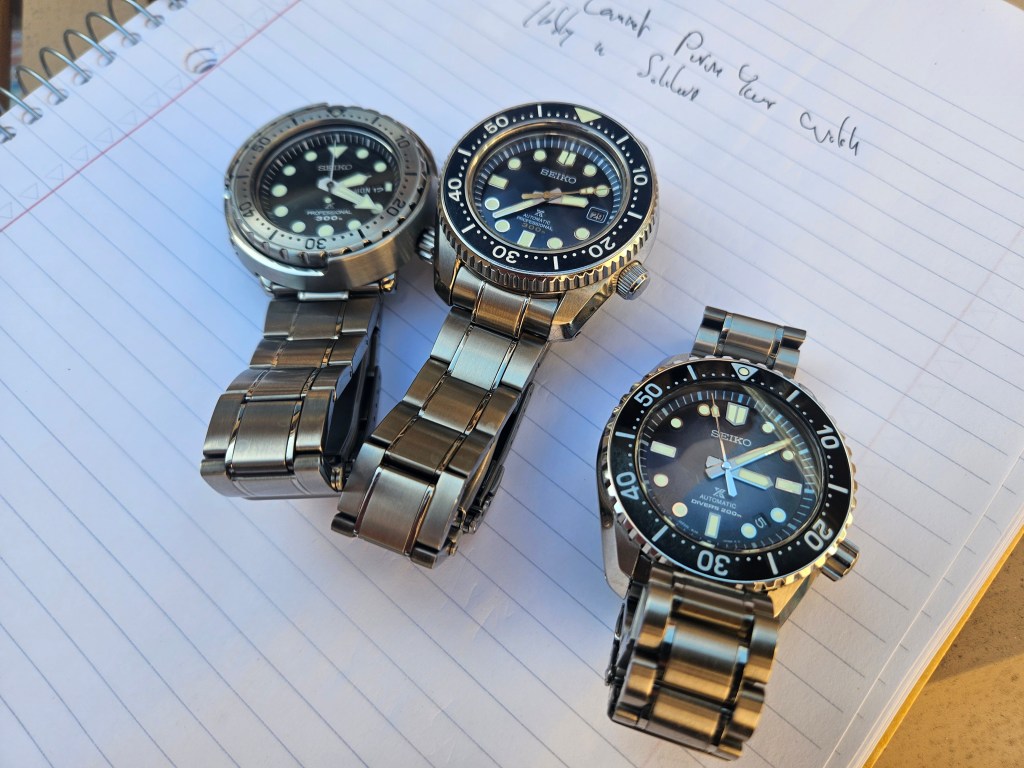
    I finally bought the Seiko bracelet from the SLA077. Four hundred dollars. And I have to admit: it transformed the watch. Steel gave it authority. Gravity. Presence. The same thing happened with my SLA023 and the Tuna SBBN049. On bracelets, these watches don’t just look good—they look heroic. Complete. Like they’ve put on their uniforms.

    So what’s the problem?

    The obvious answers come first. Bracelets are heavier. Links press into the wrist at odd angles. Sizing becomes a seasonal engineering project as weight and weather shift. All true.

    But none of that explains the deeper resistance.

    Because the truth is, this isn’t about comfort. It’s about identity.

    Straps represent something to me: restraint, practicality, anti-bling minimalism. Being “the strap guy” feels like a moral position. Seven watches on rubber feels orderly. Clean. Controlled. And in the strange psychology of collecting, control is another word for happiness.

    Except the mind doesn’t stay controlled for long.

    After months of strap purity, I start craving variety. Maybe one bracelet. Maybe two. A little diversity. A little steel.

    And that’s when the real problem begins.

    The moment a watch goes on a bracelet, it becomes a box queen.

    I tell myself I’m saving it for special occasions. But special occasions turn out to mean a birthday dinner twice a year. Meanwhile, the watch sits in the box, looking magnificent and doing absolutely nothing.

    This morning, after a post-workout nap, I woke up with a plan. Enough of this. I would remove the bracelets from the three offenders and restore order.

    Then I opened the watch box.

    And there they were—those watches on steel—looking perfect. Finished. Complete. Like museum pieces that had finally been framed correctly.

    I couldn’t do it.

    So here I am typing this while wearing my Seiko Uemura SLA051 on an MM300 waffle, fully aware of a simple truth:

    If this watch were on a bracelet, it would still be sitting in the box.

    At this point, I don’t see a solution. I’ve stopped looking for one. This is simply another occupational hazard of the enthusiast’s life.

    I suffer from Bracelet Ambivalence Disorder—the chronic inability to commit to either straps or bracelets, marked by alternating attraction and avoidance. Bracelets are admired. Straps are worn. The heart wants steel. The wrist wants rubber.

    If anyone else suffers from this condition, please make yourself known.

    Misery, like stainless steel, feels lighter when shared.

  • The Psychology of Watch Regret

    The Psychology of Watch Regret

    Many watch obsessives suffer from a peculiar torment: they cannot live with a certain watch—and they cannot live without it.

    I know men who have bought, sold, and rebought the same Seiko Tuna a dozen times. Some have done the same dance with the MM300. The watch leaves. Relief follows. Then memory begins its quiet revision. The flaws soften. The virtues glow. Soon the search begins again.

    If you stay in this hobby long enough, you may find yourself performing the same ritual.

    First comes infatuation. The watch arrives. For a few weeks it feels inevitable, permanent, right. Then something shifts. It wears too large. Too heavy. Too shiny. Too common. The magic drains out. Now the watch feels like a mistake that must be corrected immediately.

    You list it on eBay. You price it aggressively. You take the loss. You feel lighter, cleaner, restored.

    Three months later you’re browsing photos of the very same model.

    This time it looks perfect.

    You buy it back at full price.

    The cycle repeats. Sell low. Buy high. Repeat until the watch has cost you the price of a small used car. Some collectors eventually place the piece in a safe—not for protection from thieves, but from themselves.

    There is a darker variation.

    You sell the watch. Regret arrives. You go looking for it again.

    But now it’s gone.

    No listings. No used examples. No inventory anywhere. The watch has slipped into the market’s shadow, and your memory transforms it into something mythic. You dream about it. You refresh search pages like a man checking hospital monitors. You wake up with the emotional intensity of a breakup and the soundtrack of the Chi-Lites playing somewhere in your head.

    Have you seen her?

    This condition has a name: The Acquisition Reversal Loop—the compulsive pattern in which a collector sells a watch to escape dissatisfaction, only to experience renewed desire and repurchase the same model, often at repeated financial loss.

    The loop is not about watches. It is about unstable desire.

    A healthy hobby is supposed to add pleasure and structure to your life. The Acquisition Reversal Loop does the opposite. It erodes judgment. Preferences become volatile. Decisions become emotional. The collector begins to resemble a child—grabbing, rejecting, reclaiming, and insisting that this time the object will finally make everything right.

    This is not enthusiasm. It is regression.

    At this point the watches are no longer possessions. They are orbiting objects in a private gravitational field of anxiety and impulse.

    And when a hobby turns into a system that repeatedly empties your wallet, disturbs your peace, and overrides your judgment, it is no longer a pastime.

    It is a small, well-lit prison.

    The question is no longer which watch to buy.

    The question is how—and whether—you intend to leave.

  • Horological Deconversion: When the Romance Finally Breaks

    Horological Deconversion: When the Romance Finally Breaks

    I recently wrote an essay arguing that pursuing mechanical watches in a digital world is a kind of elegant absurdity—an expensive devotion to obsolete technology while the rest of civilization marches toward sensors, satellites, and software. My proposed remedy was simple and slightly heretical: sell the mechanicals and replace them with an atomic or Bluetooth G-Shock. Accuracy, durability, zero drama. Efficiency instead of romance. Sanity instead of ritual.

    The piece was meant to provoke. Not just readers—me. Writing, after all, is less self-expression than self-interrogation. As Kafka put it, it’s the axe for the frozen sea. Sometimes the ice you crack belongs to your own illusions.

    What began as a tongue-in-cheek thought experiment turned into something less comfortable. It forced me to examine the possibility that my love for mechanical watches isn’t love at all—it’s theology.

    Over the years I refined my taste, sold the excess, and curated a tight collection of mechanical divers. Vintage aesthetic. Tool-watch credibility. A faint whiff of James Bond climbing out of the ocean with a harpoon gun and moral certainty. I told myself this evolution reflected discernment, maturity, identity.

    But the thought experiment raised a harder question: Did I discover my taste—or manufacture it?

    Human beings have a habit of building sacred spaces inside a profane world. Perhaps my watches became sacred cows—objects elevated not because they were necessary, but because I needed something to stand against modern life. Mechanical time as resistance. Analog as virtue. Nostalgia as courage.

    In this story, I cast myself as a quiet rebel.

    But what if the story is fiction?

    What if I’m not resisting anything at all? What if I’ve simply joined a small tribe of aging enthusiasts who reassure each other that spending thousands on obsolete machines is an act of character rather than consumerism?

    At that point, the romance starts to look like cosplay.

    Thousands spent on purchase. Thousands more on service. All to reenact a cinematic memory of youth. The whole enterprise begins to resemble those baseball fantasy camps where middle-aged men pay to take batting practice with retired heroes and pretend, for a weekend, that the dream never ended.

    The thought experiment did something dangerous: it planted a fantasy.

    Sell everything.

    Replace the collection with one or two G-Shocks.

    Start over.

    The appeal isn’t the watch. It’s the psychological reset. The possibility of closing a chapter and reclaiming the mental bandwidth the hobby quietly occupies. Change, after all, is the most intoxicating drug available to a restless mind.

    I’ve felt this kind of impulse before.

    In 2005, after three decades of gym culture, I was standing in an LA Fitness in Torrance, wiping someone else’s sweat off a treadmill while pop music pounded overhead and everyone talked about nothing. The thought hit me with sudden clarity: I need to get out of here.

    Within a week I’d left the gym, bought kettlebells, started power yoga in my garage, and never went back. At the time it felt impulsive. In hindsight, it was alignment—something deep finally overriding inertia.

    I sometimes wonder if watch collectors experience the same internal shift—the moment when accumulation feels less like passion and more like weight. The urge to take a wrecking ball to the collection. To simplify. To breathe.

    This moment has a name: Horological Deconversion—the quiet psychological turn when watches stop looking like identity and start looking like artifacts of habit, mythology, and sunk cost.

    I know someone who went through it. A serious collector. Deeply invested. One day he had the overwhelming urge to sell everything and replace the collection with a $20 Casio F-91W. Eventually he did. He told me the move saved his sanity.

    He still reads the forums. Still watches the madness unfold. But now he’s an observer, not a participant. The zoo is still interesting when you’re no longer inside the cage.

    Anyone who sells their mechanical collection, buys a single indestructible digital, and walks away lighter will have my respect. Not because minimalism is virtuous, but because exits are hard. Leaving a closed system always is.

    There’s something quietly heroic about it—the horological version of a Shawshank escape. Crawl through the tunnel. Emerge on the other side. Stand in the rain and realize the prison was partly self-built.

    And somewhere beyond the walls, there’s a small, durable watch keeping perfect time—and a life of freedom and expanding possibilities.

  • Rome Wasn’t Built in a Day, and Neither Was a Better Body

    Rome Wasn’t Built in a Day, and Neither Was a Better Body

    Five months into a rotator cuff injury, my left shoulder now runs a morning protest movement. Today it was particularly militant. The arthritis pain was so loud it drowned out my writing, which is saying something, because writing is usually where I go to escape pain, not negotiate with it.

    The solution, as usual, was humility. I picked up light dumbbells and did slow lateral raises—nothing heroic, nothing Instagram-worthy. Just enough movement to get blood into the joint and remind it that we are still partners, not enemies. The pain eased. Ibuprofen helped too, but I’ve learned the hard lesson: skip it for a day, let the inflammation throw a party, and it takes hours to evict the guests.

    Rotator cuff arthritis is a mechanical problem disguised as a moral one. When the joint isn’t tracking well, the socket gets irritated, and the irritation becomes inflammation. Night makes it worse. While you sleep, the synovial fluid thickens into something closer to cold syrup. Morning arrives, and the shoulder feels like a rusty hinge. The cure is movement—gentle, persistent, unglamorous movement. Every time I loosen it up, the joint forgives me a little.

    Training now looks less like conquest and more like diplomacy. Two kettlebell sessions a week, mostly lower body, with some shrugs and narrow-stance knee push-ups—just enough upper-body work to maintain function without provoking rebellion. Power yoga is back three days a week, a return to the early-2000s era of Bryan Kest and Rodney Yee, now supplemented by the Man Flow Yoga channel. I modify poses for the shoulder, but once I settle into the rhythm, the familiar state returns—the quiet, steady current of yoga flow. At this point, the mental repair may be more important than the physical.

    The Schwinn Airdyne—the Misery Machine—has been demoted to one day a week. Left unchecked, I turn cardio into a courtroom, constantly trying to beat yesterday’s calorie output. Competition with yourself sounds noble until it becomes another form of anxiety.

    Underneath all of this sits the larger ambition: weight loss through appetite discipline. Easier declared than achieved. Two nights ago I dreamed I wanted to be lean again but could only get there through GLP-1 drugs (which I’ve never taken). Such a dream is what your subconscious imagines when it has lost faith in your willpower. I’m hovering around 230—solid in a T-shirt, but without the narrower waist that signals to the world (and to my lab results) that discipline has the upper hand. For me, that line is about 210.

    Physical self-improvement is rarely about aesthetics alone. It’s an attempt to become the kind of person who can choose the long-term over the immediate—the kind of person who doesn’t negotiate with every craving. Discipline isn’t punishment. It’s the architecture of a calmer life.

    This question of belief came back to me while watching the documentary Queen of Chess, about Judit Polgar, who fought her way through a male-dominated chess world. Her advice was simple: you have to believe in yourself. The line landed harder than expected.

    But belief doesn’t arrive on command. If your history includes abandoned goals and broken dietary programs, confidence isn’t a mindset—it’s a construction project. It’s built the only way durable things are built: small wins, repeated often enough that the brain stops arguing.

    Rome wasn’t built in a day. Neither is a shoulder. Neither is a waist. Neither is a self you trust.

  • Letting Go of the Bro Code

    Letting Go of the Bro Code

    My friend Lee retired at sixty-one, fled the tech industry, and landed in Santa Fe like a man stepping out of a chrysalis. The move gave him what he said his spirit had been begging for: a clean reinvention. These days he volunteers as a rescue worker at the local ski resort—hauling people out of trouble, useful again, awake in his body.

    My own retirement is eighteen months away, and I feel the same hunger for reinvention—but without the romance of relocation. My wife and kids aren’t uprooting, and neither am I. So if I’m going to change, the terrain has to be internal. I don’t need a new zip code; I need a new relationship with myself.

    Some of this craving is spiritual. Some of it is brutally practical. For the past five months I’ve been rehabbing a torn rotator cuff marinated in arthritis. I tried to negotiate with my kettlebell workouts—adjusting angles, trimming volume, pretending moderation would save me. It half-worked. What didn’t improve was the resentment. In fact, it metastasized.

    I know exactly how I got here. I overdid kettlebells—four days in a row, again and again—until my shoulder finally filed a formal complaint. Now the bells feel less like tools and more like accusations. I still want to train five or six days a week, but the thought of picking them up fills me with a low-grade fury. When resentment becomes chronic, it’s information. Ignoring it is how you end up injured and stubbornly proud about it.

    What I keep circling back to is yoga—specifically my mid-2000s era, when power yoga was my religion. Back when Bryan Kest and Rodney Yee videos taught me that yoga could be punishing, sweaty, and deeply satisfying. One hour. Total exhaustion. Muscles lit up, ego humbled, mind quiet. I want that again—not just the shape of it, but the mental state. I want to get lean. I want a diet that actually complements the practice: simple, semi-vegan, enjoyable. Yoga four days a week. The exercise bike on the others. Nothing heroic. Nothing destructive.

    Of course, underneath all of this is the same old human wish: character. I want a yoga lifestyle that reflects self-possession, self-discipline, and self-confidence—the real currencies of happiness. Not indulgence. Not macho theater. If I’m going to retire in the Southern California suburbs, fine. But I can’t be the retired guy slowly maiming himself in the garage, clinging to an identity that no longer serves him.

    Yoga never hurt me. Not once. It always left me clearer, calmer, and stronger in ways that mattered. As a lifetime weightlifter, I’m realizing I need to let go of the Bro-Coding and Bro-Signaling that once fed my pride. What is a real man, anyway? It isn’t someone chasing pump and punishment while overeating and limping through life. It’s someone fit, injury-free, and genuinely disciplined.

    Lee rescues skiers. I admire that. But before I can rescue anyone—before I can reinvent anything—I have to rescue myself first.