Category: Health and Fitness

  • Fast-Flow Kettlebell Training

    Fast-Flow Kettlebell Training

    Since I no longer need to pack on muscle like a linebacker or risk a hernia proving I still can, I’ve officially abandoned the classic kettlebell approach: go heavy, rest like royalty, and worship at the altar of hypertrophy. That style had its season. It built the frame. But now? I’ve halved the weight, tripled the reps, and slashed the rest time down to barely enough to curse under my breath. The result? My sweat output now requires a mid-workout wardrobe change. Honestly, I live for it.

    At sixty-four, I’ve traded High-Volume Kettlebell for what I now call Fast-Flow Kettlebell. It’s not about brute force anymore—it’s about metabolic chaos and graceful suffering. I should probably slap a ™ on that phrase, start a YouTube channel, and sell it to my fellow sexagenarians like it’s a classified military protocol for reclaiming youth through righteous burn.

    Train like a special ops fighter, minus the risk of blowing out your spine. Stay lean, keep the blood pumping, and switch shirts like you’re in a glam-rock concert. That’s my fountain of youth.

  • Botoxed Sphinx Cats and Other Body Dysmorphia Fables

    Botoxed Sphinx Cats and Other Body Dysmorphia Fables

    In the early ’90s, I had a student whose entire identity was shackled to the number on a stadiometer. I don’t recall the exact figure, but he was somewhere south of five-foot-five—a detail that tormented him like a Greek curse. What I do remember is that he was a strikingly handsome kid. Slender, well-proportioned, with the kind of face you’d expect to see in a Calvin Klein ad, not in a therapy session about height insecurity. But none of that mattered. He couldn’t see past the measuring tape in his head.

    It was during one of our writing lab sessions—those clattering dens of early-’90s Macintoshes, all beige and humming, where I played roving editor and motivational coach—that he confided in me. Class was winding down, students trickling out like post-cardio gym rats, and this nineteen-year-old lingered behind with something heavy to unload.

    He told me that being short felt like a life sentence. But the real damage, he confessed, came not from his height—but from the manic overcompensation it inspired. When talking in groups, he’d find the highest available perch to stand on—benches, stairs, anything to give him the illusion of height. He wore shoe lifts, which he kept hidden in his closet like a box of shame. But worst of all? He trained himself to walk perpetually on his tiptoes.

    Yes, tiptoes. Every day, every step. As if sneaking through life as a burglar of inches.

    Eventually, his spine cried uncle. The tiptoe act wrecked his back, forced him into surgery, and—here’s the gut punch—cost him an entire inch. In his effort to stretch himself, he ended up shorter. He admitted he hated himself for it, and I believed him.

    Looking at him—this good-looking, intelligent kid—it struck me just how dangerous our internal narratives can be. We live so much in our heads that our perception becomes more powerful than reality. A stray comment in middle school morphs into a life-defining trauma. A mirror becomes a courtroom. And the verdict? Never good enough.

    His story is a tragic little parable of body dysmorphia: how the seeds of insecurity, if left unchecked, sprout into weeds that choke reason, and in our desperate attempts to “fix” ourselves, we often end up disfiguring what was never broken.

    Our bodies are our canvases. And oh, how savagely the world critiques them. Some of us starve. Some inject ourselves with synthetic youth. Some spend fortunes on surgeries that leave us looking like Botoxed sphinx cats. And some, like my student, ruin their spines to gain half an inch that no one but they ever noticed.

    We’re all vulnerable to the feedback loop. When I’m lean and muscular on YouTube, the algorithm sings. I get compliments. DMs. Admiring questions about my training and my “age-defying” lifestyle. When I’m twenty pounds heavier? Crickets. I become one more bloated has-been talking into the void.

    Yes, our bodies are our canvas. But if we’re not careful, our efforts to “improve” that canvas can become self-mutilation masquerading as self-love.

  • How Losing 20 Pounds Made Me Rethink My Entire Watch Collection (and My Life)

    How Losing 20 Pounds Made Me Rethink My Entire Watch Collection (and My Life)

    Yesterday I filmed a 26-minute YouTube video on my main channel—ostensibly about watches. That was the bait. But somewhere between adjusting my camera and admiring my newly lean frame (twenty pounds down since April, thank you very much), I realized I wasn’t really talking about watches at all. I was talking about aging, restraint, identity, and how not to let your inner teenager run the damn show.

    The video was titled something like “My Four Watch Goals at Sixty-Four,” which sounds practical until you realize that my goals weren’t horological—they were existential. The first one? Stop being so maudlin. I actually said the word, spelled it out like a substitute teacher on a caffeine bender, and gave a definition. Maudlin: emotional excess masquerading as depth, the adolescent urge to turn life into performance art just so you can feel something.

    To illustrate, I offered up a formative trauma: being sixteen, watching Bill Bixby in The Incredible Hulk, and weeping—actually weeping—when he transformed into Lou Ferrigno’s green rage monster. It wasn’t just TV. It was catharsis. I was an Olympic weightlifter-slash-bodybuilder-slash-piano prodigy who didn’t know what to do with all the emotion I’d stuffed under my pecs and sonatas. Watching Bixby morph into a snarling demigod gave me permission to feel. In my forties, I channeled that same melodrama into wearing oversized diver watches—big, bold, and absurdly heroic, as if my wrist were auditioning for a Marvel reboot. That, too, was maudlin cosplay. Now I’m trying something radical: maturity.

    Goal two? Quit being an enabler. I admitted that, like it or not, I’m an influencer. I don’t collect in a vacuum. Every time I flex a new piece, it’s like handing out free permission slips to fellow addicts. So I’ve decided to use my powers for good—or at least for moderation.

    Goal three: Stay fit, get bloodwork, be a warrior in plain clothes. The watch isn’t the main course. It’s the garnish. If I’m going to wear something worth noticing, I should have the body and the biomarkers to back it up. Otherwise, I’m just a gilded potato.

    And finally, goal four: Minimalist watch heroes. The quiet monks of the community who own one to three watches and seem perfectly content. They’re my North Stars. They aren’t buying watches out of panic, nostalgia, or identity crises—they’re grounded, self-possessed, wise. I envy them. I aspire to be one of them. I’m not there yet, but I’m squinting in their direction.

    Honestly, I assumed the video would tank. My viewers tend to want horological eye-candy, not existential reflection wrapped in fitness updates. But to my surprise, the response was overwhelming—close to a thousand views on day one, dozens of comments. People thanked me. Some said they were booking doctor appointments. Others said they were starting diets. I’m fourteen years into making YouTube videos, and this might be the one I’m proudest of.

    Because the truth is, most watch YouTubers are just dressing up emotional poverty in brushed stainless steel. They get maudlin about bezels and bracelets, desperate to out-hype each other in a gaudy attention economy. It’s exhausting. What people really want—what they’re starving for—is someone speaking like a human being. No curation. No affectation.

    I ended my video with a confession: I’m still that sixteen-year-old kid. And if you cue up The Lonely Man theme from The Incredible Hulk, the one where David Banner walks down the rainy sidewalk in soft focus, I will—without shame—start crying. Again. Because some emotions don’t age. They just find quieter places to hide.

  • One Day, One House, No Excuses

    One Day, One House, No Excuses

    This morning, I brewed a pot of delicious Stumptown French roast—molten, bitter, potent—and padded over to my computer feeling dangerously wholesome. A good man with good intentions. Which, of course, is always the start of a problem. I was toying with the idea of living more virtuously: dialing back the animal fat, leaning into tempeh and nutritional yeast, pretending a plant-based diet isn’t just a long goodbye to flavor. You know, the usual summer resolutions—less cheese, more clarity.

    Somewhere between the aroma of roasted beans and my first click of the mouse, I felt something resembling courage. Not the real, bare-knuckled kind, but the kind that sneaks in when the house is quiet and you haven’t yet sabotaged yourself with toast. I thought: Gird up thy loins like a man. (Who says that anymore? Besides prophets and people named Chet.) But still, the idea stuck. Maybe I was finally ready to stop flinching and start living with actual conviction—about food, fitness, morality, and cholesterol.

    And yet I know myself. Talk is cheap. I have spent years writing grocery lists for lives I never lived. What matters is performance.

    Which brings us to today. My summer has officially begun. My wife and teenage daughters are off to Disneyland—a place I regard with the same warmth I reserve for colonoscopies and TikTok. They know this, and mercifully leave me out of the Mouseketeer pilgrimage. Which means: the house is mine.

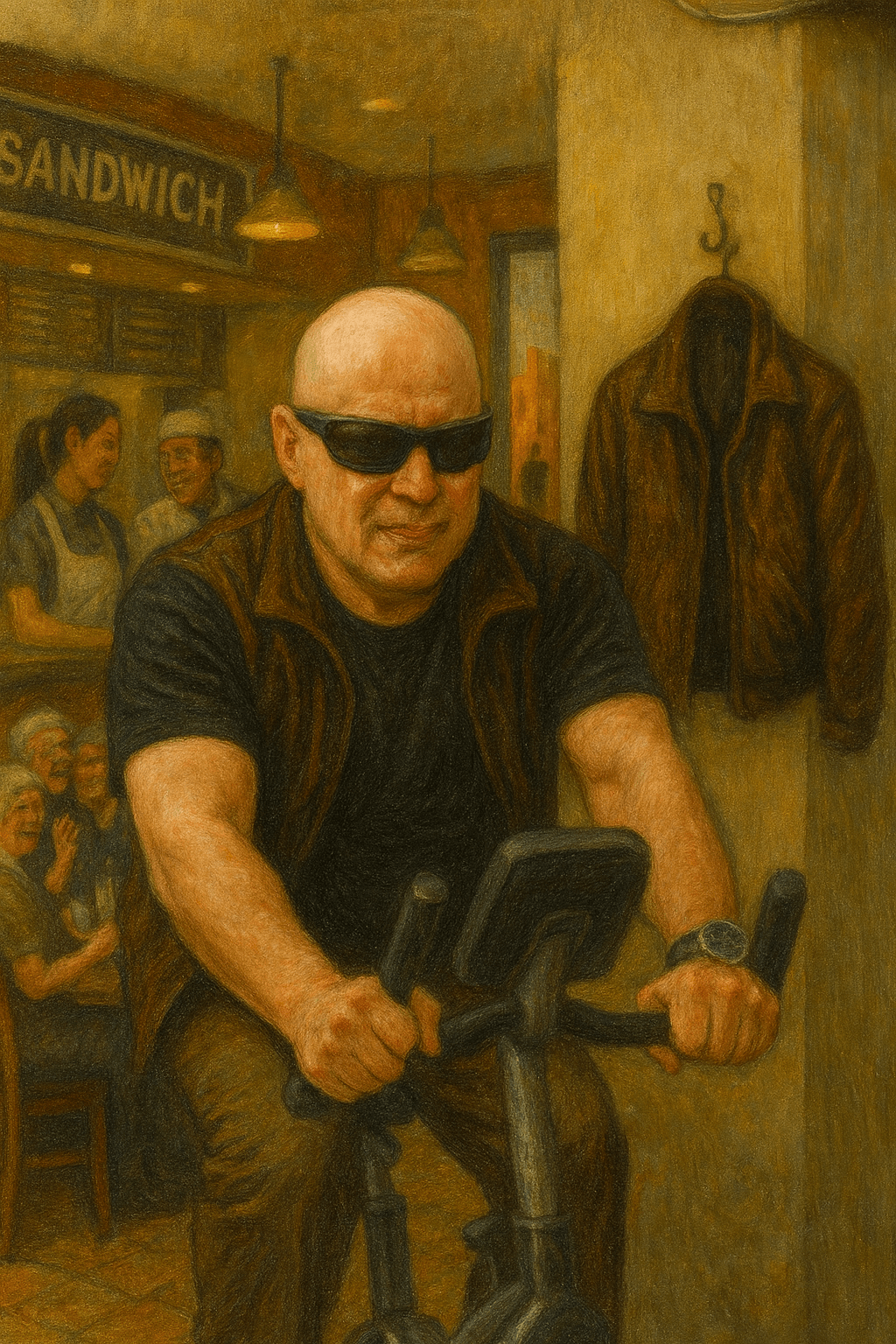
    I have made a pact with myself. Today, I will submit my final grades, mount the Schwinn Airdyne for a 60-minute sufferfest (estimated burn: 650-750 calories, depending on whether I channel Rocky Balboa or Mister Rogers), and I will rehearse my piano composition—tentatively titled Gene Wilder’s Prelude to Mischief and Madness. If all goes well, I’ll record it and upload it to my YouTube channel, where it will be watched by six people and a bot from Belarus.

    Alone time is rare in a house shared with twin teenage girls, a wife, and the occasional haunting presence of someone asking what’s for dinner. I daydream of a private studio—soundproofed, monk-like, adorned with a grand ebony Yamaha piano and maybe a faint aura of genius. Instead, I have today: a suburban cosplay fantasy in which I pretend to be a cloistered artist, instead of a middle-aged man in gym shorts wondering if tempeh is as bioavailable as the vegan influencers claim it is.

    And yet… it’s enough. Let the performance begin.

  • Mercury Rising, Tuna Retiring: A Fish Addict’s Tofu Detox

    Mercury Rising, Tuna Retiring: A Fish Addict’s Tofu Detox

    Howard Stern recently went public with the kind of health confession that makes nutrition nerds shiver with schadenfreude: years of eating fish like a ravenous sea lion left him with sky-high mercury levels—over 30, when 8 is considered the red alert line. His white blood cell count crashed, and his bloodstream began to resemble a periodic table. So now he’s easing into a mostly plant-based diet, still clinging to salmon and shrimp a few times a week like a man transitioning from whiskey to kombucha.

    Taking a page from Howard’s mercury memoir, I’m retiring my daily canned-fish salad lunch. No more tuna tins. No more mackerel mania. In their place? A half-block of Trader Joe’s High-Protein Tofu, sautéed in olive oil like a grown-up with arteries worth protecting. The whole package is 70 grams of protein. I’ll eat one half at lunch, the other half either for dinner or for the next day.

    Preparation, of course, requires a bit of tofu theater. I wrap the slab in a dish towel and stack a Dutch oven on top like I’m pressing it into a confession. From there, it crisps nicely in the pan—unlike my nerves, which are still adjusting to life without anchovies.

    The salad base: arugula, because I enjoy a green that fights back. The dressing: Greek yogurt whipped with nutritional yeast, herbs, and spices—a tangy, umami-rich blend that says “I’m trying” louder than balsamic ever could.

    If I need a protein boost, I’ll toss in some drained beans or egg whites, though I refuse to let the salad become a protein arms race. The goal isn’t to feel full for eight hours—it’s to avoid mercury poisoning while still pretending I’m eating for pleasure.

    We’ll see how satisfying it all is. At worst, I miss the old tuna days. At best, I keep my nervous system intact and live long enough to be skeptical of my next health phase.

  • Nostalgia, Nihilism, and the Need for a North Star

    Nostalgia, Nihilism, and the Need for a North Star

    We live in a state of perpetual performance. Not just for others, but for ourselves. It’s cosplay with consequences—playful on the surface, deadly serious underneath. We obsess over how our performance lands. We evaluate our worth by the reactions we elicit. At stake is not just our reputation, but our very sense of moral character.

    This obsession isn’t new. The philosopher Blaise Pascal put it bluntly: we’d rather appear virtuous than actually be virtuous. It’s easier to sculpt the image than to develop the core. In this way, we’ve become artisans of curation, not content—architects of persona, not people.

    We live, as Shakespeare warned, on a stage. But our thirst for applause is bottomless. The more we receive, the more we crave. We become validation addicts, forever chasing the next fix of approval. And when applause falters or vanishes, anxiety rushes in. To soothe this anxiety, we self-medicate. Not just with likes and follows—but with food, consumption, workouts, and delusion.

    Some of us drown that dread in comfort food. Others sprint in the opposite direction—discipline, clean eating, high-performance regimens. But often, that stoicism is just cosplay too: hunger in a different mask. When that fails, we drift into nostalgia. We reimagine the past—not as it was, but as it flatters us to believe it was. We cast ourselves as the hero, the lover, the misunderstood genius. The story becomes so good, we forget it isn’t true. We live in the fiction and lose our grip on reality.

    This disconnect—between who we pretend to be and who we are—makes us brittle. Maladapted. And so the cycle deepens: more consumption, more self-distraction, more illusion. Consumerism becomes therapy. Hedonism becomes self-care. Nihilism becomes a badge of honor. All of it is cosplay. And all of it is corrosive.

    Philosophy, religion, and therapy exist to confront this masquerade. They offer a language for our delusions, a history of our dysfunction, and a spiritual direction out of the maze. They remind us that cosplay is not identity, and performance is not presence.

    I don’t pretend to have it figured out. But I’ve found insight in thinkers like Phil Stutz, who warns against the seductive ease of instant gratification, and Steven Pressfield, who speaks of resisting the lure of comfort in favor of a purposeful life. I’ve also been challenged—and strangely comforted—by Paul’s doctrine of kenosis: the radical idea that we’re not here to inflate ourselves but to empty ourselves in service of others. In a world obsessed with power and “respect,” that message lands like a thunderclap.

    What unsettles me most is not our ignorance—it’s our awareness. Many of us know the truth. We even live it for a while. But we drift. We relapse. We trade the hard-earned clarity for the cheap thrill of our old scripts. That’s what demoralizes me: not just the fall, but the speed and ease with which it happens.

    Yet I still believe in the power of a North Star. Call it purpose, vision, a calling—whatever name it takes, it’s the gravitational pull that keeps us from floating off into the void of our appetites. I think of Ann Kim, the Korean immigrant told to stay in her lane. She didn’t. She found her voice, expressed it through food, and became a James Beard Award-winning chef.

    The path to a good life, I suspect, doesn’t begin with fear of failure. It begins with a compelling vision of who we are meant to be. And the discipline to never look away from it.

  • Why I’m Eating Like My Life Depends on It (Because It Might)

    Why I’m Eating Like My Life Depends on It (Because It Might)

    In 2020, my mother passed away from kidney disease. She refused to go on a dialysis machine. I found out a few days ago that her sister, now 80, has stage-4 kidney disease. My aunt doesn’t drink or smoke, but her doctor told her that age can do its job on the kidneys and will give her medication and a diet to slow down the disease’s progression. 

    I assume I may have a genetic predisposition for tired kidneys, so at 63, I’m looking to make some preventative dietary changes. I’m going to watch my potassium, phosphates, and sodium. I’m going to cut down on dairy, nuts, nut butters, sweets, diet sodas, canned fish, meat and such. I’m going to keep my creatine at 3 grams a day. Being overweight, having high sugar levels, high cholesterol, and high blood pressure are all bad for the kidneys, so my diet has to keep those areas under control. I remember Doctor Peter Attia writing in his book Outlive: The Science and Art of Longevity that having advanced kidney disease presents a shorter lifespan diagnosis than stage-4 cancer, so I feel motivated to be diligent. My diet now looks like this:

    Breakfast: I’ll rotate 5 breakfast grains in which I will measure exactly one-fourth cup of one of the following: 1. steel-cut oatmeal, 2. quinoa, 3. buckwheat groats, 4. bulgur, and 5. hulled or foxtail millet (11-12 grams of protein) with half a cup of Greek plain yogurt, chia seeds, walnuts, plain soy milk, phosphate-free protein powder, berries, and coffee.

    Lunch: Salad with 20 grams of protein tempeh, rinsed from a can or cooked beans or salmon with balsamic vinegar, herbs and spices, half cup of soy milk, berries or small tangerine. 

    Post-nap Afternoon Snack: One cup of plain Greek yogurt with phosphate-free protein powder, or no powder at all, and berries. 

    Dinner: Vegetables, protein of some kind, including braised tofu, and a small apple. If I want a vegan dinner, I can make a mixture of rice or quinoa with black beans, tofu or tempeh, and a cup of coconut milk. 

    Between meals: No more diet soda of any kind, only water, herbal tea, and soda water.   

  • Neddy Merrill Disease: Lifting Weights to Outrun the Abyss

    Neddy Merrill Disease: Lifting Weights to Outrun the Abyss

    I take no glory in training through my 60s. At nearly 64, with a lifting life that began in 1974 amid the clang of Olympic barbells and testosterone-choked gyms, I no longer chase records or applause. These days, I chase mobility. I chase not falling apart. A nagging flare of golfer’s elbow—inner right, thank you very much—has made its uninvited return, forcing me to swap kettlebell rows for gentler “lawnmower” pulls and abandon my beloved open-palm curls in favor of reverse curls, the orthopedic equivalent of safe sex.

    There was a time, of course, when I confused self-worth with showing off. I strutted under heavy weights in the ‘70s through the ‘90s like a tragic extra from Pumping Iron, nursing shredded rotator cuffs and wrecked lumbar discs in my quest to impress… well, no one, really. The mirror? My dad? Arnold? These days I tiptoe a tightrope between intensity and injury, trying to silence the reckless ghost of my twenty-year-old self who still believes he’s indestructible.

    This tug-of-war with time reminds me of Neddy Merrill, the doomed protagonist in John Cheever’s “The Swimmer,” who tries to recapture youth by swimming across his neighbors’ pools like a suburban Odysseus, only to arrive at his own foreclosed house—empty, echoing, and final. I see flashes of my own Neddy Merrill alter ego every time I glimpse my neighbor, a sturdy cop in his early 40s, shepherding his twin teenage sons off to jiu-jitsu. I envy them—their youth, their purpose, their untouched joints. But I remind myself that comparison is the mother of misery. I don’t train for glory anymore. I train because the alternative is to surrender to frailty, to collapse into a slow-motion horror film of decay. I train because being strong is still cheaper than therapy, and it’s the only middle finger I can raise at time’s relentless advance.

  • From Breakdown to Brand: What Comedians Know That College Students Should

    From Breakdown to Brand: What Comedians Know That College Students Should

    In the Amazon Prime documentary Group Therapy, Neil Patrick Harris plays a surprisingly restrained version of himself as moderator while six comedians—Tig Notaro, Nicole Byer, Mike Birbiglia, London Hughes, Atsuko Okatsuka, and Gary Gulman—dissect the raw material of their lives. The big reveal? That material doesn’t go from trauma to stage in one dramatic leap. No, it must be fermented, filtered, and fashioned into something more useful than pain: a persona.

    Mike Birbiglia delivers the central thesis of the show, and I’ll paraphrase with a bit more bite: You can’t stagger onto stage mid-breakdown and expect catharsis to double as comedy. That’s not a gift—it’s a demand. You’re taking from the audience, not offering them anything. The real craft lies in the slow, deliberate process of transforming suffering into something elegant, pointed, and—yes—entertaining. That means the comic must achieve emotional distance from the wreckage, construct a precise point of view, and build a persona strong enough to carry the weight without buckling. In other words, the chaos must be curated. Unlike therapy, where you’re still bleeding onto the couch, stand-up demands a version of you that knows how to make the bloodstains rhyme.

    This process is a perfect metaphor for what college students must do, and what adulthood means for all of us, whether we realize it or not. College students are not just acquiring credentials—they’re building selves. And that takes more than GPAs and LinkedIn bios. It requires language, history, personal narrative, and a working origin myth that turns their emotional baggage into emotional architecture. And yes, it sounds crass, but the result is a kind of “self-brand”—an identity with coherence, voice, and purpose, forged from pain but presented with polish.

  • His Royal Hairdresser: A Dream in Kettlebells and Class Anxiety

    His Royal Hairdresser: A Dream in Kettlebells and Class Anxiety

    Last night, my subconscious staged an outdoor fitness class without my consent.

    I found myself in a park in Redondo Beach, the sun blinding, the grass impossibly green—an Instagram-filtered fantasy of Southern California wellness. I was mid-kettlebell swing, drenched in purpose and a light sheen of dream-sweat, when I realized I was surrounded. Dozens of adult learners had appeared from nowhere, kettlebells in hand, eager and expectant. Apparently, I was their instructor. No one had hired me. No one had asked. But the dream had spoken, and I complied.

    Midway through a set of Turkish get-ups, a British emissary arrived. She looked like a character from a post-Brexit spy novel: stern, sun-dried, calves like cannonballs, dressed in a starched khaki uniform that screamed military cosplay and mid-level bureaucrat. She informed me—in clipped tones—that she worked for Prince Charles and that, regrettably, I lacked the proper haircut to instruct kettlebell technique. Apparently, the heir to the throne had strong feelings about grooming standards in recreational fitness.

    I explained, gently but firmly, that I was bald. Smooth as an egg. No haircut necessary. She did not care. My objections were irrelevant. Orders were orders.

    We marched off to a nearby luxury hotel, the kind with carpeting so plush it slows your gait. Prince Charles was there, sitting cross-legged on a massive hotel bed surrounded by two open laptops, deep in what I can only assume was royal doom-scrolling. When he saw me, he snapped both laptops shut with the speed of a man hiding state secrets or Wordle stats.

    He gestured toward a massive, throne-adjacent salon chair, upholstered in padded leather and colonial guilt. “You need your hair parted down the middle,” he declared.

    Again, I protested—I was bald. But His Royal Highness was undeterred. He placed a comb on my scalp, and as if conjured by the Crown itself, hair appeared. Thick, black, center-parted. The haircut was bestowed.

    Feeling both knighted and absurd, I reached into my wallet and tipped him two twenties. He accepted the bills with the contempt of a man too wealthy for paper currency. It was as though I had handed him used Kleenex. He nodded, purely out of ritual, and turned back to his laptops, already erasing the memory of me from his mind.

    I returned to the park, my hair neatly parted, my purpose restored. I resumed leading my eager students in kettlebell swings, disappearing into the warm fog of belonging, convinced—for at least this dream—that I was a vital member of my sun-drenched community.