Category: technology

  • Three Protein Wafers and a Funeral for Joy

    Three Protein Wafers and a Funeral for Joy

    I drank my first protein shake in 1975, at thirteen—an age when you’ll ingest anything if it promises muscle. It was milk and two heroic scoops of Bob Hoffman’s “Super Hi-Proteen,” a granular blend of soy, brown sugar, and the kind of mystery ingredients that seemed to come with a warning label in spirit if not in ink. I swallowed it like a pledge of allegiance. Years later, I realized I’d been spooning down hog slop with a marketing budget.

    Protein powders, of course, grew up. Whey replaced soy, monk fruit and stevia replaced sugar, and the flavor profile advanced from “punishment” to “tolerable.” I returned, cautiously, folding a scoop into my oatmeal or stirring it into yogurt. A lifetime lifter develops a habit I’ll call protein insurance—the quiet reassurance that your muscles won’t starve because you forgot to eat like a grown man.

    And so the shake became a fixture—less a meal than a policy.

    Bodybuilders and civilians alike now drink these things by the gallon, not just for insurance but for convenience. Which raises a question that refuses to stay polite: assuming we’re not slowly marinating ourselves in trace metals such as lead and cadmium, are we doing something more subtle—something that damages the soul? Rachel Sugar poses a version of this in her Atlantic essay “Admit It, That Protein Shake Is Basically Soylent,” where the modern ideal appears in a hoodie: a tech bro so devoted to efficiency that he outsources eating to a beige slurry. Why cook, why chew, why pause, when a bottle can reduce nourishment to a task you can complete between emails?

    Enter Soylent, the Willy Wonka chewing gum of Silicon Valley—a full meal compressed into a swallow, a dinner table dissolved into a transaction. At best, it tastes like competent baby food. At worst, it tastes like ambition without appetite.

    Soylent had its moment and then receded, but the protein shake did not. It adapted, multiplied, rebranded. Giants like The Coca-Cola Company now print money selling pre-made bottles fortified with protein, “adaptogens,” and antioxidant halos. The label reads like a résumé; the experience reads like chalk. A nation too busy to cook, trained to snack, and newly anxious about muscle retention—thanks to the rise of GLP-1 receptor agonists—is primed to accept frictionless nutrition. Open. Sip. Be optimized.

    None of this is accidental. The arithmetic of food is unforgiving: real food spoils and yields modest margins; ultra-processed food endures and pays dividends. The industry didn’t just produce these powders—it educated us to desire them, dressed them in the language of health, beauty, and time savings, and invited us to trade ritual for efficiency.

    Last week, I tried a thought experiment on my writing students. They’re working on an argument about whether ultra-processed foods are villains to both body and soul.

    “Imagine,” I said, “three protein wafers a day. They regulate appetite, deliver perfect nutrition, sculpt you into an Instagram after photo, and carry you past a hundred. No cooking. No dishes. No decisions.”

    I let that sit for a moment.

    “Now imagine what disappears. The dinners that run long. The laughter that spills over the table. The argument that turns into a story. The quiet, ordinary pleasure of chewing.”

    In this optimized life, your insurer applauds and your followers multiply. But you become something flatter—efficient, photogenic, and faintly ghostlike. Not dead, exactly. Just thinned out where life used to be.

    I asked for a show of hands. Who would choose the wafers?

    Not one hand rose.

    For all our flirtation with powders and promises, the verdict was clear: they want to be healthy, yes—but not at the cost of becoming efficient shadows of themselves. Real food, with all its inconvenience and noise, remains the center. The shake can stay as insurance. It just can’t be the policy that replaces the warmth of home.


  • Canvas Crashes and a Protein Bar Declares War on My Molar

    Canvas Crashes and a Protein Bar Declares War on My Molar

    Five days ago, an hour before my afternoon class, I performed my sacred office ritual: a Barbell’s Salty Peanut protein bar followed by a red apple. The pairing is non-negotiable. The bar coats my teeth in a fudge-like film; the apple arrives like a janitor, scrubbing the residue with righteous crunch. It’s dental choreography. It works—until it doesn’t.

    Mid-bar, I bit down and hit something that did not belong in the human diet. A crack, a jolt, a flash of pain in my upper left molar that suggested litigation. I spit out the offending bite and there it was: a small, defiant piece of gravel. Not metaphorical gravel. Geological. I briefly entertained the idea of a calcified peanut shell, but no—this was the kind of object that builds driveways, not snacks.

    I discarded the rock, finished the bar like a man negotiating with fate, and approached the apple with the caution of a bomb technician, chewing exclusively on my right side. The tooth protested—sharp when I bit down, sensitive when I dared sip cold sparkling water. I called my dentist. He agreed to see me Monday while my daughters are in for their cleaning, a kind of dental drive-by.

    I told him, only half joking, that if this turns into a root canal, I’ll be leaving the country under an assumed name. My claustrophobia is not a charming quirk; it’s a governing principle. The rubber wedge they use to keep your mouth open transforms my throat into a closed border. When I can’t swallow on command, panic doesn’t knock—it kicks the door in. I am praying for a humble composite fix, something modest and merciful. A root canal would turn me into a beachside exile, scanning the horizon for dental extradition.

    As if one anxiety weren’t enough, two days later my college’s learning system—Canvas—collapsed under a ransomware attack that apparently took down thousands of schools. An hour before class, I discovered my lecture had vanished into the digital abyss. I called my engineering friend Pedro to deliver a live report of my unraveling. I told him I’d have to improvise, which in teaching is another word for “pray for coherence.”

    Then a thought arrived like a small miracle: my lectures are linked to Google Slides. If I could log into my Google account, I could resurrect the class. I told Pedro I’d head to the room early and test the login before the students arrived. I looked down at my desk—keys, empty protein bar wrapper, the usual debris of academic life—but no phone.

    “Where the hell is my phone?” I said.

    “You’re talking to me on it,” Pedro replied.

    We laughed the way men laugh when reality briefly exposes its wiring. For twelve years, Pedro has been my unofficial tech support, but informing me that the phone I was using was in my hand may be his finest work.

    Between the compromised tooth and the compromised Canvas infrastructure, I felt like a man auditioning for a nervous breakdown. Instead, I walked into class and, perversely, had one of the best sessions of the semester. We discussed ultra-processed foods—their design, their addictiveness, the way they quietly rig the game of weight management. Then I offered a heretical counterargument: homemade food can be just as seductive, just as dangerous to restraint.

    To prove the point, I pulled up a photograph from the Los Angeles Times: a $38 basturma brisket sandwich from Yerord Mas, built from Australian wagyu and dusted with cumin, garlic, and chiles. The image did not educate so much as seduce. Within seconds, my students had located the menu and confirmed the price with the forensic zeal of the hungry.

    “We should Uber to Glendale,” I said, “and call it field research.”

    At that point I added, “Some of you are going to complain to the Dean that you enrolled in a critical thinking class and all I do is talk about food.”

    They laughed—real laughter, not the polite classroom version. The room had a charged, fizzy quality, as if the collapse of Canvas had granted us permission to loosen the tie a notch. Chaos had stripped the day down to its essentials: conversation, curiosity, a shared joke.

    I needed that laugh more than I care to admit.

    Now I’m waiting. Will the dentist deliver a quick, civilized repair, or will I be pricing one-way tickets and practicing aliases on a beach somewhere in Mexico, scanning the horizon for a man carrying a drill?

    In the meantime, I chew carefully, avoid gravel, and consider the possibility that the most dangerous part of my day is not the curriculum, but the snack.

  • The Day I Logged Off the AI Panic Machine and Walked at the Beach

    The Day I Logged Off the AI Panic Machine and Walked at the Beach

    I teach college writing, which means I’ve spent the last four years staring at the AI question the way a man stares at a fire he suspects might jump the fence. When ChatGPT arrived, it didn’t knock politely. It crashed into the room like a UFO and rearranged the furniture. Since then, I’ve read what feels like a small library’s worth of essays—predictions, warnings, elegies for the essay itself—and contributed a few of my own, because that’s what we do: we metabolize disruption by writing about it.

    But there comes a point when the analysis stops clarifying and starts echoing.

    I’ve reached that point. My brain has filed a quiet injunction: no more. Not just a break from AI, but a break from reading about how exhausted everyone else is by AI. The discourse has become a hall of mirrors—each reflection slightly more fatigued than the last.

    I’ve been here before. In 2010, I had newborn twins, which is another way of saying I was living inside a low-grade emergency. The market offered guidance—books, podcasts, earnest experts—but I wanted none of it. I was already doing the job. Additional commentary felt like a second shift. Experience was loud enough; analysis was just noise layered on top.

    Both episodes point to the same condition: Applied Reality Rejection—the refusal to consume secondary discourse when you’re already neck-deep in the primary experience. When you’re in it, more talk about it doesn’t help. It dilutes.

    And here’s the part the essays rarely admit: reading about AI doesn’t soothe AI anxiety. It compounds it. Each think piece arrives like a fresh weather report announcing the same storm in slightly different prose.

    So I’m choosing friction of a better kind. I play the piano until my attention steadies. I pick up kettlebells and let gravity argue with me for a while. I walk the beach and let the horizon do what no article can—put scale back into the day. The analog world doesn’t theorize; it recalibrates.

    That was the remedy with the twins, too. Not another podcast on sleep training, but a walk, a dumb TV binge, a sweaty hour in the garage. Relief came from stepping out of the commentary loop, not diving deeper into it.

    Which is why, when I see another AI essay queued up from The Atlantic or The New Yorker, I feel a familiar tightening—and then I close the tab. Not out of contempt, but out of preservation.

    I’ve heard enough echoes. It’s time to drive two miles to Catalina Avenue and take a walk at the beach.

  • From Coffeehouse to Clickbait

    From Coffeehouse to Clickbait

    Invoking the word democracy in an essay feels like trying to sell a ghost–intangible, shapeless, and increasingly irrelevant to an audience fixated on the price of eggs and the cost of gasoline. We live in a state of Democratic Abstraction Fatigue, where civic ideals have been repeated so often and defined so poorly that they’ve lost all emotional voltage. Democracy has become a word people nod at politely while checking their grocery receipts.

    Salience is the problem. Democracy competes poorly in a culture that values immediacy over abstraction, sensation over structure. A fluctuating gas price commands attention because it hurts now. Democracy, by contrast, whispers about norms, institutions, and procedures–important, yes, but bloodless in the moment. When everything urgent is concrete and everything essential is abstract, the essential loses.

    We can attempt a definition to anchor the word: a democracy is a system of fair elections, peaceful transfers of power, and a citizenry capable of resisting manipulation by charlatans, influencers, and political opportunists whose incompetence would, in a sane society, disqualify them on sight. But even this definition now feels aspirational, almost quaint.

    Because the truth is harder: those guardrails are eroding. Adam Kirsch, in “The Era of Rational Discourse Is Over,” reminds us that American wars have often been sold under false pretenses–the Spaniards sank the USS Maine, Iraq hoarded weapons of mass destruction. But what distinguishes the present is not deception; it is indifference. The machinery no longer bothers to persuade. There is no narrative to construct, no public to convince, no Congress to consult. The decision is the justification. We have entered a phase of Executive Drift, where power operates with minimal friction and even less explanation.

    How did we arrive here? Kirsch turns to Jürgen Habermas, who witnessed the collapse of Nazism and the fragile rebirth of democratic life in Germany. For Habermas, democracy depended on what he called “communicative action”–a culture of dialogue where ideas are tested, challenged, refined, and, occasionally, improved. Democracy was not just a system of voting; it was a system of thinking.

    That system now shows signs of collapse. We inhabit an era of Communicative Decay, where discourse has splintered into tribal fragments, each sealed off from contradiction, each sustained by outrage. Argument has been replaced by performance. Listening has been replaced by waiting for your turn to strike.

    In The Structural Transformation of the Public Sphere, Habermas imagined democracy as an expanded coffeehouse—a literate, engaged public exchanging ideas with rigor and civility. It was a world in which communication flowed in two directions: we spoke, and we listened. Today, we scroll. We absorb. We react. But we do not engage.

    The modern condition might be better described as a dopamine democracy, where public opinion is shaped not by deliberation but by stimulation. Algorithms reward the loudest, the angriest, the most unhinged voices. Complexity is punished. Nuance is buried. What rises instead is spectacle–content engineered to trigger, not to inform.

    The consequences are predictable. Citizens become passive, then inert. Critical thinking atrophies. Conspiracy theories flourish in the vacuum. Truth becomes negotiable, then irrelevant. We do not fall from democracy in a single dramatic collapse; we degrade into a version of ourselves that no longer demands it.

    Mass media and weaponized misinformation accelerate the decline. Lies are no longer liabilities; they are tools. Identity replaces evidence. Tribe replaces truth. You are not expected to think–you are expected to align.

    And so we arrive at the most unsettling feature of our moment: the people who ascend in this environment are not the most disciplined, the most thoughtful, or the most competent, but the most performative, the most shameless, the most willing to exploit the system’s weaknesses. Infantilism becomes a strategy. Narcissism becomes an asset.

    A culture that rewards such traits should provoke alarm. It should trigger a course correction. But instead, we drift–distracted, entertained, anesthetized.

    Democracy has not been overthrown.

    It has been neglected.

    And like anything neglected long enough, it begins to disappear–quietly, gradually, while most of us are still asleep.

  • In Defense of Gilded Consolation

    In Defense of Gilded Consolation

    Men in their fifties and sixties, catching the faint chill of irrelevance, often reach for a new toy the way a man reaches for a jacket he hopes still fits. The purchase is meant to keep them “in the conversation,” as if relevance were a room you could reenter with the right accessory. Call it Luxury Youth Prosthetics—cars, watches, cameras, gleaming devices strapped on like extensions of a younger self, engineered to suggest vitality even when the signal is weak. The Lexus SUV hums with quiet authority, the Nikon Z8 promises cinematic family memories, and the titanium G-Shock gleams like a tiny declaration that time, at least, is still under control. Yes, the performance can tip into self-parody. We’ve all seen the man trying too hard, his purchases shouting what his presence no longer whispers.

    But it would be cheap to dismiss the entire enterprise as vanity. Not every indulgence is a cry for help; sometimes it’s just a man making his days more agreeable. If the mortgage is paid, the kids are fed, and no one is pawning their future for a dashboard upgrade, then a little luxury can function as a civilizing influence. The Lexus SUV turns a Costco run into a pleasant experience. The Nikon Z8 captures the faces you’re suddenly aware you don’t have forever. The titanium G-Shock tells the time clearly, which is no small mercy when time feels increasingly abstract.

    Strip away the theater, and what remains is something quieter and more defensible. Call it Gilded Consolation: not a performance for others, but a private pact with comfort. The goal is not to look young, but to live well—within reason, within means, and without apology.

  • Cognitive Lag Drift Meets the Frogman’s Calm

    Cognitive Lag Drift Meets the Frogman’s Calm

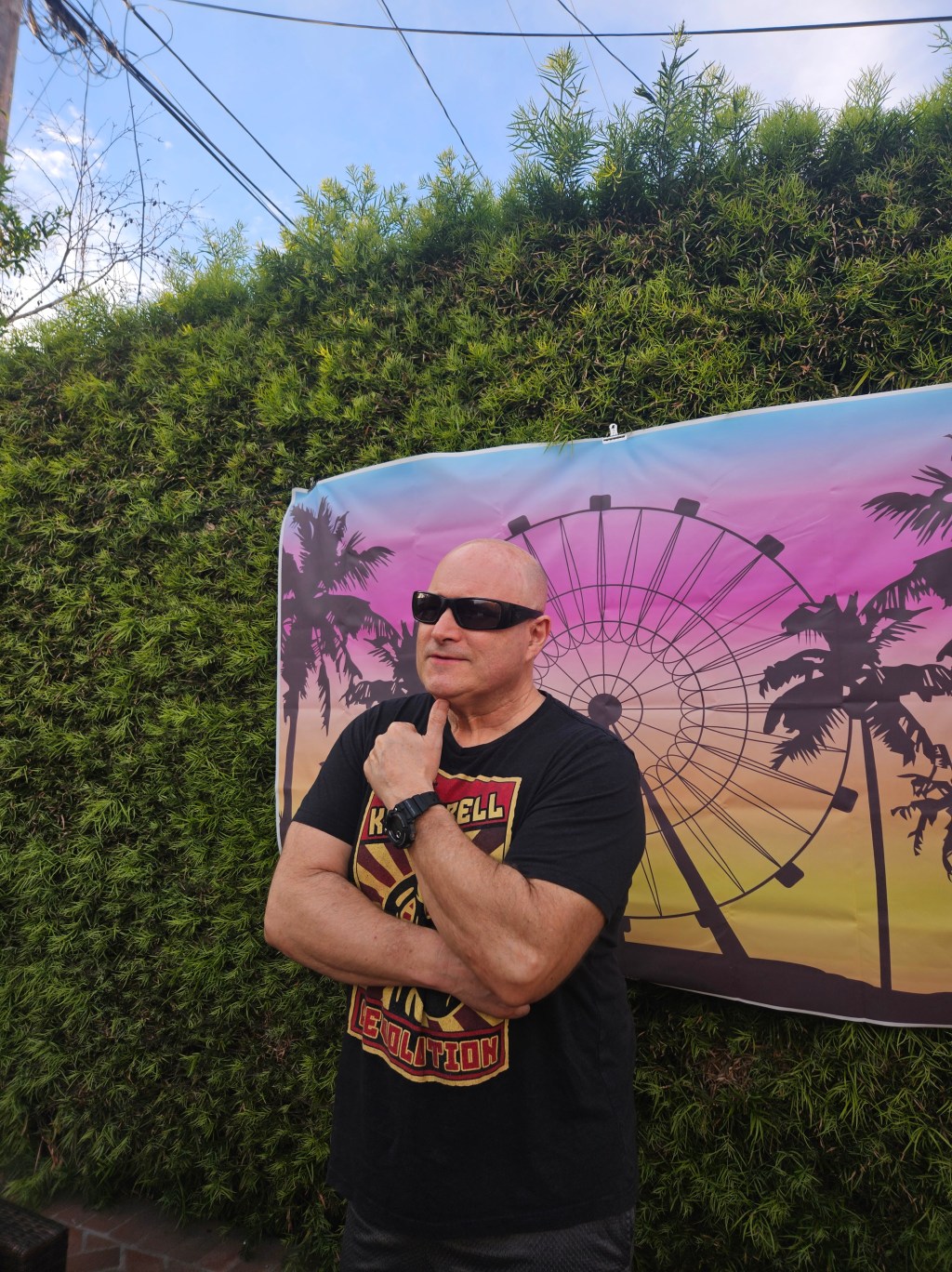
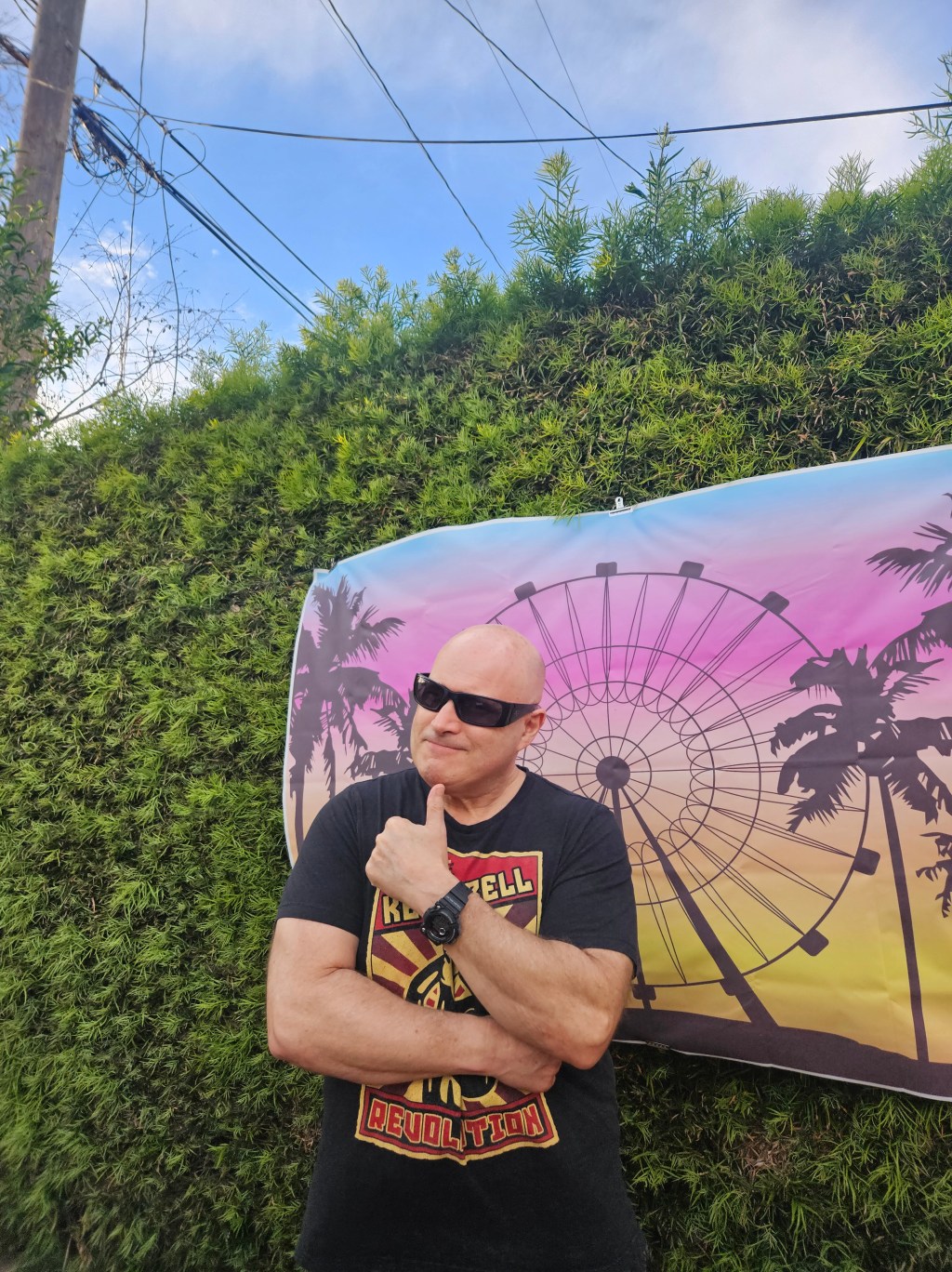
    Camp Flog Gnaw sounds like the name of an enormous toothy cartoon monster, but it was a weekend-long bacchanal of sound and sweat for my wife and our twin daughters, two days of music and mayhem baked under the unforgiving Los Angeles sun. My wife braved the trip on Friday and came home looking like a survivor of a maritime disaster, muttering that leaving Dodger Stadium traffic was like trying to escape a collapsing pyramid. She begged me to handle Sunday drop-off and assured me they would Uber home like civilized people. Armed with a “Fast Pass” for the 110 North, I engaged Google Maps, which promptly betrayed me and sent me barreling into downtown—an urban obstacle course specifically engineered to destroy men my age. Pedestrians sprang into the street like feral pigeons, daring me to earn a manslaughter charge. Driverless Waymo cars drifted past me with pastel-lit antennae, cheerful like clown hearses guiding me into the underworld. The lanes themselves seemed painted by committee: solid, dashed, turning, not turning, red, green, “maybe stop,” “maybe don’t”—a psychedelic optical exam administered at 20 mph.

    I began to notice a quiet but unsettling shift in my driving. Two hazards arrived at the same time, like conspirators who had compared notes. First, the road itself had changed. It no longer presented information—it assaulted me with it. Screens glowed, dashboards pulsed, alerts chimed, and every passing car seemed to flash some new digital signature. The highway had become a carnival of LEDs.

    Second—and less forgiving—was what was happening inside my own head. My processing speed had slowed just enough to matter. Not dramatically. Not catastrophically. Just enough to turn split-second decisions into small negotiations. And driving is no place for negotiation. The convergence of these two developments created Cognitive Lag Drift: the subtle but consequential slowing of mental processing speed that impairs real-time decision-making in high-stakes environments like driving, where milliseconds matter.

    The result was a kind of sensory overload paired with cognitive lag—a bad marriage. What used to feel like a calm, controlled glide now felt like I was trying to play a video game while someone flicked the lights on and off in rapid succession. The margin for error hadn’t changed. I had.

    Driving was no longer serene. It was a test I hadn’t agreed to take.

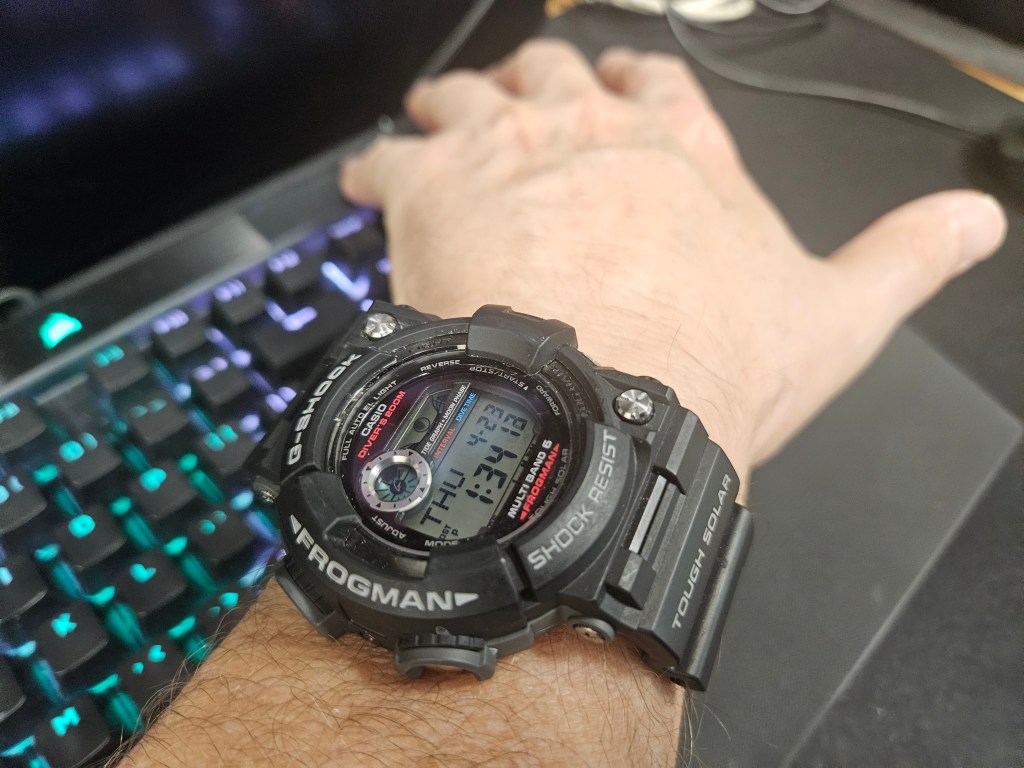
    And yet—strangely—on my wrist sat a counterargument. My Casio G-Shock Frogman did not flash, negotiate, or editorialize. It did not offer lane suggestions, heart rate, moral encouragement, or existential commentary. It simply displayed the time in large, unapologetic numerals, like a monk who has taken a vow of clarity. No animations. No alerts. No betrayal. In a world where every screen demands interpretation, the Frogman delivers a verdict: 5:42. That’s it. No subtext, no narrative arc, no committee-painted ambiguity. The road may have turned into a casino of stimuli and my brain into a cautious bureaucrat, but the watch remains a quiet tyrant of precision. I glance down and feel, for a fleeting second, that order is still possible—that somewhere in this strobe-lit madness, truth can be reduced to a number that does not argue back.

    When I finally dropped off my wife and daughters, I whispered a confession to my wife: “I’m done with this. I think I’m giving my Accord to you, and the other car to the girls. I’m retiring from the driving game.” They didn’t laugh; they’ve seen cracks in the armor. I’m a high-strung man, and at sixty-four, the neurons don’t fire like they used to. I can still handle a five-mile radius around my house—my personal demilitarized zone—but pull me into the wilds of Los Angeles traffic and I’m ready to hang up my driver’s jersey. Downtown LA isn’t a city. It’s a gladiatorial arena where the young come to dominate, and I say to myself, “This is no country for old men.”

  • “I Am the Frogman”: The Last Shout Before the Door Seals

    “I Am the Frogman”: The Last Shout Before the Door Seals

    I’ve spent more than a decade documenting my watch obsession on YouTube—a pursuit that begins as hobby and ends, if you’re not careful, as behavioral conditioning. You think you’re making videos. You’re actually being trained. The algorithm dispenses rewards and punishments with clinical indifference: views, comments, silence. You adapt. Of course you adapt. That’s the job now.

    The trouble is that the algorithm has no interest in truth, balance, or restraint. It prefers spectacle. It rewards the emotional range of a teenager who’s just discovered caffeine: hyperbole, dread, euphoria, FOMO, regret—delivered with the urgency of a man announcing the end of civilization via bezel insert. You wake up one morning and discover you’ve succumbed to Algorithmic Persona Drift—a slow mutation in which your public self becomes a louder, shinier, more hysterical version engineered for attention rather than accuracy.

    Feed it, and it feeds you back. The cycle tightens. Every video must be more decisive, more apocalyptic, more “this changes everything.” You produce manifestos. You narrate epiphanies. You analyze your own obsession with the intensity of a man dissecting his own heartbeat. The result is predictable: you become a caricature of yourself—recognizable, marketable, and faintly absurd.

    If you can tolerate that, the system will reward you. The numbers rise. The revenue trickles, then flows. You build a small empire out of controlled exaggeration. But there comes a moment—quiet, unwelcome—when you no longer recognize the man delivering the lines. The performance has outgrown the person. At that point, the decision presents itself with unpleasant clarity: keep feeding the machine and let it finish the job, or step away and salvage what remains of your voice.

    That’s one exit.

    The other is less dignified. You don’t leave; you are expelled. The causes are familiar—burnout, self-disgust, ennui, health—but the most decisive is also the least negotiable: age. You wake up one day and realize the tempo has changed. The rhythms that once animated you now sound distant, like music leaking from another room. The new release, the hyped drop, the celebrity of the week—none of it lands with the old voltage. Mortality has entered the conversation and lowered the volume.

    You try to resist. You tell yourself enthusiasm is a choice. But the gap widens anyway. You find yourself oddly relieved that you no longer care about bracelet articulation or dial gradients or the fever dream that the “perfect collection” is one purchase away. The brotherhood reveals itself for what it always was: half fellowship, half support group. You no longer feel the urge to compare scars from impulse buys, to laugh at the madness, to whisper—half-serious, half-hopeful—that this watch will finally cure you.

    For me, the separation was unmistakable. Twenty years dissolved into a blur of rotating bezels and contingency divers. Then, at sixty-three, something tapped my shoulder. Not a crisis. A correction. The obsession didn’t die; it simply lost its authority. Desire dimmed, replaced by a quiet recognition that watches are exquisitely engineered ways of losing to time.

    The feeling calls to mind a scene from Battlestar Galactica: a traitor sealed behind glass, the airlock hissing, the crew watching with solemn finality. Not melodrama—procedure. That’s aging. Not tragic, not cruel—inevitable. At some point, those still inside the illusion of endless tomorrows begin to edge away from those who have seen the horizon contract.

    A pane descends. It isn’t hostile. It’s accurate.

    You tap the glass, wave, try to rejoin the cockpit of youthful urgency. You even lift your wrist—your hulking G-Shock Frogman—and make your case. “Look,” you want to say, “I’m still in it.” But the seal has set. Reentry is not part of the design.

    What remains is less dramatic and more demanding: dignity. Accept the season you’re in. Build meaning instead of inventory. Offer something useful to those still racing ahead, even if they don’t yet see why it matters. They will. Everyone does, eventually.

    The algorithm fades. The noise recedes.

    And you are left, at last, with a quieter, harder question: not what you want next—but who you intend to be without the applause.

  • The Sovereign Appetite: How Wealth Devours the Soul

    The Sovereign Appetite: How Wealth Devours the Soul

    In “What I Learned About Billionaires at Jeff Bezos’s Private Retreat,” filmmaker Noah Hawley dissects the moral corrosion that accompanies extreme wealth—a corrosion fueled not by scarcity but by excess. The old adage comes to mind: the more you feed the demon, the hungrier it gets. Only now the demon eats without consequence, outside the jurisdiction of any moral law. The rules that bind ordinary people—limits, restraint, accountability—simply dissolve. In their place emerges what can only be called the Sovereign Appetite Doctrine: an unspoken creed in which desire, once backed by sufficient capital, becomes its own justification, rendering restraint unnecessary and morality negotiable.

    Hawley’s invitation to a 2018 Bezos retreat in Santa Barbara offered a front-row seat to this phenomenon. What he encountered was not insight but spectacle: a carousel of TED Talk-style presentations untethered from any coherent theme, a parade of ideas without consequence or urgency. These talks did not enlighten so much as signal—a kind of intellectual flex, as obligatory to the setting as Wagyu skewers and caviar. Surrounded by this polished emptiness, Hawley found himself asking the only honest question available: “Why am I here?”

    The retreat itself bordered on the absurd. His wife slipped on wet grass and broke her wrist; he and his children contracted hand, foot, and mouth disease, their faces erupting in red blisters. It was less a summit of visionaries than a fever dream of excess, where discomfort and decadence coexisted without irony.

    Bezos, at the time, still seemed to believe in performance. Clad in a tight T-shirt, laughing a little too hard, projecting a curated affability, he appeared invested in being seen as morally intact. There was effort in the act—a sense that the audience still mattered. He had not yet fully surrendered to the Sovereign Appetite Doctrine.

    But, as Hawley notes, that restraint has since evaporated. Today, figures like Bezos, Mark Zuckerberg, and Elon Musk no longer perform for approval. They have crossed into something colder and more insulated. In Hawley’s words, “They float in a sensory-deprivation tank the size of the planet, in which their actions are only ever judged by themselves.”

    Here lies the true seduction of wealth. It is not the acquisition of luxury goods but the eerie power of living in a world where everything is “effectively free.” Loss—the very mechanism that gives life weight—disappears. When nothing can be meaningfully lost, nothing can be meaningfully gained. Stakes vanish. Experience flattens. Life becomes curiously hollow, a theater without tension. This is the Infinite Buffer Effect: wealth so vast it absorbs every setback, neutralizing consequence and draining life of narrative shape.

    And yet, this emotional flattening coincides with a grotesque expansion of power. The wealthy, insulated from consequence, begin to experience a counterfeit omnipotence. They act without friction and, in doing so, lose the ability to perceive others as real. As Hawley writes, “If everything is free and nothing matters, then the world and other people exist only to be acted upon, if they are acknowledged at all.”

    At this point, they no longer inhabit the same moral universe as the rest of us. Cause and effect no longer apply in any meaningful way. They have become full converts to the Sovereign Appetite Doctrine.

    The word that clarifies this condition is solipsism—not as an abstract philosophy but as a lived reality. The world contracts until only the self remains vivid. Everything else fades into backdrop. Hawley shows how extreme wealth accelerates this contraction. When “everything is free and nothing matters,” the presence of other people—their inner lives, their suffering—loses its immediacy. Power without resistance breeds a dangerous illusion: that one’s actions carry no moral weight. Others become instruments, props, scenery. Empathy atrophies. Reality itself begins to feel negotiable. The self expands to fill the entire field of meaning, mistaking insulation for sovereignty.

    Hawley closes by contrasting today’s ultra-wealthy with the robber barons of the Gilded Age. However ruthless, those earlier figures “engaged with the world around them.” Today’s elite, by contrast, drift above it, severed from consequence, history, and meaning. They suffer from what Hawley calls “a disassociation from the reality of cause and effect, from meaning, and history.”

    This is not freedom but its grotesque parody—a form of plutocratic dissociation in which the individual floats outside shared reality, unbound not only from constraint but from significance itself.

    It is no accident that Hawley, the creator behind Fargo, can render this psychological landscape with such precision. He has long been fascinated by characters who drift beyond moral gravity. Here, he turns that same lens on the most powerful figures in our world—and what he reveals is not triumph, but a slow and chilling disappearance of the human.

  • The Quiet Art of Not Wasting Your Life

    The Quiet Art of Not Wasting Your Life

    If we care about the state of our souls, we have to ask a difficult question: How do we treat time as a sacred, limited gift—something to be used with urgency, yet protected by stillness? In other words, how do we move with purpose without surrendering to the chaos of perpetual hurry?

    My problem—one I can’t dodge—is how easily I waste time while convincing myself I’m doing something worthwhile. I wake up intending to write, but drift into “research”: consumer products I don’t need, fitness principles I already know, or whatever flickers across my screen and triggers FOMO. The drain is subtle but relentless. A morning that should belong to reading and writing dissolves into trivial pursuits. I justify it with a familiar lie: I am a nobody with nothing to say. What difference does it make if I squander a few hours? Why not entertain myself instead?

    These rationalizations amount to treating my life with reckless disregard. They expose something uglier beneath the surface—a low sense of self-worth and a quiet flirtation with nihilism, the belief that nothing really matters.

    Of course, talk is cheap. I can articulate all of this with precision and still change nothing. I tell myself my habits should align with my beliefs, echoing Arthur Brooks from The Meaning of Your Life: Finding Purpose in an Age of Emptiness. But knowledge without discipline is decoration. When I waste time online, it doesn’t just distract me—it diminishes me. It acts like kryptonite. I become a lesser version of myself.

    I know the alternative. When I guard my attention, I compose longer, more ambitious piano pieces. When I don’t, I squeeze creativity into leftover scraps of time and produce reheated versions of my past work—safe, derivative, forgettable.

    It is astonishing how easily we waste time and then defend the waste, even when the defense collapses under minimal scrutiny. I remember falling into this pattern around the year 2000, when the internet first began its quiet takeover. Looking back, I think of Jim Harrison’s line: “It’s so easy to piss away your life on nonsense.” The accuracy is almost cruel.

    This realization struck me again this morning. I had “nothing” to write about, yet decided to open John Mark Comer’s The Ruthless Elimination of Hurry. Within two pages, the emptiness I claimed dissolved into a torrent of thoughts—about chaos, distraction, sacred versus profane time, and the psychology of hurry itself.

    Comer has reason to feel overwhelmed. As a pastor delivering six teachings every Sunday to accommodate a growing congregation, burnout is almost inevitable. My situation is the inverse. I am a college writing instructor with an abundance of free time, and with retirement a year away, that abundance is about to expand into something even larger—and potentially more dangerous.

    Comer imagines his future: a successful pastor, bestselling author, and sought-after speaker. By every external metric, he wins. But internally, he sees something else—hollowness, irritability, exhaustion, and a life that feels “emotionally unhealthy and spiritually shallow.” He barely recognizes himself.

    So he steps away. After a decade of acceleration, he takes a sabbatical. He sees a therapist. Stripped of his role as a megachurch pastor—the centerpiece of his identity—he feels disoriented, describing himself as “a drug addict coming off meth.” He has time now, but no clarity about who he is without the machinery of constant activity.

    He frames his book simply: imagine meeting him for coffee in Portland, talking about how not to drown in the “hypermodern” world. His approach is explicitly Christian, rooted in the life and teachings of Jesus, and aimed at answering a deceptively simple question: what does it mean to rest? And more importantly, how does one rest in a culture that equates value with speed?

    I approach this with skepticism. I’ve been a Christian-obsessed agnostic since I was seventeen, and I have little patience for spiritual platitudes. Still, Comer has earned his authority through suffering, not abstraction. He anticipates my resistance and addresses it directly: “If you want a quick fix or a three-step formula in an easy acronym, this book isn’t for you either. There’s no silver bullet for life. No life hack for the soul. Life is extraordinarily complex. Change is even more so. Anybody who says differently is selling you something.”

    That alone earns my attention.

    So I’ll take the invitation. I’ll sit down for coffee and listen to what he has to say in his so-called “anti-hurry manifesto.”

  • Frictionmaxxing in the Age of Ease

    Frictionmaxxing in the Age of Ease

    In “Our Longing for Inconvenience,” Hanif Abdurraqib diagnoses a modern sacrilege: we have streamlined the sacred. Love, once a slow collision of timing, nerve, and chance, has been repackaged as a swipe—faces flicked past like clearance items in a digital aisle. Courtship now resembles an online shopping spree, complete with filters, wish lists, and the quiet suspicion that you’re not choosing so much as being A/B tested. It raises an unflattering question: are we still falling in love, or have we become compliant participants in a well-designed experiment? Convenience has done what convenience always does—it removed the friction and took some of the humanity with it. What remains is efficient, scalable, and faintly hollow.

    The backlash has a name—call it frictionmaxxing. People, starved for something earned, are reintroducing resistance on purpose: analog rituals, delayed gratification, tasks that refuse to collapse into a tap. There’s nostalgia for the Before Convenience Times, when the self felt hammered into shape rather than 3D-printed from preference settings. The mythology is simple: meaning requires effort; effort requires inconvenience.

    I’m not moved by the usual props—turntables, VCRs, the museum of obsolete plastic. That feels like cosplay. But I do recognize the pull in two places of my own life that refuse to fake it: my acoustic Yamaha upright piano that answers only to touch and time, and my kettlebells that don’t care about my feelings or my notifications. Both demand presence. Both punish distraction. They’re small, stubborn antidotes to the screen’s narcotic ease.

    Abdurraqib’s warning is less about gadgets than about posture. Convenience doesn’t just lubricate life; it reclines it. We become passive, distractible, pleasantly numb—a polite version of Friedrich Nietzsche’s Last Man, optimized for comfort and allergic to striving. The tragedy isn’t that we have tools; it’s that the tools quietly train us to avoid anything that resists us.

    Here’s the confession that ruins the tidy narrative: I don’t need to blame screens for my preference for ease. I came that way. Given the choice between puttanesca and a bowl of oatmeal with protein powder, I will choose the path that requires fewer verbs. I love puttanesca in theory—the garlic, the brine, the argument it makes on the tongue. I do not love it enough to perform the liturgy required to summon it. Convenience didn’t corrupt me; it recognized me.

    The same instinct flared when at forty-eight I became a father–twins, no less. The prospect of nights broken into fragments, of diapers and pacing and the long choreography of care, filled me with a very modern dread: the dread of interruption. I complained. My cousin Garrett, who has the inconvenient habit of being right, told me that the friction is the bond—that the lost sleep and the repetition are not bugs but features, the forge where attachment is made. I believed him. Belief, however, did not improve my mood at three in the morning.

    None of this is going away. Convenience will continue to refine itself into invisibility, and our hunger for something earned will continue to nag at us like a conscience we can’t quite uninstall. The only workable response is not purity but partition: carve out blocks of time that refuse assistance, that insist on effort, that return you to the body and the task. Live, briefly, off the grid of your own habits.

    The irony, of course, is waiting for us with a smile. Give it six months and there will be a frictionmaxxing app to schedule your inconvenience, optimize your resistance, and remind you to be authentic at 4:30 p.m. You’ll tap “confirm,” and somewhere a server will congratulate you for choosing friction the convenient way.