Blog

  • Energy Vampires and the Cost of Desire (college essay prompt)

    Energy Vampires and the Cost of Desire (college essay prompt)

    Write a 1,200-word essay that advances a clear, arguable thesis about time—how it is lost, misused, and quietly drained—by analyzing Winter Dreams and Torch Song. Focus on relationships that operate like “energy vampires”: people who absorb attention, distort priorities, and leave the other person with less time, less clarity, and less life than before.

    In your introductory paragraph, define “energy vampire”–a person who consumes another’s attention, time, and emotional resources while giving little in return. Then illustrate your definition with a paragraph-long personal experience in which you encountered someone who drained your time or energy. 

    The present your thesis that examines the dynamics between Dexter Green and Judy Jones, and between Jack Lorey and Joan Harris. Where do these pairings overlap, and where do they diverge? In what ways do these relationships function as “time vampires,” diverting the protagonists from lives they might otherwise have lived?

    Finally, take a position on responsibility. To what extent are Dexter and Jack victims of these draining relationships, and to what extent do they participate in their own depletion? Support your claims with close textual analysis and specific evidence.

  • In Defense of Gilded Consolation

    In Defense of Gilded Consolation

    Men in their fifties and sixties, catching the faint chill of irrelevance, often reach for a new toy the way a man reaches for a jacket he hopes still fits. The purchase is meant to keep them “in the conversation,” as if relevance were a room you could reenter with the right accessory. Call it Luxury Youth Prosthetics—cars, watches, cameras, gleaming devices strapped on like extensions of a younger self, engineered to suggest vitality even when the signal is weak. The Lexus SUV hums with quiet authority, the Nikon Z8 promises cinematic family memories, and the titanium G-Shock gleams like a tiny declaration that time, at least, is still under control. Yes, the performance can tip into self-parody. We’ve all seen the man trying too hard, his purchases shouting what his presence no longer whispers.

    But it would be cheap to dismiss the entire enterprise as vanity. Not every indulgence is a cry for help; sometimes it’s just a man making his days more agreeable. If the mortgage is paid, the kids are fed, and no one is pawning their future for a dashboard upgrade, then a little luxury can function as a civilizing influence. The Lexus SUV turns a Costco run into a pleasant experience. The Nikon Z8 captures the faces you’re suddenly aware you don’t have forever. The titanium G-Shock tells the time clearly, which is no small mercy when time feels increasingly abstract.

    Strip away the theater, and what remains is something quieter and more defensible. Call it Gilded Consolation: not a performance for others, but a private pact with comfort. The goal is not to look young, but to live well—within reason, within means, and without apology.

  • The Futility of Resisting Chronological Drift Syndrome

    The Futility of Resisting Chronological Drift Syndrome

    Eight years ago, at a funeral—an appropriate venue for truth disguised as humor—my cousin, a retired ophthalmologist and former hospital administrator, told me his greatest challenge in retirement was finding enough time to spend his money. It landed as a joke with a faint echo of confession. Back then, he was still visible—still a man whose time, opinions, and presence registered on the social radar.

    Now, in his mid-seventies, the joke has curdled. He tells me the most striking feature of aging is not pain, not decline, but disappearance. People look past him as if he were a smudge on the lens he once spent a career perfecting. He has entered Graylight Erasure: still present in the room, but no longer illuminated by attention, interest, or acknowledgment. The body remains; the spotlight moves on.

    I’ve tried to account for this vanishing act, and the first culprit is economic. Consumer culture is a young man’s game—desire, impulse, upgrade, repeat. When you fall out of that loop, you don’t just lose purchasing power; you lose narrative value. You become a spectator in a drama that no longer requires your participation. This is Market Exit Obsolescence: the quiet demotion that occurs when you age out of the demographic worth seducing. The ads stop speaking to you, and soon enough, so do people.

    The second cause is more primitive: denial. Aging is bad for morale. It interrupts the fantasy that time is generous and endings are negotiable. Youth is a fever dream in which mortality is a rumor; old age is the nutrition label you avoided reading—the one that ruins the snack. An older person carries inconvenient data: limits, deadlines, the unadvertised fine print of being alive. And no one likes a walking disclosure statement.

    So the culture develops a reflex. Call it the Mortality Contagion Effect—the quiet recoil from those who remind us, without trying, that the clock is not decorative. As if proximity might transmit the condition. As if attention were a kind of exposure.

    My cousin didn’t lose his competence, his intelligence, or his history. He lost his audience. And in a culture that equates attention with existence, that loss feels less like aging and more like erasure.

    Watching my cousin—healthy, financially well-off, and increasingly ignored—I see what aging really delivers: Chronological Drift Syndrome. It’s the moment you realize the culture has shifted into a higher gear while you’re still driving the same well-maintained car. The rhythms change, the references mutate, the priorities rebrand overnight, and suddenly you’re not wrong—you’re just out of sync. You haven’t stopped moving; the world has simply sped past you and called it progress.

    As you age, you may attempt to resist this growing misalignment with youth culture. You may try to make yourself youthful with potions, makeovers, and pharmaceuticals, but these measures will soon backfire. You will find that fighting Chronological Drift Syndrome is a bit like sprinting on a moving walkway that’s headed the other way—you burn calories, attract attention, and end up exactly where you started, only louder and slightly winded. The harder you try to keep up—deploying borrowed slang, auditioning for trends, nodding along to references you Googled ten minutes earlier—the more you resemble a man trying to crash a party he once hosted. 

    Desperation has a smell, and it pairs poorly with youth culture, which detects inauthenticity the way a smoke alarm detects toast. The irony is brutal: the effort to remain relevant is what renders you ridiculous. The more elegant move is to step off the conveyor, plant your feet, and accept the drift with a straight back and a sense of humor. Dignity, unlike trends, ages well.

  • Professor of Nothing in Particular

    Professor of Nothing in Particular

    In Michel Houellebecq’s novel Submission, François is a man who has already filed his best years under “returned goods.” A writing professor in his early forties, he surveys his life with the cool detachment of a critic reviewing a book he didn’t enjoy but can’t quite put down. He blames, with some justice and more convenience, the moral economy of Western social democracies—systems that canonize money and status while leaving meaning to fend for itself. In this world, desire has been simplified to a shopping list. The only sanctioned faith is consumption; the only liturgy is acquisition. You study, you specialize, you exit the university with a résumé and a pulse, and then you prove your seriousness by acquiring things—objects, experiences, signals—until the performance of satisfaction becomes indistinguishable from satisfaction itself. François finds the spectacle tedious, but tedium does not grant immunity. He is as lonely, as unmoored, as anyone else—another citizen of an Ennui Infrastructure that delivers comfort with the enthusiasm of a sedative.

    His chosen saint is Joris-Karl Huysmans, the Catholic convert who traded decadence for doctrine and found, in surrender, a structure strong enough to hold a life. François studies him the way a starving man studies a menu. He recognizes the appeal—order, ritual, a metaphysical address where one might finally receive mail—but recognition is not conversion. He remains stalled in Agnostic Paralysis, admiring belief as a piece of architecture he cannot inhabit. Literature becomes his compromise: books as companions, authors as lanterns. Yet even a luminous guide cannot substitute for a destination. Huysmans can light the road; he cannot make François walk it.

    The job does not save him. Teaching, for François, is a cleanly run sham—a system that reproduces diluted versions of itself with industrial patience. A handful of students catch fire; the rest learn to approximate. He participates in Replicant Pedagogy with professional competence and private contempt, earning a salary in exchange for maintaining a machine that produces echoes and calls them voices. He is good at it. He is paid for it. He is not sustained by it.

    His relationships are equally provisional—brief alliances with pleasure that end as soon as the lights come on. Women are not partners so much as intervals, pauses between bouts of the same familiar boredom. Bitterness seeps in, not as a dramatic outburst but as a steady, low-grade leak. The pattern is reliable: a spike of sensation, a trough of meaning. François lives on Dopamine Subsistence Living, a diet of small thrills that keep the organism moving while starving the person.

    He envies the faithful with a precision that hurts. They possess what he lacks: structure that does not dissolve, families that do not negotiate their own existence, communities that do not expire at closing time. They are, in the most irritating sense, steadier. This steadiness reads to him as advantage, and advantage breeds resentment. He knows, in a way that knowledge cannot help, that they have found a grammar for living that he cannot conjugate.

    Nothing in his life bends toward change. There is no arc, only duration. He suffers the quiet violence of Spiritual Disinheritance—cut off from inherited meanings without the courage or capacity to invent replacements. The days proceed; the man does not.

    In this, François is less a character than a diagnosis. He is a cautionary specimen of Liquid Modernity—a life conducted without anchors in a culture that mistakes motion for progress. He has choices but no commitments, roles but no center, pleasures that evaporate on contact. He sees the hollowness of the system and lacks the will to exit it; even his longing for faith stalls at the threshold like a guest who won’t knock. What remains is not catastrophe but drift: a consciousness fully aware of its own directionlessness, proceeding anyway. It is the most modern tragedy—nothing collapses, and therefore nothing changes.

  • The First Chapter That Ate Your Book

    The First Chapter That Ate Your Book

    You come to a conclusion that feels less like insight and more like a verdict: you don’t write books. You write beginnings. Your first chapters arrive with swagger—clean sentences, live current, the sense that something large and dangerous has finally found its voice. Then the voltage drops. Page by page, the prose flattens, the ideas thin, the attention frays. What started as a symphony becomes elevator music. The opening didn’t lie; it just spent the budget in the first scene.

    The problem has a name: First-Chapter Mirage—that narcotic flash of brilliance that convinces you endurance will follow. It doesn’t. You mistake ignition for engine. You draft again, and again, and again—thirty years of rehearsing the same disappointment with professional discipline. Each time the opening whispers, You’re a novelist. Each time the middle replies, You’re a sprinter.

    Eventually you stop arguing with physics. You pivot. No more epics, no more essays with spinal cords. You go small—epigrams, fragments, paragraphs cut to a bright edge. They accumulate like polished shells. Thread enough of them together and you can call it a “book,” the way a pukka shell necklace can pass for a coastline if you squint.

    But don’t flatter yourself. Pukka Shell Authorship has limits. It gives you sheen without sweep, intensity without architecture. It can gesture at argument but rarely sustain one; it can dazzle in the moment and leave no aftertaste of necessity. It is, at best, a collection that behaves like a book when the lights are low.

    So proceed—just not triumphantly. Write lapidary aphoristic paragraphs with care and the transitions with suspicion. Admit what the form can’t do. Let humility do the binding your structure won’t. If you’re going to string shells, at least know you’re not building a cathedral.

  • One Pose After Another

    One Pose After Another

    In her essay “The Popcorn Resistance of ‘One Battle After Another,’” Hope Reeves announces her lineage with the solemnity of inherited doctrine: she is the daughter of two members of the Weathermen, the radical group that inspired the film’s insurgents. What follows is less a review than a grievance. Reeves objects that Paul Thomas Anderson’s rebels are not revolutionaries but caricatures—“deranged agitators” who seem to exist only to detonate things and themselves. Where her parents possessed, in her telling, a rigorous political philosophy—a diagnosis of America’s ailments and a plan for cure—Anderson offers chaos without a syllabus. The film, she complains, squanders its moment on spectacle. It refuses to function as a generational bugle call. It gives us handsome actors, grotesque enemies, and no promise of redemption.

    The complaint reveals more about the critic than the film. Reeves commits a projection error dressed as moral seriousness. She presumes the movie’s job is to ratify her preferred politics and then faults it for failing to salute. This is not a failure of the film; it is a failure of categories. Anderson is not staging a seminar in revolutionary theory. He is staging a wake for our appetite for performance. His rebels are ridiculous on purpose—left and right alike—because the subject is not ideology but cosplay: the human need to wear a cause like a costume and mistake the costume for a self.

    In Anderson’s world, commitment looks less like conviction than intoxication. The characters lurch from pose to pose, from slogan to slogan, as if chasing a high that keeps evaporating. The cycle is the point: one performance after another, one hit after another, each promising meaning and delivering only momentum. Politics here is not a program but a habit—tribal, theatrical, and chemically gratifying. We are not persuaded; we are stimulated. We do not think; we refresh.

    Reeves wants a call to action. Anderson offers a diagnosis. He shows a culture that confuses noise for purpose and ritual for agency, a culture that keeps returning to the stage because the stage is the only place it feels alive. The film does not rescue its characters because rescue would flatter us. Instead, it holds up a mirror and refuses to blink. It is not the movie Reeves wanted. It is the movie that understands the room.

  • The Appetite Recursion Loop

    The Appetite Recursion Loop

    Looking back, I can trace a clean, ugly line connecting my love of watches and my love of food: appetite, indulgence, anger, shame. It’s not a lifestyle. It’s a loop. I want more than I should, I give in, I punish myself for giving in, and then I reset the machine and start again. Call it the Appetite Recursion Loop—a closed system where desire feeds indulgence, indulgence feeds shame, and shame reloads desire with fresh ammunition. It feels inevitable because, most days, it is.

    Appetite and chaos are my factory settings. In the early ’90s, when I lived in a bachelor pad that smelled like basil and ambition, my Navy SEAL friend Mike would call and say, “McMahon, I can hear you chewing through the phone. Every time I call, you’re eating. What is it now, Fat Face?”

    “Angel hair pasta with pesto.”

    “Sounds dangerous. I’m coming over.”

    And he would—arriving just in time to annihilate whatever I’d cooked. His metabolism ran on military drills and Pacific swells; mine ran on fantasy and carbohydrates. He burned calories like a wildfire. I cultivated them.

    He once called with an offer: Santa Barbara, surfing, and a setup with a friend of his girlfriend’s. “Now can you surf?” he asked.

    That’s how I found myself on excursions that had nothing to do with waves and everything to do with spectacle.

    Mike lived with his father, Bob—a former Marine with a foghorn voice and a temper that could peel paint. Their daily routine was a ritualized war: shouting about lawns, garages, groceries—two men chesting up like rival roosters while spit flew. Five minutes later, ceasefire. We’d pile into Mike’s Toyota for Mongolian beef with Social Distortion rattling the doors. Back home, John Wayne on the TV, Bob opening his gun safe “in case the Duke needs backup.” To me, this wasn’t dysfunction. It was familiar. It was home.

    I was raised in a house where anger was the native language. Fathers barked, belts translated. When rage is your baseline, it’s like living with your brain tuned permanently to a Death Metal station. Eventually, you stop hearing it. You call it normal. It isn’t.

    I know that now because I married a woman fourteen years younger than me, and we have twin teenage daughters who have no interest in Death Metal Dad. They want something closer to Smooth Jazz—Bach, Earth, Wind & Fire—anything that doesn’t rattle the drywall. They’re right. Rage isn’t masculinity. It’s intoxication. A sloppy, corrosive one.

    My version of sobriety isn’t about alcohol. It’s about anger. That means tracking triggers like a customs agent. One of the biggest? New watches. Shiny objects flip a switch. The Death Metal station hums back to life. Desire spikes, anxiety follows, and then comes the familiar hangover: self-reproach with a side of irritability. I become a joyless man—Grandma Sour Pants in sneakers. My family doesn’t want to be around me. Frankly, neither do I.

    Money isn’t the problem. I can afford the watches. What I can’t afford is the noise. I own eight pieces worth about fifteen grand, and even that feels like mental bookkeeping—rotations, rationalizations, inventory control for a hobby that was supposed to be fun. If I owned twelve, I’d need a project manager and a therapist. My watch friends say, “Life is short. Buy what you want.” That’s not wisdom. That’s indulgence wearing a tie. A man-child with a credit card is still a man-child—and no man-child is happy. He buys to outrun loneliness, and the purchases lose every race.

    Ninety-five percent of my buys were impulsive. Which means ninety-five percent were evidence—exhibits entered into the case against my maturity. I sold most of them at a loss, not because I needed the cash, but because I needed to feel like I wasn’t owned by my own impulses.

    I’m a product of the Me-Generation—California, ’70s, self as deity. Stories I Only Tell My Friends captures it perfectly: the Counterculture as the Worship of the Self—whatever the Self wants, the Self gets. No brakes, no compass. Malibu as a sunlit laboratory for beautiful people making terrible decisions. When desire becomes sacred, reality becomes optional—and the bill comes due.

    When I see a watch I love, my brain lights up like I’ve just taken a hit of something illegal. Desire surges. Then anger—because the loss of control is the real offense. I don’t want rehab for watches. I want a hobby that fits inside reality instead of dragging me out of it. Pleasure without compulsion. Enjoyment without obsession. A life without permanent FOMO.

    And here’s the final punchline: even writing this makes me nostalgic for being sixteen in Santa Monica and Malibu in 1976. I start looking backward like Lot’s wife, feel the salt forming, the Death Metal station warming up again. That’s my cue. Change the channel.

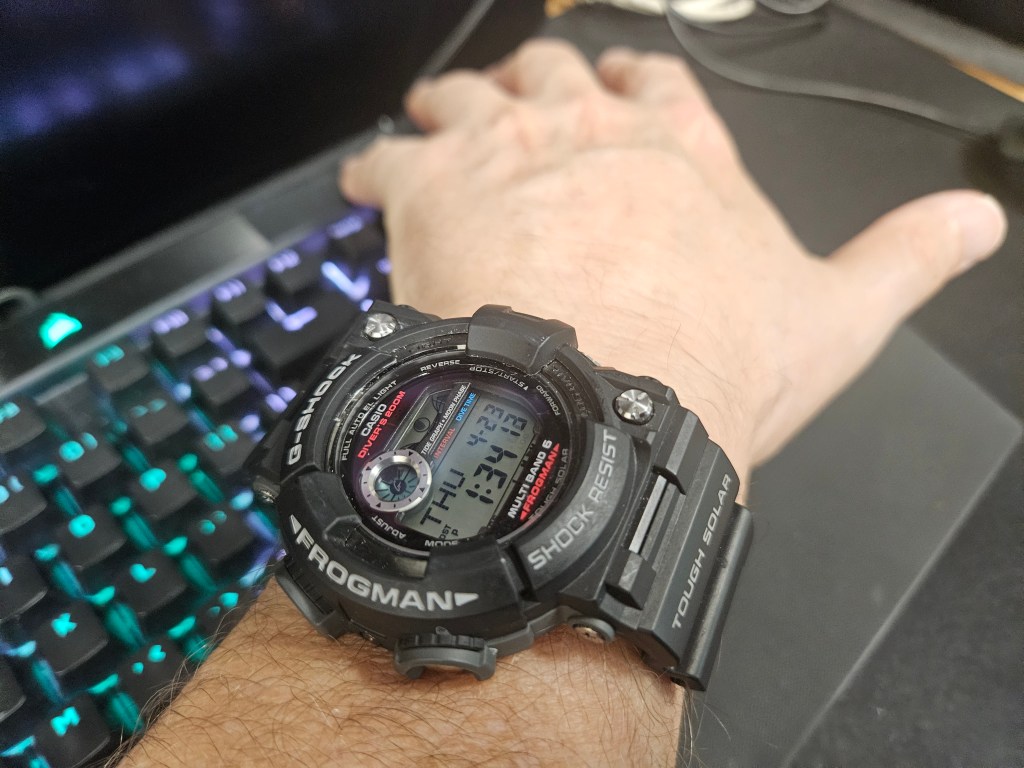
    Which is why I wonder if the shift to the G-Shock Frogman was an attempt at self-surgery—a clean cauterization of the need for more. A reset. My G-Shock friends laugh. The Frogman isn’t the cure, they say. It’s Act One of a new addiction.

    If they’re right, then “I Am the Frogman” isn’t transformation.

    It’s mythology.

    And I’m the one who wrote it.

  • Cognitive Lag Drift Meets the Frogman’s Calm

    Cognitive Lag Drift Meets the Frogman’s Calm

    Camp Flog Gnaw sounds like the name of an enormous toothy cartoon monster, but it was a weekend-long bacchanal of sound and sweat for my wife and our twin daughters, two days of music and mayhem baked under the unforgiving Los Angeles sun. My wife braved the trip on Friday and came home looking like a survivor of a maritime disaster, muttering that leaving Dodger Stadium traffic was like trying to escape a collapsing pyramid. She begged me to handle Sunday drop-off and assured me they would Uber home like civilized people. Armed with a “Fast Pass” for the 110 North, I engaged Google Maps, which promptly betrayed me and sent me barreling into downtown—an urban obstacle course specifically engineered to destroy men my age. Pedestrians sprang into the street like feral pigeons, daring me to earn a manslaughter charge. Driverless Waymo cars drifted past me with pastel-lit antennae, cheerful like clown hearses guiding me into the underworld. The lanes themselves seemed painted by committee: solid, dashed, turning, not turning, red, green, “maybe stop,” “maybe don’t”—a psychedelic optical exam administered at 20 mph.

    I began to notice a quiet but unsettling shift in my driving. Two hazards arrived at the same time, like conspirators who had compared notes. First, the road itself had changed. It no longer presented information—it assaulted me with it. Screens glowed, dashboards pulsed, alerts chimed, and every passing car seemed to flash some new digital signature. The highway had become a carnival of LEDs.

    Second—and less forgiving—was what was happening inside my own head. My processing speed had slowed just enough to matter. Not dramatically. Not catastrophically. Just enough to turn split-second decisions into small negotiations. And driving is no place for negotiation. The convergence of these two developments created Cognitive Lag Drift: the subtle but consequential slowing of mental processing speed that impairs real-time decision-making in high-stakes environments like driving, where milliseconds matter.

    The result was a kind of sensory overload paired with cognitive lag—a bad marriage. What used to feel like a calm, controlled glide now felt like I was trying to play a video game while someone flicked the lights on and off in rapid succession. The margin for error hadn’t changed. I had.

    Driving was no longer serene. It was a test I hadn’t agreed to take.

    And yet—strangely—on my wrist sat a counterargument. My Casio G-Shock Frogman did not flash, negotiate, or editorialize. It did not offer lane suggestions, heart rate, moral encouragement, or existential commentary. It simply displayed the time in large, unapologetic numerals, like a monk who has taken a vow of clarity. No animations. No alerts. No betrayal. In a world where every screen demands interpretation, the Frogman delivers a verdict: 5:42. That’s it. No subtext, no narrative arc, no committee-painted ambiguity. The road may have turned into a casino of stimuli and my brain into a cautious bureaucrat, but the watch remains a quiet tyrant of precision. I glance down and feel, for a fleeting second, that order is still possible—that somewhere in this strobe-lit madness, truth can be reduced to a number that does not argue back.

    When I finally dropped off my wife and daughters, I whispered a confession to my wife: “I’m done with this. I think I’m giving my Accord to you, and the other car to the girls. I’m retiring from the driving game.” They didn’t laugh; they’ve seen cracks in the armor. I’m a high-strung man, and at sixty-four, the neurons don’t fire like they used to. I can still handle a five-mile radius around my house—my personal demilitarized zone—but pull me into the wilds of Los Angeles traffic and I’m ready to hang up my driver’s jersey. Downtown LA isn’t a city. It’s a gladiatorial arena where the young come to dominate, and I say to myself, “This is no country for old men.”

  • When Theft Becomes a Fashion Statement

    When Theft Becomes a Fashion Statement

    In his Atlantic essay “Theft Is Now Progressive Chic,” Thomas Chatterton Williams takes a scalpel to a peculiar strain of moral vanity—the kind that treats petty theft as a political accessory. His targets include Jia Tolentino and Hasan Piker, figures who flirt with the idea that swiping lemons from Whole Foods, sharing passwords, or hopping paywalls is not merely harmless but faintly heroic. Williams calls it what it is: a breezy contempt for the social contract dressed up as rebellion. When small theft is rebranded as civic virtue, even Vicky Osterweil, the author of In Defense of Looting, begins to look like the sober one in the room.

    I confess the whole thing landed on me with the sting of belated education. I had not realized there were circles where breaking the law could be laundered into moral performance. Apparently, this is not an isolated glitch but a trend. The next day, another Atlantic writer, Graeme Wood, weighed in with “Something Is Happening to America’s Moral Code,” invoking James C. Scott’s notion of “anarchist calisthenics”—those small acts of rule-breaking meant to keep the spirit of rebellion limber. Wood’s diagnosis is less romantic: a set of half-formed ethics, offered with confidence and examined with indifference.

    What came to mind was Rob Henderson’s idea of “luxury beliefs”—ideas that burnish the speaker’s status while exporting the costs to people who can’t afford them. Consider the casual encouragement of shoplifting. In theory, it’s a minor jab at corporate excess. In practice, it lands on the backs of people like my students—working-class college kids who clock retail hours to pay for what they own.

    They tell me what it looks like on the floor. Managers instruct them not to intervene—too risky, too litigious. So they stand there, professionally inert, as merchandise walks out the door. The result isn’t liberation; it’s demoralization. They watch others take what they themselves budget and sweat to buy. And the losses don’t evaporate into the ether—they reappear as higher prices, a quiet tax that falls hardest on those already counting dollars.

    This is the part that doesn’t make it into the manifesto. It’s easy to romanticize petty theft when you’re insulated from its consequences. It’s harder to maintain the pose when you’re the one absorbing the cost.

    There’s a particular kind of intellectual decay that sets in when smart people talk only to one another, applauding the cleverness of their own provocations. The room gets warmer, the ideas get softer, and reality is politely asked to wait outside. I’ve admired Tolentino’s work for its sharpness and nuance. But there’s a difference between insight and indulgence, and when the latter starts masquerading as the former, credibility takes a hit.

    At some point, the performance of rebellion stops looking brave and starts looking careless. And the people paying for it are the ones least invited to the conversation.

  • “I Am the Frogman”: The Last Shout Before the Door Seals

    “I Am the Frogman”: The Last Shout Before the Door Seals

    I’ve spent more than a decade documenting my watch obsession on YouTube—a pursuit that begins as hobby and ends, if you’re not careful, as behavioral conditioning. You think you’re making videos. You’re actually being trained. The algorithm dispenses rewards and punishments with clinical indifference: views, comments, silence. You adapt. Of course you adapt. That’s the job now.

    The trouble is that the algorithm has no interest in truth, balance, or restraint. It prefers spectacle. It rewards the emotional range of a teenager who’s just discovered caffeine: hyperbole, dread, euphoria, FOMO, regret—delivered with the urgency of a man announcing the end of civilization via bezel insert. You wake up one morning and discover you’ve succumbed to Algorithmic Persona Drift—a slow mutation in which your public self becomes a louder, shinier, more hysterical version engineered for attention rather than accuracy.

    Feed it, and it feeds you back. The cycle tightens. Every video must be more decisive, more apocalyptic, more “this changes everything.” You produce manifestos. You narrate epiphanies. You analyze your own obsession with the intensity of a man dissecting his own heartbeat. The result is predictable: you become a caricature of yourself—recognizable, marketable, and faintly absurd.

    If you can tolerate that, the system will reward you. The numbers rise. The revenue trickles, then flows. You build a small empire out of controlled exaggeration. But there comes a moment—quiet, unwelcome—when you no longer recognize the man delivering the lines. The performance has outgrown the person. At that point, the decision presents itself with unpleasant clarity: keep feeding the machine and let it finish the job, or step away and salvage what remains of your voice.

    That’s one exit.

    The other is less dignified. You don’t leave; you are expelled. The causes are familiar—burnout, self-disgust, ennui, health—but the most decisive is also the least negotiable: age. You wake up one day and realize the tempo has changed. The rhythms that once animated you now sound distant, like music leaking from another room. The new release, the hyped drop, the celebrity of the week—none of it lands with the old voltage. Mortality has entered the conversation and lowered the volume.

    You try to resist. You tell yourself enthusiasm is a choice. But the gap widens anyway. You find yourself oddly relieved that you no longer care about bracelet articulation or dial gradients or the fever dream that the “perfect collection” is one purchase away. The brotherhood reveals itself for what it always was: half fellowship, half support group. You no longer feel the urge to compare scars from impulse buys, to laugh at the madness, to whisper—half-serious, half-hopeful—that this watch will finally cure you.

    For me, the separation was unmistakable. Twenty years dissolved into a blur of rotating bezels and contingency divers. Then, at sixty-three, something tapped my shoulder. Not a crisis. A correction. The obsession didn’t die; it simply lost its authority. Desire dimmed, replaced by a quiet recognition that watches are exquisitely engineered ways of losing to time.

    The feeling calls to mind a scene from Battlestar Galactica: a traitor sealed behind glass, the airlock hissing, the crew watching with solemn finality. Not melodrama—procedure. That’s aging. Not tragic, not cruel—inevitable. At some point, those still inside the illusion of endless tomorrows begin to edge away from those who have seen the horizon contract.

    A pane descends. It isn’t hostile. It’s accurate.

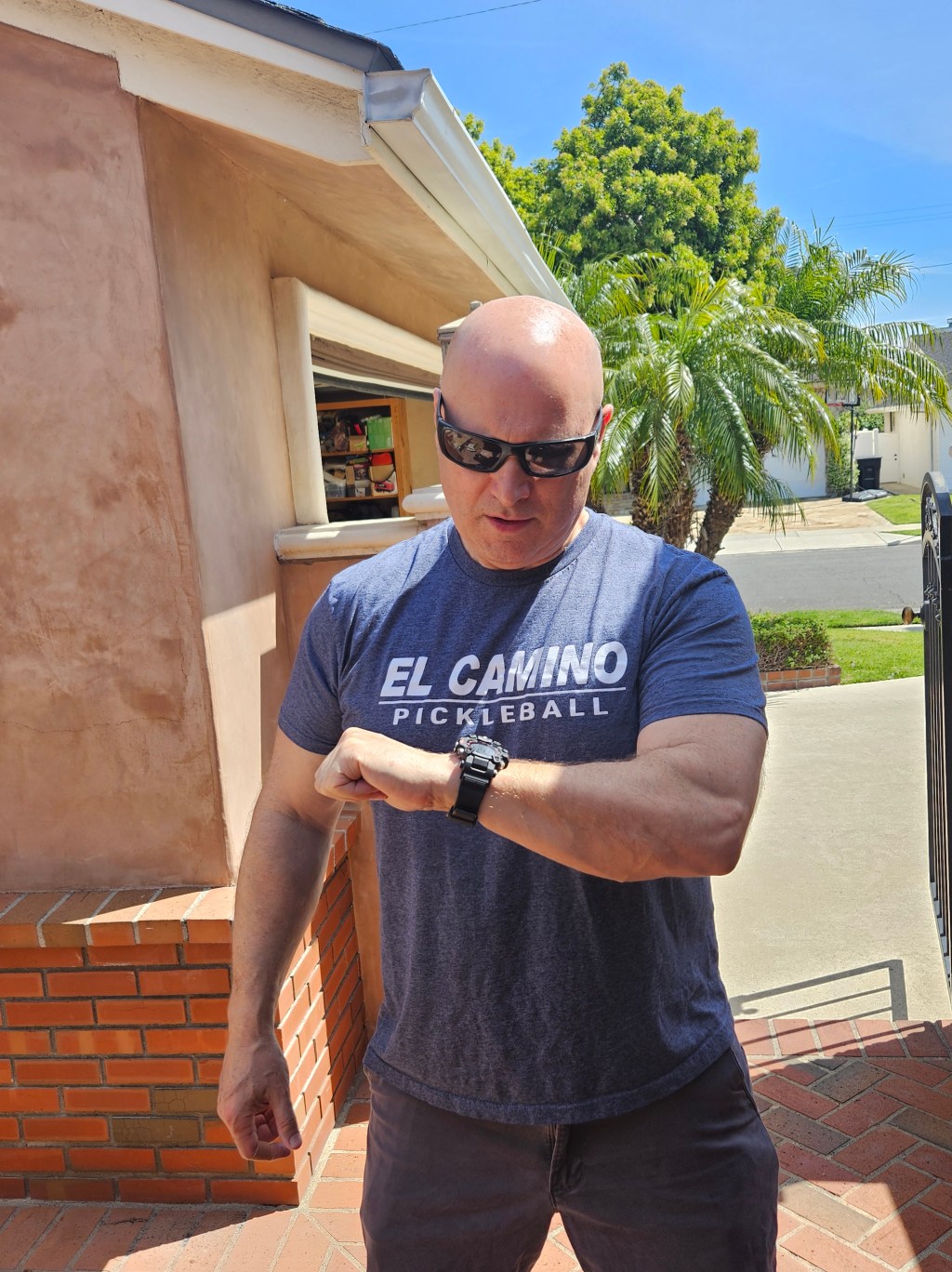
    You tap the glass, wave, try to rejoin the cockpit of youthful urgency. You even lift your wrist—your hulking G-Shock Frogman—and make your case. “Look,” you want to say, “I’m still in it.” But the seal has set. Reentry is not part of the design.

    What remains is less dramatic and more demanding: dignity. Accept the season you’re in. Build meaning instead of inventory. Offer something useful to those still racing ahead, even if they don’t yet see why it matters. They will. Everyone does, eventually.

    The algorithm fades. The noise recedes.

    And you are left, at last, with a quieter, harder question: not what you want next—but who you intend to be without the applause.