Tag: fiction

  • A Portrait of the Artist as a Sweaty Young Man

    A Portrait of the Artist as a Sweaty Young Man

    In the fall of 1979, I was seventeen years old, a freshman in college, and already trapped in the tragicomic theater of my own self-regard. My deltoids were large, my ego fragile, and my sense of fashion—catastrophic. I had shown up that day to the cafeteria in a tight black turtleneck, the kind of garment that might look sleek on a Parisian intellectual but looked positively deranged on a teenage bodybuilder seated alone under sun-drenched plate-glass windows. The sun baked through the glass like a punishment from Apollo himself, and there I sat, moping in a puddle of my own sweat and self-loathing while Jimmy Buffett’s “Margaritaville” chirped mockingly from the jukebox.

    The song, a hymn to sloth and sangria, might as well have been composed to ridicule me personally. I didn’t know how to be carefree. I didn’t sip margaritas or laugh at spilled salt. I sat there glowering at my hamburger like it owed me money.

    College wasn’t a choice; it was a parental ultimatum. My mother, newly divorced and perpetually exasperated, had threatened to eject me from the house if I didn’t enroll. My father, who fed me barbecued steak at his bachelor pad and treated my emotions like a disease he couldn’t contract, declared that my ego—his exact word—was too “delicate” for a job with the sanitation crew. “You’re not built for trash,” he said between bites. “You need a title.” I agreed. I said I needed something white-collar, something that sounded mobile—like it wore loafers and got invited to cocktail parties.

    Yet there I sat, jobless, broke, sweating through a wool turtleneck like a fool in a Russian novel. Just a few weeks earlier, I had been juggling job offers like a hustler on the make. One gig was as a bouncer at a teenage disco called Maverick’s in San Ramon, a temple of polyester and hormonal chaos where high schoolers writhed to the anesthetizing thump of K.C. and the Sunshine Band. I hated everything about that job—the music, the fake glamour, the pretense of authority as I stalked the aisles flexing my lats like I was auditioning for a sequel to Saturday Night Fever: The Security Guard Chronicles.

    My mother’s revolving door of boyfriends didn’t help. One, a Raiders defensive coordinator, had promised me a job moving pianos, which somehow never materialized. Another, Sid Briggs, was allegedly a “businessman” with Teamsters connections and the vague scent of federal indictment. He too promised me a job managing a health club. That never happened either. The only real employment I had was at Maverick’s, which came to a dramatic end during a riot. My fellow bouncer Martino and I decided we were too precious to die for three bucks an hour, so we walked out mid-melee and drove off down Crow Canyon Road. Martino repeated like a monk reciting scripture, “I’m not going to risk my life for three dollars an hour.”

    We were fired. Unceremoniously. I was left with $300 in my checking account and a 1971 metallic brown Ford Galaxy that had just drained me dry with repairs. That car had the elegance of a Soviet tank and handled like one too.

    And now here I was, sulking under the cruel sunlight, marinating in Buffet’s faux-Carribbean nihilism. “Wasting away,” he sang. No kidding.

    At six feet tall and 210 pounds of resentful muscle, I radiated a kind of lonely menace. My professors were afraid of me. People steered clear. I was a human bug zapper. But then came John O’Brien.

    He walked right up to my isolated table like he was planting a flag. Set down his tray, extended a hand, and introduced himself. A compact redhead from Boston with the kind of fast-twitch charisma that usually belongs to politicians or cult leaders. He had moxie, confidence, and a girlfriend who looked like a shampoo commercial. But unlike most people with that kind of glow, he wasn’t a narcissist. He had radar. And he picked up my signal loud and clear: lost kid, no job, no love life, no clue.

    John decided to fix me.

    First, he got me a job. He worked at Jackson’s Wine & Spirits in Berkeley and said, “They need a guy. You’re the guy.” He called me that night with the details. Two days later, I was on the floor learning about merlot and discount vodka.

    Then, with the subtlety of a Vegas magician, he decided to address my romantic failure. He looked across the cafeteria, spotted two stunning nineteen-year-olds, and summoned them with a whistle so loud and precise it could’ve herded cattle. They glided over—one blonde, one with honey-colored hair—and I immediately began sweating like a man having a cardiac episode in church. It was flop sweat, and I couldn’t stop it. I tugged at the neck of my turtleneck like it was trying to strangle me and muttered, “It’s not hot in here.”

    The girls smiled politely, and I squirmed in my own skin like a teenage werewolf caught mid-shift. John watched it all with the amused detachment of a man inspecting a fixer-upper. He had found a dilapidated house—me—and now he was assessing the structural damage.

    He had his work cut out for him.

  • Dorian Gray Wears a Diver

    Dorian Gray Wears a Diver

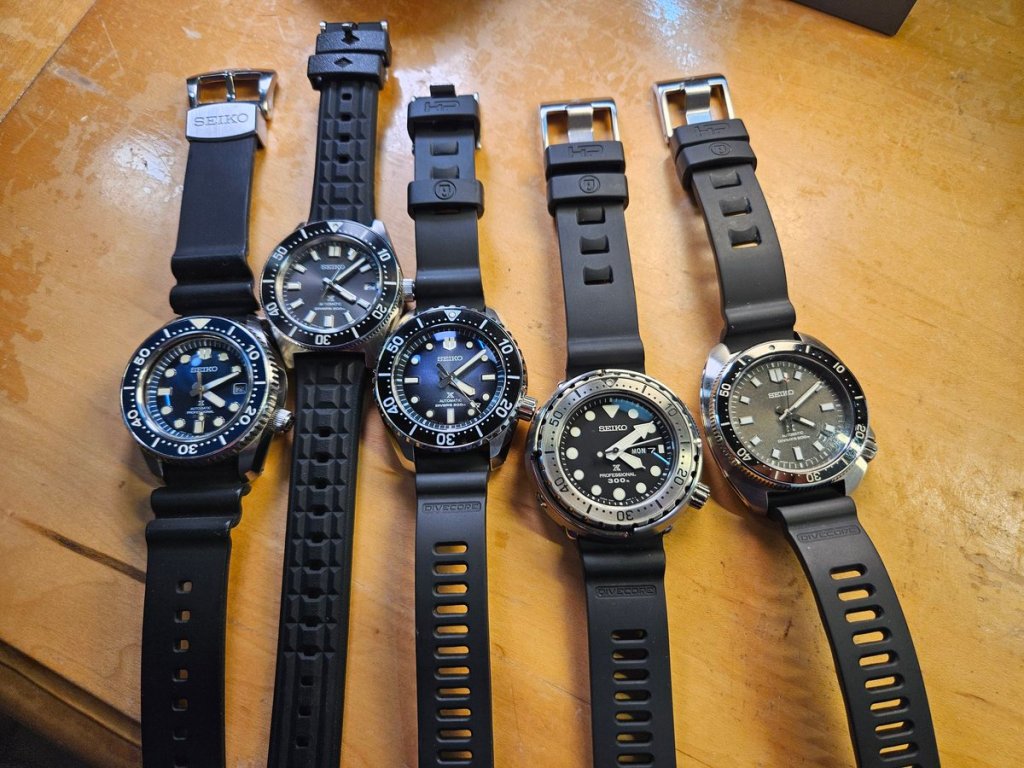
    I turn 64 this October. By all logic—and illogic—I should reward myself with a seventh watch. Something different. Something elegant. Something that whispers, you’re still in the game. Not another diver—I already have six of those aquatic symbols of masculine resolve. Maybe a sleek Grand Seiko. Or a snotty, sapphire-dialed Euro snob with just enough heritage to make me feel like I matter. Or more likely, a Citizen Satellite Wave Attesa Chronograph.

    But here’s the rub: I don’t have time.
    Literally.

    Buying another timepiece at this stage of life feels like auditioning for a band that stopped playing decades ago. The idea of adding yet another horological trophy to my drawer feels less like celebration and more like denial—of mortality, of limits, of the inconvenient truth that, like it or not, I’m on the back nine. The dopamine buzz of acquiring another shiny object is no longer innocent. It reeks of delusion. It’s a middle-aged man’s sugar pill. A form of spiritual Botox.

    Desire at this age should mellow. Shouldn’t it? Shouldn’t I have graduated to some Zen-like state of detachment, where I sip tea and listen to birdsong and chuckle softly at the foolishness of wanting things?

    Instead, I find myself lusting after lacquered dials and ceramic bezels with the unbridled thirst of a teenage boy at a mall kiosk. It makes me feel like Dorian Gray—but in reverse. I strap youth onto my wrist while the portrait in the basement, the one of my soul, grows grotesque. Not just wrinkled, but warped. A decaying ghoul of greed and vanity, clutching a watch roll and whispering, just one more.

    Another sobering thought: Getting another beautiful watch won’t make me happy. It will make me bitter because as pleasurable as it will be to behold it on my wrist, I will know deep down that this pleasure pales in comparison to the dopamine-rush I get from watching it displayed on YouTube videos. Much of the pleasure is in my head, not on my wrist. 

    These are not healthy thoughts for a birthday.

    And yet, here we are. When you’re a consumer with a conscience, you live in a state of cognitive dissonance. You want the toy. You hear the whisper of death. You long to be mature. You also want the damn Seiko. Buying stuff, especially beautiful, useless stuff, is supposed to be fun—frivolous, even. But once you’ve glimpsed the truth—the metaphorical rot in the basement—you can’t unsee it.

    That’s the thing about aging: it doesn’t always give you peace. Sometimes it just gives you clarity. And clarity can be a buzzkill.

  • The Disappearing Novel and the Culture That Forgot How to Read

    The Disappearing Novel and the Culture That Forgot How to Read

    In his New York Times column “When Novels Mattered,” David Brooks laments the slow vanishing of the novelist as a public figure. Once, the release of a new novel—especially by the likes of Saul Bellow or Toni Morrison—was a cultural event. Now it barely causes a ripple.

    The novel no longer commands attention. The digital age has crushed the reader’s patience, fractured our attention span, and flooded our minds with the shallow stimuli of TikTok, endless texts, and algorithmic rabbit holes. Where once we waited for a new Roth novel with the same anticipation reserved today for a Marvel sequel, we now swipe past literature as if it were spam.

    For Brooks, this is not just a loss—it’s a tragedy. The decline of the novel signals something deeper: a society losing its capacity for moral complexity, nuance, and emotional depth. The great literary writers, he argues, once served as our secular prophets, our social conscience. They told the truth—harsh, beautiful, layered. They gave us characters who were flawed, human, and real—not two-dimensional avatars chasing dopamine hits on social media.

    One of Brooks’ most compelling insights is that this decline is not simply the result of technological distraction, but of cultural timidity. Great literature, he reminds us, requires audacity. The ability to speak outside the safe lanes. To challenge the dominant orthodoxy. And today, particularly among the liberal elite, that audacity is wilting. Brooks argues that young people, especially on college campuses, whisper their opinions in fear. The social cost of independent thinking has grown too high.

    Interestingly, Brooks—who has recently skewered the excesses of the political right—spares them from scrutiny here. His focus is firmly on the left, on the performative virtue and self-censorship that, while well-meaning, suffocates creative risk. In this climate, it’s easier to be righteous than original. Virtue signaling may win you applause online, but it doesn’t lead to great art.

    Yet the most persuasive moment in the essay arrives late, when Brooks describes the collective psychic damage of the last decade. “Our interior lives,” he writes, “are being battered by the shock waves of public events. There has been a comprehensive loss of faith.” That line lands hard. It names something many of us feel: that we are living in a Bosch-like hellscape of noise, cruelty, and absurdity—a fever dream of moral exhaustion.

    Brooks doesn’t say this, but I will: perhaps literature isn’t dead, just stunned. In shock. In digestion. Maybe we can’t write the great novels of this era because we haven’t fully metabolized the era itself. The story hasn’t ended, and we’re still trying to make sense of the firestorm.

    Is the novel dead? I doubt it. It’s sleeping off the chaos. There are still serious novelists out there—unhyped, uncelebrated—doing the slow, unsexy work. One who deserves more recognition is Sigrid Nunez, whose clear, intimate prose hits as hard as anything in Bellow’s canon.

    The talent remains. The novels are still being written. What’s missing is the cultural infrastructure that once elevated them to necessity. We don’t need more influencers—we need readers with stamina. We need a culture willing to wrestle with meaning again.

  • The Fever Swamp of Watch Collecting

    The Fever Swamp of Watch Collecting

    Once upon a time—last week, to be precise—I made a YouTube video arguing that a man should not chase variety in his watch collection but instead find his signature style and whittle his hoard down to a tasteful few. Like a monk with only one robe. Or a chef with one good knife. Or a middle-aged guy who knows that buying yet another GMT won’t fix his marriage.

    Now, did I believe what I was saying? Not entirely. I was, to be honest, talking myself off the ledge. It was a kind of public self-hypnosis: say it enough times on camera, and maybe I’ll stop buying watches I never wear. But I’ll admit—the thought experiment was stimulating, like sniffing ammonia salts just to feel something. Most commenters agreed, saying peace of mind only arrived after purging the herd. But not all. Some insisted that a large, diverse collection brings them genuine joy. Fair. Not everyone needs to live like a horological monk.

    Still, I enjoyed making the video. It felt like intellectual calisthenics for the soul, even if it didn’t convert me.

    One viewer, the formidable “Captain Nolan,” asked a deceptively simple question that demands more than a quick reply:

    “How can you discover your identity without trying watches in every category—divers, pilots, field watches, dress, digital, mechanical, quartz, and so on?”

    By “identity,” he means your taste. What fits your lifestyle, your aesthetic, your internal brand. A fair question. And at first, I answered like a smug adolescent. I said, “You know what you like the same way I knew Raquel Welch was the apex of female beauty when I was nine. One glance. No need to watch Love American Style reruns or thumb through Vogue. Case closed.”

    But that answer is glib. And idiotic. Taste in watches—unlike adolescent lust—is not a hormonal thunderclap. It’s a process.

    So here’s the grown-up answer: yes, you do need to try different styles, just like trying on jackets at Nordstrom. Some are flattering, some make you look like a Bulgarian hitman. It’s tactile. Visceral. And wildly expensive. To really figure out your taste, you may end up spending $5,000 to $10,000 just to land in the right neighborhood. You might call this the Fitting Room Narrative—the idea that trying on a wide range of watches will help you find the “real you.”

    It sounds rational. Comforting, even. But I don’t believe in it.

    The problem is the human brain. It’s not a spreadsheet. It’s a haunted house full of desires, delusions, and marketing fumes. So let me propose a more honest alternative: The Fever Swamp Narrative.

    Here’s how it works:

    You fall headfirst into the hobby. You start buying watches the way a toddler grabs Halloween candy. You buy microbrand divers, G-Shocks, Speedmasters, and maybe a Rolex or two if your credit limit allows it. You tell yourself each one serves a “purpose.” You start spending a grand a month, easy. Over ten years, you’ve spent more than most people do on therapy. And God knows you need therapy.

    Eventually, the collection metastasizes. Dozens of watches, each one representing a temporary high. You stop wearing half of them. You obsess over straps, bezels, lume. Your identity fuses with your hobby. You’re no longer a man who wears watches; you’re a man being worn by them.

    Then comes the collapse: financial strain, marital tension, the vacant stare of a man wondering why he owns three identical Seikos. Maybe you go through a breakup or foreclosure. Maybe your friends stage an intervention. Maybe your dog leaves you. Think about that. Your watch obsession got so bad your dog abandoned you. 

    You finally tap out. Sell the collection. Keep three. Or two. Or one. You tell yourself you’re “cured.”

    Except… maybe you’re not. Maybe, like Bell’s palsy or a bad ex, the obsession lies dormant. All it takes is one random trigger—a stressful day, a YouTube thumbnail, a flash sale—and you relapse. Buy a Sinn. Then a Squale. Then you’re back in the swamp.

    Why do we cling to the Fitting Room Narrative when it’s so obviously false? Because it has a tidy structure. A clean arc. Beginning, middle, resolution. We’re narrative junkies. We want our Luke Skywalkers to finish Jedi school and never regress. 

    Same with watch collectors. We want the Watch Ninja to overcome his demons and live a Zen life with a single Grand Seiko. If he relapses, we unsubscribe. He becomes a punchline. Another Liver King of horology.

    Still don’t believe me? Consider Pete Rose. In the ‘70s, he was “Charlie Hustle,” the human embodiment of work ethic. But zoom out, and the myth crumbles. Pete wasn’t disciplined—he was compulsive. He gambled, lied, betrayed friends. The man was a walking cautionary tale wrapped in a Cincinnati Reds jersey.

    Or take Sedona. Supposedly a spiritual vortex. In reality, a commercialized fever dream of overpriced crystals, green juice, and pseudo-mystical hokum. You arrive expecting transcendence and leave with a maxed-out credit card and lower back pain from a “chakra realignment.”

    We love myths because they sell. But real life is more complicated. Messier. Less flattering.

    So I could tell you a satisfying tale about finding my “true self” through curating a humble collection of retro divers and minimalist field watches. I could wrap it all up with a bow. But I won’t. Because that would be fiction.

    And honestly, haven’t we had enough of that?

  • Trader Joe’s and the End of the World (One Tofu Block at a Time)

    Trader Joe’s and the End of the World (One Tofu Block at a Time)

    With my wife and twin daughters making the long drive home from San Francisco, I realized someone had to restock the household pantry. That someone was me. So by 8 a.m., I was wandering the fluorescent aisles of Trader Joe’s, still half-asleep, in search of tempeh, oat milk, and maybe a reason to keep going.

    Twenty seconds in, I spotted Eliot—a jazz musician in his early forties who’s worked there forever and knows every spice rack and frozen entrée by memory. I hadn’t seen him in a while. He asked if I’d retired from teaching at the local college yet.

    “Two more years,” I said, adding, “but who knows what’s happening to writing classes in the Age of ChatGPT. Everyone talks like they know. They don’t.”

    He asked how I’m handling it in the classroom.

    “I’m not sure I am,” I told him. “I can teach. I can perform. I can entertain. But grading online essays? That’s an existential crisis wrapped in a PDF. I’m dancing in quicksand.”

    Eliot nodded grimly. “This generation doesn’t read.”

    “My daughters don’t,” I said. “Their friends don’t. They’re sweet kids, empathetic and funny, but they don’t seem built for a world that requires deadlines, grit, or employment.”

    Eliot, without hesitation: “We’re screwed.”

    “And there’s no going back,” I said. “CNN gets out-watched by Joe Rogan. Most people get their facts from guys yelling into ring lights while drinking protein shakes.”

    We stared into the epistemic abyss together, nodded, and parted ways before we started crying in the chip aisle.

    Twenty minutes later, I made it to the checkout line, where I was greeted by Megan—the tall, soft-spoken vegan cashier who’s known me for years. She had just broken up with her boyfriend and noticed the mountain of super-firm tofu in my cart.

    We exchanged tofu recipes, talked about the protein digestibility scale, and mourned the impossibility of plant-based love in a society fueled by backyard barbecue. Her breakup, as it turns out, was partly due to meat incompatibility. “He grilled like it was a belief system,” she said.

    We also touched—briefly—on factory farming, which always makes me want to cry or scream or stop eating altogether. But just like I couldn’t solve the collapse of literacy and truth with Eliot, I couldn’t solve the meat-industrial complex with Megan.

    All I could do was pay for my groceries and accept the fact that I’m a limited man in a crumbling culture, armed with tofu, oat milk, and a Costco-sized tub of almond butter.

    I loaded the trunk with the small consolation that I had, at the very least, fed my family.

  • Joyface and the Gooseberry Lie

    Joyface and the Gooseberry Lie

    In the short story “Gooseberries,” Chekhov builds a quiet indictment of false contentment. The story opens with Ivan Ivanich, a veterinarian, and his friend Bourkin, the schoolmaster, soaked from rain and flushed from vigorous exercise. There’s a rugged, life-affirming joy in their discomfort—an honest happiness born from movement, exposure, and the humbling vastness of the natural world.

    This raw joy stands in mocking contrast to Ivan’s brother, Nikolai, a man who has spent years grinding away at bureaucratic tedium, nursing a fantasy of rural bliss. His goal? To retreat to the country and become a minor land baron, surrounded by gooseberry bushes and sycophantic peasants. Ivan, ever the clear-eyed cynic, knows this is no pastoral ideal—it’s a death wish in disguise. He describes his brother’s dream as “six feet of land,” a nod not to acreage, but to a coffin.

    Drenched and weary, Ivan and Bourkin seek shelter with their friend Aliokhin at his mill. There, Chekhov offers fleeting pleasures: the warmth of hospitality, the intimacy of shared conversation, the sensual revival of a hot bath. These are the real joys of life—ephemeral, yes, but earned and communal.

    And then the story pivots. Ivan launches into his monologue about Nikolai, who finally escaped the city by marrying (and then outliving) an “ugly old widow,” purely to fund his pastoral delusion. The transaction is grotesque in its coldness—he’s not marrying for love but for the deed to a fantasy. When the widow dies, he buys his estate, plants twenty gooseberry bushes, and gorges himself in bloated isolation.

    Ivan visits and is appalled. His brother, the red dog, and the cook—all puffed and pampered—look like livestock awaiting slaughter. They have the physicality of pigs and the spirituality of corpses. Nikolai dotes on his gooseberries with religious fervor, insisting on his happiness. But Ivan sees through it. This isn’t happiness—it’s Joyface, a self-inflicted psychosis, a desperate mask slapped over a hollow life.

    What horrifies Ivan is not merely his brother’s delusion, but its implication: that many of the world’s so-called happy people are just as corrupt, just as morally dead. These are the bloated rich, insulated from suffering, convinced of their own virtue while causing quiet devastation to the world around them.

    To witness such delusion is to lose faith in people altogether. Ivan begins to spiral into misanthropy, seeing humanity not as a noble species, but a swarm of narcissists chasing comfort, stroking their chimeras, and calling it joy.

  • Operation 2B: Writing at the Edge of Madness

    Operation 2B: Writing at the Edge of Madness

    Last night, I dreamed I was recruited into a top-secret engineering project. Why? I have no idea. I’m not an engineer. I don’t calculate. I conjugate. But apparently, someone in a conference room with clearance and questionable judgment decided that this classified operation needed… a writer.

    They dropped me into a government-issue apartment compound, a cheerless complex filled with bunking engineers and low-grade existential dread. I was assigned a shared unit with mismatched strangers. One of them, a single mother, had laid out a modest spread of peanut butter, celery, and crackers for her toddler—a rationed still life of parental competence. “Eat,” she told me. “You’ll need fuel for the project.” And so I did—voraciously, like a man preparing to write the Constitution on deadline.

    One by one, my roommates peeled off to private rooms. There was a charming British expat with a silver beard and a childhood photo of himself in a Bentley—Old Money in exile. Despite his aristocratic roots, he was delightfully upbeat, the kind of man who would whistle while burying landmines. But soon, he too was reassigned. It became clear that my “team” had evaporated, and I had been left behind. Not fired. Not forgotten. Just… chosen. To work alone. On a project I didn’t understand. Surrounded by a sea of mechanical pencils. Hundreds of them, like offerings at the altar of Bureaucratic Futility.

    Feeling the weight of vague responsibility, I walked to the project site—a sprawl of white dust and scattered canopies that looked more like a failed music festival than a classified facility. Under one tent, I found two twenty-somethings playing at adulthood. I asked the woman which pencil I should use. She shrugged but confessed the 2B graphite was easiest on her eyes. A clue. A preference. A hierarchy of legibility. I realized she would be my proofreader, my silent companion in this ridiculous odyssey.

    Then came the sign. A man appeared—former military, highly decorated, looking like a character drafted from a Tom Clancy novel. Without a word, he walked up to my apartment door and placed a sign the size of a license plate in the window frame: BE COURAGEOUS. The kind of sign you see right before a high-stakes mission or a TED Talk.

    And that was it. My mission was mine alone. A 500-page manuscript I had to read to prepare myself for the project. No advisor, no support, no backup—just me, a pile of pencils, and a shadowy proofreader who preferred 2B. I awoke shortly after, microwaved some buckwheat groats, brewed a pot of dark roast coffee, and stared into my kitchen tiles wondering if this was a dream about writing… or about surviving it.

  • The Ascent of Paper Towel Man

    The Ascent of Paper Towel Man

    Last night, my subconscious staged a farce: I was back on my old college campus, nervously ordering textbooks for my freshman comp classes—because that’s how my brain parties at night. After hours in the academic underworld of ISBNs and course numbers, I stumbled home under a moonless sky only to be seized by a grim realization: I forgot to order a crucial book.

    Panic.

    In this emergency, I reached not for Xanax, but a dark green landline phone, the color of envy or perhaps bureaucratic despair. I called the English Chair. Except in dream logic, the English Chair was not the overworked academic I know—but Scott Galloway, the sarcastic podcaster and economics professor. 

    I told him he had to submit the textbook order by midnight.

    True to form, he lobbed verbal grenades at me. Taunts, jabs, snide remarks. His voice had that tone—the kind that leaves you wondering if you’re being insulted or inducted into a secret society of useful idiots.

    I said, “Don’t joke over the phone. Only mock me in person.”

    He replied, “Fine. Come over. I’m having a dinner party.”

    Naturally.

    So, in the witching hour, I opened my front door—expecting a miles-long slog up a mountain—and instead, in the way only dreams and luxury real estate can allow, I was already at Casa Galloway, perched perilously on stilts over a cliff like some Bond villain’s hideout with a podcast studio.

    He was charming in person—gregarious, warm, practically glowing with hospitality. He led me into a dimly lit dining room where guests laughed and angel hair pasta sat arranged like delicate tumbleweeds on silver trays. White sauce shimmered like divine lubrication.

    “Take as much as you like,” he said, arms open.

    I hesitated. Did he make enough? Should I pretend restraint for the optics? Was this a test of my caloric discipline?

    I took a tiny, tragic portion.

    He raised an eyebrow. I mumbled something about “leaving enough for everyone,” which seemed to impress him. He praised my selflessness, as if I’d just refused seconds at a famine relief banquet.

    After eating my guilt-ridden noodle clump and participating in some effervescent dinner chatter, I left and returned home to my modest flat at the bottom of the hill. But before I could nestle into my bed of neuroses, it hit me: Galloway might be short on paper towels after his soirée.

    And I had a Costco-sized case.

    I threw the rolls under my arm and charged up the mountain like a sentient Amazon Prime delivery. My quads flexed with purpose. I was the Paper Towel Man, delivering absorbency and justice. I swung the rolls from hand to hand like batons of competence.

    I found him on the front porch—a cliffside slab barely larger than a yoga mat, with a waterfall crashing nearby like some sort of capitalist Shangri-La.

    “I’ve brought reinforcements,” I said, brandishing the paper towels like sacred scrolls.

    He smiled, then warned me: “The last fifty feet are treacherous.”

    Of course they were. The final ascent required mountaineering skills I didn’t have—jagged rocks, sudden drops, the kind of climb you’d expect in a spiritual thriller set in Tibet.

    But I was determined. Galloway had ordered my textbook and served me pasta. Reciprocity was sacred. I would reach that porch if it killed me.

    And then I woke up. Standing in my kitchen. Brewing coffee. Scribbling this fever dream into a notebook, trying to decide if it meant anything—or just meant I shouldn’t eat carbs after 9 p.m.

  • If Cormac McCarthy Wrote a Movie Treatment for The Beatles’ “The Long and Winding Road.” 

    If Cormac McCarthy Wrote a Movie Treatment for The Beatles’ “The Long and Winding Road.” 

    FADE IN:

    A road. It winds through the wastes like a serpent that forgot its own name. Cracked earth on either side. Fence posts like grave markers. Vultures in the sky, circling nothing in particular, just keeping warm. A man walks it. His boots are flayed open. His eyes are sunburned. His soul is a blister dragging itself behind him.

    His name is Lyle. Or maybe Thomas. The script never says. Doesn’t matter. He’s every man who ever wrote a love letter in blood and mailed it into the void.

    He is looking for her. She has no name, just a shape in the distance, a memory braided from perfume and last words. She left him. Maybe twice. Maybe more. He kept the door open. She never knocked.

    The road has been long. Winding. Bleak. It led him through dead towns and ghost motels. Once he stayed in a place where the concierge was a buzzard and the minibar held only regret.

    He speaks not. The road speaks for him. It says:

    Every fool must follow something. You picked hope. Bad draw.

    Flashbacks flicker: A woman, face soft as moonlight, eyes like unpaid debt. She tells him she’s leaving. He says he’ll wait. She laughs. That’s the last thing she gives him. Her laughter. Acid-bright and final.

    Along the road he meets others—pilgrims of delusion.

    One man rides a shopping cart filled with old love songs on cassette.

    One woman sews wedding dresses for brides that never were.

    One child sells maps to places that no longer exist.

    They all walk. They all believe the road leads somewhere. It don’t.

    Eventually, Lyle comes upon a house at the end of the road. It is the house. Her house. Or what’s left of it. The windows are boarded. The door is gone. Inside, just dust, a broken phonograph, and a bird trapped in the chimney, fluttering against the soot.

    He kneels.

    Not to pray. To listen.

    There’s no music. No answer. Only wind. And the bird’s soft thump, thump, thump.

    He lies down. The road curls around him like a noose.

    FADE TO BLACK.

    The final line scrolls in silence:

    Love didn’t leave. It just stopped answering the door.

  • If Cormac McCarthy Wrote a Movie Treatment for the Bee Gees’ “Fanny (Be Tender With My Love)”

    If Cormac McCarthy Wrote a Movie Treatment for the Bee Gees’ “Fanny (Be Tender With My Love)”

    MOVIE TREATMENT: Fanny (Be Tender With My Love)

    FADE IN:

    Dust plains. Endless. Cattle skeletons sun-bleached and smiling in the dirt. A wind hisses through creosote like it knows a secret. A man rides into this ruin on a horse too tired to live and too dumb to die. His name is Merle. Once a singer. Once a lover. Now a shadow in spurs.

    He carries a guitar with one string and a heart torn open like a blister.

    He is looking for Fanny.

    Fanny of the laugh that could undo a priest. Fanny of the hips that made men renounce geography. Fanny who told him to be strong and then walked out with a mule-skinner named Dutch who wore cologne and shot rattlesnakes for fun.

    She left Merle in the middle of a love song.

    Now Merle drags that song across the desert like a broken leg.

    The locals say Fanny dances at The Rusted Mirage, a bar built on an old mine shaft. It sits at the edge of a dead lake where the water’s gone but the longing remains. Inside, broken men drink varnish and pray to forgotten gods. There’s a jukebox that plays nothing but Bee Gees covers sung by a toothless man in a gold suit. Fanny’s silhouette haunts the stage, flanked by two coyotes who think they’re her backup dancers.

    Merle stumbles in like a man arriving at his own funeral. He sees her. She sees him. Silence falls like a noose.

    He says

    Fanny. Be tender.

    She says

    Boy you shoulda thought of that when you threw my birthday pie in the fire.

    He says

    That was an accident.

    She says

    So was my affection.

    They duel. Not with pistols. With ballads. His sorrowful wail versus her falsetto fury. The bartender cries. A dog howls. Someone overdoses on sassafras in the corner.

    By dawn, Merle lies collapsed. Empty. She kisses him once—on the temple, like a burial rite. Then disappears into the jukebox, leaving behind only a boa made of scorpion tails and crushed velvet.

    FADE OUT.

    A narrator, gravel-voiced and full of scorn, speaks:

    Love’s a fever dream. Some wake up cured. Some never wake at all.