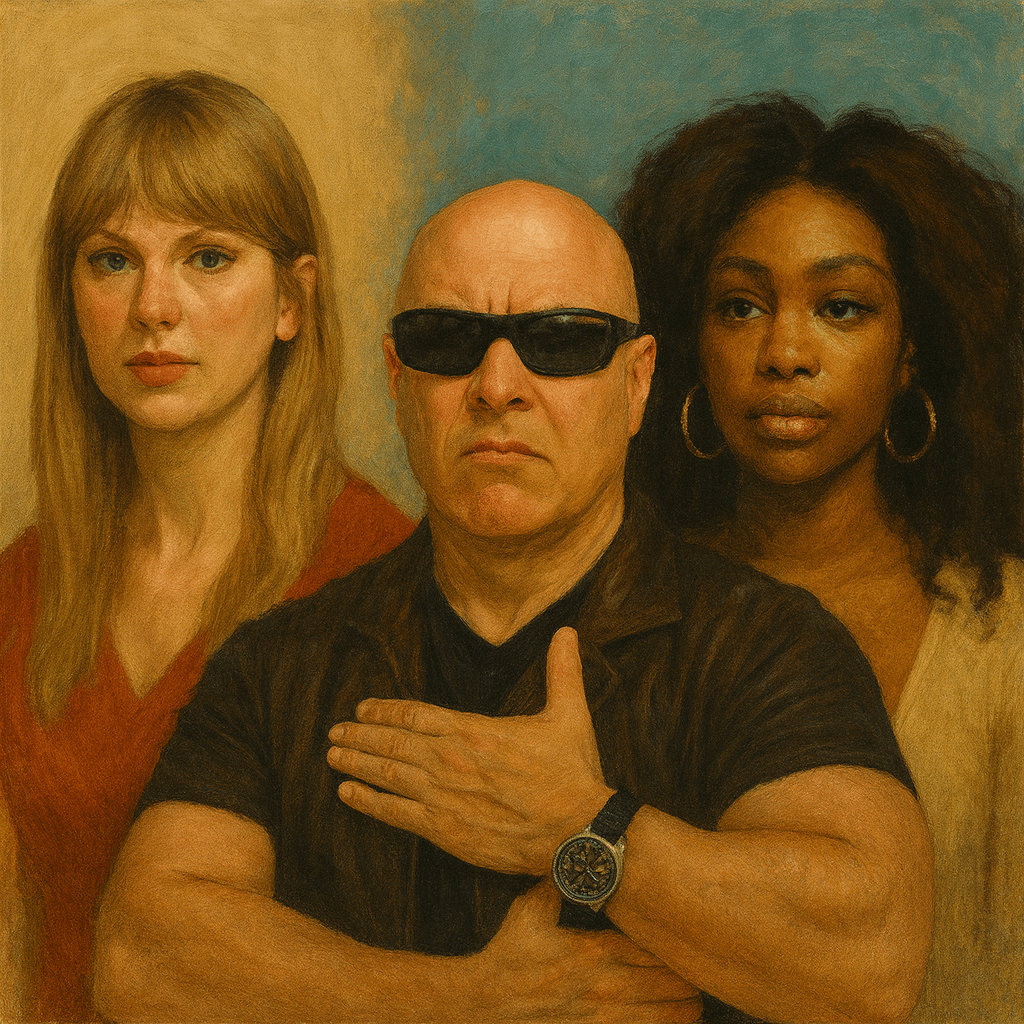
In my freshman writing class, I recently staged a little spectacle about thesis statements. To illustrate contrast, I pulled out two cultural heavyweights: SZA and Taylor Swift. Hyperbole was the hook. My admiration for SZA was real; my critique of Swift was exaggerated for theatrical effect. Still, my tirade sounded more like a roast than a teaching tool:
“While Taylor Swift may rack up 25% more Spotify streams than SZA, numbers don’t tell the whole story—unless, of course, you mistake a stadium chant for art. SZA sings with depth and raw emotion, while Swift wheezes through her catalog like an underfed Victorian orphan. SZA’s sound is bold, kaleidoscopic, and alive, drawing from the lush soul of the ’70s. Swift, meanwhile, serves up limp sonic garnish—music with the texture and excitement of a wilted celery stalk rescued from beneath the fridge. SZA makes adult art; Swift makes musical mac and cheese for the kid’s menu at Chili’s.”
In reality, I don’t think Swift is a wasteland of celery stalks and Victorian wheezing. I admitted to my students that Swift is likely a good person, a competent artist, and that I wish her well. My guilt lingered, though. Bombast is a teaching trick, but sometimes the fire singes the wrong target.
That guilt sharpened when I stumbled across Spencer Kornhaber’s “How Did Taylor Swift Convince the World That She’s Relatable?” over morning coffee. One line hit me like a cold shower: “The most consequential American singer of the past 20 years, Swift can claim commercial achievements that equal or surpass those of the Beatles, Madonna, and Michael Jackson.”
Relatability is her true superpower. Swift has broadcast her heartbreaks, doubts, and longings in ways that make her sound like a big sister or Greek chorus to her fans’ lives. Her brand isn’t just pop—it’s therapy with a backbeat.
Kornhaber nails it: “Listening to a Swift song is like eating a candy bar that transmits a personal essay into your memory. If you eat enough candy bars, it becomes a novel, and then a series of novels, and then (this is when you become a Swiftie) a virtual-reality, open-world video game you play with friends and strangers.” It’s a metaphor that could apply to any great artist. I thought of The Truman Show, where daily life becomes the commodity, the spectacle, the art.
Swift deserves her accolades. She is a master craftsman of polished, radio-ready memoir-pop. But her songs still strike me as a touch bland, like a dependable frozen dinner—satisfying but forgettable. My twin daughters agree. When a Swift track seeps out of SiriusXM Coffee House, we sigh in unison and silently wish it were SZA.
 Cinemorphosis
Leave a comment