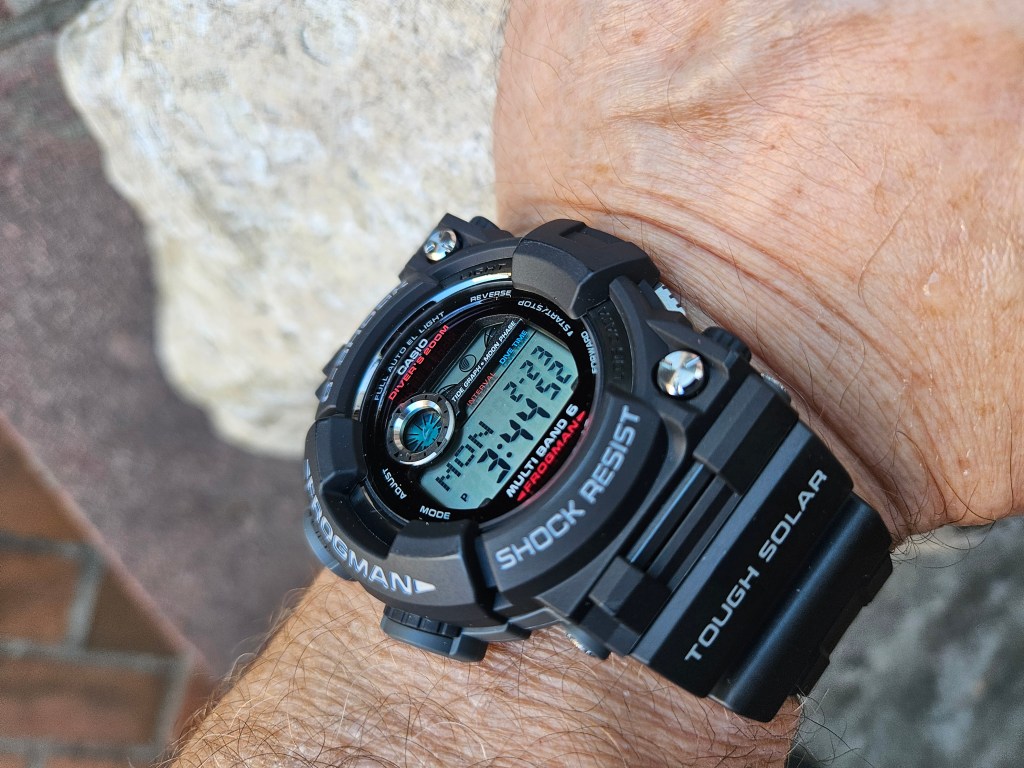
I used to tell people I didn’t like the G-Shock Frogman GWF-1000.
It’s oversized. It’s digital. It looks like something the wardrobe department would strap onto a second-tier superhero—Aquaman’s anxious cousin, assigned to guard the aquarium gift shop. On a 64-year-old man, it doesn’t whisper confidence. It screams midlife distress—the horological equivalent of jet-black hair dye and a motorcycle you’re afraid to start.
And yet, for the past six months, it hasn’t left my wrist.
My mechanical divers—polished steel, sapphire crystals, analog dignity—sit untouched, lined up in their box like former lovers trying to understand what went wrong.
“How could you do this to us?” they seem to ask.
“You are dead to me,” I reply.
At this point, the relationship between my wrist and the Frogman is no longer metaphorical. It is psychological. Possibly spiritual. There may be paperwork involved.
Let me be clear: this attachment is not based on taste. On a man my age, the Frogman doesn’t look stylish. It looks like evidence being quietly assembled by concerned family members.
But it is not coming off.
Because something happened.
Not gradually. Not subtly.
Change.
When I started wearing the Frogman, I felt different—sharper, more contained, more adult. My appetite shrank. My focus tightened. I developed the kind of self-control normally associated with retired Marines and monks who eat lentils without complaint.
Three meals a day. No snacks. No “kitchen reconnaissance missions.”
Then something even stranger happened.
My wife and daughters didn’t say a word, but their behavior shifted. The eye-rolling stopped. The subtle household demotion—from “head of family” to “eccentric roommate”—quietly reversed.
Somehow, I had acquired gravity.
I was no longer the suburban performance artist of half-finished plans and questionable purchases. I had become a man whose decisions suggested forethought rather than impulse.
A man who appeared, alarmingly, to be in charge.
But the real change was this:
My nightmares stopped.
Not reduced. Not improved.
Stopped.
For decades I lived with them—night after night, a private theater of dread that never closed. Then the Frogman arrived, and the nightmares scattered into darkness like silverfish when the lights come on.
Now my dreams are peaceful. I run through fields of berries. In the voice of John Lennon, I sing, “I am the Frogman.”
Explain that.
A resin watch—battery, rubber strap, digital display—accomplished what therapy, discipline, and time could not.
Part of me wants to leave the miracle alone. When something rescues you from overeating, ridicule, and nocturnal terror, you don’t interrogate it. You say thank you and keep your mouth shut.
If it isn’t broken, don’t fix it.
If you don’t understand the blessing, don’t analyze it.
Unfortunately, I am a curious man.
I want mechanisms. Theories. Experts. I want to understand how a mass-produced object rewired my habits, my household_toggle status, and my sleep cycle.
That investigation is the project ahead—the study of what I can only call the Frogman Elixir Effect: a transformation so complete that the man who bought the watch no longer quite exists.
I am no longer the wearer.
I am the Frogman.
Before we go further, I should correct something.
Earlier, I said I thought the Frogman was ugly.
That was a lie.
Why I lied is a matter for future therapy—some mixture of denial, self-protection, and the fear of becoming the man who falls in love with industrial resin.
The truth is this:
The moment I saw it, I loved it.
Not liked. Loved.
It was, and remains, the most beautiful thing I have ever seen.
Now that the truth is out, we can proceed honestly.
At work, my colleague Dave noticed the change. One afternoon he suggested I attend a support group in the basement of a nearby church—men, he said, who believed they had also become Frogmen.
Out of curiosity, I went.
There were two dozen of us. Same age. Same watch.
When the meeting began, we introduced ourselves the only way that felt accurate:
“I am the Frogman.”
Our counselor, Terry, immediately informed us that this was impossible. Only one of us could be the Frogman.
Complicating matters, Terry was wearing the same model. There were rumors he believed he was the authentic Frogman and was using the group to establish theological authority. None of us trusted him.
Still, we met every Wednesday.
And something was undeniable.
We had all changed.
Better habits. Better focus. Better discipline. The same quiet upgrade in self-command. It was like taking creatine for the psyche. A testosterone booster for decision-making. Samson’s weapon—though one member insisted Samson actually used a donkey’s jawbone and demonstrated this point by raising his Frogman like a sacred artifact.
The group is going well.
Because the journey is no longer about wearing a watch.
It is about fusion.
What Terry eventually helped us name was Horological Identity Fusion—the state in which the boundary between wearer and object dissolves. The watch is no longer an accessory. It is a psychological extension. Removing it would feel less like changing gear and more like abandoning a role.
Or losing a limb.
And once that fusion occurs, something strange happens.
You don’t wear the tool.
You become the person the tool assumes you are.


 Cinemorphosis
Leave a comment