For more than twenty years, I lived inside the watch hobby like a man living inside a museum—reverent, obsessive, and curiously uninterested in the exhibits’ stated purpose. I rotated Seiko divers, admired their dials like stained glass, felt their rotors hum like distant machinery—and barely cared what time it was. That’s the joke with teeth: the one function watches exist to perform was never the center of my fixation. I wasn’t tracking time. I was courting it. Romance, nostalgia, the giddy satisfaction of gears responding to my wrist’s movement—those were my currencies. Timekeeping was just the pretext.
G-Shock, in that world, was vulgar. Too digital. Too close to the smartwatch species I distrust—the glowing, needy devices that feel less like tools and more like supervisors. A G-Shock belonged on a mannequin posed mid-adventure, not on a human being trying to convince himself he possessed taste.
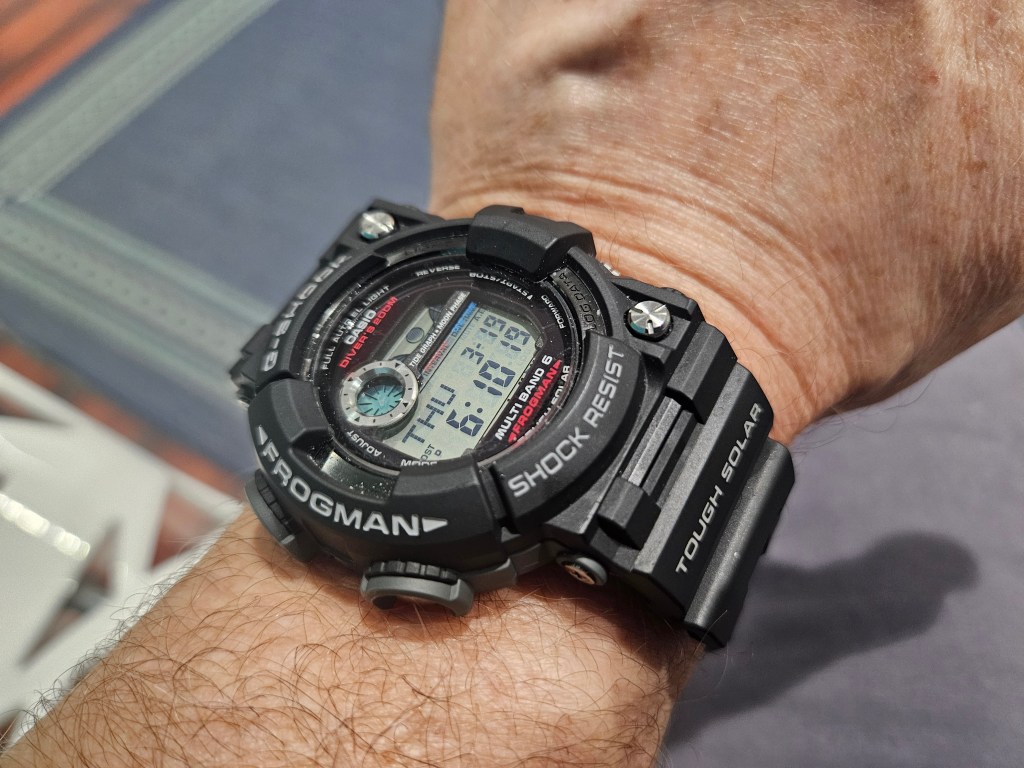
And yet, sometime around 2010, the Frogman GWF-1000 slipped past my defenses. That asymmetrical case had a crooked charisma, like a boxer with a broken nose who still wins fights. I’d think about it, then shut it down with the usual litany: plastic, digital, not my tribe. I repeated those lines for years, the way a man repeats vows he secretly hopes to break.
About a month ago, something in me stopped negotiating. The impulse didn’t arrive politely; it landed like a fever. I ordered the Frogman from Japan and watched it crawl through customs as if it were being interrogated for treason. Three weeks later, it showed up. I strapped it on.
And there it was—presence. Not the polished, self-conscious presence of a luxury diver, but a blunt, physical authority. It didn’t ask for admiration. It assumed compliance.
Then came the real disruption: Tough Solar and Multiband-6. Set it and forget it—except you don’t forget it, because it quietly corrects you. The watch syncs itself to atomic time, and suddenly you are no longer negotiating with approximation. You are pinned to reality. No drift, no romance, no mechanical shrug. Just accuracy, arriving nightly like a silent auditor.
I didn’t expect the psychological effect. Being anchored to exact time produced a strange calm, the way a well-balanced diet makes you realize how erratic you’ve been eating. My mechanical divers—beautiful, expensive, lovingly chosen—never gave me that. They gave me narrative. The Frogman gave me certainty.
The numbers didn’t help the old regime either. Five hundred dollars for the Frogman. A little over a hundred for the GW-7900 Rescue. Both delivered the same atomic truth. Meanwhile, my divers sat there—two, three times the price—offering charm, yes, but also drift, maintenance, and the faint suspicion that I’d been paying for the idea of precision rather than precision itself.
Before I start sounding like a late-night infomercial for resin and radio signals, I need to detour—briefly, and deliberately—to a song that used to haunt my teenage gym sessions: “You Light Up My Life” by Debby Boone. It would float through the speakers while I benched and curled, all syrup and sentiment, and it filled me with such irritation that I lifted harder just to drown it out. The song wasn’t just bad; it was suffocating in its insistence on emotional purity.
This matters because the watch hobby is full of that same conversion energy. The language of revelation. The before-and-after testimony. And men, in particular, are suckers for it.
We don’t adopt hobbies; we convert to them. We don’t adjust our diets; we declare them. We don’t experiment; we renounce and rebuild. One week it’s mechanical purity, the next it’s quartz precision, then solar enlightenment. Each shift arrives with the force of a Damascus-road epiphany, complete with blind spots and overconfidence.
I know this pattern because I’ve lived it—in watches, in fitness, in every arena where identity can be strapped on, laced up, or swallowed. Men love absolutes. We love the feeling of total overhaul. We love the idea of the metamorphosis so much we may have a figurine on our desk: Thing or Megatron–icons of brute conversion. We mistake intensity for clarity and call it transformation.
So when I talk about G-Shock, I have to keep one hand on the brake. Because “being anchored to Real Time” has the flavor of conversion, and conversion is intoxicating. It makes you want to declare the past obsolete and the present definitive. It turns a purchase into a philosophy.
And yet—facts remain stubborn. I’m typing this wearing the GW-7900 Rescue. Tomorrow will be the Frogman. The next day, back to the Rescue. The mechanicals sit in their box a few feet away, arranged with care, untouched—like last year’s tax documents: important, preserved, and no longer consulted.
That doesn’t make G-Shock a religion. It makes it a correction. Whether I treat it as one or the other will determine whether this is clarity—or just another episode in a long history of well-dressed delusion.
 Cinemorphosis
Leave a comment