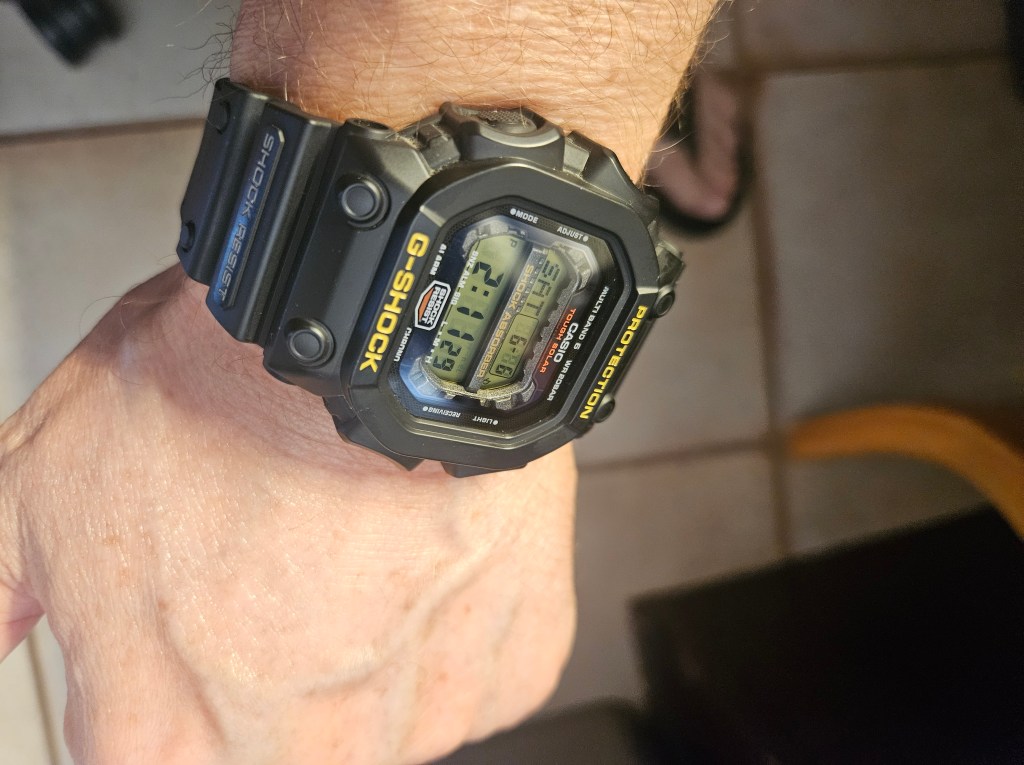
I am obsessed with accurate watches. I own radio-controlled G-Shocks that communicate with atomic clocks in the middle of the night, correcting themselves so that I don’t have to endure the indignity of being three seconds late to nowhere. I put them near windows to improve reception, check whether they synchronized overnight, and derive absurd satisfaction from knowing that the watch on my wrist agrees with official time down to the second.
Yet I’ve recently discovered an embarrassing irony: while my watches keep nearly perfect time, the clock inside my head is hopelessly slow. Ask me how long I’ve been teaching, lifting weights, trying to write books, or engaging in any of my other lifelong enterprises, and I routinely misplace entire decades. My G-Shock may be off by half a second. My autobiographical clock is off by twenty years.
This discrepancy recently surfaced in a dream about my friend Adam, whom I’ve known since 1998, when he took my college writing class. Adam went on to build a successful career in advertising and branding, married, had a daughter, and now works from home. Perhaps because of his professional expertise, my dreaming mind decided that Adam was precisely the man to stage an intervention.
With my retirement approaching, he apparently concluded that my malfunctioning internal clock required professional attention. He took me to an office specializing in something I didn’t know existed: the rebranding of human beings.
I was immediately suspicious.
“Rebranding” is one of those words that makes me reach instinctively for my wallet. I imagined consultants with expensive eyeglasses explaining that retirement represented an exciting opportunity to “reimagine my personal narrative” while helping me establish an Instagram presence in which I would pose beside cappuccinos and announce that sixty-five was the new forty-five.
No thanks.
But the woman assigned to me wasn’t like that.
She was maternal, down-to-earth, dressed in jeans and a football jersey. No power suit. No TED Talk headset. No laminated diagram explaining My Journey. She had the reassuring manner of someone who might help you change a tire and then send you home with a casserole.
She explained that retirement required more than leaving my job.
I had to reinvent myself.
Worse, I had to rebrand myself.
I prepared to resist, but something about her practical manner disarmed me. Fine. Ask your questions.
She began with the basics.
How old was I?
How many years had I been teaching?
How long had I been trying to write novels?
How many years had I been trying to lose weight?
How long had I been lifting weights?
Easy questions.
Except I got nearly every answer wrong.
Not slightly wrong.
I was shaving decades off my life.
“How long have you been teaching writing?”
“About twenty years.”
She looked at her records.
“Forty.”
Oh.
Next question.
“How long have you been lifting weights?”
“Forty years.”
Another glance at the paperwork.
“Fifty-four.”
Excuse me?
Apparently I had begun lifting weights sometime during the Nixon administration and simply neglected to update my internal records.
The interrogation continued.
Every number I produced was suspiciously flattering. Years disappeared from my career. Decades vanished from my ambitions. Entire geological periods evaporated from my biography.
I had apparently been cooking the chronological books.
That’s when I realized I suffered from Autobiographical Time Lag: the discrepancy between one’s actual age and the age assumed by one’s interior sense of self.
I know how old I am.
Of course I do.
But apparently some deeper part of my brain does not.
That brain maintains a fraudulent set of books in which everything happened twenty years ago. I’ve been teaching for twenty years. I’ve been lifting for forty. I’ve been struggling with my weight for a while. I’ve been trying to become a writer for a reasonable amount of time.
Then the auditor from the Department of Time arrives.
Forty years.
Fifty-four years.
Decades.
Decades.
More decades.
The horror of aging is partly numerical. You don’t experience yourself as a stack of calendar pages. Consciousness feels continuous. The thirteen-year-old who picked up his first weights doesn’t seem like some extinct ancestor whose bones were recently discovered beneath a shopping mall.
He’s me.
I can still feel him in there.
So my brain performs an enormous act of biographical compression. It takes fifty-four years of lifting weights and somehow files them under “I’ve been doing this for a long time.”
But fifty-four years isn’t a long time.
It’s a civilization.
I’ve been lifting weights longer than many of the people I work with have been alive. Presidents have come and gone. The Soviet Union collapsed. The Internet appeared. Phones became computers. Artificial intelligence began helping me write essays about how old I am.
And through all of it, apparently, I’ve been doing curls.
The same distortion applies to teaching. Forty years sounds preposterous. Surely I haven’t been standing in front of college writing classes for four decades.
But I have.
I’ve taught through chalkboards, dry-erase boards, overhead projectors, PowerPoint, Canvas, online instruction, Zoom, and artificial intelligence. At this point I’m less a professor than a sedimentary record of educational technology.
The woman in the football jersey understood something I didn’t.
Before I could reinvent myself for retirement, I had to locate myself accurately on the map of chronological time.
I couldn’t begin the next chapter while pretending I was halfway through the previous one.
That, I realized, was the purpose of the strange rebranding office. They weren’t going to manufacture some shiny post-retirement identity for me. They weren’t going to turn me into Professor 2.0, complete with a podcast, personal logo, and inspirational LinkedIn posts about embracing change.
They were performing an intervention.
The first step wasn’t reinvention.
It was arithmetic.
I kept giving the woman the age of the man I felt myself to be.
She kept giving me the age of the man who actually existed.
And the numbers refused to negotiate.
Perhaps that’s the strangest thing about getting older. The calendar ages with perfect accuracy, but my autobiographical clock is running slow.


Leave a comment