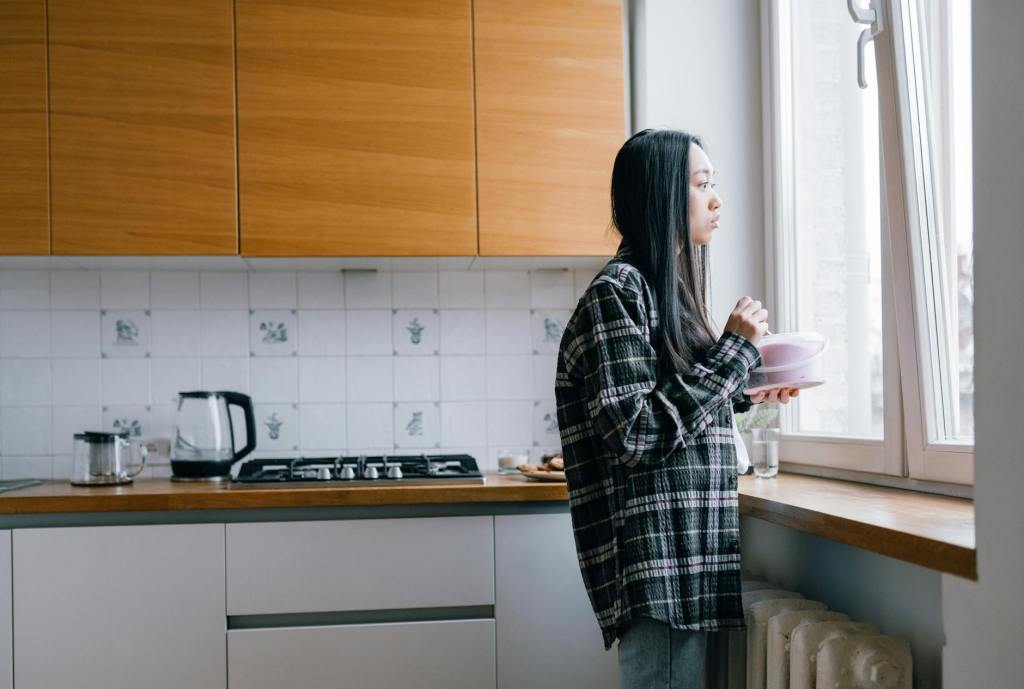
There is something faintly dystopian about solitary people spending hours online watching other solitary people perform the microscopic rituals of daily life: tying shoelaces, cracking open cans of diet soda, pouring kibble into a cat’s bowl, unloading groceries with monk-like precision, folding laundry beneath soft lighting while melancholy piano music drifts through the background like emotional Febreze.
At some point loneliness ceased being merely a condition to endure and became a genre of entertainment.
You are not simply alone anymore. You are curating aloneness, aestheticizing it, monetizing it, and binge-watching it as though isolation itself were a luxury lifestyle brand. The modern internet increasingly resembles a vast digital aquarium filled with emotionally sedated people observing one another through glass while reassuring themselves that this counts as connection.
I sometimes wonder if this phenomenon functions as a form of emotional jiu-jitsu. Instead of confronting the pain of alienation directly, people transform it into a consumer product. The loneliness does not disappear; it merely changes costume. By packaging solitude into soothing, carefully curated content, the sharp edge of disconnection becomes dulled. The ache remains, but now it arrives with ambient lighting, artisanal tea preparation, and a Scandinavian throw blanket.
We now inhabit a condition I would call Consumptive Solitude: the state in which loneliness evolves from a painful human experience into a consumable form of entertainment. Isolated individuals compulsively watch other isolated individuals perform the mundane choreography of domestic life in order to simulate companionship without assuming the emotional risks, obligations, friction, compromise, or unpredictability of genuine human intimacy.
This pathology is explored in Faith Hill’s essay “The Strange Appeal of the Solitude Influencer,” in which she examines the rise of what she calls “solitude influencers” and what their popularity reveals about contemporary society. These influencers present carefully curated lives of performative isolation: beautiful apartments, immaculate routines, quiet mornings, tasteful meals, dim lighting, tasteful melancholy, and endless scenes of one person existing in exquisitely controlled seclusion.
The performance contains all the machinery of attention addiction without the inconvenience of actual friendship. There are no difficult conversations, no emotional demands, no conflicting schedules, no awkward silences, no disappointments, and no compromise. The viewer receives the emotional atmosphere of companionship without having to endure another person’s needs or complexity. It is intimacy stripped of reciprocity.
Naturally, narcissism plays some role in this ecosystem. But narcissism alone does not explain the appeal. Control may be the deeper force at work. Real life is chaotic, humiliating, exhausting, and unpredictable. The solitude influencer offers the fantasy of total environmental management. Everything is calm. Everything is clean. Everything is curated. Nothing intrudes.
For burned-out viewers, the effect can become psychologically narcotic, almost ASMR-like in its soothing predictability. After spending the day navigating economic stress, social tension, workplace absurdity, family obligations, and digital overload, people retreat into videos of someone silently pouring a glass of chablis while a Haydn sonata drifts through a minimalist apartment that appears untouched by conflict, debt, sickness, or despair.
As I read Hill’s essay, I kept thinking about the word infantilization.
The solitude influencer increasingly functions like a pacifier for emotionally exhausted adults. Millions of viewers recalibrate their nervous systems through these carefully controlled simulations of peace and containment. Some no longer wish to engage fully with the real world. Others feel incapable of doing so. Still others may have quietly surrendered altogether.
And this is where the phenomenon begins to feel genuinely troubling.
I suspect there is something psychologically regressive about spending one’s days and nights watching solitary performers enact sanitized domestic rituals for passive spectators. At some point, watching people “play house” begins replacing the harder work of building a life oneself. The performance of adulthood slowly replaces adulthood itself.
Because you can only simulate intimacy, routine, domesticity, and emotional safety for so long before you begin forgetting what genuine growth requires: risk, struggle, awkwardness, responsibility, sacrifice, and contact with real people whose existence cannot be muted, paused, skipped, unsubscribed from, or optimized into aesthetic tranquility.
The solitude influencer offers peace without vulnerability, companionship without obligation, and emotional atmosphere without genuine human entanglement.
And that may be precisely why so many people find it irresistible.


Leave a Reply